
Tag Archives: vat-relief

VAT: Global Accounting simplification

By   2 May 2017

VAT: Second Hand Scheme  – Global Accounting simplification

Overview

The problem with the VAT Second-Hand Goods Scheme is that details of each individual item purchased, and then later sold, has to be recorded. This requirement can lead to a lot of paperwork and an awful lot of administration which, obviously, many businesses are not too keen to comply with.

Global Accounting is an optional, simplified variation of the Second Hand Margin Scheme (Margin Scheme).

It differs from the standard Margin Scheme because rather than accounting for the margin achieved on the sale of individual items VAT is calculated on the margin achieved between the total purchases and total sales in a particular accounting period without the requirement to establish the mark up on each individual item.  It is beneficial if a business buys and sells bulk volume, low value eligible goods, and is unable to maintain the detailed records required of businesses who use the standard Margin Scheme

There two significant differences in respect of Global Accounting compared to the standard Margin Scheme. The first difference is that losses on an item are automatically offset against profits on items. Thus losses and profits are offset together in the period. In the standard Margin Scheme no VAT is due if a loss is made on an item, but that loss cannot be offset against any other profit.  There is also a timing advantage with Global Accounting because all purchases made in the period are included, even if those goods are not actually sold in the same period.

Goods which may be included in Global Accounting

Global Accounting can be used for all items which are eligible under the standard Margin Scheme.  However, the following goods cannot be included in Global Accounting:

  • individual items costing more than £500 (although these can be accounted for via the standard Margin Scheme)
  • aircraft, boats and outboard motors,
  • caravans and motor caravans,
  • horses and ponies, and
  • motor vehicles, including motorcycles; except those broken up for scrap.

Starting to use the scheme

When a business starts using Global Accounting, it may find that it already has eligible stock on hand.  It may include the value of this stock when it calculates the total purchases at the end of the first period.  If a business does not take its stock on hand into account, it will have to pay VAT on the full price, rather than on the margin achieved, when it is sold.

Note: any goods bought on an invoice which shows a separate VAT figure are not eligible for resale under the scheme.

The calculation

VAT is calculated at the end of each tax period. Because you can take account of opening stock in your scheme calculations, you may find that you produce a negative margin at the end of several periods. In other words, your total purchases may exceed your total sales. In such cases, no VAT is due. But you must carry the negative margin forward to the next period as in the following example:

Period One

  1. a)      Total purchase value of stock on hand 10,000
  2. b)      Total purchases 2,000
  3. c)      Total sales 8,000

Margin = c – (a+b) = (4,000)

Because this is a negative margin there is no VAT to pay.  However, negative margin must be carried forward into the next period as follows:

Period Two

  1. a)      Negative margin from previous period 4,000
  2. b)      Total purchases 1,000
  3. c)      Total sales 7,000
  4. d)      Margin = c – (a + b), sales minus (purchases plus negative margin), £7,000 – (£1,000 + £4,000) 2,000
  5. e)      VAT due = margin (£2,000) × VAT fraction (1/6) 333.33

There is no negative margin to carry forward this time. Therefore, in the third period, the margin is calculated solely by reference to sales less purchases.

The negative margin may only be offset against the next Global Accounting margin. It cannot be offset against any other figure or record.

Global Accounting Records and Accounts

A business does not need to keep all the detailed records which are required under the normal Margin Scheme – for instance, you do not have to maintain a detailed stock book.

Global Accounting records do not have to be kept in any set way but they must be complete, up to date and clearly distinguishable from any other records.  A business must keep records of purchases and sales as set out below, together with the workings used to calculate the VAT due.

If HMRC cannot check the margins declared from the records, VAT will be due on the full selling price of the goods sold, even if they were otherwise eligible for the scheme.

Buying goods under Global Accounting

When a business buys goods which it intends to sell under Global Accounting it must:

  • check that the goods are eligible for Global Accounting
  • obtain a purchase invoice. If a business buys from a private individual or an unregistered entity, the purchaser should make out the invoice at the time the goods are purchased.  If purchased from another VAT-registered dealer, the dealer must make out the invoice at the time of sale, and
  • enter the purchase details of the goods in your Global Accounting purchase records.  The purchase price must be the price on the invoice which has been agreed between you and the seller.

You cannot use the scheme if VAT is shown separately on the invoice.

if you are buying from a private individual or an unregistered business, you must make out the purchase invoice yourself.

When selling goods under Global Accounting

If the purchase conditions above apply, Global Accounting may be used when the goods are sold by:

  • recording the sale in the usual way
  • issuing a sales invoice for sales to other VAT-registered dealers and keeping a copy of the invoice, and
  • transferring totals of copy invoices to the Global Accounting sales record or summary
  • you must be able to distinguish at the point of sale between sales made under Global Accounting and other types of transaction

Leaving the scheme

If a business stops using Global Accounting for any reason, it must make a closing adjustment to take account of purchases for which it has taken credit, but which have not been sold (closing stock on hand). The adjustment required does not apply if the total VAT due on stock on hand is £1,000 or less. In the final period for which the business uses the scheme, it must add the purchase value of its closing stock to the sales figure for that period.  In this way VAT will be paid (at cost price) on the stock for which the business previously had credit under the scheme.

Items sold outside the scheme

If goods are sold which had been included in a business’ Global Accounting purchase (for example, they are exported), a business must adjust its records accordingly.  This is done by subtracting the purchase value of the goods sold outside the scheme from the total purchases at the end of the period.

Stolen or destroyed goods

If a business loses any goods through breakage, theft or destruction, it must subtract their purchase price from your Global Accounting purchase record.

Repairs and restoration costs

A business may reclaim the VAT it is charged on any business overheads, repairs, restoration costs, etc. But it must not add any of these costs to the purchase price of the goods sold under the scheme.

For further advice on any global accounting, used goods schemes, or any other special VAT schemes please contact me.
VAT Update on Associated Newspapers case – treatment of vouchers

By   24 April 2017

Two months ago the Court of Appeal mainly ruled in favour of Associated Newspapers on the treatment of vouchers.  Commentary and links here

The decision consequently cast doubt on HMRC’s published guidance on the VAT treatment of vouchers.

HMRC have announced that they are seeking leave to appeal to the Supreme Court.  Although this further delays definitive rules on vouchers, it is hoped that if it goes to the Supreme Court we will get some sort of closure on this matter.

VAT EORI – What is it? Do I need one?

By   19 April 2017

What is an EORI?

EORI is an acronym for Economic Operator Registration & Identification.

An EORI number is assigned to importers and exporters by HMRC, and is used in the process of customs entry declarations and customs clearance for both import and export shipments travelling to or from the EU and countries outside the EU.

What is the EORI number for?

An EORI number is stored both nationally and on a central EU EORI database. The information it provides is used by customs authorities to exchange information, and to share information with government departments and agencies. It is used for statistical and security purposes.

Who needs an EORI number?

You will require an EORI number if you are planning to import or export goods with countries outside the EU.  Also, you may need an EORI number to trade with these countries in Europe: Andorra, Bosnia and Herzegovina, Gibraltar, Guernsey, Iceland, Jersey, Liechtenstein, Macedonia, Moldova, Norway, Switzerland.

Format of the EORI number

VAT registered companies will see the EORI as an extension of their VAT number. Your VAT nine digit VAT number will be prefixed with “GB” and suffixed with “000”.

How do I apply for an EORI Number?

Non VAT registered companies can apply using this link – FORM C220

VAT registered companies can apply using this link – FORM C220A

Once completed, your form should be emailed to:  eori@hmrc.gsi.gov.uk

How long will my EORI application take?

EORI applications take up to three working days to process.

Please contact us if you have any issues with importing or exporting.

VAT Legal impact of The Great Repeal Bill and Article 50

By   3 April 2017

Changes to VAT on the day the UK leaves the EU – details of new White Paper

There has been significant confusion and differing views over how the UK would treat existing CJEU case law and its impact on the UK legislation when the UK leaves the EU.

Welcome certainty and clarity has been provided by the publication of a White Paper in respect The Great Repeal Bill (GRB).  Full details of the GRB here

Background

The European Communities Act 1972 (ECA) gives effect in UK law to the EU treaties. It incorporates EU law into the UK domestic legal order and provides for the supremacy of EU law. It also requires UK courts to follow the rulings of the Court of Justice of the European Union (CJEU). Some EU law applies directly without the need for specific domestic implementing legislation, while other parts of EU law need to be implemented in the UK through domestic legislation. As explained in the White Paper, domestic legislation other than the ECA also gives effect to some of the UK’s obligations under EU law. The government states that “…it is important to repeal the ECA to ensure there is maximum clarity as to the law that applies in the UK, and to reflect the fact that following the UK’s exit from the EU it will be UK law, not EU law, that is supreme.” The GRB will repeal the ECA on the day we leave the EU.

Overview

The main point stressed in the White Paper is that “The same rules and laws will apply on the day after exit as on the day before. It will then be for democratically elected representatives in the UK to decide on any changes to that law, after full scrutiny and proper debate” and “This Bill will, wherever practical and appropriate, convert EU law into UK law from the day we leave so that we can make the right decisions in the national interest at a time that we choose.”

 The intention is that the GRB will do three things:

  • It will repeal the ECA and return power to UK institutions.
  • The Bill will convert EU law as it stands at the moment of exit into UK law before we leave the EU. This allows businesses to continue operating knowing the rules have not changed significantly overnight, and provides fairness to individuals, whose rights and obligations will not be subject to sudden change. It also ensures that it will be up to the UK Parliament (and, where appropriate, the devolved legislatures) to amend, repeal or improve any piece of EU law (once it has been brought into UK law) at the appropriate time once we have left the EU.
  • The Bill will create powers to make secondary legislation. This will enable corrections to be made to the laws that would otherwise no longer operate appropriately once we have left the EU, so that our legal system continues to function correctly outside the EU, and will also enable domestic law once we have left the EU to reflect the content of any withdrawal agreement under Article 50.

This means that case law precedent from the CJEU will continue to apply (for a time at least). Any uncertainties/disagreements over the meaning of UK law after the UK leaves the EC that has been derived from EU cases will be decided by reference to the CJEU case law as it exists on the day the UK leaves. As a consequence, the GRB is likely to give CJEU case law similar precedent status to the UK Supreme Court.  The result is that Tribunals (and other court cases) will be heard in a similar way as they are now and both sides may continue to rely on case law as they have up to this point.  Any changes to the VAT legislation, if any, may then be made at a more leisurely pace while providing certainty while this is done.

Customs

There will also be changes to the current UK Customs regime as a consequence of the UK leaving the Single Market. The Customs Declaration Services (CDS) programme is intended to replace the existing system for handling import and export freight (CHIEF) from January 2019. Now that the Government has made a decision to leave the EU customs union, there is concern that this project is in place on time. A letter from the Treasury Select Committee states that “even modest delays, there is potential for major disruption to trade and economic activity”.

There are still a lot of uncertainties which will not be dealt with until we know the terms of the UK leaving and we will try to report these as soon as we have any information. Please subscribe to our free monthly e-newsletter to keep up to date on this, and other VAT developments. Simply email us at marcus.ward@consultant.com

Changes to the VAT Flat Rate Scheme – A reminder

By   31 March 2017

Flat Rate Scheme (FRS)

I have looked at the changes to the FRS and the impact of these here

This is a timely reminder for all businesses using the FRS as changes to the scheme come into effect tomorrow: 1 April 2017.

The first matter to consider is if your business is a “limited cost trader”. This may be done on the HMRC website here

Relevant costs, in this instance, only include goods (please see below). 

If not a limited cost trader no further action is required.

If a business qualifies as a limited cost trader (which is likely to include, but not limited to, labour-intensive businesses where very little is spent on goods) there are the following choices.

Options

  • Continue on the FRS but using the increased percentage of 16.5% (which is effectively equal to the 20% rate).
  • Leave the FRS and use conventional VAT accounting
  • Deregister for VAT if a business’ turnover is below that of the deregistration limit – which will be £83,000 pa from tomorrow.

Relevant Goods

It should be noted that the goods referred to above mean goods that are used exclusively for the purposes of a business, but do not include:

  • vehicle costs including fuel, unless you’re operating in the transport sector using your own, or a leased vehicle
  • food or drink for you or your staff
  • capital expenditure goods of any value
  • goods for resale, leasing, letting or hiring out if your main business activity doesn’t ordinarily consist of selling, leasing, letting or hiring out such goods
  • goods that you intend to re-sell or hire out unless selling or hiring is your main business activity
  • any services

As may seen, the definition is very restrictive.  Failure to recognise this change is likely to result in penalties and interest being levied.

If you would like any advice on this matter, please contact us as soon as possible considering the timing of the implementation.

VAT Triangulation – What is it? Is it a simple “simplification”?

By   24 March 2017

Unusually in the VAT world, Triangulation is a true simplification and is a benefit for businesses carrying out cross-border trade in goods.

What is it?

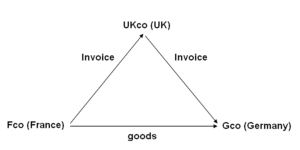
Triangulation is the term used to describe a chain of intra-EU supplies of goods involving three parties in three different Member States (MS). It applies in cases where, instead of the goods physically passing from one to the other, they are delivered directly from the first to the last party in the chain. Thus:

trig (2)In this example; a UK company (UKco) receives an order from a customer in Germany (Gco). To fulfil the order the UK supplier orders goods from its supplier in France (Fco). The goods are delivered from France to Germany.

Basic Treatment

Without simplification, UKco would be required to VAT register in either France or Germany to ensure that no VAT is lost.  That is; if registered in France, French VAT (TVA) would be charged to UKco, this would be recovered and the onward supply to Gco would be VAT free. The supply to Gco would be subject to acquisition tax in Germany.  VAT therefore is neutral to all parties.  Alternatively, UKco may choose to VAT register in Germany.  This would mean that it would be able to produce a German VAT number to Fco so to obtain the goods VAT free.  UKco would recover acquisition tax it applies to itself on the purchase and charge German VAT to Gco. Again, VAT is neutral to all parties.

Triangulation does away with these requirements.

To avoid creating a need for many companies to be structured in this way, Triangulation simplification was created via the EU VAT legislation (which is implemented across all MS) so, in this example, UKco is not required to register in any MS outside the EU.

Simplification

Under the simplification procedure Fco issues an invoice to UKco without charging VAT and quoting UKco’s VAT number. UKco, in turn, issues an invoice to Gco without charging VAT. The invoice is required to show the narrative “VAT Simplification Invoice Article 141 simplification”.  Gco should account for the purchase from UKco in its German VAT Return using the Reverse Charge mechanism. Details of the Reverse Charge here

The Conditions

EU VAT Directive 2006/112/EC, Article 141 sets out the conditions which must be met for Triangulation simplification to apply. Using the example above these may be summarised as:

  • There are three different parties (separate taxable persons) VAT registered in three different MS
  • The goods are transported directly from Fco to Gco
  • The invoice flow involves Fco selling the goods to UKco (the intermediate supplier)
  • UKco supplier in turn invoices its customer, Gco
  • UKco must obtain a valid VAT number from Gco (MS of destination) and quote this number on its invoice
  • UKco must quote “Article 141 simplification” on its invoice to Gco.

Impact on businesses

A business may be involved in triangulation as either:

  • the first supplier of the goods (Fco in the example above),
  • the intermediate supplier (UKco in the example above), or
  • the final consumer (Gco in the example above).

In whichever role, it is important to ensure all relevant details have been obtained and the documentation is correct.

And after Brexit?

As in many areas, we do not yet know how Brexit will affect the UK’s relationship with the EU. In general, the “worse” case scenario for UK business is that this simplification will be unavailable and all cross-border transactions will be treated as exports and imports similar to any other transactions with countries outside the EU and UK business will need to VAT register in one or more MS in the EU. This will add complexity and possibly delays at borders for goods moving to and from the UK. It is also likely to create additional cash flow issues.

In these uncertain times it makes sense to keep abreast of the (likely) changing requirements and take advantage of the simplification while it lasts.

Office of Tax Simplification reports on VAT

By   6 March 2017

The Office of Tax Simplification has recently published its interim report on VAT simplification.

Full details here

The main areas covered are:

  • The UK’s high VAT registration threshold
  • Incidental exempt supplies
  • Complexity of multiple rates
  • Option to Tax and Capital Goods Scheme
  • Treatment of VAT overpayments
  • Alternative Dispute Resolution (details of ADR here)
  • Non-Statutory clearances by HMRC
  • Special schemes eg; Flat rate Scheme and TOMS
  • Penalties

Please contact us should you have any queries on any of the issues covered by the report.

VAT Planning – The Four “A”s

By   6 March 2017

To a degree, VAT planning may be considered as something of an abstract concept.  It may be straightforward, or very complex, but what does all successful VAT planning have in common?  What process should be applied in order to get the right solution and to ensure that nothing is missed?   Well this is my technique and it helps me to focus on what is necessary:

The planning process may be broken down into four distinct elements:

Planning process – The four As

  • Ascertainment
  • Analysis
  • Alternatives
  • Action

One must initially obtain all relevant information and consider the appropriate legislation, case law and HMRC documents etc –

Ascertainment

In my experience, the most difficult part of this is obtaining all of the relevant information.  It is not always clear if you have received everything available – so it is often difficult to establish what is relevant and what is not.  The skill is asking the right questions of course.  Any competent VAT adviser should be able to “get the answer” if (s)he has the full picture.

Then one must analyse the information –

Analysis

Whether it is reading contracts closely, considering EC legislation, reviewing audit trails, searching case law, looking at documentation or carrying out calculations a full analysis is vital in the process of delivering accurate, useful and relevant advice.

The next step is to use the analysis to construct some various alternatives on how to proceed –

Alternatives

The most appropriate solution may present itself immediately, or various structures may need to be considered in detail in order to find some workable alternatives.  It is important not to miss anything at this point and to communicate properly with one’s client.  Consideration is required of a client’s attitude to, inter alia; complexity, risk, time invested and tax in general in order to properly tailor VAT advice.

Finally, consideration is given to the alternatives and a decision made on what action to take –

Action

This is another point at which good communication with one’s client is important.  The client needs to understand the technicalities, the risks, the impact on business, the resources required etc in order to make an informed decision.  A good adviser will also be aware of the appropriate level of assistance required with implementation. I also find it helps if the worst case scenario is explained in each alternative and the level of resistance from HMRC one is likely to encounter.  I also always bear in mind that most people do not “speak VAT jargon”, spend their waking hours studying indirect tax legislation or reviewing VAT cases, so clear and straightforward English is needed! (Also, I find my diagrams and flowcharts created at meetings a help, even if just to amuse clients with my artistic skills!)

VAT Latest from the courts; vouchers (again)

By   13 February 2017

The Court of Appeal (CA) case: Associated Newspapers Limited (ANL) considered the VAT treatment of free vouchers.

Business promotions are an area of VAT which continues to prove complex.  This is further exacerbated by changes to the legislation at EC and domestic level and ongoing case law.   A background to the issue of vouchers here 

And a background to the hearing of this particular case at the Upper Tribunal here

Background

The appeal concerned the VAT consequences (in respect of both input and output tax) of promotional schemes carried out by ANL in order to boost the circulation of the newspapers: Daily Mail and the Mail On Sunday.  ANL gave away Marks & Spencer vouchers to people who bought these newspapers for a minimum of three months. The questions where whether attributable (to the provision of the vouchers) input tax was recoverable, and, was there a deemed supply such that output tax was due on the vouchers.  One scheme was managed for ANL by The Hut.com Limited. The Hut received a fee for its services which was subject to VAT and which ANL sought to deduct as input tax. The Hut also purchased the retailer vouchers in batches (usually at a discount) and invoiced them to ANL at cost and also subject to VAT.  In another scheme, ANL purchased vouchers directly from Marks & Spencer.

Decision

HMRC sought to rely on  paragraph 14 of VAT Information Sheet 12/2003, viz: “Where face value vouchers are purchased by businesses for the purpose of giving them away for no consideration (e.g. to employees as ‘perks’ or under a promotion scheme) the VAT incurred is claimable as input tax subject to the normal rules. Output tax is due under the Value Added Tax (Supply of Services) Order 1993. Therefore all vouchers given away for no consideration will be liable to output tax to the extent of the input tax claimed”.

However, the CA agreed with the decisions made at the Upper Tribunal.  Although the vouchers were given away (no consideration) input tax was recoverable because there was an overarching business purpose for the expenditure (increasing sales).  Additionally, it was decided that the provision of the vouchers was not caught by the deemed supply rules so there was no output tax due when the vouchers were given away to readers. ANL also sought to reclaim input tax on vouchers purchased directly from Marks & Spencer – usually at a discount from their face value, but at a price which purported to include VAT. The CA also agreed with the UT on this point; that no VAT was charged on these retailer vouchers, and consequently, there was no input tax to recover.

Commentary

An interesting case, and one that will reward with a reading in full.  It does seem that HMRC’s views on vouchers need revising in light of this decision.  As always, if your business, or your clients’ businesses, are involved with vouchers in any way it is important to ensure that the VAT treatment is correct.  This is especially relevant in light of; previous case law, recent changes to the rules applicable to the treatment of vouchers (as set out in the link above) as well as this specific case.

Please contact us should you wish to discuss this matter.

Oops! – Top Ten VAT howlers

By   16 December 2016
I am often asked what the most frequent VAT errors made by a business are. I usually reply along the lines of “a general poor understanding of VAT, considering the tax too late or just plain missing a VAT issue”.  While this is unquestionably true, a little further thought results in this top ten list of VAT horrors:
  1. Not considering that HMRC may be wrong. There is a general assumption that HMRC know what they are doing. While this is true in most cases, the complexity and fast moving nature of the tax can often catch an inspector out. Added to this is the fact that in most cases inspectors refer to HMRC guidance (which is HMRC’s interpretation of the law) rather to the legislation itself. Reference to the legislation isn’t always straightforward either, as often EC rather than UK domestic legislation is cited to support an analysis. The moral to the story is that tax is complicated for the regulator as well, and no business should feel fearful or reticent about challenging a HMRC decision.
  2. Missing a VAT issue altogether. A lot of errors are as a result of VAT not being considered at all. This is usually in relation to unusual or one-off transactions (particularly land and property or sales of businesses). Not recognising a VAT “triggerpoint” can result in an unexpected VAT bill, penalties and interest, plus a possible reduction of income of 20% or an added 20% in costs. Of course, one of the basic howlers is not registering at the correct time. Beware the late registration penalty, plus even more stringent penalties if HMRC consider that not registering has been done deliberately.
  3.  Not considering alternative structures. If VAT is looked at early enough, there is very often ways to avoid VAT representing a cost. Even if this is not possible, there may be ways of mitigating a VAT hit.
  4.  Assuming that all transactions with overseas customers are VAT free. There is no “one size fits all” treatment for cross border transactions. There are different rules for goods and services and a vast array of different rules for different services. The increase in trading via the internet has only added to the complexity in this area, and with new technology only likely to increase the rate of new types of supply it is crucial to consider the implications of tax; in the UK and elsewhere.
  5.  Leaving VAT planning to the last minute. VAT is time sensitive and it is not usually possible to plan retrospectively. Once an event has occurred it is normally too late to amend any transactions or structures. VAT shouldn’t wag the commercial dog, but failure to deal with it at the right time may be either a deal-breaker or a costly mistake.
  6.  Getting the option to tax wrong. Opting to tax is one area of VAT where a taxpayer has a choice. This affords the possibility of making the wrong choice, for whatever reasons. Not opting to tax when beneficial, or opting when it is detrimental can hugely impact on the profitability of a project. Not many businesses can carry the cost of, say, not being able to recover VAT on the purchase of a property, or not being able to recover input tax on a big refurbishment. Additionally, seeing expected income being reduced by 20% will usually wipe out any profit in a transaction.
  7.  Not realising a business is partly exempt. For a business, exemption is a VAT cost, not a relief. Apart from the complexity of partial exemption, a partly exempt business will not be permitted to reclaim all of the input tax it incurs and this represents an actual cost. In fact, a business which only makes exempt supplies will not be able to VAT register, so all input tax will be lost. There is a lot of planning that may be employed for partly exempt businesses and not taking advantage of this often creates additional VAT costs.
  8.  Relying on the partial exemption standard method to the business’ disadvantage. A partly exempt business has the opportunity to consider many methods to calculate irrecoverable input tax. The default method, the “standard method” often provides an unfair and costly result. I recommend that any partly exempt business obtains a review of its activities from a specialist. I have been able to save significant amounts for clients simply by agreeing an alternative partial exemption method with HMRC.
  9.  Not taking advantage of the available reliefs. There are a range of reliefs available, if one knows where to look. From Bad Debt Relief, Zero Rating (VAT nirvana!) and certain de minimis limits to charity reliefs and the Flat Rate Scheme, there are a number of easements and simplifications which could save a business money and reduce administrative and time costs.
  10.  Forgetting the impact of the Capital Goods Scheme. The range of costs covered by this scheme has been expanded recently. Broadly, VAT incurred on certain expenditure is required to be adjusted over a five or ten year period. Failure to recognise this could either result in assessments and penalties, or a position whereby input tax has been under-claimed. The CGS also “passes on” when a TOGC occurs, so extra caution is necessary in these cases.

So, you may ask: “How do I make sure that I avoid these VAT pitfalls?” – And you would be right to ask.

Of course, I would recommend that you engage a VAT specialist to help reduce the exposure to VAT costs!