
Category Archives: EC

VAT legislation – relationship between EU and UK law. A guide

By   10 April 2017

How does the UK system fit with EU legislation?

Further to my recent article on the legal impact of The Great Repeal Bill and Article 50 here I thought it would be a good idea to take a step back and look at the background. We now know that on the day the UK leaves the EU the following rules will still apply and that there will be no immediate changes to the status quo. After Brexit there is likely to be a review of the VAT position, but we expect any changes to the system to be subtle at first with any significant changes (if any) being made over a much longer period.

So where are we now?

As most people will know, UK domestic VAT law is derived from EU legislation, but what is the actual relationship?

It is important to understand how both elements of legislation work in cases of dispute with HMRC as it often provides additional ammunition.

History

Most Member States already had a system of VAT before joining the EU but for some countries VAT had to be introduced together with membership of the EU.

When the UK joined the EU in 1972 it replaced two taxes; purchase tax and selective employment tax with VAT.

In 1977, the Council of the European Communities sought to harmonise the national VAT systems of its Member States by issuing the Sixth Directive to provide a uniform basis of assessment and replacing the Second Directive promulgated in 1967.

Council Directive 2006/112/EC (the VAT Directive) sets out the infrastructure for a common VAT system which each Member State is required to implement by means of its own domestic legislation. This important Directive codifies into one piece of legislation all the amendments to the original Sixth Directive, thus clarifying EU VAT legislation currently in force.

Intention

The aim of the VAT Directive is to harmonise the indirect tax within the EU, and it specifies that VAT rates must be within a certain range. The basic aims are:

  • Harmonisation of VAT law
  • Harmonisation of content and layout of the VAT declaration
  • Regulation of; accounting, providing a common legal accounting framework
  • Common framework for detailed description of invoices and receipts
  • Regulation of accounts payable
  • Regulation of accounts receivable
  • Standard definition of national accountancy and administrative terms

EU Statements

There are four types of EU statements:

  • Regulations – Are binding in their entirety and have general effect to all EU Member States. They are directly applicable in the UK legal system
  • Directives – Are binding as to result and their general effect is specific to named EU countries. The form and methods of compliance are left to the addressees.
  • Decisions – Are binding in their entirety and are specific to an EU country, commercial enterprise or private individual.
  • Recommendations and Opinions – Are not binding and are directed to specific subjects on which the Council’s or Commission’s advice has been sought.

EU Legislation as part of UK Legislation

EU law is made effective for UK legislation via European Communities Act 1972 section 2. The effects of EU law as regards UK VAT legislation is summarised as follows.

Direct effect

The Court of Justice has held “wherever the provisions of a directive appear … to be unconditional and sufficiently precise, those provisions may … be relied upon as against any national provision which is incompatible with the directive insofar as the provisions define rights which individuals are able to assert against the state” – Becker.  Also, in UFD Ltd it was stated that “in all appeals involving issues of liability, the Tribunal should consider the relevant provisions of the Council directives to ensure that the provisions of the UK legislation are consistent therewith”.

Primacy of EU Directives over UK legislation

A UK court which is to apply provisions of EU law is under a duty to give full effect to those provisions, if necessary refusing of its own motion to apply any conflicting provision of national legislation.

Interpretation of UK law

If UK VAT legislation is unclear or ambiguous, Tribunals are “entitled to have regard to the provisions of the relevant EU Directive in order to assist in resolving any ambiguity in the construction of the provisions under consideration’ (English-Speaking Union of the Commonwealth).

Legal principles

In implementing the common VAT structure, domestic legislation is required to recognise certain legal principles.

Examples of some of these are the principle of:

  • Equality of citizens
  • Subsidiarity and proportionality
  • Non-discrimination on grounds of nationality
  • Fiscal neutrality
  • Legal certainty and the protection of legitimate expectations.

Practical application for most taxpayers

Practically, a result of the above is that taxpayers are regularly able to recover VAT (plus interest) paid to HMRC in error in cases where the UK domestic legislation has not implemented EU law correctly.  However, HMRC has no right to recovery where VAT has been under-collected as a result of inappropriate implementation of the EU legislation.
VAT Legal impact of The Great Repeal Bill and Article 50

By   3 April 2017

Changes to VAT on the day the UK leaves the EU – details of new White Paper

There has been significant confusion and differing views over how the UK would treat existing CJEU case law and its impact on the UK legislation when the UK leaves the EU.

Welcome certainty and clarity has been provided by the publication of a White Paper in respect The Great Repeal Bill (GRB).  Full details of the GRB here

Background

The European Communities Act 1972 (ECA) gives effect in UK law to the EU treaties. It incorporates EU law into the UK domestic legal order and provides for the supremacy of EU law. It also requires UK courts to follow the rulings of the Court of Justice of the European Union (CJEU). Some EU law applies directly without the need for specific domestic implementing legislation, while other parts of EU law need to be implemented in the UK through domestic legislation. As explained in the White Paper, domestic legislation other than the ECA also gives effect to some of the UK’s obligations under EU law. The government states that “…it is important to repeal the ECA to ensure there is maximum clarity as to the law that applies in the UK, and to reflect the fact that following the UK’s exit from the EU it will be UK law, not EU law, that is supreme.” The GRB will repeal the ECA on the day we leave the EU.

Overview

The main point stressed in the White Paper is that “The same rules and laws will apply on the day after exit as on the day before. It will then be for democratically elected representatives in the UK to decide on any changes to that law, after full scrutiny and proper debate” and “This Bill will, wherever practical and appropriate, convert EU law into UK law from the day we leave so that we can make the right decisions in the national interest at a time that we choose.”

 The intention is that the GRB will do three things:

  • It will repeal the ECA and return power to UK institutions.
  • The Bill will convert EU law as it stands at the moment of exit into UK law before we leave the EU. This allows businesses to continue operating knowing the rules have not changed significantly overnight, and provides fairness to individuals, whose rights and obligations will not be subject to sudden change. It also ensures that it will be up to the UK Parliament (and, where appropriate, the devolved legislatures) to amend, repeal or improve any piece of EU law (once it has been brought into UK law) at the appropriate time once we have left the EU.
  • The Bill will create powers to make secondary legislation. This will enable corrections to be made to the laws that would otherwise no longer operate appropriately once we have left the EU, so that our legal system continues to function correctly outside the EU, and will also enable domestic law once we have left the EU to reflect the content of any withdrawal agreement under Article 50.

This means that case law precedent from the CJEU will continue to apply (for a time at least). Any uncertainties/disagreements over the meaning of UK law after the UK leaves the EC that has been derived from EU cases will be decided by reference to the CJEU case law as it exists on the day the UK leaves. As a consequence, the GRB is likely to give CJEU case law similar precedent status to the UK Supreme Court.  The result is that Tribunals (and other court cases) will be heard in a similar way as they are now and both sides may continue to rely on case law as they have up to this point.  Any changes to the VAT legislation, if any, may then be made at a more leisurely pace while providing certainty while this is done.

Customs

There will also be changes to the current UK Customs regime as a consequence of the UK leaving the Single Market. The Customs Declaration Services (CDS) programme is intended to replace the existing system for handling import and export freight (CHIEF) from January 2019. Now that the Government has made a decision to leave the EU customs union, there is concern that this project is in place on time. A letter from the Treasury Select Committee states that “even modest delays, there is potential for major disruption to trade and economic activity”.

There are still a lot of uncertainties which will not be dealt with until we know the terms of the UK leaving and we will try to report these as soon as we have any information. Please subscribe to our free monthly e-newsletter to keep up to date on this, and other VAT developments. Simply email us at marcus.ward@consultant.com

VAT Triangulation – What is it? Is it a simple “simplification”?

By   24 March 2017

Unusually in the VAT world, Triangulation is a true simplification and is a benefit for businesses carrying out cross-border trade in goods.

What is it?

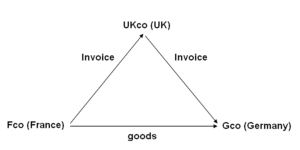
Triangulation is the term used to describe a chain of intra-EU supplies of goods involving three parties in three different Member States (MS). It applies in cases where, instead of the goods physically passing from one to the other, they are delivered directly from the first to the last party in the chain. Thus:

trig (2)In this example; a UK company (UKco) receives an order from a customer in Germany (Gco). To fulfil the order the UK supplier orders goods from its supplier in France (Fco). The goods are delivered from France to Germany.

Basic Treatment

Without simplification, UKco would be required to VAT register in either France or Germany to ensure that no VAT is lost.  That is; if registered in France, French VAT (TVA) would be charged to UKco, this would be recovered and the onward supply to Gco would be VAT free. The supply to Gco would be subject to acquisition tax in Germany.  VAT therefore is neutral to all parties.  Alternatively, UKco may choose to VAT register in Germany.  This would mean that it would be able to produce a German VAT number to Fco so to obtain the goods VAT free.  UKco would recover acquisition tax it applies to itself on the purchase and charge German VAT to Gco. Again, VAT is neutral to all parties.

Triangulation does away with these requirements.

To avoid creating a need for many companies to be structured in this way, Triangulation simplification was created via the EU VAT legislation (which is implemented across all MS) so, in this example, UKco is not required to register in any MS outside the EU.

Simplification

Under the simplification procedure Fco issues an invoice to UKco without charging VAT and quoting UKco’s VAT number. UKco, in turn, issues an invoice to Gco without charging VAT. The invoice is required to show the narrative “VAT Simplification Invoice Article 141 simplification”.  Gco should account for the purchase from UKco in its German VAT Return using the Reverse Charge mechanism. Details of the Reverse Charge here

The Conditions

EU VAT Directive 2006/112/EC, Article 141 sets out the conditions which must be met for Triangulation simplification to apply. Using the example above these may be summarised as:

  • There are three different parties (separate taxable persons) VAT registered in three different MS
  • The goods are transported directly from Fco to Gco
  • The invoice flow involves Fco selling the goods to UKco (the intermediate supplier)
  • UKco supplier in turn invoices its customer, Gco
  • UKco must obtain a valid VAT number from Gco (MS of destination) and quote this number on its invoice
  • UKco must quote “Article 141 simplification” on its invoice to Gco.

Impact on businesses

A business may be involved in triangulation as either:

  • the first supplier of the goods (Fco in the example above),
  • the intermediate supplier (UKco in the example above), or
  • the final consumer (Gco in the example above).

In whichever role, it is important to ensure all relevant details have been obtained and the documentation is correct.

And after Brexit?

As in many areas, we do not yet know how Brexit will affect the UK’s relationship with the EU. In general, the “worse” case scenario for UK business is that this simplification will be unavailable and all cross-border transactions will be treated as exports and imports similar to any other transactions with countries outside the EU and UK business will need to VAT register in one or more MS in the EU. This will add complexity and possibly delays at borders for goods moving to and from the UK. It is also likely to create additional cash flow issues.

In these uncertain times it makes sense to keep abreast of the (likely) changing requirements and take advantage of the simplification while it lasts.

VAT Latest from the courts – Evidence for zero rated exports

By   10 March 2017

In the First Tier Tribunal case of Grange Road Car Sales one of the main issues was the evidence required to satisfy HMRC that goods have actually left the UK (and, as exports, be zero rated). If a business cannot satisfy HMRC then the sales must be standard rated.  There are different levels of evidence required for different types of export, and this case is a handy reminder of the importance of having the correct documentation. I have briefly set out below the different requirements and would strongly advise that any business that exports, regularly or occasionally, to keep this situation under constant review. It is an area which is easy for HMRC to “pick off” transactions and to be “unsatisfied”…

The case

In this case the supplier of cars was based in Northern Ireland and purportedly exported cars to the Republic of Ireland. The purchasers were said to drive the cars over the land boundary.  In brief, the appeal was thrown out because both the evidence given in court and the documentation provided appears to have been woefully lacking; which is putting it politely. The case makes entertaining reading (if reading about VAT cases is your thing!). However, it does raise a serious point about exports.

An overview of export requirements

These requirements for exports are set out in Public Notice 703 (although in this case, as the supply was said to be intra-EU, the rules are set out in Public Notice 725). Not only are the requirements prescribed in detail, but they have the force of law (unlike a lot of HMRC’s published Notices).  Unless these conditions are met, it is not possible to treat an export as zero rated, even if a business knows that the goods have physically left the UK.

Proof of export

The section of the Notice covering evidence is mainly set out in paragraph 6.

Official evidence

Official evidence is produced by Customs systems, for example Goods Departed Messages (GDM) generated by NES.

Commercial transport evidence

This describes the physical movement of the goods, for example:

  • Authenticated sea-waybills
  • Authenticated air-waybills
  • PIM/PIEX International consignment notes
  • Master air-waybills or bills of lading
  • Certificates of shipment containing the full details of the consignment and how it left the EC, or
  • International Consignment Note/Lettre de Voiture International (CMR) fully completed by the consignor, the haulier and the receiving consignee, or Freight Transport Association own account transport documents fully completed and signed by the receiving customer

Photocopy certificates of shipment are not normally acceptable as evidence of export, nor are photocopy bills of lading, sea-waybills or air-waybills (unless authenticated by the shipping or airline).

Supplementary evidence

You are likely to hold, within your accounting system some, or all, of the following:

  • customer’s order
  • sales contract
  • inter-company correspondence
  • copy of export sales invoice
  • advice note
  • consignment note
  • packing list
  • insurance and freight charges documentation
  • evidence of payment, and/or
  • evidence of the receipt of the goods abroad.

You must hold sufficient evidence to prove that a transaction has taken place, though it will probably not be necessary for you to hold all of the items listed.

What must be shown on export evidence?

  • The evidence you obtain as proof of export, whether official or commercial, or supporting must clearly identify:
  • the supplier
  • the consignor (where different from the supplier)
  • the customer
  • the goods
  • an accurate value
  • the export destination, and
  • the mode of transport and route of the export movement

Vague descriptions of goods, quantities or values are not acceptable. An accurate value, for example; £50,000 must be shown and not excluded or replaced by a lower or higher amount.

How long must I retain export documentation?

To substantiate zero-rating a transaction you must make sure that the proof of export is:

  • kept for six years, and
  • made readily available to any visiting VAT Officer to substantiate the zero-rating of your exports

What happens if I do not hold the correct export evidence?

If you do not hold the correct export evidence, within the appropriate time limits, then the goods supplied become subject to VAT at the appropriate UK rate.

Additional, or different, evidence is required in the following cases:

  • The supply is to a recipient in the EU
  • Where the supplier does not arrange shipment of the goods
  • Where an overseas customer arranges his own export
  • Merchandise in baggage (MIB)
  • Groupage or consolidation transactions
  • Postal exports
  • Exports by courier and fast parcel services
  • Exports by rail
  • Exports through packers
  • Exports through auctioneers
  • Exports from Customs, Excise and/or Fiscal warehouses
  • Supplies to the Foreign and Commonwealth Office
  • Exports to the Channel Islands

This list is not exhaustive.

Summary

As may be seen, there is a degree of complexity here, and curiously, just waving a car off to a different country does not create, in itself, a zero rated export.

We are able to review a business’ export procedures to ensure that, as far as possible, HMRC is satisfied that goods have left the UK and that the correct documentation is held to evidence this.

Please contact us if this service is of interest.

Budget 2017 – VAT

By   8 March 2017

In today’s budget, the Chancellor of the Exchequer made the following announcements on VAT:

VAT Registration

The annual VAT registration limit has been increased from £83,000 to £85,000 in line with inflation.

The deregistration limit has been increased from £81,000 to £83,000.

Registration in respect of acquisitions from other Member States has also been increased to £85,000.

Notes:  The UK’s VAT registration threshold is the highest in the EU. Businesses trading below the threshold can choose to register voluntarily. This may be appropriate in order to recover input tax on purchases (where the addition of VAT on sales would not create issues).

It is understood that the increase in the threshold will prevent around 4,000 businesses from having to register for VAT by the end of the 2017 to 2018 financial year.

VAT: ‘Split Payment’ model

It was announced that: Some overseas traders avoid paying UK VAT, undercutting online and high street retailers and abusing the trust of UK consumers who purchase goods via online marketplaces. Building on the measures introduced in Budget 2016, the government will shortly publish a call for evidence on the case for a new VAT collection mechanism for online sales. This would harness technology to allow VAT to be extracted directly by the Exchequer from online transactions at the point of purchase. This is often referred to as a ‘Split Payment’ model. This is the next step in tackling the non-payment of VAT by some overseas traders selling goods online to UK consumers”.

Use and enjoyment provisions for business to consumer mobile phone services

The government will remove the VAT use and enjoyment provision for mobile phone services provided to consumers. The measure will bring those services used outside the EU within the scope of the tax. It will also ensure mobile phone companies can’t use the inconsistency to avoid UK VAT. This will bring UK VAT rules in line with the internationally agreed approach

Making Tax Digital for Business 

And that, in a nutshell, is all Philip Hammond had to say directly on VAT.  However, via the Making Tax Digital for Business (MTDfB) Policy Paper, it was announced that businesses, self-employed people and landlords will be required to start using the new digital service from:

  • April 2018 if they have profits chargeable to Income Tax and pay Class 4 National NICs and their turnovers are in excess of the VAT threshold
  • April 2019 if they have profits chargeable to Income Tax and pay Class 4 NICs and their turnovers are below the VAT threshold
  • April 2019 if they are registered for and pay VAT
  • from April 2020 if they pay Corporation Tax

Businesses, self-employed people and landlords with turnovers under £10,000 are exempt from these requirements.

It was further announced that a one year deferral from the mandating of MTDfB for unincorporated businesses and landlords with turnovers below the VAT threshold. This means that only those businesses with turnovers in excess of the VAT threshold with profits chargeable to Income Tax and that pay Class 4 NICs will be required to start using the new digital service from April 2018.

I suppose that we should be grateful that there were not too many changes to VAT announced (I’m sure there will be many more as a result of Brexit…….).

VAT Latest from the courts – Reverse Charge

By   13 February 2017

The First Tier Tribunal case of University Of Newcastle Upon Tyne is a useful reminder of the impact of the Reverse Charge.

A brief guide to the Reverse Charge is included below.

Background

As with many UK universities, Newcastle was keen to encourage applications to study from new students from overseas. This is an important form of income for the institution.  It used local (overseas) agents to recruit students. Some 40% of those students were studying as undergraduates, 40% as postgraduates on one year “taught” courses and 20% as postgraduate research students studying for doctorates.  In 2014 the University had agreements with more than 100 agents worldwide. The agents used their own resources to recruit students for universities around the world, including in the UK. The University entered into contractual arrangements with agents and paid commission to them. In 2008 the University paid agent commissions of £1.034m, rising to £2.214m in 2012.

The Tribunal was required to consider whether the services supplied by the agents were a single supply to University or separate supplies to both the University and students. If the entire supply is to the University then the Reverse Charge is applicable and, because the University is partly exempt, this would create a VAT cost to it. If the supplies are to both the students and the University, the Reverse Charge element would be less and the VAT cost reduced. (There were changes to the Place Of Supply legislation during the period under consideration, but I have tried to focus on the overall impact in this article.)

The University contended that agents made two supplies: a supply to the University of recruitment services and a supply to students of support services. The commission paid by the University should therefore be apportioned so as to reflect in part direct consideration paid by the University for supplies of services to it, and in part third party consideration for services supplied to the students. The supplies to students would not made in the UK and therefore were not subject to UK VAT.

Decision

After thorough consideration of all of the relevant material, the judge decided that the agents made a single supply of services to the University and make no supplies to students. This meant that the University must account for VAT on the full value of services received since 2010 under the Reverse Charge (although before 2010 different rules on place of supply applied).  Additionally,  it was decided the University was not entitled to recover as input tax VAT for which it is required to account by means of a Reverse Charge. There was no direct and immediate link between the commission paid to agents and any taxable output of the University or the economic activities of the University as a whole.

Commentary

It is understood that the way the University recruited students using overseas agents is common amongst most Universities in the UK, so this ruling will have a direct impact on them.  It was hardly a surprising decision, but underlines the need for all businesses to consider the impact of the application of the Reverse Charge.  Of course, the Reverse Charge will only create an actual VAT cost if a business is partly exempt, or involved in non-business activities.  The value of the Reverse Charge also counts towards the VAT registration threshold.  This means that if a fully exempt business receives Reverse Charge services from abroad, it may be required to VAT register (depending on value). Generally, this means an increased VAT cost. This situation may also affect a charity or a NFP entity.

The case also highlights the importance of contracts, documentation and website wording (should any more reminders be needed).  VAT should always be borne in mind when entering into similar arrangements. It may also be possible to structure arrangements to avoid or mitigate VAT costs if carried out at an appropriate time.

We can assist with any of the above and are happy to discuss this with you.

Guide – Reverse charge on services received from overseas
Normally, the supplier of a service is the person who must account to the tax authorities for any VAT due on the supply.  However, in certain situations, the position is reversed and it is the customer who must account for any VAT due.  This is known as the ‘Reverse Charge’ procedure.  Generally, the Reverse Charge must be applied to services which are received by a business in the UK VAT free from overseas. 
Accounting for VAT and recovery of input tax.
Where the Reverse Charge procedure applies, the recipient of the services must act as both the supplier and the recipient of the services.  On the same VAT return, the recipient must
  • account for output tax, calculated on the full value of the supply received, in Box 1;
  • (subject to partial exemption and non-business rules) include the VAT stated in box 1 as input tax in Box 4; and;
  • include the full value of the supply in both Boxes 6 and 7.
Value of supply.
The value of the deemed supply is to be taken to be the consideration in money for which the services were in fact supplied or, where the consideration did not consist or not wholly consist of money, such amount in money as is equivalent to that consideration.  The consideration payable to the overseas supplier for the services excludes UK VAT but includes any taxes levied abroad.
Time of supply.
The time of supply of such services is the date the supplies are paid for or, if the consideration is not in money, the last day of the VAT period in which the services are performed.
The outcome
The effect of the provisions is that the Reverse Charge has no net cost to the recipient if he can attribute the input tax to taxable supplies and can therefore reclaim it in full. If he cannot, the effect is to put him in the same position as if had received the supply from a UK supplier rather than from one outside the UK. Thus the charge aims to avoid cross border VAT rate shopping. It is not possible to attribute the input tax created directly to the deemed (taxable) supply. 

VAT – Overseas Holiday Lets: A Warning

By   16 January 2017
Do you, or your clients, own property overseas which you let to third parties when you are not using it yourself?

It is important to understand the VAT consequences of owning property overseas.

The position of UK Holiday Lets

It may not be commonly known that the UK has the highest VAT threshold in the EC. This means that for many ‘sideline’ businesses such as; the rental of second or holiday properties in the UK, the owners, whether they are; individuals, businesses, or pension schemes, only have to consider VAT if income in relation to the property exceeds £83,000 pa. and this is only likely if a number of properties are owned.

It should be noted that, unlike other types of rental of homes, holiday lettings are always taxable for VAT purposes.

Overseas Holiday Lets

Other EC Member States have nil thresholds for foreign entrepreneurs.  This means that if any rental income is received, VAT registration is likely to be compulsory. Consequently, a property owner that rents out a property abroad will probably have a liability to register for VAT in the country that the property is located.  Failure to comply with the domestic legislation of the relevant Member State may mean; payment of back VAT and interest and fines being levied. VAT registration however, does mean that a property owner can recover input tax on expenditure in connection with the property, eg; agent’s fees, repair and maintenance and other professional costs.  This may be restricted if the home is used for periodical own use.

Given that every EC Member State has differing rules and/or procedures to the UK, it is crucial to check all the consequences of letting property overseas. Additionally, if any other services are supplied, eg; transport, this gives rise to a whole new (and significantly more complex) set of VAT rules.

A final word of warning; I quite often hear the comment “I’m not going to bother – how will they ever find out?”

If an overseas property owner based in the UK is in competition with local letting businesses, those businesses generally do not have any compulsion in notifying the local authorities. In addition, I have heard of authorities carrying out very simple initiatives to see if owners are VAT registered. In many resorts, income from tourism is vital and this is a very important revenue stream for them so it is well policed.

Please contact us if you are affected by this matter; we have the resources to advise and act on a worldwide basis.

www.marcusward.co

Crime doesn’t pay……..VAT. Is there tax on illegal activities?

By   4 January 2017
A gentle introduction to VAT for the new year.  A number of people have been surprised to find that crime does pay tax, thank you very much. It seems bad enough that the police should chase and catch you, put you in the dock and send you to prison, without finding that your first visitor is HMRC….

Dodgy perfume?

Goodwin & Unstead were in business selling counterfeit perfume. They were also up-front about what they were doing. Unstead claimed that “Everything I can carry in my vehicle, everything I trade in and sell, is a complete copy of the real thing. I do not sell goods as the real thing. In fact I sell my goods for a quarter of the original price. I am not out to defraud or con the public. I only appeal to the poseurs in life.”

The real manufacturers might have sued these men for passing off the product of their chemistry experiments in trademarked bottles, but it was HMRC who sent them to jail – for failing to register and pay VAT on their sales. The amount they should have collected was estimated at £750,000, which shows that they must have appealed to a great many poseurs.
.
If they had paid the VAT, Customs would have had no problem with them. Their customers must have been reasonably satisfied – if your counterfeit perfume smells something like the real thing, why worry?
They tried to get out of jail with an ingenious argument – if the sale of the perfume was illegal, surely there shouldn’t be VAT on it. It wasn’t legitimate business activity, so it wasn’t something that ought to be taxable. The European Court had no time for this. They pointed out that it would give lawbreakers an advantage over lawful businesses; they wouldn’t have to charge VAT. The judges suggested that maybe people would even deliberately break the law so they could get out of tax; in this case, the only thing that made the trade illegal was treading on someone’s trademark rights, and that was something that might happen at any time in legitimate businesses. The judges said that VAT would apply to any trade which competed in a legal marketplace, even if the particular sales broke the law for some reason. Counterfeit perfume is VATable because real perfume is too. Of course, Customs have traditionally had two main roles – looking for drug smugglers, and dealing with VAT-registered traders. They have generally treated both with much the same suspicion, but the ECJ made it clear in this case that the two sets of customers are completely separate.

“Personal” services?

Customers paid the escort £130, of which £30 was paid to the agency. VAT on £130 or VAT on £30?

The first hearing before the Tribunal went something like this (this may be using artistic licence, but the published summary implies it was so):

HMRC: “We think the VAT should be on £130 because the escorts are acting as agents of the escort business.”
Trader: “No, it’s just £30, the £100 belongs to the escort and is nothing to do with me.”
Tribunal chairman: “All right, tell me a bit about how the business operates.”
Customs: “No.”
Tribunal chairman: “What?”
Customs: “You don’t want to know.”
Tribunal chairman: “How can I decide whether the escorts are acting as agent or principals without knowing how the business operates?”
Customs: “Don’t go there, just give us a decision.”
Tribunal chairman: “Trader, you tell me how the business operates.”
Trader: “I agree with him, you don’t want to know.”
The Tribunal seems to have been a bit baffled by this. They were aware that Customs had a great deal more evidence which had been collected during the course of a thorough investigation, and they asked the parties to go away and decide whether they might let the Tribunal see a bit more of it so they could make a judgement rather than a guess.

What about drugs then?

It’s well-known that you are allowed to smoke dope in some establishments in Amsterdam, although the Dutch authorities are thinking about restricting this to Netherlands’ residents. They may find that such a rule contravenes the European Law on freedom of movement – under the EU treaty, you can’t be meaner to foreigners than you are to your own people just because they are foreign. That’s a nice idea, but individuals and governments keep trying it on. Anyway, the Coffeeshop Siberie rented space to drug dealers who would sell cannabis at tables for people to take advantage of the relaxed atmosphere. Presumably they are preparing to examine passports or local utility bills before making the sale, if only the Dutch are to be allowed to get stoned. Anyway, the Dutch authorities asked the coffee shop’s owners for VAT on the rent paid by the dealers, and the owners appealed to the ECJ. This time, surely, it was sufficiently illegal. Although the consumption of drugs was tolerated, it was still against the law, and it must therefore be not VATable.
The judges pointed out that the coffee shop was not actually selling drugs. They were just providing the space for other people to sell drugs. Although selling drugs was completely illegal, and there was no legitimate market in cannabis, renting space was a normal business activity. Renting space to someone who did something illegal with it was in the same category as the dodgy perfume sales in Goodwin & Unstead: it was a bit illegal, but not illegal enough. The VAT was still due.

Counterfeiting?

In a German case, the ECJ ruled that the importation of counterfeit money was outside the scope of VAT. The Advocate-General observed that a line must be drawn between, on the one hand, transactions that lie so clearly outside the sphere of legitimate economic activity that, instead of being taxed, they can only be the subject of criminal prosecution, and, on the other hand, transactions which though unlawful must nonetheless be taxed, if only for ensuring in the name of fiscal neutrality, that the criminal is not treated more favourably than the legitimate trader’.

So, there you have it, if you are of a criminal disposition, and you want to avoid VAT, funny money is the way to go.  Please note, this does not constitute advice…..!

VAT – EC proposal for new rules for e-commerce and online businesses

By   1 December 2016

The EC has announced measures to simplify VAT for e-commerce businesses in the EU. The proposals will purportedly allow consumers and businesses to buy and sell goods and services more easily online.

 New VAT rules for sales and goods and services online

Currently, online traders have to register for VAT in all the Member States to which they sell goods. Often cited as one of the biggest barriers to cross-border e-commerce, these VAT obligations cost businesses around €8,000 for every EU country into which they sell. We are now proposing that businesses make one simple quarterly return for the VAT due across the whole of the EU, using the online VAT One Stop Shop. This system already exists for sales of e‑services such as mobile phone apps, and has been proven successful with more than €3 billion in VAT being collected through the system in 2015. Administrative burdens for companies will be reduced by a staggering 95%, giving an overall saving to EU business of €2.3 billion and increasing VAT revenues for Member States by €7 billion.

Simplifying VAT rules for micro-businesses and start-ups

A new annual threshold of €10,000 in online sales will be introduced under which businesses selling cross-border can continue to apply the VAT rules they are used to in their home country. This will make complying with VAT rules easier for 430,000 companies across the EU, representing 97% of all micro-business trading cross‑border. A second new yearly threshold of €100,000 will make life easier for SMEs when it comes to VAT, with simplified rules for identifying where their customers are based. The thresholds could be applied as early as 2018 on e‑services, and by 2021 for online goods. Other simplifications would allow the smallest businesses to benefit from the same familiar VAT rules of their home country, such as invoicing requirements and record keeping. The first point of contact will always be with the tax administration where the business is located and businesses will no longer be audited by each Member State where they have sales.

VAT fraud from outside the EU – Removal of Low Value Consignment (LVC) relief

Small consignments imported into the EU that are worth less than €22 are currently exempt from VAT. With around 150 million parcels imported free of VAT into the EU each year, the EC says that this system is open to massive fraud and abuse, creating major distortions against EU business. Firstly, EU businesses are put at a clear disadvantage since unlike their non-EU competitors, they are liable to apply VAT from the first eurocent sold. Secondly, imported high-value goods such as smartphones and tablets are consistently undervalued or wrongly described in the importation paperwork in order to benefit from this VAT exemption. The Commission has therefore decided to remove LVC relief

Equal rules for taxing e-books, e-newspapers and their printed equivalents

Current rules allow Member States to tax printed publications such as books and newspapers at reduced rates or, in some cases, super-reduced or zero rates. The same rules exclude e-publications, meaning that these products must be taxed at the standard rate. Once agreed by all Member States, the new set-up will allow (but not oblige) Member States to align the rates on e-publications to those on printed publications.

Action

Please contact us if any of the above affects your business or your client’s businesses.

VAT – Input tax on buy out costs and VAT grouping

By   23 November 2016

Latest from the courts

May input tax incurred by a VAT group be attributed to the activities of a single member of that group?

In the First Tier Tribunal (FTT) case of Heating and Plumbing Supplies Ltd, the issue was whether input tax incurred on professional costs of a management buyout were recoverable.

Background

A company was formed with the intention of buying the shares of a trading company.  The purchasing company and the trading company were then VAT grouped and the professional costs were invoiced to, and paid for, by the VAT group (the tax point being created after the date that the VAT group was formed).  HMRC disallowed the claim for the relevant input tax on the grounds that the purchasing company itself did not make any taxable supplies (it did not engage in an economic activity).  While this may have been correct, the appellant contended that in these circumstances, the VAT group must be considered as a single taxable person and that the activities of the group as a whole that should be considered. The input tax was an overhead of the group, and because the group itself only made taxable supplies (via the representative member) the input tax was recoverable in full by the representative member

Decision

Following recent case law in Skandia America at the Court of Justice, the judge here decided in favour of the appellant. It was ruled that HMRC may not look at the purchasing company in isolation but rather, the group must be considered as a whole.  The FTT stated that when a VAT group is formed the identities of the individual members of the group disappear…” meaning that a VAT group is a single taxable entity, the VAT status of the individual members being irrelevant in this situation. This confirms our long held view on the status of VAT groups and provides welcome clarification on the matter.

Relevance

This case highlights that HMRC’s policy of looking at the activities of a group member individually is inappropriate.  This is so even if the grouping structure provides input tax recovery which would not have been available had the companies been VAT registered independently.

Typically in these circumstances, HMRC will either challenge the decision, or amend its guidance to reflect this ruling.  We await news on how HMRC will react.

Action

If a business has either been denied input tax on buy out or similar acquisition costs, or made a decision not to recover this VAT, it would be prudent to lodge a claim with HMRC (plus interest).

We are able to assist with such a claim.

www.marcusward.co