Category Archives: Disputes

VAT: Electronic sales suppression (ESS) compliance checks

By   8 September 2026
HMRC has published a new Factsheet CC/FS68A which provides information on electronic sales suppression (ESS). It explains the powers HMRC can use to help it identify and tackle ESS. It also explains the penalties which may be levied if a person is in possession of an ESS tool.
More details on ESS and ESS tools here

HMRC powers

Finance Act 2022, Schedule 14 allows HMRC to issue an information notice for ESS. This means HMRC can ask for certain information that applies to ESS. It allows the issue of a Notice to a ‘relevant person’ for a ‘relevant purpose’.

Relevant Person

A ‘relevant person’ is any person who HMRC think may be liable to a penalty for being involved in ESS.

Relevant purpose

A ‘relevant purpose’ is the reason HMRC is asking for information about ESS and ESS tools.

The law allows HMRC to do this in three situations. These are to help HMRC:

  • decide whether a relevant person has made, supplied, promoted, or possesses an ESS tool and whether this person is liable to a penalty
  • understand how the ESS tool works
  • identify any other person who has made, supplied, promoted, or possesses the ESS tool. 

VAT: What is a taxable supply? – Definition

By   8 September 2026

VAT Basics

Taxable supply

It is sometimes useful when considering a transaction to “go back to basics” for VAT purposes. There are certain tests to determine whether a supply is taxable, and these are set out below. Broadly, the tests establish whether UK VAT is payable on a sale and they determine whether an entity is “in business”, that is; carrying on an economic activity.

A transaction is within the scope of UK VAT if all four of the following conditions are satisfied:

  • It is a supply of goods or services.

There is a distinction between the two types of supply as different VAT treatments may apply.  Generally, everything that is not tangible goods is services. However, if no goods or services are actually provided, there is no supply.  Indeed, if there is no consideration for a supply, in most cases it is not a taxable supply.

  • It takes place in the UK.

There are quite complex tests to consider when analysing the “place of supply”, especially where services are concerned.  If the place of supply is outside the UK then usually no UK VAT is due, however, the supply may be subject to VAT in another country.

  • It is made by a taxable person.

A taxable person is any legal entity which is, or should be, registered for VAT in the UK.

  • It is made in the course or furtherance of any business carried on by that person

Business

The term “business” is only used in UK legislation, The Principal VAT Directive refers to “economic activity” rather than “business” and since UK domestic legislation must (well historically) conform to the Directive both terms must be seen as having the same meaning.  Since the very first days of VAT there have been disagreements over what constitutes a “business”. I have only recently ended a dispute over this definition for a (as it turns out) very happy client. The tests were set out as long ago as 1981 and may be summarised as follows:

  • Is the activity a serious undertaking earnestly pursued?
  • Is the activity an occupation or function, which is actively pursued with reasonable or recognisable continuity?
  • Does the activity have a certain measure of substance in terms of the quarterly or annual value of taxable supplies made (bearing in mind that exempt supplies can also be business)?
  • Is the activity conducted in a regular manner and on sound and recognised business principles?
  • Is the activity predominantly concerned with the making of taxable supplies for a consideration?
  • Are the taxable supplies that are being made of a kind which, subject to differences of detail, are commonly made by those who seek to profit from them?

So, if these tests are passed a taxable supply exists. The next step is to establish which VAT rate applies. In an often quoted comment from the judge in the Morrison’s Academy Boarding Houses Association 1978 STC1 Court Of Session case “…In my opinion it will never be possible or desirable to define exhaustively ‘business’ ”. Which what it lacks in helpfulness, makes up for in candour.

There was something of a deviation from the Lord Fisher tests in the Longbridge Court of Appeal case, however, that appears to be a blip and HMRC seem to have reverted to Lord Fisher in subsequent hearings on the same topic. A bit of a: watch this space area of VAT.

Recent cases on business

Recent case law on this issue here and here and HMRC Internal guidance on the Lord Fisher tests here

Commentary

Tip: It is often easier to consider what isn’t a taxable supply to establish the correct VAT treatment.  Specific examples of situations which are not taxable supplies are; donations, certain free supplies of services, certain grants or funding, some compensation and some transactions which are specifically excluded from the tax by legislation, eg; transfers of going concerns (TOGC).

I think that it is often the case that the basic building blocks of the tax are overlooked, especially in complex situations and I find it helps to “go back to the first page” sometimes.

VAT – Residential Property Triggerpoints

By   24 August 2026

What to look out for

VAT and property transactions are uneasy bedfellows at the best of times.  Getting the tax wrong, or failing to consider it at all can result in a loss of income of 20% on a project, or forgoing all input tax incurred on a development. Even a simple matter of timing can affect a transaction to a seller’s detriment. Here I take a brief look at issues that can impact residential property transactions.  It is important to recognise when VAT may affect a project so I hope that some of these triggerpoints may prove useful.

General points

The following are very general points on residential properties. No two cases are the same, so we strongly recommend that specific advice is obtained.

Refurbishing “old” residential properties

Broadly speaking, the VAT incurred on such work is not reclaimable as the end use of the property will be exempt (either sale or rent). There is no way round this as it is not possible to opt to tax residential dwellings. It may be possible to use the partial exemption de minimis limits if there are any other business activities in the same VAT registration. If this is the only activity of a business, it will not even be permitted to register for VAT. There are special rules if the number of dwellings change as a result of the work (see below).

New residential builds

The first sale (or the grant of a long lease 21 years plus) of a newly constructed dwelling by “the person constructing” is zero rated. This means that any VAT incurred on the construction is recoverable. Care should be taken if the new dwelling is let on a short term basis rather than/before being sold as this will materially affect input tax recovery.  Advice should always be taken before such a decision is made as there is planning available to avoid such an outcome. VAT incurred on professional and legal costs of the development may also be recovered such as; architects, solicitors, advisers, agents etc. VAT registration is necessary in these cases and our advice is to VAT register at the earliest stage possible.

The construction of new dwellings is zero rated, along with any building materials supplied by the contractor carrying out the work.  The zero rating also extends to sub-contractors.  It is not necessary for a certificate to be provided in order to zero rate such building works.

Conversions

There are special rules for refurbishments which create a different number of dwellings (eg; dividing up a single house into flats, or changing the total number of flats in a block, or making one dwelling by amalgamating flats). Generally, it is possible for contractors to invoice for their building work at the reduced rate of 5%. This rate may also apply to conversions. A conversion is defined as work undertaken on a non-residential property, such as a barn, office or church, into one or more self-contained dwellings.  Once converted the sale of the residential property will be zero rated and all of the input tax incurred on associated costs is recoverable (similar to a new build).

Renovation of empty residential premises

Reduced rating at 5% is also available for the renovation or alteration of empty residential premises. Such a premises is one that has not been lived in during the two years immediately before the work starts. HMRC will insist on documentary evidence that the property has been empty for that time.

Purchase of a commercial property intended for conversion

If it is intended to convert a commercial property into residential use and the vendor indicates that (s)he will charge VAT (as a result of the option to tax having been exercised) it is possible for the purchaser to disapply the option to tax by the issue of a certain document; form VAT 1614D. This means that the sale will become exempt.  Advice should always be sought on this issue by parties on each side of the transaction as it very often creates difficulties and significant VAT and other costs (mainly for the vendor).

Mixed developments

If what is being constructed is a building that is only in part a zero-rated dwelling, a contractor can only zero-rate its work for the qualifying parts. For example, if a building  containing a shop with a flat above is constructed, only the construction of the flat can be zero-rated. An apportionment must be made for common areas such as foundations and roof etc. The sale of the residential element when complete is zero rated and the sale of the commercial part will be standard rated if under three years since completion.  If the commercial part is over three years old at the date of sale, or is rented rather than sold, the supply will be exempt with the option to tax available – details here.  If an exempt supply is made, the recovery of input tax incurred on the development will be compromised and it is important that this recognised and planning put in place to avoid this outcome.

DIY building projects

There is a specific scheme for DIY Housebuilders to recover input tax incurred on the construction of a dwelling for the constructor to live in personally.  Details here https://www.marcusward.co/?s=diy

Sale of an incomplete residential development

There are two possible routes to relief if a project is sold before dwellings have been completed (either new build or conversion).  This can often be a complex area, however, there is some zero rating relief which may apply, and also it may be possible to apply TOGC (Transfer Of a Going Concern) treatment to the sale.  In both cases, it is likely that input tax previously claimed by the developer should not be jeopardised.

Overview

There are VAT complications for the following types of transactions/developments and issues:

  • definition of a dwelling
  • arrangements where consortiums or syndicates are used/profit share
  • transactions in connection with nursing or children’s homes or similar
  • “granny flats” in the garden of existing houses
  • work on charitable buildings/ for charities
  • converting specific commercial property into residential property – particularly ex-pubs
  • sales to Housing Associations
  • sales of “substantially reconstructed protected buildings”
  • buying VATable buildings
  • date of completion – zero rating cut off
  • supplies by members of VAT groups
  • definition of building materials
  • input tax on white goods and similar
  • alterations for people with disabilities
  • garages with dwellings
  • land supplied with a property
  • buying property with existing, continuing leases
  • beneficial owner versus legal owner issues
  • change of intention (buying land/property with the intention of using it for one purpose, but the intention changes after purchase)
  • where professional/architect’s fees are incurred
  • planning gains
  • own use of a property
  • mobile homes
  • reverse premiums/surrenders/reverse surrenders re; leases
  • holiday lets and
  • hotels
  • business use by purchaser/tenant
  • contract stage of a property purchase where VAT is potentially chargeable by vendor
  • timing of supplies
  • work re; schools, churches, village halls, hospitals, or any other “unusual” structures

This list is not exhaustive, but I hope it gives a broad idea of where VAT needs to be considered “before the event”. As always, we are available to assist.

A VAT Did you know?

By   31 July 2026

Scottish snowballs VAT free, but if you buy Swedish snowballs, they are standard rated.

VAT Success Stories

By   26 May 2026
I often write about how it is important to seek VAT advice at the right time, see triggerpoints. So, I thought that I’d give some practical examples on where we have saved our clients money, time and aggravation.

Investment company

HMRC denied claims for input tax incurred on costs relating to the potential acquisition of an overseas business and threatened to deregister the plc as it was not, currently, making taxable supplies. Additionally, HMRC contended that even if VAT registration was appropriate, the input tax incurred did not relate to taxable supplies and was therefore blocked.

We were able to persuade HMRC that our client had a right to be VAT registered because It intended to make taxable supplies (supplies with a place of supply outside the UK which would have been taxable if made in the UK) and that the input tax was recoverable as it related to these intended taxable supplies (management charges to the acquired business). This is a hot topic at the moment, but we were able to eventually demonstrate, with considerable and detailed evidence that there was a true intention.

This meant that UK VAT registration was correct and input tax running into hundreds of thousands of pounds incurred in the UK was repaid.

Restaurant

We identified and submitted a claim for a West End restaurant for nearly £200,000 overpaid output tax. We finally agreed the repayment with HMRC after dealing with issues such as the quantum of the claim and unjust enrichment.

Developer

Our property developing client specialises in very high-end residential projects in exclusive parts of London. They built a dwelling using an existing façade and part of a side elevation. We contended that it was a new build (zero rated sale and no VAT on construction costs and full input tax recovery on other costs). HMRC took the view that it was work on an existing dwelling so that 5% applied and input tax was not recoverable. After site visits, detailed plans, current and historical photograph evidence HMRC accepted the holy grail of new build. The overall cost of the project was tens of millions.

Charity

A charity client was supplying services to the NHS. The issue was whether they were standard rated supplies of staff or exempt medical services. We argued successfully that, despite previous rulings, the supplies were exempt, which benefited all parties. Our client was able to deregister from VAT, but not only that, we persuaded HMRC that input tax previously claimed could be kept. This was a rather pleasant surprise outcome.  We also avoided any penalties and interest so that VAT did not represent a cost to the charity in any way. If the VAT was required to be repaid to HMRC it is likely that the charity would have been wound up.

Shoot

A group of friends met to shoot game as a hobby. They made financial contributions to the syndicate in order to take part. HMRC considered that this was a business activity and threatened to go back over 40 years and assess for output tax on the syndicate’s takings which amounted to many hundreds of thousands of pounds and would have meant the shoot could not continue. We appealed the decision to retrospectively register the syndicate.

After a four-year battle HMRC settled on the steps of the Tribunal. We were able to demonstrate that the syndicate was run on a cost sharing basis and is not “an activity likely to be carried out by a private undertaking on a market, organised within a professional framework and generally performed in the interest of generating a profit.” – A happy client.

Chemist

We assisted a chemist client who, for unfortunate reasons, had not been able to submit proper VAT returns for a number of years.  We were able to reconstruct the VAT records which showed a repayment of circa £500,000 of VAT was due.  We successfully negotiated with HMRC and assisted with the inspection which was generated by the claim.

The message? Never accept a HMRC decision, and seek good advice!

VAT: Bad Debt Relief – A guide

By   19 May 2026

VAT Basics

Bad Debt Relief (BDR)

We understand that businesses and consumers are likely to fall into default in increasing numbers if the economy continues to worsen and it is anticipated that the ability to settle of debts on time will significantly decrease. It is apparent that many debts will never be settled. Consequently, it appears timely to look at the available VAT relief.

The VAT position

VAT registered businesses usually account for tax on an accruals basis (but see CAS) and will therefore be required to account for output tax in the same VAT period as an invoice is issued to a customer. If that invoice is not paid and a bad debt arises this would mean that tax has been accounted for on a payment which has not been received.

Relief

Anything which can relieve the burden of VAT is to be welcomed, especially in such trying times. So VAT Bad Debt Relief (BDR) is a useful tool if a business is aware of it and understand when it may be claimed.

It is at the very least frustrating when a client does not pay, and in some cases this situation can lead to the end of a business. At least the VAT charged to the client should not become a cost to a supplier. The BDR mechanism goes some way to protect a business from payment defaulters.

There is a relief however, as normal with tax, there are specific conditions:

Conditions for claiming BDR

The supplier must have supplied goods or services for a consideration in money and must have accounted for and paid VAT on the supply. All or part of the consideration must have been written off as a bad debt by making the appropriate entry in the business’ records (this does not have to be a “formal” procedure and need not be notified to the customer). At least six months (but not more than four years and six months) must have elapsed since the later of the date of supply or the due date for payment.

Records required

Various records and evidence must be kept (for four years from the date of claim), in particular to identify:

  • the time and nature of the supply, the purchaser, and the consideration
  • the amount of VAT chargeable on the supply
  • the accounting period when this VAT was accounted for and paid to HMRC
  • any payment received for the supply
  • entries in the refund for bad debts account
  • the accounting period in which the claim is made

Procedure for claiming BDR

This part is straightforward: The claim is made by including the amount of the refund in Box 4 of the VAT Return for the period in which the debt becomes over six months old. The amount of BDR is either set-off against output tax due, or may create a refund position with HMRC.

Repayment of refund

Repayment of VAT refunded is required where payment is subsequently received or where the above conditions have not been complied with.

Adjustment of input tax for the debtor

Businesses are required to monitor the time they take to pay their suppliers and repay input tax claimed if they have not paid the supplier within six months. Subsequent payment of all or part of the debt will allow a corresponding reclaim of input tax. This is an easy assessment for HMRC to make at inspections, so businesses should make reviewing this matter this a regular exercise.

Finally, there is tax point planning available to defer a tax point until payment is received for providers of continuous supplies of services. Please see here

More on general VAT payment problems here.

VAT: Public EV charging update

By   18 May 2026

Further to the Charge My Street Limited case, which we considered here HMRC has published Policy Paper Revenue and Customs Brief 4 (2026): VAT liability of supplies of electricity from public electric vehicle charge points.

This paper sets out the VAT treatment of supplies of electricity from public EV charging points.

HMRC’s position remains that charging electric vehicles at public charge points is standard rated for VAT. 

Supplies of fuel and power to a domestic premises are subject to the reduced rate of VAT at 5%. HMRC’s long-standing policy is that electric vehicle charge points located in public areas do not qualify as domestic premises and the standard rate of VAT applies to the supply of electricity at these locations.

The First-tier Tribunal found in favour of Charge My Street Limited. It concluded that Note 5(g) of Item 1 of Group 1 of Schedule 7A to the VAT Act 1994 covers supplies of electricity to an identified person at any identifiable premises, provided the total supplied does not exceed 1,000 kWh in a calendar month. The FTT clarified there is no additional requirement for the premises to be owned or controlled by the person receiving the supply, nor do the premises need to be buildings. This means locations such as public car parks may be included. The FTT decided that supplies of EV charging at public charging stations fell within the de minimis limit for supplies of electricity, and so were deemed to be for domestic use and, accordingly, subject to the reduced rate.

HMRC has applied for permission to appeal the First-tier Tribunal’s decision.

The penalty regime…the dark side of VAT

By   29 April 2026
VAT Penalties

I have made a lot of references to penalties in other articles over the years. So I thought it would be a good idea to have a closer look; what are they, when are they levied, rights of appeal, and importantly how much could they cost if a business gets it wrong?

Overview

Broadly, a penalty is levied if the incorrect amount of VAT is declared, either by understating output tax due, or overclaiming input tax, or accepting an assessment which is known to be too low.

Amount of penalty

HMRC detail three categories of inaccuracy. These are significant, as each has its own range of penalty percentages. If an error is found to fall within a lower band, then a lower penalty rate will apply. Where the taxpayer has taken ‘reasonable care,’ even though an error has been made, then no penalty will apply.

  • An error, when reasonable care not taken: 30%;
  • An error which is deliberate, but not concealed: 70%;
  • An error, which is deliberate and concealed: 100%.

Reasonable care

There is no definition of ‘reasonable care’. However, HMRC have said that they would not expect the same level of knowledge or expertise from a self-employed person, as from a large multi-national.

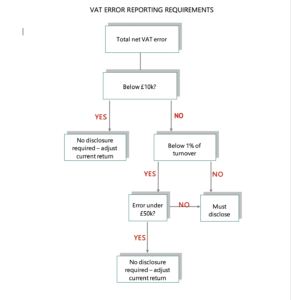
HMRC expect that, where an issue is unclear, advice is sought, and a record maintained of that advice. They also expect that, where an error is made, it is adjusted, and HMRC notified promptly. They have specifically stated that merely to adjust a return will not constitute a full disclosure of an error. Therefore, a penalty may still be applicable.

Notification

Further, where there is an ‘unprompted disclosure’ of the error, HMRC have power to reduce the penalty further. This measure is designed to encourage businesses to review their own VAT returns.

A disclosure is unprompted if it is made at a time when a person had no reason to believe that HMRC have discovered or are about to discover the inaccuracy. The disclosure will be treated as unprompted even if at the time it is made, the full extent of the error is not known, as long as fuller details are provided within a reasonable time.

What the penalty is based on

The amount of the penalty is calculated by applying the appropriate penalty rate (above) to the ‘Potential Lost Revenue’ or PLR. This is essentially the additional amount of VAT due or payable, as a result of the inaccuracy, or the failure to notify an under-assessment. Special rules apply where there are a number of errors, and they fall into different penalty bands.

Defending a penalty

The percentage penalty may be reduced by a range of ‘defences:’

– Telling; this includes admitting the document was inaccurate, or that there was an under-assessment, disclosing the inaccuracy in full, and explaining how and why the inaccuracies arose;

– Helping; this includes giving reasonable help in quantifying the inaccuracy, giving positive assistance rather than passive acceptance, actively engaging in work required to quantify the inaccuracy, and volunteering any relevant information;

– Giving Access; this includes providing documents, granting requests for information, allowing access to records and other documents.

HMRC have included a provision whereby a penalty can be suspended for up to two years. This will occur for a careless inaccuracy, not a deliberate inaccuracy. HMRC will consider suspension of a penalty where, given the imposition of certain conditions, the business will improve its accuracy. The aim is to improve future compliance and encourage businesses which genuinely seek to fulfil their obligations.

Appealing a penalty 

HMRC have an internal reconsideration procedure, where a business should apply to in the first instance. If the outcome is not satisfactory, the business can pursue an appeal to the First Tier Tribunal. A business can appeal on the grounds of; whether a penalty is applicable, the amount of the penalty, a decision not to suspend a penalty, and the conditions for suspension.

The normal time limit for penalties to four years. Additionally, where there is deliberate action to evade VAT, a 20 year limit applies. In particular, this applies to a loss of VAT which arises as a result of a deliberate inaccuracy in a document submitted by that person.

These are just the penalties for making “errors” on VAT returns. HMRC have plenty more for anything from late registration to issuing the wrong paperwork.

Even darker

There are even more severe penalties for deliberate acts, including significant terms of imprisonment. That is the subject of another article.

Assistance

My advice is always to check on all aspects of a penalty and seek assistance for grounds to challenge a decision to levy a penalty. We have a very high success rate in defending businesses against inappropriate penalties.  It is always worth running a penalty past us.

HMRC Updates on VAT appeals

By   20 April 2026

HMRC has updated its list of VAT appeals, which sets out the status of HMRC appeals and recent cases which they consider have potential implications for other taxpayers.

This is a list of VAT appeals that HMRC has lost, or partly lost, that could have implications for other businesses.

The list is updated regularly and details of finalised cases are retained for six months.

VAT: Composite or separate supplies – The A & D McFarlane case

By   10 March 2026

Latest from the courts

Yet more on composite or separate supplies. As a background to the issue please see previous relevant cases here here here and here. This is the latest the seemingly endless and conflicting series of cases on whether certain supplies are multiple or single. 

In the First-Tier Tribunal case (FTT) of Alan and Diane McFarland the appellants operated a ‘bed and breakfast’ for other people’s cattle.

The issue

The VAT issue was whether there were separate supplies:

  • zero-rated supply of animal food
  • exempt supply of land.

Additionally, the appellant contended that the supply of animal food was a principal supply, and everything else, including the land, was ancillary. 

HMRC took the view that there was a single taxable supply of ‘animal care’ and not separate supplies of exempt stabling and zero-rated feed. It also rejected the claim that the appellant had an exclusive right of occupation over any defined area, noting that there was no agreement conferring such a right with the consequence that this could not be an exempt supply. On the zero-rated animal foodstuffs point; HMRC concluded that the supplies do not qualify for zero-rating as the food provided formed part of the overall service of animal husbandry.

Legislation

  • Exemption: right over land or any licence to occupy land – The VAT Act 1994, Schedule 9, Group 1,  item 1
  • Zero-rating: animal feeding stuffs – The VAT Act 1994, Schedule 8, Group 1, Item 2.

Decision

The FTT found that there was a single standard rated supply of ‘looking after’ cattle. The supply made by the appellant fell squarely within the Levob (Levob Verzekeringen BV [C-41/04]) category, being so closely linked that they form, objectively, a single, indivisible economic supply, which it would be artificial to split. – HMRC notes on Levob here.

The supply was a fully integrated package of services directed towards the rearing and finishing of cattle. This included: daily mixing and provision of feed, management of water and housing, maintenance of handling facilities, statutory record‑keeping, and disease‑control obligations. These activities were inseparable in practice and indispensable for the operation of the recipient’s cattle‑finishing business. Neither the accommodation nor the feed, nor any other individual component, was offered or taken independently. There was a single price for the complete service. There was also a single invoice and a single description of the supply on the invoice. There was no indication on the invoice that both exempt and zero-rated services were being supplied.

The appellant provided a single composite service of animal rearing and management, to which all elements, including accommodation and feed, were merely constituent elements.

The Tribunal also dismissed the alternative argument of the that the supply of food was the principal supply, with all other elements, including accommodation and the wider activities being merely ancillary. The provision of food was not an aim in itself. The food could not sensibly be separated from the accommodation, handling, record-keeping and welfare-related functions that were also performed. It was, therefore, not the principal supply but an integrated component of the single composite supply.

The appeal was consequently dismissed.

Commentary

Yet another case on the perennial composite/single supply issue. This case was relatively straightforward and the outcome was no surprise. It is essential that businesses that potentially deal with agent/principal matters or make supplies at different VAT rates consider their position. Contracts, other documentation and the commercial reality need to be considered. We recommend that in such circumstances a review is carried out specifically to establish the correct VAT position .