
Category Archives: Small Businesses

VAT Triangulation – What is it? Is it a simple “simplification”?

By   24 March 2017

Unusually in the VAT world, Triangulation is a true simplification and is a benefit for businesses carrying out cross-border trade in goods.

What is it?

Triangulation is the term used to describe a chain of intra-EU supplies of goods involving three parties in three different Member States (MS). It applies in cases where, instead of the goods physically passing from one to the other, they are delivered directly from the first to the last party in the chain. Thus:
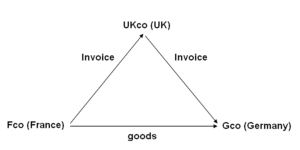
trig (2)In this example; a UK company (UKco) receives an order from a customer in Germany (Gco). To fulfil the order the UK supplier orders goods from its supplier in France (Fco). The goods are delivered from France to Germany.

Basic Treatment

Without simplification, UKco would be required to VAT register in either France or Germany to ensure that no VAT is lost.  That is; if registered in France, French VAT (TVA) would be charged to UKco, this would be recovered and the onward supply to Gco would be VAT free. The supply to Gco would be subject to acquisition tax in Germany.  VAT therefore is neutral to all parties.  Alternatively, UKco may choose to VAT register in Germany.  This would mean that it would be able to produce a German VAT number to Fco so to obtain the goods VAT free.  UKco would recover acquisition tax it applies to itself on the purchase and charge German VAT to Gco. Again, VAT is neutral to all parties.

Triangulation does away with these requirements.

To avoid creating a need for many companies to be structured in this way, Triangulation simplification was created via the EU VAT legislation (which is implemented across all MS) so, in this example, UKco is not required to register in any MS outside the EU.

Simplification

Under the simplification procedure Fco issues an invoice to UKco without charging VAT and quoting UKco’s VAT number. UKco, in turn, issues an invoice to Gco without charging VAT. The invoice is required to show the narrative “VAT Simplification Invoice Article 141 simplification”.  Gco should account for the purchase from UKco in its German VAT Return using the Reverse Charge mechanism. Details of the Reverse Charge here

The Conditions

EU VAT Directive 2006/112/EC, Article 141 sets out the conditions which must be met for Triangulation simplification to apply. Using the example above these may be summarised as:

  • There are three different parties (separate taxable persons) VAT registered in three different MS
  • The goods are transported directly from Fco to Gco
  • The invoice flow involves Fco selling the goods to UKco (the intermediate supplier)
  • UKco supplier in turn invoices its customer, Gco
  • UKco must obtain a valid VAT number from Gco (MS of destination) and quote this number on its invoice
  • UKco must quote “Article 141 simplification” on its invoice to Gco.

Impact on businesses

A business may be involved in triangulation as either:

  • the first supplier of the goods (Fco in the example above),
  • the intermediate supplier (UKco in the example above), or
  • the final consumer (Gco in the example above).

In whichever role, it is important to ensure all relevant details have been obtained and the documentation is correct.

And after Brexit?

As in many areas, we do not yet know how Brexit will affect the UK’s relationship with the EU. In general, the “worse” case scenario for UK business is that this simplification will be unavailable and all cross-border transactions will be treated as exports and imports similar to any other transactions with countries outside the EU and UK business will need to VAT register in one or more MS in the EU. This will add complexity and possibly delays at borders for goods moving to and from the UK. It is also likely to create additional cash flow issues.

In these uncertain times it makes sense to keep abreast of the (likely) changing requirements and take advantage of the simplification while it lasts.

VAT Latest from the courts – Allocation of payments

By   13 March 2017

VAT payment problems

In the Upper Tribunal (UT) case of Swanfield Limited (Swanfield)

The matter was whether HMRC had the right to allocate payments made by the applicant to specific periods against the wishes of the taxpayer.

Background

Swanfield was late with returns/payments such that it was subject to the Default Surcharge (DS) mechanism.  Details of the DS regime here

HMRC issued DSs to Swanfield, many at the maximum rate 15%. The total involved was said to be over £290,000. However, if the payments made by Swanfield had been allocated in a certain way (broadly; to recent debts as desired by the taxpayer) it would have substantially reduced the amount payable. However, HMRC allocated the payments to previous, older periods which were not the subject of a DS.

The Issue

The issue was relatively straightforward; did HMRC have the authority to allocate payments as they deemed fit, or could the taxpayer make payments for specific periods as required?

The Decision

The UT found that Swanfield were entitled to allocate payments made to amounts which would become due on supplies made in the (then) current period, even though the due date had not yet arrived.  Additionally, HMRC did not have the authority to unilaterally allocate payments made by the taxpayer to historical liabilities as they saw fit, in cases where the taxpayer has explicitly made those payments in relation to current periods.  In cases where there is no specific instruction in respect of allocation of the payment, HMRC was entitled to allocate payment without any obligation to minimise DS. The UT remitted this case back to the First Tier Tribunal to decide, as a matter of fact, whether Swanfield had actually made the necessary allocation.

Commentary

This is a helpful case which sets out clearly the responsibilities of both parties.  It underlines the necessity of a taxpayer to focus on payments and how to manage a debt position to mitigate any penalties.  Staying silent on payments plays into the hands of HMRC. It is crucial to take a proper view of a business’ VAT payment position, especially if there is difficulties lodging returns of making payment. Planning often reduces the overall amount payable, or provides for additional time to pay (TTP).  A helpful overview of payment problems here

Things can be done if a business is getting into difficulties with VAT; whether they are; reporting, submitting returns, making payments, or if there are disputes with HMRC. There are also structures that may be put in place to assist with VAT cashflow.

We would always counsel a business not to bury its head in the sand if there are difficulties with HMRC.  Please make contact with us and, in almost all cases, we can improve the situation, along with providing some relief from worries. VAT may be payable, but there are ways of managing payments – as this case demonstrates.

Budget 2017 – VAT

By   8 March 2017

In today’s budget, the Chancellor of the Exchequer made the following announcements on VAT:

VAT Registration

The annual VAT registration limit has been increased from £83,000 to £85,000 in line with inflation.

The deregistration limit has been increased from £81,000 to £83,000.

Registration in respect of acquisitions from other Member States has also been increased to £85,000.

Notes:  The UK’s VAT registration threshold is the highest in the EU. Businesses trading below the threshold can choose to register voluntarily. This may be appropriate in order to recover input tax on purchases (where the addition of VAT on sales would not create issues).

It is understood that the increase in the threshold will prevent around 4,000 businesses from having to register for VAT by the end of the 2017 to 2018 financial year.

VAT: ‘Split Payment’ model

It was announced that: Some overseas traders avoid paying UK VAT, undercutting online and high street retailers and abusing the trust of UK consumers who purchase goods via online marketplaces. Building on the measures introduced in Budget 2016, the government will shortly publish a call for evidence on the case for a new VAT collection mechanism for online sales. This would harness technology to allow VAT to be extracted directly by the Exchequer from online transactions at the point of purchase. This is often referred to as a ‘Split Payment’ model. This is the next step in tackling the non-payment of VAT by some overseas traders selling goods online to UK consumers”.

Use and enjoyment provisions for business to consumer mobile phone services

The government will remove the VAT use and enjoyment provision for mobile phone services provided to consumers. The measure will bring those services used outside the EU within the scope of the tax. It will also ensure mobile phone companies can’t use the inconsistency to avoid UK VAT. This will bring UK VAT rules in line with the internationally agreed approach

Making Tax Digital for Business 

And that, in a nutshell, is all Philip Hammond had to say directly on VAT.  However, via the Making Tax Digital for Business (MTDfB) Policy Paper, it was announced that businesses, self-employed people and landlords will be required to start using the new digital service from:

  • April 2018 if they have profits chargeable to Income Tax and pay Class 4 National NICs and their turnovers are in excess of the VAT threshold
  • April 2019 if they have profits chargeable to Income Tax and pay Class 4 NICs and their turnovers are below the VAT threshold
  • April 2019 if they are registered for and pay VAT
  • from April 2020 if they pay Corporation Tax

Businesses, self-employed people and landlords with turnovers under £10,000 are exempt from these requirements.

It was further announced that a one year deferral from the mandating of MTDfB for unincorporated businesses and landlords with turnovers below the VAT threshold. This means that only those businesses with turnovers in excess of the VAT threshold with profits chargeable to Income Tax and that pay Class 4 NICs will be required to start using the new digital service from April 2018.

I suppose that we should be grateful that there were not too many changes to VAT announced (I’m sure there will be many more as a result of Brexit…….).

VAT Planning – The Four “A”s

By   6 March 2017

To a degree, VAT planning may be considered as something of an abstract concept.  It may be straightforward, or very complex, but what does all successful VAT planning have in common?  What process should be applied in order to get the right solution and to ensure that nothing is missed?   Well this is my technique and it helps me to focus on what is necessary:

The planning process may be broken down into four distinct elements:

Planning process – The four As

  • Ascertainment
  • Analysis
  • Alternatives
  • Action

One must initially obtain all relevant information and consider the appropriate legislation, case law and HMRC documents etc –

Ascertainment

In my experience, the most difficult part of this is obtaining all of the relevant information.  It is not always clear if you have received everything available – so it is often difficult to establish what is relevant and what is not.  The skill is asking the right questions of course.  Any competent VAT adviser should be able to “get the answer” if (s)he has the full picture.

Then one must analyse the information –

Analysis

Whether it is reading contracts closely, considering EC legislation, reviewing audit trails, searching case law, looking at documentation or carrying out calculations a full analysis is vital in the process of delivering accurate, useful and relevant advice.

The next step is to use the analysis to construct some various alternatives on how to proceed –

Alternatives

The most appropriate solution may present itself immediately, or various structures may need to be considered in detail in order to find some workable alternatives.  It is important not to miss anything at this point and to communicate properly with one’s client.  Consideration is required of a client’s attitude to, inter alia; complexity, risk, time invested and tax in general in order to properly tailor VAT advice.

Finally, consideration is given to the alternatives and a decision made on what action to take –

Action

This is another point at which good communication with one’s client is important.  The client needs to understand the technicalities, the risks, the impact on business, the resources required etc in order to make an informed decision.  A good adviser will also be aware of the appropriate level of assistance required with implementation. I also find it helps if the worst case scenario is explained in each alternative and the level of resistance from HMRC one is likely to encounter.  I also always bear in mind that most people do not “speak VAT jargon”, spend their waking hours studying indirect tax legislation or reviewing VAT cases, so clear and straightforward English is needed! (Also, I find my diagrams and flowcharts created at meetings a help, even if just to amuse clients with my artistic skills!)

VAT – Claiming input tax on fuel. A warning

By   27 February 2017

In the First Tier Tribunal (FTT) case of Cohens Chemist the issue was whether VAT paid on employees’ mileage expenses was recoverable.

Background

The appellant offers a delivery service of prescription medicines.  This service was undertaken by the appellants’ employees, using their own vehicles. The employees buy the fuel which is to be used in their vehicles, with their own money, and later submit claims to the appellants for the payment of a mileage allowance related to the distance covered.  The allowance includes an element of reimbursement for the fuel used.  The appellant then claim credit for the input tax included in the cost of the fuel which they have reimbursed in this way. This is permissible via VAT (Input Tax) (Reimbursement by Employers of Employees’ Business Use of Road Fuel) Regulations 2005. HMRC sought to disallow these claims on the basis that there were no supporting invoices form the petrol stations and that the detailed records kept were not sufficient to support the recovery of VAT.

Decision

Unfortunately for the taxpayer,  it was decided that the failure by to retain fuel receipts in compliance with mandatory requirement of Regulations meant that the disallowance of the input tax claims was appropriate.  This was particularly costly for Cohens Chemist as the input tax at stake here was £67,000. Additionally, the Tribunal held that there was discretion to allow alternative evidence and that this discretion was reasonably exercised to reject the claim.

Commentary 

A very simple lesson to be learned from this case:

Always obtain and retain fuel receipts!  

Failure to do so can be very costly, and it does not matter how detailed and accurate your fuel records are.  You must check your system for the VAT treatment of fuel allowances.

VAT – What is a caravan? Latest from the courts

By   27 January 2017

Motorhomes versus caravans…

In the Upper Tribunal (UT) case of Oak Tree Motorhomes Limited the simple issue was whether motorhomes may be considered to fall within the definition of a “caravan” and thus benefit from certain zero rating provisions.  Oak Tree sold certain vehicles commonly called ‘motor homes’, ‘motor caravans’ and ‘campervans’

The VAT Act 1994, Section 30(2) provides that supplies of goods of a description specified in Schedule 8 are zero-rated. At the relevant time this was VAT Act 1994, Schedule 8, Group 9, item 1 which described the following goods: “Caravans exceeding the limits of size for the time being permitted for the use on roads of a trailer drawn by a motor vehicle having an unladen weight of less than 2,030 kilogrammes.” Oak Tree contended that the sales of their vehicles were covered by this item and thus should have been zero rated rather than standard rated.

So what is a caravan?

The term is not defined in the VAT legislation, but HMRC base its interpretation on the definitions in the Caravan Sites and Control of Development Act 1960 and the Caravans Sites Act 1968 as set out in Public Notice 701/20 para 2.1.  In that Notice HMRC state that:

“A caravan is a structure that:

  • is designed or adapted for human habitation
  • when assembled, is physically capable of being moved from one place to another (whether by being towed or by being transported on a motor vehicle so designed or adapted), and
  • is no more than:
  • 20 metres long (exclusive of any drawbar)
  • 8 metres wide, or
  • 05 metres high (measured internally from the floor at the lowest level to the ceiling at the highest level)”

(Note: No reference is made to engine here).

The Decision

It was accepted by HMRC that the vehicles were large enough to qualify as caravans, so the matter turned on the interpretation of a “caravan” and whether the fact that the relevant vehicles incorporated an engine disbarred them. The UT did not appear to waste much time in agreeing with the First Tier Tribunal that a motorhome was not a caravan.  This was so even though accommodation in a motorhome and a qualifying caravan might be almost identical. The UT considered that the First Tier Tribunal’s interpretation of “caravan” by reference to the Oxford English Dictionary was appropriate. An important definition being one which refers to a caravan as generally “…able to be towed”. It was also decided that an engine represented “…an obvious and significant distinction” between a caravan and a motorhome.  It is also interesting that despite HMRC’s Notice referring to the Caravan Act 1960, the UT considered that this should not be used in determining whether a vehicle should be regarded as a caravan

Commentary

This was almost a foregone conclusion, but the appellant obviously thought it was worth another bite at the cherry as the claim was worth over £1.1 million (and an ongoing saving). There are lots of areas involving caravans that throw up VAT oddities, including, but not limited to; pitches, skirts, contents, holiday homes and compound/multiple supplies here 

It may also mean that HMRC will have to consider redrafting Notice 701/20

If a business is involved in any transactions involving caravans it would be prudent to consider whether all of the available reliefs are being taken advantage of, and whether VATable supplies have been correctly identified.

VAT – Overseas Holiday Lets: A Warning

By   16 January 2017
Do you, or your clients, own property overseas which you let to third parties when you are not using it yourself?

It is important to understand the VAT consequences of owning property overseas.

The position of UK Holiday Lets

It may not be commonly known that the UK has the highest VAT threshold in the EC. This means that for many ‘sideline’ businesses such as; the rental of second or holiday properties in the UK, the owners, whether they are; individuals, businesses, or pension schemes, only have to consider VAT if income in relation to the property exceeds £83,000 pa. and this is only likely if a number of properties are owned.

It should be noted that, unlike other types of rental of homes, holiday lettings are always taxable for VAT purposes.

Overseas Holiday Lets

Other EC Member States have nil thresholds for foreign entrepreneurs.  This means that if any rental income is received, VAT registration is likely to be compulsory. Consequently, a property owner that rents out a property abroad will probably have a liability to register for VAT in the country that the property is located.  Failure to comply with the domestic legislation of the relevant Member State may mean; payment of back VAT and interest and fines being levied. VAT registration however, does mean that a property owner can recover input tax on expenditure in connection with the property, eg; agent’s fees, repair and maintenance and other professional costs.  This may be restricted if the home is used for periodical own use.

Given that every EC Member State has differing rules and/or procedures to the UK, it is crucial to check all the consequences of letting property overseas. Additionally, if any other services are supplied, eg; transport, this gives rise to a whole new (and significantly more complex) set of VAT rules.

A final word of warning; I quite often hear the comment “I’m not going to bother – how will they ever find out?”

If an overseas property owner based in the UK is in competition with local letting businesses, those businesses generally do not have any compulsion in notifying the local authorities. In addition, I have heard of authorities carrying out very simple initiatives to see if owners are VAT registered. In many resorts, income from tourism is vital and this is a very important revenue stream for them so it is well policed.

Please contact us if you are affected by this matter; we have the resources to advise and act on a worldwide basis.

www.marcusward.co

VAT Self-billing and latest from the courts

By   6 January 2017

Self-billing: where the customer issues the invoice (and how this can go wrong).

A recent case Court of Appeal case: GB Housley here has highlighted the inherent dangers of using the self-billing system.  Self-billing is a very useful mechanism for a lot of businesses, especially in respect of activities like royalties and scrap purchases where the supplier may not know (or know immediately) the value of the supply.  Before we look at the case, it may be useful to recap the rules for self-billing.

Self-billing is an arrangement between a supplier and a customer. Both customer and supplier must be VAT registered. The customer prepares the supplier’s invoice and forwards a copy to the supplier with the payment.  There is no requirement to notify HMRC or get approval for using the arrangement.

If you are the customer

You issue the documentation and you are able to reclaim as input tax the VAT shown on the self-billing invoice.

In order to set up self-billing arrangements with your supplier you are required to:

  • enter into an agreement with each supplier
  • review agreements with suppliers at regular intervals
  • keep records of each of the suppliers who let you self-bill them
  • make sure invoices contain the required information and are correctly issued

If a supplier stops being registered for VAT then you can continue to self-bill them, but you can’t issue them with VAT invoices. Your self-billing arrangement with that supplier is no longer covered by the VAT regulations.

Self-billing agreements

You can only operate a self-billing arrangement if your supplier agrees to put one in place. If you don’t have an agreement with your supplier your self-billed invoices won’t be valid, and you won’t be able to reclaim the input tax shown on them.

Both parties need to sign a formal self-billing agreement. This is a legally binding document. The agreement must contain:

  • your supplier’s agreement that you, as the self-biller, can issue invoices on your supplier’s behalf
  • your supplier’s confirmation that they won’t issue VAT invoices for goods or services covered by the agreement
  • an expiry date – usually for 12 months’ time but it could be the date that any business contract you have with your supplier ends
  • your supplier’s agreement that they’ll let you know if they stop being registered for VAT
  • details of any third party you intend to outsource the self-billing process to

Reviewing self-billing agreements

Self-billing agreements usually last for 12 months. At the end of this you will need to review the agreement to make sure you can prove to HMRC that your supplier agrees to accept the self-billing invoices you issue on their behalf. It’s very important that you don’t self-bill a supplier when you don’t have their written agreement to do so.

Record keeping

If you are a self-biller you’ll need to keep certain records. These are:

  • copies of the agreements you make with your suppliers
  • the names, addresses and VAT registration numbers of the suppliers who have agreed that you can self-bill them

If you don’t keep the required records, then the self-billed invoices you issue won’t be proper VAT invoices.

All self-billed invoices must include the statement “The VAT shown is your output tax due to HMRC”.

It is important that a business does not add VAT to self-billed invoices that it issues to suppliers who are not VAT-registered.

A business will only be able to reclaim  input tax shown on self-billed invoices if it meets all the record keeping requirements.

If you are a VAT registered supplier

If one of your customers wants to set up a self-billing arrangement with you, they’ll ask you to agree to this in writing. If you agree, they will give you a self-billing agreement to sign.

For VAT purposes you will be required to do all of the following:

  • sign and keep a copy of the self-billing agreement
  • agree not to issue any sales invoices to your customer for any transaction during the period of the agreement
  • agree to accept the self-billing invoices that your customer issues
  • tell your customer at once if you change your VAT registration number, deregister from VAT, or transfer your business as a going concern

The VAT figure on the self-billed invoice your customer sends you is your output tax.   You are accountable to HMRC for output tax on the supplies you make to your customer, so you should check that your customer is applying the correct rate of VAT on the invoices they send you. If there has been a VAT rate change, you will need to check that the correct rate has been used.

The Case

The issues were whether the lack of formalised self-billing agreements disqualified the use of self-billing, and if that was the case, whether alternative evidence should have been accepted to support a claim for input tax. The CoA discharged HMRC’s assessment which was issued to GB Housley – a scrap metal merchant.

The assessment was based on input tax claims made on the basis of the self-billed documents.  It was ruled that although the self-billing was used in error, HMRC should have considered alternative evidence and used its discretion on whether to allow the claims on transactions which took place. For this reason, as it is unclear whether HMRC would have assessed if they had considered other information, the assessment should be removed.

A timely warning to ensure that all of the conditions of self-billing arrangements are met, and that this is clearly demonstrable.  Ongoing monitoring is crucial for businesses operating self-billing as an overlooked change can affect the VAT treatment.

In this case, it looks like the applicant was rather fortunate, but this outcome cannot be relied on if self-billing is applied incorrectly.

We are able to advise on such agreements, arrangements and accounting.

Oops! – Top Ten VAT howlers

By   16 December 2016
I am often asked what the most frequent VAT errors made by a business are. I usually reply along the lines of “a general poor understanding of VAT, considering the tax too late or just plain missing a VAT issue”.  While this is unquestionably true, a little further thought results in this top ten list of VAT horrors:
  1. Not considering that HMRC may be wrong. There is a general assumption that HMRC know what they are doing. While this is true in most cases, the complexity and fast moving nature of the tax can often catch an inspector out. Added to this is the fact that in most cases inspectors refer to HMRC guidance (which is HMRC’s interpretation of the law) rather to the legislation itself. Reference to the legislation isn’t always straightforward either, as often EC rather than UK domestic legislation is cited to support an analysis. The moral to the story is that tax is complicated for the regulator as well, and no business should feel fearful or reticent about challenging a HMRC decision.
  2. Missing a VAT issue altogether. A lot of errors are as a result of VAT not being considered at all. This is usually in relation to unusual or one-off transactions (particularly land and property or sales of businesses). Not recognising a VAT “triggerpoint” can result in an unexpected VAT bill, penalties and interest, plus a possible reduction of income of 20% or an added 20% in costs. Of course, one of the basic howlers is not registering at the correct time. Beware the late registration penalty, plus even more stringent penalties if HMRC consider that not registering has been done deliberately.
  3.  Not considering alternative structures. If VAT is looked at early enough, there is very often ways to avoid VAT representing a cost. Even if this is not possible, there may be ways of mitigating a VAT hit.
  4.  Assuming that all transactions with overseas customers are VAT free. There is no “one size fits all” treatment for cross border transactions. There are different rules for goods and services and a vast array of different rules for different services. The increase in trading via the internet has only added to the complexity in this area, and with new technology only likely to increase the rate of new types of supply it is crucial to consider the implications of tax; in the UK and elsewhere.
  5.  Leaving VAT planning to the last minute. VAT is time sensitive and it is not usually possible to plan retrospectively. Once an event has occurred it is normally too late to amend any transactions or structures. VAT shouldn’t wag the commercial dog, but failure to deal with it at the right time may be either a deal-breaker or a costly mistake.
  6.  Getting the option to tax wrong. Opting to tax is one area of VAT where a taxpayer has a choice. This affords the possibility of making the wrong choice, for whatever reasons. Not opting to tax when beneficial, or opting when it is detrimental can hugely impact on the profitability of a project. Not many businesses can carry the cost of, say, not being able to recover VAT on the purchase of a property, or not being able to recover input tax on a big refurbishment. Additionally, seeing expected income being reduced by 20% will usually wipe out any profit in a transaction.
  7.  Not realising a business is partly exempt. For a business, exemption is a VAT cost, not a relief. Apart from the complexity of partial exemption, a partly exempt business will not be permitted to reclaim all of the input tax it incurs and this represents an actual cost. In fact, a business which only makes exempt supplies will not be able to VAT register, so all input tax will be lost. There is a lot of planning that may be employed for partly exempt businesses and not taking advantage of this often creates additional VAT costs.
  8.  Relying on the partial exemption standard method to the business’ disadvantage. A partly exempt business has the opportunity to consider many methods to calculate irrecoverable input tax. The default method, the “standard method” often provides an unfair and costly result. I recommend that any partly exempt business obtains a review of its activities from a specialist. I have been able to save significant amounts for clients simply by agreeing an alternative partial exemption method with HMRC.
  9.  Not taking advantage of the available reliefs. There are a range of reliefs available, if one knows where to look. From Bad Debt Relief, Zero Rating (VAT nirvana!) and certain de minimis limits to charity reliefs and the Flat Rate Scheme, there are a number of easements and simplifications which could save a business money and reduce administrative and time costs.
  10.  Forgetting the impact of the Capital Goods Scheme. The range of costs covered by this scheme has been expanded recently. Broadly, VAT incurred on certain expenditure is required to be adjusted over a five or ten year period. Failure to recognise this could either result in assessments and penalties, or a position whereby input tax has been under-claimed. The CGS also “passes on” when a TOGC occurs, so extra caution is necessary in these cases.

So, you may ask: “How do I make sure that I avoid these VAT pitfalls?” – And you would be right to ask.

Of course, I would recommend that you engage a VAT specialist to help reduce the exposure to VAT costs!

VAT – A Christmas Tale

By   12 December 2016
Well, it is Christmas….

Dear Marcus

My business, if that is what it is, has become large enough for me to fear that HMRC might take an interest in my activities.  May I explain what I do and then you can write to me with your advice?  If you think a face to face meeting would be better I can be found in most decent sized department stores from mid September to 24 December.

First of all I am based in Greenland but I do bring a stock of goods, mainly toys, to the UK and I distribute them.  Am I making supplies in the UK?

The toys are of course mainly for children and I wonder if zero rating might apply?  I have heard that small T shirts are zero rated so what about a train set – it is small and intended for children. Does it matter if adults play with it?

My friend Rudolph has told me that there is a peculiar rule about gifts.  He says that if I give them away regularly and they cost more than £150 I might have to account for VAT.  Is that right?

My next question concerns barter transactions.  Dads often leave me a food item such as a mince pie and a drink and there is an unwritten rule that I should then leave something in return.  If I’m given Tesco’s own brand sherry I will leave polyester underpants but if I’m left a glass of Glenfiddich I will be more generous and leave best woollen socks.  Have I made a supply and what is the value please?  My feeling is that the food items are not solicited so VAT might not be due and, in any event; isn’t food zero-rated, or is it catering? Oh, and what if the food is hot?

Transport is a big worry for me.  Lots of children ask me for a ride on my airborne transport.  I suppose I could manage to fit 12 passengers in.  Does that mean my services are zero-rated?  If I do this free of charge will I need to charge air passenger duty?  Does it matter if I stay within the UK?  My transport is the equivalent of six horse power and if I refuel with fodder in the UK will I be liable for fuel scale charges?  After dropping the passengers off I suppose I will be accused of using fuel for the private journey back home.  Somebody has told me that if I buy hay labelled as animal food I can avoid VAT but if I buy the much cheaper bedding hay I will need to pay VAT.  Please comment.

Can I also ask about VAT registration?  I know the limit is £83,000 per annum but do blips count?  If I do make supplies at all, I do nothing for 364 days and then, in one day (well night really) I blast through the limit and then drop back to nil turnover.  May I be excused from registration?  If I do need to register should I use AnNOEL Accounting?  At least I can get only one penalty per annum if I get the sums wrong.

I would like to make a claim for input tax on clothing.  I feel that my red clothing not only protects me from the extreme cold but it is akin to a uniform and should be allowable.  These are not clothes that I would choose to wear except for my fairly unusual job.  If lady barristers can claim for black skirts I think I should be able to claim for red dress.  And what about my annual haircut?  That costs a fortune.  I only let my hair grow that long because it is expected of me.

Insurance worries me too.  You know that I carry some very expensive goods on my transport.  Play Stations, Mountain Bikes, i-pads and Accrington Stanley replica shirts for example.  My parent company in Greenland takes out insurance there and they make a charge to me.  If I am required to register for VAT in England will I need to apply the reverse charge?  This seems to be a daft idea if I understand it correctly.  Does it mean I have to charge myself VAT on something that is not VATable and then claim it back again?

Next you’ll be telling me that Father Christmas isn’t real……….

HAPPY CHRISTMAS EVERYBODY!