
Tag Archives: business

VAT – Input tax recovery by holding companies

By   10 May 2017

HMRC has published updated guidance on the recovery of input tax incurred by holding companies.

The guidance may be found here

It is important for holding companies and/or their advisers to read and understand the changes to the VAT recovery rules as costs are often significant. The changes are a result of various UK and CJEU case law which, in general, considered; the definition of economic activity, the direct and immediate link to taxable supplies made by a holding company, the contractual and payment arrangements and the use of the input tax.

Key Points

The guidance considers:

  • When a shareholding is used as part of an economic activity
  • Is the Holding Company the recipient of the supply?
  • Is the Holding Company undertaking economic activity for VAT purposes?
  • Shareholding acquired as a direct, continuous and necessary extension
  • Intention to make taxable supplies
  • Contingent consideration for management services
  • The effect of a holding company joining a VAT Group
  • Stewardship costs
  • Mixed economic and non-economic activities

Generally

In order to recover the relevant input tax, it must be incurred by a taxable person in the course of an economic activity and have a direct and immediate link to taxable supplies made by that person. This has been a long settled definition and the guidance seeks to apply these tests to holding companies.  This means that, in order to receive a supply, a holding company must;

  • Contract for it
  • Use it
  • Be invoiced for it
  • Pay for it

Specifically

The publication considers previously disputed situations such as:

  • Services provided on contingent terms are not an economic activity because the necessary reciprocity between the obligations of the holding company and of the subsidiary is absent
  • How input tax incurred by holding companies which make taxable supplies to some subsidiaries and not to others and those that make taxable supplies and exempt loans should be dealt with
  • If a shareholding is acquired as a direct, continuous and necessary extension of a taxable economic activity of the holding company the input tax incurred on acquisition costs may be deducted even if management charges are not made
  • A holding company joining a VAT group cannot change a non-economic activity into an economic one or create an automatic link between holding company costs and the taxable outputs of other group members (For VAT to be deductible, the holding company must provide management services to the companies acquired in the VAT group, or earn interest from loans granted to them, and these must support taxable supplies made by the VAT group)
  • If a member of a VAT group incurs costs for non-economic (“business”) activity, the supplies are treated as being used by the representative member for non-economic purposes
  • Stewardship costs (group audit, legal, brand defence, bid defence etc) are costs for the purposes of the VAT group as a whole rather than for the purposes of the holding company activities

Action

The previous input tax position of holding companies should be reviewed in light of the above guidance and adjustments made as necessary.  In some cases, the guidance may provide additional opportunities to reclaim input tax which was previously thought to be barred, and conversely, it is possible that VAT claimed as a result of the understanding of the position at the time may need to be repaid.

We can assist in reviewing the input tax position of holding companies and advising on structures for future intended acquisitions.  The four year cap applies to such adjustments of input tax, so the clock is ticking for past transactions.

Image: company stamps
VAT Inspections …and how to survive them

By   5 May 2017

VAT Inspections

The first point to make is that inspections are usually quite standard and routine and generally there is nothing to worry about.  They are hardly enjoyable occasions, but with planning they can be made to go as smoothly as possible. As an inspector in my previous life, I am in a good position to look at the process from “both sides”.  If you are concerned that the inspection is not routine (for any reason) please contact us immediately.

Background

Typically, the initial meeting will begin with an interview with the business owner (and/or adviser) to go through the basic facts.  The inspector will seek to understand the business and how it operates and will usually assess the answers with specific tests (further tests will be applied to the records).  After the interview the inspector(s) will examine the records and will usually have further queries on these. More often than not they will carry out; bank reconciliations, cash reconciliations, mark-up exercises, and often “references” which are the testing of transactions using information obtained from suppliers and customers.  There are many other exercises that may be carried out depending on the type of business.  Larger businesses have more regular inspections where one part of the business is looked at each meeting.  The largest businesses have more or less perpetual inspections (as one would expect).  The length of the inspection usually depends on:

  • Size of the business
  • Complexity of the business
  • Type of business (HMRC often target; cash businesses, the construction industry, property investment, partially exempt businesses, charities and NFP entities, cross-border transactions and financial services providers amongst others)
  • Compliance history
  • Associated/past businesses
  • Intelligence received
  • Errors found
  • Credibility of the business owner and records

The above measurements will also dictate how often a business is inspected.

More details on certain inspections/investigations here

The initial inspection may be followed by subsequent meetings if required, although HMRC state that they aim is to conclude matters at the time of the first meeting.

The inspection – how to prepare 

  • Ensure that both the person who completes the VAT returns and the person who signs the VAT returns will be available for all of the day(s) selected
  • Arrange with your adviser, to be available to you and the inspector on the days of the inspection
  • Thoroughly review your VAT declarations and have ready, if relevant, any disclosures or other declarations you consider you need to make to HMRC at the start of the inspection (this should avoid penalties)
  • Have available all VAT returns and working papers for the last four years or the period since you were registered for VAT including:
    • Annual accounts
    • The VAT account and all related working papers
    • All books and accounts, cashbook, petty cashbook, sales and purchases day books
    • Sales and purchase invoices
    • All supporting documentation, eg; contracts, correspondence, etc.
    • Bank statements
    • VAT certificate and certificate of registration
    • Any other documentation relating to “taxable supplies”
  • Have available the full VAT correspondence files ensuring that they are fully up-to-date
  • Ensure you have full information on any; one-off, unusual or particularly high value transactions

 The inspection – during the visit 

  • Ask the inspector(s) to identify themselves by name on arrival (they carry identity cards)
  • Be polite, friendly and hospitable as far as possible
  • Make a desk or space available for them to work near to you – in this way you can oversee/overlook what they do
  • Only allow access to the files that form part of your “VAT Records”
  • Enable the VAT inspector, if they ask, to inspect your business premises (and have someone accompany them)
  • Be cautious with your answers to seemingly “innocent” questions and comments. If in doubt ask for time to check, or that the question be put in writing (never guess or provide an answer which you think HMRC want)
  • If something inconsistent is found (or suggested) ask for full details and take note of all of the documentation to which the query relates – this will enable you to provide necessary information to your adviser

The inspection – at the end of the visit

The inspector should:

  • Explain the main work they have done. For example which VAT accounting periods they reviewed
  • Explain any areas of concern they have, discuss them and seek to agree any future action that needs to be taken; and
  • Illustrate as fully as possible the size and reason for any adjustment to the VAT payable, and describe how the adjustment will be made

You should:

  • Obtain a summary of the inspection from HMRC (not always an easy task)
  • Ask the inspector to put all of HMRC’s concerns about your business to you in writing
  • Confirm with the inspector all time limits for providing additional information to HMRC

After the inspection

HMRC will write to you confirming:

  • Any issues identified
  • Further information required
  • Improvements required to record keeping
  • Any corrections required
  • Whether VAT has been over or under paid
  • Any penalties and interest which will be levied
  • Deadlines for payment.

On a final point: Never simply assume that the inspector is correct in his/her decision.  It always pays to seek advice and challenge the decision where possible.  Even if it is clear that an error has been made, mitigation may be possible.

We can provide a pre-inspection review as well as attending inspections if required.  It is quite often the case that many HMRC enquiries may be nipped in the bud at the time of the inspection rather than becoming long drawn out sagas. We can also act as negotiator with HMRC and handle disputes on your behalf.

VAT evasion by non-EU online sellers

By   26 April 2017

Investigation by The National Audit Office (NAO) into overseas sellers failing to charge VAT on online sales.

The NAO have investigated concerns that online sellers outside the EU are avoiding charging VAT. Full report here

The NAO has published the findings from its investigation into the concern that online sellers based outside the EU are not charging VAT on goods located in the UK when sold to UK customers. Online sales accounted for 14.5% of all UK retail sales in 2016, just over half of these were non-store sales, mainly through online marketplaces.

VAT rules require that all traders based outside the EU selling goods online to customers in the UK should charge VAT if their goods are already in the UK at the point of sale. In these cases, sellers should pay import VAT and customs duties when the goods are imported into the UK and charge their customers VAT on the final selling price. The sellers should also be registered with HMRC and are required to submit regular VAT returns.

Some of the key findings of the investigation are as follows:

HMRC estimates that online VAT fraud and error cost between £1 billion and £1.5 billion in lost tax revenue in 2015-16 but this estimate is subject to a high level of uncertainty. This estimate represents between 8% and 12% of the total VAT gap (The VAT gap is the difference between the amount of VAT that should, in theory, be collected by HMRC, against what is actually collected) of £12.2 billion in 2015-16. UK trader groups believe the problem is widespread, and that some of the biggest online sellers of particular products are not charging VAT. These estimates exclude wider impacts of this problem such as the distortion of the competitive market landscape.

HMRC recognised online VAT fraud and error as a priority in 2014, although the potential risk from online trading generally was raised before this. In 2013 the NAO reported that HMRC had not yet produced a comprehensive plan to react to the emerging threat to the VAT system posed by online trading. The report found HMRC had developed tools to identify internet-based traders and launched campaigns to encourage compliance but had shown less urgency in developing its operational response. Trader groups claim that online VAT fraud has been a problem as early as 2009, which has got significantly worse in the past five years. The Chartered Trading Standards Institute shares this view. Based on the emergence of the fulfilment house (a warehouse where goods can be stored before delivery to the customer) model, HMRC recognised online VAT fraud and error as one of its key risks in 2014 and began to increase resources in this area in 2015.

HMRC’s assessment is that online VAT losses are due to a range of non-compliant behaviours, but has not yet been able to assess how much is due to lack of awareness, error or deliberate fraud. Amazon and eBay consider that lack of awareness of the VAT rules is a major element of the problem. Amazon and eBay have focused on educating overseas sellers and providing tools to assist with VAT reporting and compliance. HMRC’s strategic threat assessment, carried out in 2014, concluded it was highly likely that both organised criminal groups based in the UK and overseas sellers in China were using fulfilment houses to facilitate the transit of undervalued or misclassified goods, or both, from China to the UK for sale online.

HMRC introduced new legal powers to tackle online VAT fraud and error in September 2016. The new joint and several liability power gives HMRC a new way to tackle suspected non-compliance, and is the first time any country has introduced such a power for this purpose. The new powers include making online marketplaces potentially jointly and severally liable for non-payment of VAT when HMRC has informed them of an issue with a seller, and they do not subsequently take appropriate action.

Conclusion

Online VAT fraud and error causes substantial losses to the UK Exchequer and undermines the competitiveness of UK businesses. Compliance with the VAT rules is a legal requirement. Not knowing about the rules does not excuse non-compliance. The UK trader groups who raised the issue report having experienced the impact of this problem through progressively fewer sales. They consider HMRC has been slow in reacting to the emerging problem of online VAT fraud and error and that there do not seem to be penalties of sufficient severity to act as a substantial deterrent.

It is too soon to conclude on the effectiveness and impact of HMRC’s new powers and whether the resources devoted by HMRC to using them match the scale of the problem. We recognise that HMRC must consider effort and efficiency in collecting VAT but its enforcement approach to online trade appears likely to continue the existing unfair advantage as perceived by UK trader groups. This is contrary to HMRC’s policy of encouraging voluntary compliance and it does not take account of the powerful effect that HMRC’s enforcement approach has on the operation of the online market as a whole. We intend to return to this subject in the future.

Further to the above, this article suggests that HMRC should have acted even earlier.

VAT legislation – relationship between EU and UK law. A guide

By   10 April 2017

How does the UK system fit with EU legislation?

Further to my recent article on the legal impact of The Great Repeal Bill and Article 50 here I thought it would be a good idea to take a step back and look at the background. We now know that on the day the UK leaves the EU the following rules will still apply and that there will be no immediate changes to the status quo. After Brexit there is likely to be a review of the VAT position, but we expect any changes to the system to be subtle at first with any significant changes (if any) being made over a much longer period.

So where are we now?

As most people will know, UK domestic VAT law is derived from EU legislation, but what is the actual relationship?

It is important to understand how both elements of legislation work in cases of dispute with HMRC as it often provides additional ammunition.

History

Most Member States already had a system of VAT before joining the EU but for some countries VAT had to be introduced together with membership of the EU.

When the UK joined the EU in 1972 it replaced two taxes; purchase tax and selective employment tax with VAT.

In 1977, the Council of the European Communities sought to harmonise the national VAT systems of its Member States by issuing the Sixth Directive to provide a uniform basis of assessment and replacing the Second Directive promulgated in 1967.

Council Directive 2006/112/EC (the VAT Directive) sets out the infrastructure for a common VAT system which each Member State is required to implement by means of its own domestic legislation. This important Directive codifies into one piece of legislation all the amendments to the original Sixth Directive, thus clarifying EU VAT legislation currently in force.

Intention

The aim of the VAT Directive is to harmonise the indirect tax within the EU, and it specifies that VAT rates must be within a certain range. The basic aims are:

  • Harmonisation of VAT law
  • Harmonisation of content and layout of the VAT declaration
  • Regulation of; accounting, providing a common legal accounting framework
  • Common framework for detailed description of invoices and receipts
  • Regulation of accounts payable
  • Regulation of accounts receivable
  • Standard definition of national accountancy and administrative terms

EU Statements

There are four types of EU statements:

  • Regulations – Are binding in their entirety and have general effect to all EU Member States. They are directly applicable in the UK legal system
  • Directives – Are binding as to result and their general effect is specific to named EU countries. The form and methods of compliance are left to the addressees.
  • Decisions – Are binding in their entirety and are specific to an EU country, commercial enterprise or private individual.
  • Recommendations and Opinions – Are not binding and are directed to specific subjects on which the Council’s or Commission’s advice has been sought.

EU Legislation as part of UK Legislation

EU law is made effective for UK legislation via European Communities Act 1972 section 2. The effects of EU law as regards UK VAT legislation is summarised as follows.

Direct effect

The Court of Justice has held “wherever the provisions of a directive appear … to be unconditional and sufficiently precise, those provisions may … be relied upon as against any national provision which is incompatible with the directive insofar as the provisions define rights which individuals are able to assert against the state” – Becker.  Also, in UFD Ltd it was stated that “in all appeals involving issues of liability, the Tribunal should consider the relevant provisions of the Council directives to ensure that the provisions of the UK legislation are consistent therewith”.

Primacy of EU Directives over UK legislation

A UK court which is to apply provisions of EU law is under a duty to give full effect to those provisions, if necessary refusing of its own motion to apply any conflicting provision of national legislation.

Interpretation of UK law

If UK VAT legislation is unclear or ambiguous, Tribunals are “entitled to have regard to the provisions of the relevant EU Directive in order to assist in resolving any ambiguity in the construction of the provisions under consideration’ (English-Speaking Union of the Commonwealth).

Legal principles

In implementing the common VAT structure, domestic legislation is required to recognise certain legal principles.

Examples of some of these are the principle of:

  • Equality of citizens
  • Subsidiarity and proportionality
  • Non-discrimination on grounds of nationality
  • Fiscal neutrality
  • Legal certainty and the protection of legitimate expectations.

Practical application for most taxpayers

Practically, a result of the above is that taxpayers are regularly able to recover VAT (plus interest) paid to HMRC in error in cases where the UK domestic legislation has not implemented EU law correctly.  However, HMRC has no right to recovery where VAT has been under-collected as a result of inappropriate implementation of the EU legislation.

Changes to the VAT Flat Rate Scheme – A reminder

By   31 March 2017

Flat Rate Scheme (FRS)

I have looked at the changes to the FRS and the impact of these here

This is a timely reminder for all businesses using the FRS as changes to the scheme come into effect tomorrow: 1 April 2017.

The first matter to consider is if your business is a “limited cost trader”. This may be done on the HMRC website here

Relevant costs, in this instance, only include goods (please see below). 

If not a limited cost trader no further action is required.

If a business qualifies as a limited cost trader (which is likely to include, but not limited to, labour-intensive businesses where very little is spent on goods) there are the following choices.

Options

  • Continue on the FRS but using the increased percentage of 16.5% (which is effectively equal to the 20% rate).
  • Leave the FRS and use conventional VAT accounting
  • Deregister for VAT if a business’ turnover is below that of the deregistration limit – which will be £83,000 pa from tomorrow.

Relevant Goods

It should be noted that the goods referred to above mean goods that are used exclusively for the purposes of a business, but do not include:

  • vehicle costs including fuel, unless you’re operating in the transport sector using your own, or a leased vehicle
  • food or drink for you or your staff
  • capital expenditure goods of any value
  • goods for resale, leasing, letting or hiring out if your main business activity doesn’t ordinarily consist of selling, leasing, letting or hiring out such goods
  • goods that you intend to re-sell or hire out unless selling or hiring is your main business activity
  • any services

As may seen, the definition is very restrictive.  Failure to recognise this change is likely to result in penalties and interest being levied.

If you would like any advice on this matter, please contact us as soon as possible considering the timing of the implementation.

VAT Triangulation – What is it? Is it a simple “simplification”?

By   24 March 2017

Unusually in the VAT world, Triangulation is a true simplification and is a benefit for businesses carrying out cross-border trade in goods.

What is it?

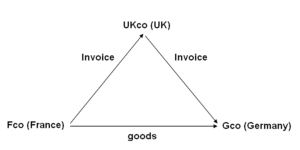
Triangulation is the term used to describe a chain of intra-EU supplies of goods involving three parties in three different Member States (MS). It applies in cases where, instead of the goods physically passing from one to the other, they are delivered directly from the first to the last party in the chain. Thus:

trig (2)In this example; a UK company (UKco) receives an order from a customer in Germany (Gco). To fulfil the order the UK supplier orders goods from its supplier in France (Fco). The goods are delivered from France to Germany.

Basic Treatment

Without simplification, UKco would be required to VAT register in either France or Germany to ensure that no VAT is lost.  That is; if registered in France, French VAT (TVA) would be charged to UKco, this would be recovered and the onward supply to Gco would be VAT free. The supply to Gco would be subject to acquisition tax in Germany.  VAT therefore is neutral to all parties.  Alternatively, UKco may choose to VAT register in Germany.  This would mean that it would be able to produce a German VAT number to Fco so to obtain the goods VAT free.  UKco would recover acquisition tax it applies to itself on the purchase and charge German VAT to Gco. Again, VAT is neutral to all parties.

Triangulation does away with these requirements.

To avoid creating a need for many companies to be structured in this way, Triangulation simplification was created via the EU VAT legislation (which is implemented across all MS) so, in this example, UKco is not required to register in any MS outside the EU.

Simplification

Under the simplification procedure Fco issues an invoice to UKco without charging VAT and quoting UKco’s VAT number. UKco, in turn, issues an invoice to Gco without charging VAT. The invoice is required to show the narrative “VAT Simplification Invoice Article 141 simplification”.  Gco should account for the purchase from UKco in its German VAT Return using the Reverse Charge mechanism. Details of the Reverse Charge here

The Conditions

EU VAT Directive 2006/112/EC, Article 141 sets out the conditions which must be met for Triangulation simplification to apply. Using the example above these may be summarised as:

  • There are three different parties (separate taxable persons) VAT registered in three different MS
  • The goods are transported directly from Fco to Gco
  • The invoice flow involves Fco selling the goods to UKco (the intermediate supplier)
  • UKco supplier in turn invoices its customer, Gco
  • UKco must obtain a valid VAT number from Gco (MS of destination) and quote this number on its invoice
  • UKco must quote “Article 141 simplification” on its invoice to Gco.

Impact on businesses

A business may be involved in triangulation as either:

  • the first supplier of the goods (Fco in the example above),
  • the intermediate supplier (UKco in the example above), or
  • the final consumer (Gco in the example above).

In whichever role, it is important to ensure all relevant details have been obtained and the documentation is correct.

And after Brexit?

As in many areas, we do not yet know how Brexit will affect the UK’s relationship with the EU. In general, the “worse” case scenario for UK business is that this simplification will be unavailable and all cross-border transactions will be treated as exports and imports similar to any other transactions with countries outside the EU and UK business will need to VAT register in one or more MS in the EU. This will add complexity and possibly delays at borders for goods moving to and from the UK. It is also likely to create additional cash flow issues.

In these uncertain times it makes sense to keep abreast of the (likely) changing requirements and take advantage of the simplification while it lasts.

VAT Latest from the courts – Employment businesses

By   21 March 2017

The Adecco case

In the Upper Tribunal (UT) case of Adecco the judge considered the tripartite situation between certain self-employed workers, employment businesses (Adecco) and the actual clients. Specifically, whether Adecco provides self-employed temporary workers to clients for the total consideration paid by client or only introductory services for commission retained by the employment business.  Broadly, whether temporary workers supply their services to Adecco or to the clients.

Background

Based on the Reed Employment Ltd v HMRC [2011] UKFTT 200 (TC) “Reed” case.  Reed also concerned the VAT treatment of supplies by an employment bureau in relation to the services of non-employed temps. The FTT in Reed concluded that the employment bureau was making supplies of introductory services to clients in respect of the placement of non-employed temps. The value of the introductory services was the commission charged to clients for the introduction of the temps and the employment bureau was only required to charge and account for VAT on its commission and not on the non-employed temps’ remuneration. Following Reed, Adecco made claims for repayment of the VAT which it had charged and accounted for in respect of payments representing the non-employed temps’ remuneration. HMRC rejected the claims. One of the reasons given for the rejection was that Adecco did not merely supply a service of introducing the non-employed temps to the clients but also supplied the non-employed temps’ services.

Decision

The UT found in favour of HMRC. It found that output tax is due on the full amount paid by the clients rather than the commission retained.  The full amount included earnings paid to the temporary workers.  The decision was based on the contracts in place in this instant case and it is possible that a different outcome would have occurred if a wider view was taken and/or if the relationship between contracts and economic reality had been considered.

Consequences

It is unlikely that this will be the definitive word on the matter and it is expected that further challenges to HMRC’s stance will be made given the two different outcomes in Reed and Adecco.  As always in these types of cases, it demonstrates the importance of contracts and careful consideration of the relationships between the parties.

For more on agent/principal relationships please see my articles on latest relevant court cases here and here

Please contact us if this case impacts on your business or that of your clients.

VAT Latest from the courts – Allocation of payments

By   13 March 2017

VAT payment problems

In the Upper Tribunal (UT) case of Swanfield Limited (Swanfield)

The matter was whether HMRC had the right to allocate payments made by the applicant to specific periods against the wishes of the taxpayer.

Background

Swanfield was late with returns/payments such that it was subject to the Default Surcharge (DS) mechanism.  Details of the DS regime here

HMRC issued DSs to Swanfield, many at the maximum rate 15%. The total involved was said to be over £290,000. However, if the payments made by Swanfield had been allocated in a certain way (broadly; to recent debts as desired by the taxpayer) it would have substantially reduced the amount payable. However, HMRC allocated the payments to previous, older periods which were not the subject of a DS.

The Issue

The issue was relatively straightforward; did HMRC have the authority to allocate payments as they deemed fit, or could the taxpayer make payments for specific periods as required?

The Decision

The UT found that Swanfield were entitled to allocate payments made to amounts which would become due on supplies made in the (then) current period, even though the due date had not yet arrived.  Additionally, HMRC did not have the authority to unilaterally allocate payments made by the taxpayer to historical liabilities as they saw fit, in cases where the taxpayer has explicitly made those payments in relation to current periods.  In cases where there is no specific instruction in respect of allocation of the payment, HMRC was entitled to allocate payment without any obligation to minimise DS. The UT remitted this case back to the First Tier Tribunal to decide, as a matter of fact, whether Swanfield had actually made the necessary allocation.

Commentary

This is a helpful case which sets out clearly the responsibilities of both parties.  It underlines the necessity of a taxpayer to focus on payments and how to manage a debt position to mitigate any penalties.  Staying silent on payments plays into the hands of HMRC. It is crucial to take a proper view of a business’ VAT payment position, especially if there is difficulties lodging returns of making payment. Planning often reduces the overall amount payable, or provides for additional time to pay (TTP).  A helpful overview of payment problems here

Things can be done if a business is getting into difficulties with VAT; whether they are; reporting, submitting returns, making payments, or if there are disputes with HMRC. There are also structures that may be put in place to assist with VAT cashflow.

We would always counsel a business not to bury its head in the sand if there are difficulties with HMRC.  Please make contact with us and, in almost all cases, we can improve the situation, along with providing some relief from worries. VAT may be payable, but there are ways of managing payments – as this case demonstrates.

VAT Latest from the courts – Evidence for zero rated exports

By   10 March 2017

In the First Tier Tribunal case of Grange Road Car Sales one of the main issues was the evidence required to satisfy HMRC that goods have actually left the UK (and, as exports, be zero rated). If a business cannot satisfy HMRC then the sales must be standard rated.  There are different levels of evidence required for different types of export, and this case is a handy reminder of the importance of having the correct documentation. I have briefly set out below the different requirements and would strongly advise that any business that exports, regularly or occasionally, to keep this situation under constant review. It is an area which is easy for HMRC to “pick off” transactions and to be “unsatisfied”…

The case

In this case the supplier of cars was based in Northern Ireland and purportedly exported cars to the Republic of Ireland. The purchasers were said to drive the cars over the land boundary.  In brief, the appeal was thrown out because both the evidence given in court and the documentation provided appears to have been woefully lacking; which is putting it politely. The case makes entertaining reading (if reading about VAT cases is your thing!). However, it does raise a serious point about exports.

An overview of export requirements

These requirements for exports are set out in Public Notice 703 (although in this case, as the supply was said to be intra-EU, the rules are set out in Public Notice 725). Not only are the requirements prescribed in detail, but they have the force of law (unlike a lot of HMRC’s published Notices).  Unless these conditions are met, it is not possible to treat an export as zero rated, even if a business knows that the goods have physically left the UK.

Proof of export

The section of the Notice covering evidence is mainly set out in paragraph 6.

Official evidence

Official evidence is produced by Customs systems, for example Goods Departed Messages (GDM) generated by NES.

Commercial transport evidence

This describes the physical movement of the goods, for example:

  • Authenticated sea-waybills
  • Authenticated air-waybills
  • PIM/PIEX International consignment notes
  • Master air-waybills or bills of lading
  • Certificates of shipment containing the full details of the consignment and how it left the EC, or
  • International Consignment Note/Lettre de Voiture International (CMR) fully completed by the consignor, the haulier and the receiving consignee, or Freight Transport Association own account transport documents fully completed and signed by the receiving customer

Photocopy certificates of shipment are not normally acceptable as evidence of export, nor are photocopy bills of lading, sea-waybills or air-waybills (unless authenticated by the shipping or airline).

Supplementary evidence

You are likely to hold, within your accounting system some, or all, of the following:

  • customer’s order
  • sales contract
  • inter-company correspondence
  • copy of export sales invoice
  • advice note
  • consignment note
  • packing list
  • insurance and freight charges documentation
  • evidence of payment, and/or
  • evidence of the receipt of the goods abroad.

You must hold sufficient evidence to prove that a transaction has taken place, though it will probably not be necessary for you to hold all of the items listed.

What must be shown on export evidence?

  • The evidence you obtain as proof of export, whether official or commercial, or supporting must clearly identify:
  • the supplier
  • the consignor (where different from the supplier)
  • the customer
  • the goods
  • an accurate value
  • the export destination, and
  • the mode of transport and route of the export movement

Vague descriptions of goods, quantities or values are not acceptable. An accurate value, for example; £50,000 must be shown and not excluded or replaced by a lower or higher amount.

How long must I retain export documentation?

To substantiate zero-rating a transaction you must make sure that the proof of export is:

  • kept for six years, and
  • made readily available to any visiting VAT Officer to substantiate the zero-rating of your exports

What happens if I do not hold the correct export evidence?

If you do not hold the correct export evidence, within the appropriate time limits, then the goods supplied become subject to VAT at the appropriate UK rate.

Additional, or different, evidence is required in the following cases:

  • The supply is to a recipient in the EU
  • Where the supplier does not arrange shipment of the goods
  • Where an overseas customer arranges his own export
  • Merchandise in baggage (MIB)
  • Groupage or consolidation transactions
  • Postal exports
  • Exports by courier and fast parcel services
  • Exports by rail
  • Exports through packers
  • Exports through auctioneers
  • Exports from Customs, Excise and/or Fiscal warehouses
  • Supplies to the Foreign and Commonwealth Office
  • Exports to the Channel Islands

This list is not exhaustive.

Summary

As may be seen, there is a degree of complexity here, and curiously, just waving a car off to a different country does not create, in itself, a zero rated export.

We are able to review a business’ export procedures to ensure that, as far as possible, HMRC is satisfied that goods have left the UK and that the correct documentation is held to evidence this.

Please contact us if this service is of interest.

Budget 2017 – VAT

By   8 March 2017

In today’s budget, the Chancellor of the Exchequer made the following announcements on VAT:

VAT Registration

The annual VAT registration limit has been increased from £83,000 to £85,000 in line with inflation.

The deregistration limit has been increased from £81,000 to £83,000.

Registration in respect of acquisitions from other Member States has also been increased to £85,000.

Notes:  The UK’s VAT registration threshold is the highest in the EU. Businesses trading below the threshold can choose to register voluntarily. This may be appropriate in order to recover input tax on purchases (where the addition of VAT on sales would not create issues).

It is understood that the increase in the threshold will prevent around 4,000 businesses from having to register for VAT by the end of the 2017 to 2018 financial year.

VAT: ‘Split Payment’ model

It was announced that: Some overseas traders avoid paying UK VAT, undercutting online and high street retailers and abusing the trust of UK consumers who purchase goods via online marketplaces. Building on the measures introduced in Budget 2016, the government will shortly publish a call for evidence on the case for a new VAT collection mechanism for online sales. This would harness technology to allow VAT to be extracted directly by the Exchequer from online transactions at the point of purchase. This is often referred to as a ‘Split Payment’ model. This is the next step in tackling the non-payment of VAT by some overseas traders selling goods online to UK consumers”.

Use and enjoyment provisions for business to consumer mobile phone services

The government will remove the VAT use and enjoyment provision for mobile phone services provided to consumers. The measure will bring those services used outside the EU within the scope of the tax. It will also ensure mobile phone companies can’t use the inconsistency to avoid UK VAT. This will bring UK VAT rules in line with the internationally agreed approach

Making Tax Digital for Business 

And that, in a nutshell, is all Philip Hammond had to say directly on VAT.  However, via the Making Tax Digital for Business (MTDfB) Policy Paper, it was announced that businesses, self-employed people and landlords will be required to start using the new digital service from:

  • April 2018 if they have profits chargeable to Income Tax and pay Class 4 National NICs and their turnovers are in excess of the VAT threshold
  • April 2019 if they have profits chargeable to Income Tax and pay Class 4 NICs and their turnovers are below the VAT threshold
  • April 2019 if they are registered for and pay VAT
  • from April 2020 if they pay Corporation Tax

Businesses, self-employed people and landlords with turnovers under £10,000 are exempt from these requirements.

It was further announced that a one year deferral from the mandating of MTDfB for unincorporated businesses and landlords with turnovers below the VAT threshold. This means that only those businesses with turnovers in excess of the VAT threshold with profits chargeable to Income Tax and that pay Class 4 NICs will be required to start using the new digital service from April 2018.

I suppose that we should be grateful that there were not too many changes to VAT announced (I’m sure there will be many more as a result of Brexit…….).