Tag Archives: cross-border

VAT – Overseas Holiday Lets; a warning

By   8 February 2016

It is important to understand the VAT consequences of owning property overseas. It may not be commonly known that the UK has the highest VAT threshold in the EC. This means that for many ‘sideline’ businesses such as; the rental of second or holiday properties in the UK, the owners, whether they are; individuals, businesses, or pension schemes, only have to consider VAT if income in relation to the property exceeds £82,000 pa. and this is only likely if a number of properties are owned.

However, other EC Member States have nil thresholds for foreign entrepreneurs meaning that if any rental income is received, VAT registration may be compulsory. Consequently, a property owner that rents out a property abroad will probably have a liability to register for VAT there. Failure to comply with the domestic legislation of the relevant Member State means; payment of back VAT and interest and fines being levied. It is also not a good idea to provoke the interest of overseas tax authorities. VAT registration however, does mean that a property owner can recover input tax on expenditure in connection with the property, eg; agent’s fees, repair and maintenance and other professional costs.  Such claims may be restricted if the home is used for own use.

It should be noted that, unlike other types of rental of homes, holiday lettings are always standard-rated. Also, the letting of holiday homes is always treated as a business activity unless lettings are very infrequent.  If lettings are a one-off or rare, evidence should be retained to evidence this fact.  There is no set number of times a property can be let before it is treated as a business, and the interpretation may differ between different Member States.  Details of taxable supplies and being in business here

Given that every EC Member State has differing rules to the UK, it is crucial to check all the consequences of letting property overseas.

A final word of warning; I quite often hear the comment “I’m not going to bother – how will they ever find out?”

If an overseas property owner based in the UK is in competition with local letting businesses, those businesses generally do not have any compulsion in notifying the authorities. In addition, I have heard of authorities carrying out very simple initiatives to see if owners are VAT registered. In many resorts, income from tourism is vital and this is a very important revenue stream for them so it is well policed.

Please contact us for further details. We have experience in dealing with overseas VAT matters on our clients’ behalf.

UK VAT Registration For Overseas Businesses – A Guide

By   5 January 2016

2013-12-01 Bury St Eds Xmas Fair0018 (2)When must an overseas business register for VAT in the UK?

This question is increasingly being asked by overseas entities which do business in the UK.  So what are the requirements, and what choices are there?

 Compliance

An overseas business must VAT register in the UK if:

 • it makes any taxable supplies of goods and services in the UK in the course of furtherance of his business. These supplies could be of any description, but commonly are the sale of goods which are physically located in the UK and the operation of certain events that take place in the UK.

• the business is registered for VAT in another EC country, and it sells and delivers goods in the UK to customers who are not VAT-registered;so-called ‘distance sales’  (details here) and the value of those distance sales exceeds the relevant threshold (currently £70,000).

• it acquires goods in the UK directly from a VAT-registered supplier in another EC country and the total value of the acquisitions exceeds the acquisitions threshold.

• it makes a claim under the EC 8th Directive or EC 13th Directive and subsequently supplies the relevant goods in the UK.

If these tests are met, a supply is made in the UK. It does not matter in which country where the business “belongs” or where it’s staff or technical resources are located.  A guide to the place of belonging  here.

For VAT purposes, the UK includes the territorial sea of the UK (ie waters within twelve nautical miles of the coastline).

There is no need to register if the only UK supplies are those on which the customer is liable to account for any VAT due under the ‘reverse charge’ procedure.

An overseas trader may also be registered if:

• he has started in business but is not yet making taxable supplies, provided he can show the intention of making taxable supplies in the future as part of his business; or

• his turnover is below the threshold, provided he can prove to HMRC that he is carrying on a business for VAT purposes and making taxable supplies.

Consequences of registration

An overseas business which is registered or required to be registered for VAT in the UK must account for VAT in respect of those supplies and acquisitions taking place in the UK. It is also liable to VAT on imports of any goods into the UK and on the acquisition in the UK of excisable goods or of new means of transport from another EC country. It also usually means that any VAT incurred in the UK may be recovered as input tax. This is particularly relevant if import VAT is incurred on importing goods into the UK.

Registration options available 

An overseas trader who is not normally resident in the UK, does not have a UK establishment and, in the case of a company, is not incorporated here, and which is required or entitled to be registered in the UK can normally choose between three registration options:

(1) It may appoint a VAT representative who will be jointly and severally liable for any VAT debts. The overseas trader must still complete a VAT registration form. In addition to this, both the overseas trader and the VAT representative must complete a Form VAT 1TR. It is understood that, in practice, very few businesses are prepared to provide the services of a VAT representative because they are unwilling to become liable for any VAT debts of the overseas trader.

(2) It may appoint an agent to deal with the VAT affairs. The agent cannot be held responsible to HMRC for any VAT debts and HMRC reserve the right not to deal with any particular agent. (In some cases, HMRC could insist that a tax representative is appointed although this cannot now be done where the overseas trader is based in a country where certain mutual assistance arrangements exist.) The overseas trader must still complete a VAT registration form. In addition, HMRC will need a letter of authority. A suggested letter of authority approved by HMRC is:

(Insert principal’s name) of (insert principal’s address) hereby appoints (insert name of UK agent or employee) of (insert address of UK agent or employee) to act as agent for the purpose of dealing with all their legal obligations in respect of Value Added Tax. 

This letter authorises the above-named agent to sign VAT return forms 100 and any other document needed for the purpose of enabling the agent or employee to comply with the VAT obligations of the principal. 

Signed (insert principal’s signature) 

Date (insert date) 

(3) It may deal with all the VAT obligations (including registration, returns and record-keeping) itself. To register, the overseas business should contact the Aberdeen VAT office at Ruby House, 8 Ruby Place, Aberdeen, AB10 1ZP (Tel: 01224 404807/818). This is known as a Non-Established Taxable Person (NETP) registration.

Summary

There can be confusion around this matter, not only from a technical aspect, but with an overseas business’ unfamiliarity with the UK authority’s requirements and also possibly language and communication problems.  Additionally, the practical aspects of identifying the need to VAT register in the UK and the completion of forms etc can delay matters.  Of course, just like any other VAT registration, there are penalties for not registering, or not registering at the appropriate time.  There is also the reluctance of certain overseas businesses to deal with UK VAT at all.  Unfortunately, a head in the sand attitude just stores up problems for the future.  We have been called on to firefight on this topic a number of times, and it rarely ends well.

VAT – Well, it is christmas…

By   7 December 2015

Dear Marcus 2013-12-01 Bury St Eds Xmas Fair0072

My business, if that is what it is, has become large enough for me to fear that HMRC might take an interest in my activities.  May I explain what I do and then you can write to me with your advice?  If you think a face to face meeting would be better I can be found in most decent sized department stores from mid September to 24 December.

First of all I am based in Greenland but I do bring a stock of goods, mainly toys, to the UK and I distribute them.  Am I making supplies in the UK?

The toys are of course mainly for children and I wonder if zero rating might apply?  I have heard that small T shirts are zero rated so what about a train set – it is small and intended for children. Does it matter if adults play with it?

My friend Rudolph has told me that there is a peculiar rule about gifts.  He says that if I give them away regularly and they cost more than £150 I might have to account for VAT.  Is that right?

My next question concerns barter transactions.  Dads often leave me a food item such as a mince pie and a drink and there is an unwritten rule that I should then leave something in return.  If I’m given Tesco’s own brand sherry I will leave polyester underpants but if I’m left a glass of Glenfiddich I will be more generous and leave best woollen socks.  Have I made a supply and what is the value please?  My feeling is that the food items are not solicited so VAT might not be due and, in any event; isn’t food zero-rated, or is it catering? Oh, and what if the food is hot?

Transport is a big worry for me.  Lots of children ask me for a ride on my airborne transport.  I suppose I could manage to fit 12 passengers in.  Does that mean my services are zero-rated?  If I do this free of charge will I need to charge air passenger duty?  Does it matter if I stay within the UK?  My transport is the equivalent of six horse power and if I refuel with fodder in the UK will I be liable for fuel scale charges?  After dropping the passengers off I suppose I will be accused of using fuel for the private journey back home.  Somebody has told me that if I buy hay labelled as animal food I can avoid VAT but if I buy the much cheaper bedding hay I will need to pay VAT.  Please comment.

Can I also ask about VAT registration?  I know the limit is £82,000 per annum but do blips count?  If I do make supplies at all, I do nothing for 364 days and then, in one day (well night really) I blast through the limit and then drop back to nil turnover.  May I be excused from registration?  If I do need to register should I use AnNOEL Accounting?  At least I can get only one penalty per annum if I get the sums wrong.

I would like to make a claim for input tax on clothing.  I feel that my red clothing not only protects me from the extreme cold but it is akin to a uniform and should be allowable.  These are not clothes that I would choose to wear except for my fairly unusual job.  If lady barristers can claim for black skirts I think I should be able to claim for red dress.  And what about my annual haircut?  That costs a fortune.  I only let my hair grow that long because it is expected of me.

Insurance worries me too.  You know that I carry some very expensive goods on my transport.  Play Stations, Mountain Bikes, i-pads and Accrington Stanley replica shirts for example.  My parent company in Greenland takes out insurance there and they make a charge to me.  If I am required to register for VAT in England will I need to apply the reverse charge?  This seems to be a daft idea if I understand it correctly.  Does it mean I have to charge myself VAT on something that is not VATable and then claim it back again?

Next you’ll be telling me that Father Christmas isn’t real……….

VAT – Where do I belong?!

By   16 November 2015
The concept of “belonging” is very important in VAT as it determines where a supply takes place and thus the rate applicable and the country in which is due. (The so-called “Place Of Supply, or POS). It is necessary, for most supplies, to establish where both the supplier, and the recipient belongs. Because this is a complex area of VAT it is not difficult to be overpaying tax in one country, not paying tax where it is properly due, or missing the tax issue completely. 

A relevant business person `belongs’ in the relevant country. A `relevant country’ means:

  •  the country in which the person has a business establishment, or some other fixed establishment (if it has none in any other country);
  •  if the person has a business establishment, or some other fixed establishment or establishments, in more than one country, the country  of the relevant establishment (ie; the establishment most directly concerned with the supply); and
  •  otherwise, the country of the person’s usual place of residence (in the case of a body corporate, where it is legally constituted).

A person who is not a relevant business person `belongs’ in the country of his usual place of residence. The `belonging’ definition applies equally to the recipient of a supply, where relevant.

Business establishment is not defined in the legislation but is taken by HMRC to mean the principal place of business. It is usually the head office, headquarters or ‘seat’ from which the business is run. There can only be one such place and it may take the form of an office, showroom or factory.

Fixed establishment is not defined in the legislation but is taken by HMRC to mean an establishment (other than the business establishment) which has both the technical and human resources necessary for providing and receiving services on a permanent basis. A business may therefore have several fixed establishments, including a branch of the business or an agency. A temporary presence of human and technical resources does not create a fixed establishment in the UK.

Usual place of residence. A body corporate has its usual place of residence where it is legally constituted. The usual place of residence of an individual is not defined in the legislation. HMRC interpret the phrase according to the ordinary usage of the words, ie; normally the country where the individual has set up home with his/her family and is in full-time employment. An individual is not resident in a country if only visiting as a tourist.

More than one establishment. Where the supplier/recipient has establishments in more than one country, the supplies made from/received at each establishment must be considered separately. For each supply of services, the establishment which is actually providing/receiving the services is normally the one most directly connected with the supply but all facts should be considered including

  •  for suppliers, from which establishment the services are actually provided;
  •  for recipients, at which establishment the services are actually consumed, effectively used or enjoyed;
  •  which establishment appears on the contracts, correspondence and invoices;
  •  where directors or others who entered into the contract are permanently based; and
  •  at which establishment decisions are taken and controls are exercised over the performance of the contract.

However, where an establishment is actually providing/receiving the supply of services, it is normally that establishment which is most directly connected with the supply, even if the contractual position is different.

VAT groups

A VAT group is treated as a single entity. This also applies when applying the ‘place of belonging’. As a result, a group has establishments wherever any member of the group has establishments.

This is an area which often leads to uncertainty, and therefore VAT issues.  It is also an area where VAT planning may; save time, resources and avoid unexpected VAT costs, either in the UK or another country.

For more on our International Services

VAT Distance Selling – avoidance structure now deemed ineffective

By   26 October 2015

The EC Commission’s VAT Committee has recently issued new guidelines to counter perceived avoidance of registering for Distance Selling by businesses.

In cases where the supplier is responsible for the delivery of goods B2C; typically mail-order and increasingly goods purchased online (so called “delivered goods”) the supplier is required to VAT register in the EC Member State of its customer(s) once a certain threshold is met. For full details of Distance Selling see here.

In order to avoid having to register, some business have sought to avoid their supply falling within the definition of delivered goods by splitting the sale of goods and the delivery.

The UK raised concerns about the planning and structures put in place to obviate the need to register in other EC Member States.  The VAT Committee has recognised these concerns and has today issued new guidelines on Distance Sales

In addition to the current rules (set out in Articles 32, 33 and 34 of the Principal VAT Directive) a Distance Sale will have occurred when goods have been “dispatched or transported by or on behalf of the supplier” in any cases where the supplier “intervenes directly or indirectly in the transport or dispatch of the goods.” The Committee has stated that it considers that the supplier shall be regarded as having intervened indirectly in the transport or dispatch of the goods if any of the following conditions apply:

(i)              The transport or dispatch of the goods is sub-contracted by the supplier to a third party who delivers the goods to the customer.

(ii)            The dispatch or transport of the goods is provided by a third party but the supplier bears totally or partially the responsibility for the delivery of the goods to the customer.

(iii)          The supplier invoices and collects the transport fees from the customer and further remits them to a third party that arranges the dispatch or transport of the goods.

The Committee further clarified that, in other cases of “intervention,” in particular where the supplier actively promotes the delivery services of a third party to the customer, puts the customer and the third party in contact and provides to the third party the information needed for the delivery of the goods, the seller should likewise be regarded as having “intervened indirectly” in the transport or dispatch of the goods.

Note: These guidelines issued by the VAT Committee are merely views of an advisory committee, they do not constitute an official interpretation of EC law and therefore do not bind the Commission or the Member States. However, the Committee’s views are highly influential and it is likely that Member States will review their procedures and implement these guidelines.

Distance Selling VAT registration can apply retrospectively and assessments and penalties for late registration and underdeclaration of VAT are likely. Also, with different VAT rates applicable in different Member States even if VAT has (incorrectly) been charged at the rate applicable in the Member State where the supplier belongs (rather than the customer) this will likely be at the incorrect rate and recovery of this incorrectly paid VAT will also create issues.

Please contact us if the above changes will affect your business as action must be taken immediately.

VAT – Trading in Bitcoin ruled exempt by ECJ

By   22 October 2015

VAT – Trading in Bitcoin ruled exempt by ECJ

Further to my article of 13 March 2014 here

The European Court of Justice (ECJ), the highest court of appeal for EC matters, has ruled that trading in digital, such as bitcoin, is exempt. this is on the basis that they are a method of payment with no intrinsic value, like goods or commodities.  They are therefore covered by the exemption relating to “currency, bank notes and coins used as legal tender” – (Article 135 (1) of the VAT directive). 

This confirms that the UK authority’s approach is correct and that the VAT treatment applied in Germany, Poland and Sweden where those authorities treated the relevant transactions as subject to VAT, is erroneous.

This is good news for the UK as it is a big (if not the biggest) player in the bitcoin sector.

Changes to the treatment of cross-border movement of goods from 1 May 2016

By   8 October 2015

How will goods cross EC borders post UCC? 

HMRC has updated its guidance notes on the Union Customs Code (UCC) which is being introduced across the EC on 1 May 2016.

Details here

Main points

  • The UCC is a revision of the Modernised Customs Code (MCC) and there will be a number of changes to how goods cross EU borders.
  • Some transitional arrangements will operate until 2020.
  • Mandatory guarantees for most special procedures and temporary storage (TS) – this only applies to new authorisations.
  • The ability to make some movements under TS rather than national transit or Electronic Transit System (ETS) – formerly New Computerised Transit System (NCTS).
  • The removal of the earlier sales provisions relating to valuation – but there are some transitional arrangements.
  • All communications between customs authorities and economic operators must be electronic.
  • Valuation: The earlier sale facility will be withdrawn and replaced by a last sale only rule. 
  • Under the UCC there will be some circumstances where the provision of a guarantee is mandatory.
  • Royalties and licence fees – Currently, for a royalty fee to be liable to duty it must: relate to the imported goods, and be paid as a condition of sale of those imported goods. Under the UCC, royalties and licence fees will generally be paid as a condition of the sale of the goods and should be included in the customs value.

Some procedures and reliefs will cease or change on 30 April 2016, these are:

  • The €10 waiver of customs duty for free circulation customs declarations – where customs duty is payable no de-minimis exemption will apply – this doesn’t affect any Community System of Duty Reliefs (CSDR) duty reliefs.
  • Goods being declared to Onward Supply Relief (OSR) can only be entered using a full customs declaration or the Simplified Declaration Procedure (SDP).
  • The use of Information Sheets for Special Procedures (INF) documents with an Entry in Declarant’s Records (EIDR).
  • Inward Processing Drawback (IP (D)) and Low Value Bulking Imports (LVBI) authorisations will no longer be valid and these authorisations can’t be used to import goods regardless of any expiry dates shown on your authorisations.
  • Processing under Customs Control (PCC) authorisation holders will be given an Inward Processing (IP) authorisation number which must be used for new importations after 30 April 2016.
  • Type D customs warehousing authorisation holders will be given a new authorisation number with a prefix of C (for type D authorisation), or E (for a type E warehouse with type D rules of assessment) – these must be used for entries to customs warehouses after 1 May 2016, the normal debt rules of assessment will apply.
  • Goods being declared to LVBI will only be entered using an SDP authorisation.

System changes

HMRC expects that some changes to economic operators’ systems will be needed. However this will depend on which authorisations are held and what procedures or processes individual businesses use. A plan for the major IT changes is already in place.

Economic Operator Registration and Identification (EORI)

There are no changes to the EORI process. It is a requirement for all economic operators (such as businesses) involved in international trade to be registered and to have an EORI number. You’ll need to have an EORI number to be able to apply for any customs authorisations, approvals or decisions. For details on EORI see here

VAT – Proof of evidence of Intra-EC supplies

By   23 September 2015

A B2B supply of goods from one Member State to another (a dispatch) is VAT free (with the recipient dealing with acquisition tax in the Member State of receipt). However, in order to VAT free treatment to apply evidence that the goods have moved cross-border must be provided and satisfy the authorities in the Member State of dispatch.

The level of evidence and type of documents required to support the right to VAT free treatment varies significantly between Member States. This has led to confusion and difficulties for businesses.

As a result the EC VAT Expert Group* have, this week, produced a paper (paper 46) named “‘Proof of evidence of Intra-EU supplies’” Here: 46 – Proof of IC Supplies

As well as identifying the wide discretion afforded to Member States as to the type of documents required, it notes that this discretion and lack of clarity often leads to disproportionate compliance burdens for businesses involved in the cross border supply of goods. This also results in the fundamental principle of fiscal neutrality and the free movements of goods being impaired.

In summary

 The Group’s findings may be summarised:

  •  Diversity of documentation

Most Member States rely on a myriad of documents which may not be listed in national legislation. Such diversity is a problem and may require businesses to provide documentary evidence that cannot be reasonably obtained. This practice does not reconcile with principles established by the ECJ. The paper adds that tax authorities tend to focus on certain formalities and not permit alternative evidence.

  •  Local initiatives

The paper notes that based on Article 131 of the VAT Directive, and often in light of the fight against fraud, tax authorities are introducing local initiatives. The compatibility of these with the EC framework may be questioned and is causing increasing burdens and costs on legitimate taxpayers.

  •  Importance given by tax authorities to the “knowledge test”

The paper considers that the level of demand from tax authorities to document intra-EC trade should not be upgraded because of fraud cases. Documentary evidence is of a type fraudsters would typically provide. The wide margin of interpretation left to tax authorities and judges regarding concepts such as “good faith” means that further guidance may be required. This, however, should not extend up to a requirement for suppliers to show evidence to authorities that their customers acted in good faith.

  •  Diversity of practices; timing versus legal certainty

The diversity of approaches across EC Member States generates costs and increase risks for businesses operating in different Member States.

Conclusion

The paper considered some recent ECJ case law on cross-border transactions and concluded VAT free treatment should be granted to the supplier when:

1)    It demonstrates that the transaction meets the substantive criteria of that provision, namely that it is entered into with another taxable person in a Member State other than that in which dispatch or transport of the goods begins. This would be done with the supplier holding at least three non-contradictory documents or elements certifying the transport or dispatch to another Member State.

2)    In this context, a reasonable customer assessment could be expected from taxpayers when tax authorities audit whether the transactions are taking place in the context of fraud and/or abuse.

Next Steps

It is recommended that new guidance could be adopted in an Implementing Regulation or an explanatory note to the relevant Articles in the VAT Directive could be prepared by the Commission.

It will be interesting to see if these recommendations are adopted.  It would make life a lot more straightforward for businesses who trade cross-border in the EC.  Although the UK has one of the most practical regimes in this respect, even genuine movements of goods from the UK can result in an unexpected and unwelcome VAT charge because of a lack of specific documentation.

* The VAT Expert Group assists and advises the European Commission on VAT matters. Details here 

I have to charge myself VAT?!

By   1 July 2015

I have to charge MYSELF VAT?!

How comes?!

Well, normally, the supplier is the person who must account to the tax authorities for any VAT due on the supply. However, in certain situations, the position is reversed and it is the customer who must account for any VAT due. Don’t get caught out!

Here are just some of the situations when you have to charge yourself VAT:

Purchasing services from abroad

These will be obtained free of VAT from an overseas supplier. What is known as the ‘reverse charge’ procedure must be applied. Where the reverse charge procedure applies, the recipient of the services must act as both the supplier and the recipient of the services. On the same VAT return, the recipient must account for output tax, calculated on the full value of the supply received, and (subject to partial exemption and non-business rules) include the VAT charged as input tax. The effect of the provisions is that the reverse charge has no net cost to the recipient if he can attribute the input tax to taxable supplies and can therefore reclaim it in full. If he cannot, the effect is to put him in the same position as if had received the supply from a UK supplier rather than from one outside the UK. Thus creating a level playing field between purchasing from the UK and overseas.

Accounting for VAT and recovery of input tax.
Where the reverse charge procedure applies, the recipient of the services must act as both the supplier and the recipient of the services.  On the same VAT return, the recipient must
      1. account for output tax, calculated on the full value of the supply received, in Box 1;
      2. (subject to partial exemption and non-business rules) include the VAT stated in box 1 as input tax in Box 4; and;
      3. include the full value of the supply in both Boxes 6 and 7.
Value of supply: The value of the deemed supply is to be taken to be the consideration in money for which the services were in fact supplied or, where the consideration did not consist or not wholly consist of money, such amount in money as is equivalent to that consideration.  The consideration payable to the overseas supplier for the services excludes UK VAT but includes any taxes levied abroad.
Time of supply: The time of supply of such services is the date the supplies are paid for or, if the consideration is not in money, the last day of the VAT period in which the services are performed.

Purchasing goods from another EC Member States

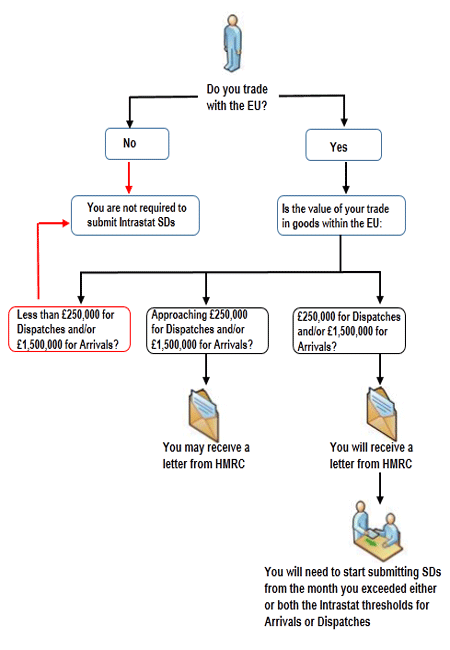
Something similar to reverse charge; called acquisition tax, applies to goods purchased from other EC Member States. These are known as acquisitions (they are imports if the goods come from outside the EC and different rules apply). The full value of the goods is subject to output tax and the associated input tax may be recovered by the business acquiring if the goods are used for taxable purposes. If you‘re not already registered for VAT in the UK and acquire goods worth £82,000 or more in the UK from other EC countries, you will have to register for VAT in the UK on the strength of the value of the acquisition tax. A business will also have to complete an Intrastat Supplementary Declaration (SDs) if its acquisitions of goods from the EC exceed an annual amount – currently £1.5 million.

Intrastat_flow_diagramMore details on Intrastat Supplementary Declarations here

Deregistration

Any goods on hand at deregistration with a total value of over £1,000 on which input tax has been claimed are subject to a self supply. This is a similar mechanism to a reverse charge in that the goods are deemed to be supplied to the business by the business and output tax is due. However, in these circumstances it is not possible to recover any input tax on the self supply.

Flat Rate Scheme

There is a self supply of capital items on which input tax has been claimed when a business leaves the flat rate scheme (and remains VAT registered).

Mobile telephones

In order to counter missing trader intra-community fraud (‘MTIC’), supplies of mobile ‘phones and computer chips which are made by one VAT registered business to another and valued at £5,000 and over are subject to the reverse charge. This means that the purchaser rather than the seller is responsible for accounting for VAT due.

Land and buildings…. and motor cars

There are certain circumstances where land and buildings must be treated as a self supply… but that is a whole new subject in itself… as is supplies in the motor trade.

Even if the result of a self-supply or reverse charge is VAT neutral HMRC is within its rights to assess and levy penalties and interest in cases where the charge has not been applied; which always seems unfair.  However, more often than not simple accounting entries will deal with the matter…. if the circumstances are recognised and it is remembered to actually make the entries!

VAT on Crowdfunding?

By   28 May 2015

The EC is has begun an investigation into whether VAT should apply to crowdfunding activities.

An alternative is for the Commission to consider whether crowdfunding should be covered by the exemption for financial services.  In my view this seems unlikely.

So what could the outcome be if VAT is applicable to crowdfunding?  Well, a large number of UK projects will face a 20% VAT liability on investor returns. This is especially relevant to the popular “rewards crowdfunding”, where payments by investors are made in return for products or services to be developed as a result of the fundraising. These rewards projects may include; films, albums, or software development, which are offered “free” or at a reduced rate. It would appear that in these cases, consideration is flowing in both directions.

The Commission may also decide that crowdfunding intermediary services offered by many platforms will become liable to VAT.

The current position is that the Commission has now referred the question of crowdfunding to the EU VAT Committee.

More on this subject as soon as we have it.