
Tag Archives: partial-exemption

New VAT Group rules

By   6 November 2019

Changes to VAT Group rules – an increased opportunity

From 1 November 2019 the rules for VAT grouping have changed.

What is a VAT group?

A VAT group allows two or more entities to account for VAT under a single registration number with one of the corporate bodies in the group acting as the representative member.

The group is registered in the name of that representative member, who is responsible, on behalf of all of the other members of the group, for completing VAT returns and paying and reclaiming VAT.

All supplies of goods and services made by any member of the group to a third party outside the group are treated as having been made by the representative member. Similarly, any supply of goods or services made by a third party outside the group to any member of the group is treated as having been made to the representative member.

Supplies of goods or services between group members are not subject to VAT and a single VAT return will be completed each period for the entire group, as opposed to separate businesses submitting individual returns.

The changes

Prior to 1 November, only bodies corporate were able to form a VAT group (mainly companies and LLPs). From the beginning of this month, VAT grouping is additionally available for all entities, including; partnerships, sole traders and trusts in certain cases.

Eligibility

Via existing legislation, grouping is permitted if the control tests are passed. Bodies corporate can form a VAT group if:

  • each is established or has a fixed establishment in the UK
  • they are under common control

(There are additional tests for certain ‘specified bodies’ set out in Notice 700/2 para 3.2)

‘Control’ has a specific meaning based on the definition of holding company and subsidiary in section 1159 of and Schedule 6 to the Companies Act 2006.

New changes to eligibility

Non-corporate entities such as individuals and partnerships can now join a VAT group if they meet all of the following conditions:

  • they are established, or have a fixed establishment in the UK
  • they can demonstrate that they control all of its body corporate subsidiaries in the group. The test will apply assuming the non-corporate entity would pass the test if it was a corporate body, eg; usually meaning 51% or more of share capital in the relevant company/companies
  • they can demonstrate that they are entitled to VAT register independently of any other business (the distinction here is that a body corporate may be included in a VAT group if it is not trading, nor intends to trade)

The current eligibility to group is set out at VAT Act 1994, Section 43A and has been updated with a new section 43AZA which includes the new changes.

VAT Group pros and cons

So, would it be beneficial to VAT group entities? I set out here the pros and cons for businesses.

  Pros

  • only one VAT return per quarter – less administration
  • no VAT on supplies between VAT group members.
  • no need to invoice etc or recognise supplies on VAT returns
  • likely to improve partial exemption position if exempt supplies are made between group companies.
  • likely to improve input tax recovery if taxable supplies are made to partly exempt group companies
  • may provide useful planning opportunities/convenience at a later date.

Cons

  • all members of the group are jointly and severally liable for any VAT due
  • only one partial exemption de-minimis limit for group
  • obtaining all relevant data to complete one return may take time thus increasing the potential for missing filing deadlines
  • a new VAT number is issued
  • assessments can be issued to the representative member relating to earlier periods when it was not the representative member and even when it was not a member of the group at that time
  • the limit for voluntary disclosures of errors on past returns applies to the group as a whole (rather than each company having its own limit)
  • payments on account limits apply to the group as a whole.  This applies to a business whose VAT liability is more than £2million pa.  Please see HMRC Reference: Notice 700/60 details here
  • may detrimentally affect partial exemption position if a partly exempt company makes taxable supplies to a fully taxable group company

Planning

If you think that there is a potential advantage for you, or your clients’ business, in VAT grouping, please contact us to discuss the VAT position.
VAT: Extent of welfare exemption – The Lilias Graham Trust case

By   3 October 2019

Latest from the courts

Certain welfare services are exempt from VAT via VAT Act 1994, Schedule 9, Group 7, Item 9 – services which are directly connected with the care or protection of children. In the The Lilias Graham Trust (LGT) First Tier Tribunal case, the scope of the exemption was considered.

Background

LGT, which has charitable status, operated residential assessment centres, which supported parents (many of whom had mental health issues) in learning how to care for their children.

It was common ground that LGT’s services were as summarised in a letter from Glasgow City Council (where relevant):

  • LGT is an assessment centre providing assessment services on the parenting capacity of those referred to the service
  • The assessment services cover families where there is an uncertainty about whether the parent(s) can safely look after their children
  • LGT is simply acting as an observer watching the parent’s care for their own children and providing information in the form of advice
  • LGT is not providing any treatment in the form of medical care for any illness or injury
  • LGT’s recommendation following the assessment provides a recommendation to social workers around whether the parent(s) has sufficient capacity to keep their child safe and healthy
  • GCC viewed the residential accommodation as a fundamental part of the provision of the assessment services on the parenting capacity of those families which were referred to LGT.

Although the major part of LGT’s income came from the Local Authority fees, it is also subsidised to a degree by grants and donations.

Technical

In this case the odd position was that HMRC was arguing for exemption because, in learning how to care for their children, the services were “closely linked” to welfare services or “directly connected” to them as provided for by the Principal VAT Directive and the VAT Act in turn.

LGT contended that their supplies to a Local Authority (which could recover any VAT charged) were taxable as they did not fall within the welfare definition. LGT admitted that there was a causal relationship between the services provided and the care and protection of children, but the connection was too remote to be deemed to be a direct connection – There were several intervening factors and intermediaries between the service provided and the care and protection of children.

At issue was net input tax of circa £400,000 which would be recoverable by LGT if its supplies were taxable, but not if they were exempt. Guide to partial exemption here.

Decision

The court found that the essential purpose of the supplies made by LGT was to ensure that the child was better cared for and had optimal protection. That is precisely why the Local Authority employed LGT. Its supplies are both closely linked and directly connected with the protection of children as also to their care. Accordingly, the appellant made supplies of welfare services which are exempt from VAT. The fact that LGT provided its services to the Local Authority rather than the parents did not mean that its services should be taxable. Therefore, there was no output tax chargeable to the Local Authority and no input tax recovery by LGT on expenditure attributable to those exempt supplies.

Commentary

In this case, HMRC originally ruled that the services were taxable and LGT were required to VAT register, it even issued a late registration penalty. HMRC clearly subsequently changed its view which put input tax which LGT had recovered at risk. There are often disputes on the extent of the exemption, and sometimes debates on whether a service is supplied, or simply staff providing their services. It is important to understand these sometimes subtle differences as getting it wrong can be costly, as LGT found out.

VAT: Land and property quiz – Answers

By   1 August 2019

The “fun” quiz.

The important thing to consider is what the purchaser does, or intends to do, with the land once purchased. This will dictate the input tax recovery position. So, can the input tax be recovered? Answers to quiz questions in the 26 July 2019 post below

Answers 

On the purchased land the person constructs:

  1. a dwelling and supplies the house on a 25-year lease

Yes

The lease is 21 years or over, so it is zero rated. However, a lease under 21 years would be an exempt so no recovery. For more details

  1. an office and uses it for his own business supplying FS to a client in China

Yes

However, if the FS supply had been to the UK or another EU Member State, the supply would be exempt so no input tax recovery. This may change in the event of a No-Deal Brexit.

  1. a storage facility and a fully taxable company leases it to another company in the same partly exempt VAT group after opting to tax

No

Unlikely to be full input tax recovery as the VAT group is itself partly exempt. The Capital Goods Scheme (CGS) may apply.

  1. a block of ten flats with a gym and swimming pool which tenants are entitled to use. Grants 99 years leases on all flats

Yes

The supply is zero rated, notwithstanding there are additional (to usual residential dwellings) facilities.

  1. a dwelling but uses it for short term holiday lets of no more than a fortnight.

Yes

Holiday lets are standard rated, so the business would be taxable. The purchaser would need to VAT register, however.

  1. a warehouse which is sold on completion but without an option to tax being made before the sale

Yes

A ‘new” commercial building (one under three years old) is mandatorily standard rated, so no option to tax is required.

  1. the land is held with the intention of constructing dwellings at some time in the future, which could be over six years

Yes

As long as the intention remains, and can be evidenced, the input tax may be attributed to the future taxable, zero rated, supply.

  1. a factory which is not subjected to an option to tax but is leased to an US company

 No

The place of supply (POS) is the UK as this is where the immovable property is located, regardless of the status of the client. Consequently, this is an exempt supply with no right to input tax recovery.

  1. a block of three flats which are rented for six months before freehold sale

No, or maybe, or yes

The initial supply is exempt, so the input tax is, preliminarily, attributed to the short term lets. However, a simplified form of the partial exemption de minimis limits may be used and, depending on the scale of the development, it is possible that some, or all, of the input tax may be recovered despite the initial exempt supplies.

  1. a sport hall by a school Academy which is leased to sporting charities and also used for its own educational purposes. No option to tax

No

It would be unlikely that an Academy would be able to recover all the input tax. Because it would make (exempt) business supplies, this would fall outside the VAT Act 1994, Section 33 rules, so there would be no input tax recovery in respect of those activities. There would be an apportionment and only the input tax referable to own use would be recoverable as those supplies of education would be non-business. If the Academy opted to tax the facilities (and was VAT registered), the input tax would be recoverable in full. No input tax referable to business use would be possible if the Academy was using VAT126 claims. VAT and Academies

  1. a manufacturing plant which a company rents to a connected (non-VAT grouped) party which makes and sells toys. The option is taken

Yes

As the connected party is fully taxable the anti-avoidance rules do not apply. If the connected party was not able to recover the VAT charged to it (say it made exempt supplies) the anti-avoidance legislation would kick in and the option would be disapplied, meaning that the input tax in the hands of the developer would not be recoverable.

  1. a car showroom and offices which a company uses for its own business of selling cars, providing finance and brokering insurance

No

There would be mixed use; car sales are taxable, finance and insurance are exempt, so some of the input tax would probably not be recoverable (dependent upon the de minimis limits). The development would be an overhead of the business. It is likely that the property would be an item covered by the CGS.

  1. a care home for the elderly which a company uses for that purpose

No

This likely be an exempt supply, so no input tax recovery on supplies which are properly VATable. There may be reliefs on construction costs, however.

  1. a small cabin office and the remaining land is used for a forestry business which will have no sales for ten years (when the trees are grown)

Yes

Although the intended taxable supplies are some way off, as long as the intention can be evidenced, the input tax may be recovered when incurred as it will relate to those intended taxable transactions. If the intention changes, this may impact the initial recovery. More information

  1. a residential block which is immediately transferred to an associated company (an arm’s length transaction) on completion. No tenants are in situ.

Yes

The transfer of the freehold triggers the zero rating. The associated company may then, if it chooses, make exempt supplies without a VAT cost. This type of planning can be very helpful.

So there we have it. How did you get on?  I would say that any score over eight is very good.

VAT: Land and property – A “fun” quiz

By   26 July 2019

VAT: Land and property

I am quite often asked the seemingly straightforward question: Can I recover VAT on this land purchase? So, by way of a little quiz, I look at why this can be a loaded question.

Background

A person purchases bare land in the UK for £450,000 which is subjected to the option to tax. So, VAT of £90,000 is incurred. Your task, should you wish to accept it, is to say yes, no, or maybe to input tax recovery in the following situations (assume the purchaser is VAT registered).

Questions

On the purchased land the person constructs:

  1. a dwelling and supplies the house on a 25-year lease
  2. an office and uses it for his own business supplying FS to a client in China
  3. a storage facility and a fully taxable company leases it to another company in the same partly exempt VAT group after opting to tax
  4. a block of ten flats with a gym and swimming pool which tenants are entitled to use. Grants 99 years leases on all flats
  5. a dwelling but uses it for short term holiday lets of no more than a fortnight.
  6. a warehouse which is sold on completion but without an option to tax being made before the sale
  7. the land is held with the intention of constructing dwellings at some time in the future, which could be over six years
  8. a factory which is not subjected to an option to tax but is leased to an US company
  9. a block of three flats which are rented for six months before freehold sale
  10. a sport hall by a school Academy which is leased to sporting charities and also used for its own educational purposes. No option to tax
  11. a manufacturing plant which a company rents to a connected (non-VAT grouped) party which makes and sells toys. The option is taken
  12. a car showroom and offices which a company uses for its own business of selling cars, providing finance and brokering insurance
  13. a care home for the elderly which a company uses for that purpose
  14. a small cabin office and the remaining land is used for a forestry business which will have no sales for ten years (when the trees are grown)
  15. a residential block which is immediately transferred to an associated company (an arm’s length transaction) on completion. No tenants are in situ.

We are looking at recovery of input tax on the land purchase here, ignoring other (say; construction and professional) costs. That is another article in itself.

The questions have been simplified, usually, they tend to be rather more “involved”.

Answers

…soon!

VAT Glossary – Partial Exemption

By   9 July 2019

The VAT world of partial exemption can be complex with some arcane language used in guidance. Here is your “cut out and keep” guide: 

A general guide to partial exemption here.

VAT Glossary

Partial Exemption

Term Explanation
Allocation Some special methods have different sectors where the recoverable element of residual input tax is different. Allocation is the means by which residual input tax is distributed to specific sectors within a method.
Annual adjustment At the end of the tax year the partial exemption calculation is recalculated using annual figures.
Apportionment Residual input tax must be apportioned to reflect the extent to which the purchases on which it is incurred are used in making onward taxable supplies. The partial exemption method carries out this function.
De minimis tests Tests designed to allow recovery of minimal amounts of exempt input tax.
Direct attribution The identification of input tax on supplies that are wholly used, or to be wholly used in making taxable supplies or are wholly used or to be wholly used in making exempt supplies.
Exempt input tax Input tax incurred on purchases which are used or to be used in making exempt supplies. It comprises input tax directly attributable to exempt supplies and, after the partial exemption method has been applied, the exempt element of residual input tax identified by the partial exemption method.
Exempt supplies Supplies made by a business, which are listed in Schedule 9 of the VAT Act 1994. VAT incurred in making exempt supplies is non-recoverable, unless they are ‘specified’ supplies, subject to the de minimis test.
Input tax VAT incurred by a VAT registered person on goods and services purchased for the purposes of a business.
Longer period This is usually the tax year for annual adjustment purposes but may in certain circumstances be shorter than a tax year. It may also be longer in the case of a mid-year stagger change.
Foreign supplies Supplies made by a business which are made outside the UK but which would be taxable if they were made in the UK.
Residual input tax Input tax which is used, or to be used, to make both taxable and exempt supplies. It is apportioned between taxable and exempt supplies by the partial exemption method. Residual input tax is commonly referred to as ‘non-attributable input tax’ or ‘the pot’.
Special method Any partial exemption method, other than the standard method, used to identify the taxable element of input tax incurred. Special methods require prior approval from HMRC.
Specified supplies Supplies specified by Treasury Order which are not taxable supplies, but which carry the right to recover input tax incurred in making them.
Standard method This is the default partial exemption method. It is specified in law and is suitable for most smaller businesses.
Taxable input tax Input tax incurred on purchases of goods and services which are used or to be used in making taxable supplies and other supplies which carry the ‘right to deduct’.
Taxable supplies Supplies made by a business, which are either standard, reduced or zero-rated. Input tax incurred in making taxable supplies is deductible.
Tax year Every VAT registered business has a tax year. This usually ends at the end of March, April or May each year, depending on the business’s VAT return periods.
VAT Groups Two or more corporate bodies accounting for VAT under a single VAT registration number. One acts as representative member and any supplies between the members of the group are disregarded for VAT purposes.

Any business which receives income from the following sources may be affected by partial exemption:

  • Property letting and sales – potentially all types of supply of land
  • Financial services
  • Insurance
  • Betting, gaming and lotteries
  • Education
  • Health and welfare
  • Sport, sports competitions and physical education
  • Cultural services

This list is not exhaustive.

If your, or your client’s business is partially exempt I always recommend a review.

I have to charge myself VAT?!

By   9 July 2019
How comes?!

Well, normally, the supplier is the person who must account to the tax authorities for any VAT due on the supply. However, in certain situations, the position is reversed and it is the customer who must account for any VAT due. Don’t get caught out!

Here are just some of the situations when you have to charge yourself VAT:

Purchasing services from abroad

These will be obtained free of VAT from an overseas supplier. What is known as the ‘reverse charge’ procedure must be applied. Where the reverse charge procedure applies, the recipient of the services must act as both the supplier and the recipient of the services. On the same VAT return, the recipient must account for output tax, calculated on the full value of the supply received, and (subject to partial exemption and non-business rules) include the VAT charged as input tax. The effect of the provisions is that the reverse charge has no net cost to the recipient if he can attribute the input tax to taxable supplies and can therefore reclaim it in full. If he cannot, the effect is to put him in the same position as if had received the supply from a UK supplier rather than from one outside the UK. Thus creating a level playing field between purchasing from the UK and overseas.

Accounting for VAT and recovery of input tax.
Where the reverse charge procedure applies, the recipient of the services must act as both the supplier and the recipient of the services.  On the same VAT return, the recipient must
      1. account for output tax, calculated on the full value of the supply received, in Box 1;
      2. (subject to partial exemption and non-business rules) include the VAT stated in box 1 as input tax in Box 4; and;
      3. include the full value of the supply in both Boxes 6 and 7.
Value of supply: The value of the deemed supply is to be taken to be the consideration in money for which the services were in fact supplied or, where the consideration did not consist or not wholly consist of money, such amount in money as is equivalent to that consideration.  The consideration payable to the overseas supplier for the services excludes UK VAT but includes any taxes levied abroad.
Time of supply: The time of supply of such services is the date the supplies are paid for or, if the consideration is not in money, the last day of the VAT period in which the services are performed.

Purchasing goods from another EU Member States

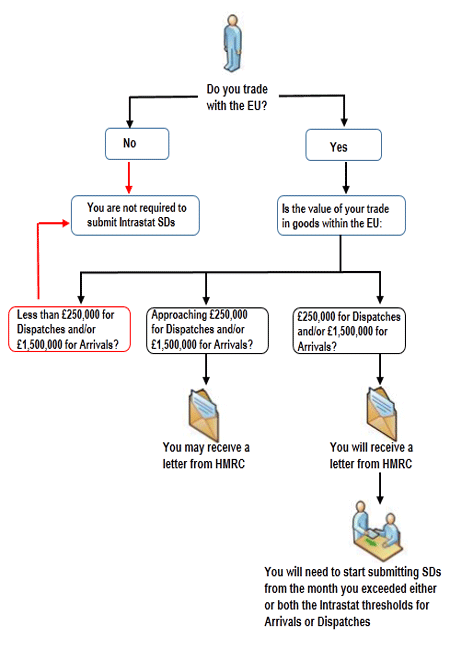
Something similar to reverse charge; called acquisition tax, applies to goods purchased from other EC Member States. These are known as acquisitions (they are imports if the goods come from outside the EU and different rules apply). The full value of the goods is subject to output tax and the associated input tax may be recovered by the business acquiring if the goods are used for taxable purposes. If you are not already registered for VAT in the UK and acquire goods worth £85,000 or more in the UK from other EC countries, you will have to register for VAT in the UK on the strength of the value of the acquisition tax. A business will also have to complete an Intrastat Supplementary Declaration (SDs) if its acquisitions of goods from the EC exceed an annual amount – currently £1.5 million.

Intrastat_flow_diagramMore details on Intrastat Supplementary Declarations here

Deregistration

Any goods on hand at deregistration with a total value of over £1,000 on which input tax has been claimed are subject to a self supply. This is a similar mechanism to a reverse charge in that the goods are deemed to be supplied to the business by the business and output tax is due. However, in these circumstances it is not possible to recover any input tax on the self supply.

Flat Rate Scheme

There is a self supply of capital items on which input tax has been claimed when a business leaves the flat rate scheme (and remains VAT registered).

Mobile telephones

In order to counter missing trader intra-community fraud (‘MTIC’), supplies of mobile telephones and computer chips which are made by one VAT registered business to another and valued at £5,000 and over are subject to the reverse charge. This means that the purchaser rather than the seller is responsible for accounting for VAT due.

And not forgetting the new domestic reverse charge for building and construction here.

Land and buildings…. and motor cars

There are certain circumstances where land and buildings must be treated as a self supply… but that is a whole new subject in itself… as is supplies in the motor trade.

Even if the result of a self-supply or reverse charge is VAT neutral HMRC is within its rights to assess and levy penalties and interest in cases where the charge has not been applied; which always seems unfair.  However, more often than not simple accounting entries will deal with the matter…. if the circumstances are recognised and it is remembered to actually make the entries!

VAT: The transport of disabled persons

By   24 June 2019

HMRC have released Revenue and Customs Brief 3 (2019) RCB3 2019 which sets out the treatment of certain transport services, specifically in relation to the Jigsaw Medical Services Upper Tribunal (UT) case. This case considered emergency ambulance services contrasted with patient transport services. It was accepted that they were exempt (“the supply of transport services for sick or injured persons in vehicles specially designed for that purpose” – VAT Act 1994, Schedule 9, Group 7, item 11) but could they “also” be treated as zero rated?

Technical

Zero rating takes precedence over exemption, so if these services qualify for both exemption and zero rating, they will be treated as zero rated. Although both treatments are VAT free, zero rating is beneficial as it provides the suppler the ability to recover input tax attributable to the supplies.

Summary

The Brief clarifies that zero rating applies if the supply of transport is in any vehicle with seating to carry ten or more passengers (including the driver) or if there would be 10 seats if wheelchair adaptations were removed. If the supply is not zero rated, say, because of the number of seats test is failed, the above exemption may apply if the service is the transport of sick or injured persons. If that exemption does not apply, then the default position applies, and the service is standard rated. RCB3 also provides information on how to apply the “ten seat rule” and on adapted vehicles.

VAT: Holiday Lets – don’t get caught out

By   14 June 2019

Further to the usual complexity with VAT and property, I have been increasingly asked about the VAT position of holiday lets, so this is a timely piece on the subject.

All residential letting is exempt… except holiday lets, which are standard rated at 20%. So, what is the difference? A house is a house, but the VAT treatment depends on how the property is advertised or “held out”.

If a property is held out for holiday accommodation, then the rental income is taxable.

What is holiday accommodation?

Holiday accommodation includes, but is not restricted to; any house, flat, chalet, villa, beach hut, tent, caravan or houseboat. Accommodation advertised or held out as suitable for holiday or leisure use is always treated as holiday accommodation. Also, increasingly, it is common for farms and estates to have cottages and converted barns within their grounds, which are exploited as furnished holiday lets so this use must be recognised for VAT purposes. Residential accommodation that just happens to be situated at a holiday resort is not necessarily holiday accommodation.

This treats holiday lets the same way as; hotels, inns and B&B were VAT applies, which is fair.

Off-season lettings

If holiday accommodation is let during off-season, it should be treated as exempt from VAT provided it is let as residential accommodation for more than 28 days and holiday trade in the area is clearly seasonal.

What does this mean?

If the letting business exceeds the VAT registration threshold, currently £85,000, it must register for VAT. This usually means that either the business would lose a sixth of its income to HMRC or its letting fees would increase by 20% – which is not usually an option in a particularly price sensitive market. The only upside to registration is that VAT incurred on costs relating to the letting (input tax) would be recoverable. This may be on expenditure such as; agents’ fees, maintenance, refurbishments, laundry, websites and advertising etc.

Agents

If a property owner provides a property to a holiday letting agent and the agent itself provides the letting directly to the end users, this does not avoid the standard rating, even if the agent pays a guaranteed rent to the freeholder. This can catch some property owners out.

Sale of the property

When the owner sells the property, although it may have been used for standard rated purposes, the sale is usually treated as exempt. However, zero rating may be available for the first sale or long lease if it is a new dwelling with no occupancy restrictions. The sale of a “pure” holiday property is likely to be standard rated if it is less than three years old. To add to the complexity, it is also possible that the sale may qualify as a VAT free Transfer Of A Going Concern (TOGC).  These are important distinctions because they determine, not only if VAT is chargeable, but, if the sale is exempt, there is usually a clawback of input tax previously claimed, potentially visa the Capital Goods Scheme (CGS).

Overseas properties

A final point: please do not forget overseas property lets. My article here sets out the tax risks.

Summary

There are a lot of VAT pitfalls for a business providing holiday lettings. But for a single site business, unless the property is large or very high end, it is likely that the income will below £85,000 and VAT can be ignored. However, it is important to monitor income and costs to establish whether:

  • registration is required
  • registration is beneficial (usually, but not exclusively, for major refurbishment projects).

As always, please contact me if you, or your clients, have any queries.

The ABC of VAT – property

By   28 May 2019

A glossary

Anyone who has had even the slightest brush with VAT will know that it is a very complex tax. Now, multiply that complexity by the intricacy and occasionally arcane nature of property law and one may see that the outcome will be less than straightforward. I have produced a general guide and an article on residential property VAT Triggerpoints

I hope the following glossary will help with steering through some of the difficulties.

  • Annex– a building which is joined to or is next to a larger main building usually an extension or addition to a building
  • Assign – to transfer the right or interest in a property from one party to another
  • Break clause – a clause allowing either landlord or tenant to give written notice after a particular date or period of the tenancy in order to end the tenancy
  • Beneficial owner – party deemed to make a supply of property rather than the legal owner
  • Blocked input tax – VAT which a developer is unable to recover when constructing a new dwelling. Typically, expenditure on good such as; carpets, fitted furniture, and gas and electrical appliances
  • Building materials– goods ordinarily incorporated into a property which attracts similar VAT treatment to the construction services.
  • Capital Goods Scheme(CGS) – a method of calculating the recovery amount of input tax incurred on property over a ten-year period, Details of the CGS here
  • Certificate – a document issued to a supplier in order to obtain certain zero-rated or reduced-rated building work
  • Change of number of dwellings– usually a conversion from commercial to residential, or a single house into flats (or flats into a single house) at 5% VAT
  • Consideration– a thing done or given in exchange for something else = a supply. Usually quantified in money, but in some cases non-monetary consideration
  • Construction of new dwellings – a zero rated supply
  • Contract – legal document detailing the agreement of terms between the vendor and buyer
  • Contractor – entity responsible for building works
  • Conversion–work on a non-residential building which results in a property designed as a dwelling(s) being created
  • Covenants – rules governing the property in its title deeds or lease. May impact the definition of dwellings
  • Curtilage– either a garden, or an area surrounding a building which is deemed to be part of the property
  • Designed as a dwelling– a property initially designed for residential use, regardless of any subsequent alternative use
  • Dilapidations – items that have been damaged during a tenancy for which the tenant is responsible for the cost of repair or replacement. Usually VAT free
  • DIY Housebuilders’ Scheme – a scheme which ‘self-builders’ to recover VAT on a new build dwelling or conversion. Details here
  • Dwelling– a building deemed to be residential
  • Empty house – if, in the ten years before work on a dwelling starts, it has not been lived in, the work may be subject to 5% rather than 20% VAT
  • Exempt– a supply that is VAT free. It usually results in attributable input tax falling to be irrecoverable
  • Facade– a wall (or two walls on a corner plot) which may be retained without affecting the zero rating of a new dwelling construction
  • Grant– a supply of an interest in land
  • Holiday home – the sale or long lease of a holiday home cannot be zero-rated even if it is designed as a dwelling
  • Housing Association – a non-profit organisation which rents residential property to people on low incomes or with particular needs
  • In the course of construction– meaningful works that have occurred in relation to the construction of a building (but prior to its completion)
  • Incorporated goods – goods sold with a new dwelling which are zero rated and to which the input tax block does not apply. See white goods
  • Input tax– VAT incurred on expenditure associated with property
  • Interest in, or right over, land– the right to access to and use of, land. Usually via ownership or lease
  • Lease – legal document governing the occupation by the tenant of a premises for a specific length of time
  • Licence to occupy– a permission to use land that does not amount to a tenancy
  • Live-work units – a property that combines a dwelling and commercial or industrial working space. Usually subject to apportionment
  • Major interest–a supply of a freehold interest or a lease exceeding 21 years
  • Multiple occupancy dwelling – a dwelling which is designed for occupation by persons not forming a single household
  • New building–a commercial building less than three years old the sale of which is mandatorily standard
  • Non-residential– a commercial building which is not used as a dwelling
  • Open market value – likely sale price with a willing seller and buyer, with a reasonable period of marketing and no special factors affecting the property
  • Option to tax (OTT) – act of changing the exempt sale or letting of a commercial into a taxable supply. The purpose is to either; recover input tax or avoid input tax being charged. Details here
  • OTT disapplication– the legal removal of a vendor’s option to tax
  • OTT not applicable – the OTT does not apply to residential buildings (so VAT can never apply to dwellings)
  • OTT revocation– the ability to revoke an option to tax after six months or twenty years
  • Partial exemption– a calculation to attribute input tax to exempt and taxable. Generally, VAT incurred in respect of exempt supplies is irrecoverable
  • Person constructing – a developer, contractor or sub-contractor who constructs a building
  • Premium – upfront payment for a supply of property
  • Relevant Charitable Purpose (RCP)–the use by a charity for non-business purposes or for use as a village hall or similar
  • Relevant Residential Purpose (RRP)– dwelling used for certain defined residential purposes, eg; children’s home, a hospice or student accommodation
  • Reverse surrender– a tenant surrenders an onerous lease to the landlord and makes a payment to surrender
  • Share of freehold – where the freehold of the property is owned by a company and the shareholders are the owners of the property
  • Single household dwelling– a building designed for occupation by a single household
  • Snagging – the correction of building faults. Usually follows the VAT liability of the original work
  • Stamp Duty Land Tax (SDLT) – tax paid by a purchaser of a property. SDLT is increased if the sale of a commercial property is the subject of an option to tax
  • Substantial reconstruction– certain significant works to a listed building
  • Surrender– a tenant surrenders the lease to the landlord in return for payment
  • Taxable supply– a supply subject to VAT at the standard, reduced or zero-rate
  • Use as a dwelling – a building which was designed or adapted for use as someone’s home and is so used
  • Vendor – entity selling a property
  • Transfer of a Going Concern (TOGC) – the VAT free sale of the assets of a business as a going concern. This may include a tenanted property
  • Zero-rated– a taxable supply subject to VAT at a rate of 0%

We strongly recommend that advice is obtained if any property transaction is being undertaken.

Details of our land and property services may be found here.

VAT: Increased input tax recovery for suppliers of financial services – Brexit

By   5 April 2019

If the UK leaves the EU in a no-deal scenario there may be a benefit for UK based suppliers of financial and insurance services (so called Specified Supplies) to recipients in the EU. These Specified Supplies attract beneficial input VAT treatment pursuant to the VAT (Input Tax) (Specified Supplies) Order 1999 (the Specified Services Order). 

Current position

Currently, these Specified Supplies are exempt and consequently, there is no right to deduct input tax incurred in connection with such services. However, if the Specified Supplies are provided to recipients located outside the EU, they are also VAT free, although any attributable input tax is recoverable; a good VAT position.

Post Brexit position

If the UK leaves the EU, the VAT treatment of supplies to non-EU countries is also applicable to the EU 27 countries; the EU would essentially become a “third country”.

Example

A City of London based bank supplies financial services to both Germany and the US clients. Income from these two clients is 50:50. At the current time the bank would be restricted to a claim of circa half of the VAT it incurs on expenditure in the UK. After Brexit, via The Value Added Tax (Input Tax) (Specified Supplies) (EU Exit) (No. 2) Regulations 2019 all input tax incurred will be recoverable in full.

What are Specified Supplies?

Specified Supplies are broadly:

  • the issue, transfer or receipt of, or any dealing with, money, any security for money or any note or order for the payment of money.
  • granting of credit
  • dealing in; shares, stocks, bonds, notes (other than promissory notes), debentures, debenture stock
  • the operation of any current, deposit or savings account.
  • the management of certain investment funds/schemes
  • insurance
  • and intermediary services in respect of the above supplies

This list is not exhaustive and is only a very general example of types of supplies which may be considered as Specified Supplies. Please seek advice on specific services.

Other matters

The government says that this change will ensure that UK businesses compete for business in the EU on an even footing with businesses in other non-EU countries.

The proposed legislation also provides that partial exemption special methods (PESM) agreed before a no-deal Brexit will be honoured so businesses will not need to apply to HMRC for approval of a new PESM. Please see guide to partial exemption here

NB: If a deal is agreed between the UK and the EU, the above legislation will not be enacted, and the current VAT treatment will continue throughout the implementation period set out in a withdrawal agreement.