All alcoholic drinks are always standard rated. Alcohol-free beer and wines are similarly subject to VAT.

All alcoholic drinks are always standard rated. Alcohol-free beer and wines are similarly subject to VAT.
I have made a lot of references to penalties in other articles over the years. So I thought it would be a good idea to have a closer look; what are they, when are they levied, rights of appeal, and importantly how much could they cost if a business gets it wrong?
Overview
Broadly, a penalty is levied if the incorrect amount of VAT is declared, either by understating output tax due, or overclaiming input tax, or accepting an assessment which is known to be too low.
Amount of penalty
HMRC detail three categories of inaccuracy. These are significant, as each has its own range of penalty percentages. If an error is found to fall within a lower band, then a lower penalty rate will apply. Where the taxpayer has taken ‘reasonable care,’ even though an error has been made, then no penalty will apply.
Reasonable care
There is no definition of ‘reasonable care’. However, HMRC have said that they would not expect the same level of knowledge or expertise from a self-employed person, as from a large multi-national.
HMRC expect that, where an issue is unclear, advice is sought, and a record maintained of that advice. They also expect that, where an error is made, it is adjusted, and HMRC notified promptly. They have specifically stated that merely to adjust a return will not constitute a full disclosure of an error. Therefore, a penalty may still be applicable.
Notification
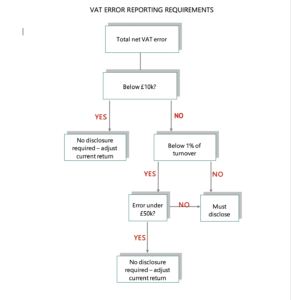
Further, where there is an ‘unprompted disclosure’ of the error, HMRC have power to reduce the penalty further. This measure is designed to encourage businesses to review their own VAT returns.
A disclosure is unprompted if it is made at a time when a person had no reason to believe that HMRC have discovered or are about to discover the inaccuracy. The disclosure will be treated as unprompted even if at the time it is made, the full extent of the error is not known, as long as fuller details are provided within a reasonable time.
What the penalty is based on
The amount of the penalty is calculated by applying the appropriate penalty rate (above) to the ‘Potential Lost Revenue’ or PLR. This is essentially the additional amount of VAT due or payable, as a result of the inaccuracy, or the failure to notify an under-assessment. Special rules apply where there are a number of errors, and they fall into different penalty bands.
Defending a penalty
The percentage penalty may be reduced by a range of ‘defences:’
– Telling; this includes admitting the document was inaccurate, or that there was an under-assessment, disclosing the inaccuracy in full, and explaining how and why the inaccuracies arose;
– Helping; this includes giving reasonable help in quantifying the inaccuracy, giving positive assistance rather than passive acceptance, actively engaging in work required to quantify the inaccuracy, and volunteering any relevant information;
– Giving Access; this includes providing documents, granting requests for information, allowing access to records and other documents.
HMRC have included a provision whereby a penalty can be suspended for up to two years. This will occur for a careless inaccuracy, not a deliberate inaccuracy. HMRC will consider suspension of a penalty where, given the imposition of certain conditions, the business will improve its accuracy. The aim is to improve future compliance and encourage businesses which genuinely seek to fulfil their obligations.
Appealing a penalty
HMRC have an internal reconsideration procedure, where a business should apply to in the first instance. If the outcome is not satisfactory, the business can pursue an appeal to the First Tier Tribunal. A business can appeal on the grounds of; whether a penalty is applicable, the amount of the penalty, a decision not to suspend a penalty, and the conditions for suspension.
The normal time limit for penalties to four years. Additionally, where there is deliberate action to evade VAT, a 20 year limit applies. In particular, this applies to a loss of VAT which arises as a result of a deliberate inaccuracy in a document submitted by that person.
These are just the penalties for making “errors” on VAT returns. HMRC have plenty more for anything from late registration to issuing the wrong paperwork.
Even darker
There are even more severe penalties for deliberate acts, including significant terms of imprisonment. That is the subject of another article.
Assistance
My advice is always to check on all aspects of a penalty and seek assistance for grounds to challenge a decision to levy a penalty. We have a very high success rate in defending businesses against inappropriate penalties. It is always worth running a penalty past us.
HMRC has published new VAT Road Fuel Scale Charges (RFSC) which apply from 1 May 2026 to 30 April 2027.
These provide details on the charges from 1 May 2026 to be used on a business’ VAT return and must be used from the start of the next prescribed accounting period beginning on or after 1 May 2026.
RFSC
A scale charge is a way of accounting for output tax on road fuel bought by a business for cars which is then put to private use. If a business uses the scale charge, it can recover all the VAT charged on road fuel without having to identify specific business and private use. The charge is calculated on a flat rate basis according to the CO2 emissions of the car.
A business will need to calculate the correct RFSC based on a car’s CO2 emissions, and the length of its VAT accounting period. This will be either one, three, or twelve months. The CO2 emissions figure may be found here if the information is not available in the log book.
More on motoring expenses here.
HMRC has updated its list of VAT appeals, which sets out the status of HMRC appeals and recent cases which they consider have potential implications for other taxpayers.
This is a list of VAT appeals that HMRC has lost, or partly lost, that could have implications for other businesses.
The list is updated regularly and details of finalised cases are retained for six months.
HMRC has updated its guidance on How VAT affects charities. This includes details of a new relief from 1 April 2026 for VAT registered businesses donating goods to a charity (Section 5.5).
A VAT-registered business can zero-rate the donation of goods to a charity or its trading subsidiary provided that the goods are to be offered for sale.
From 1 April 2026, businesses do not have to account for VAT when they donate goods to a charity for:
Goods may be donated without incurring a VAT charge when:
Before 1 April 2026 businesses were required to account for VAT on a deemed supply when goods forming part of their assets were donated to a charity and input tax had originally been recovered on their purchase.
More on VAT and charities here.
Crowdfunding is the practice of funding a project or venture by raising many small amounts of money from a large number of people, typically via the internet on specifically designed platforms and is an alternative to traditional ways of raising finance. The model is usually based on three parties: the project initiator who proposes the idea or project to be funded, individuals or groups who support the idea, and a moderating organisation (the “platform”) that brings the parties together to launch the idea.
Crowdfunding is a major, growing source of funding for startups, charities, and creative projects, with the global market predicted to grow annually by around 15% from 2026 to 2033 with platforms like Kickstarter, Seedrs, Crowdcube, and GoFundMe being major players.
VAT Treatment
The VAT treatment of supplies that might potentially be made is no different to similar financing arrangements, for example; sponsorship, donations and investments made through more traditional routes. Whether a recipient of crowdfunding is liable to charge and pay VAT depends on the facts in each case.
Examples
Donations
Goods and/or services
Combination
Investment
Royalties
Loan-based
VAT registration
If income from the sources above which are deemed to be subject to VAT exceeds the VAT registration limit (currently £90,000 in any twelve-month period) the person, in whichever legal identity, such as; individual, company, partnership, Trust etc will be liable to register for VAT. If income is below this limit, it will be possible, but not mandatory to VAT register. The benefits of voluntary registration here.
Input tax recovery
If VAT registered, any input tax incurred on costs relating to crowdfunding is usually recoverable (see here for exceptions). However, if the costs relate to donations or some types of investment then input tax claims are specifically blocked as they would relate to non-business activities. If exempt supplies are made, attributable input tax is generally blocked unless it is de minimis.
Commentary
There can be difficulties in establishing the tax liability of crowdfunding and in a broader sense “sponsorship” in general. However, experience insists that the biggest issue is initially identifying that there may be a VAT issue at all. If you, or your clients are involved in crowdfunding, or have sponsors, it would be prudent to review the VAT treatment of the activities.