Author Archives: Marcus Ward

I have to charge myself VAT?!

By   1 July 2015

I have to charge MYSELF VAT?!

How comes?!

Well, normally, the supplier is the person who must account to the tax authorities for any VAT due on the supply. However, in certain situations, the position is reversed and it is the customer who must account for any VAT due. Don’t get caught out!

Here are just some of the situations when you have to charge yourself VAT:

Purchasing services from abroad

These will be obtained free of VAT from an overseas supplier. What is known as the ‘reverse charge’ procedure must be applied. Where the reverse charge procedure applies, the recipient of the services must act as both the supplier and the recipient of the services. On the same VAT return, the recipient must account for output tax, calculated on the full value of the supply received, and (subject to partial exemption and non-business rules) include the VAT charged as input tax. The effect of the provisions is that the reverse charge has no net cost to the recipient if he can attribute the input tax to taxable supplies and can therefore reclaim it in full. If he cannot, the effect is to put him in the same position as if had received the supply from a UK supplier rather than from one outside the UK. Thus creating a level playing field between purchasing from the UK and overseas.

Accounting for VAT and recovery of input tax.
Where the reverse charge procedure applies, the recipient of the services must act as both the supplier and the recipient of the services.  On the same VAT return, the recipient must
      1. account for output tax, calculated on the full value of the supply received, in Box 1;
      2. (subject to partial exemption and non-business rules) include the VAT stated in box 1 as input tax in Box 4; and;
      3. include the full value of the supply in both Boxes 6 and 7.
Value of supply: The value of the deemed supply is to be taken to be the consideration in money for which the services were in fact supplied or, where the consideration did not consist or not wholly consist of money, such amount in money as is equivalent to that consideration.  The consideration payable to the overseas supplier for the services excludes UK VAT but includes any taxes levied abroad.
Time of supply: The time of supply of such services is the date the supplies are paid for or, if the consideration is not in money, the last day of the VAT period in which the services are performed.

Purchasing goods from another EC Member States

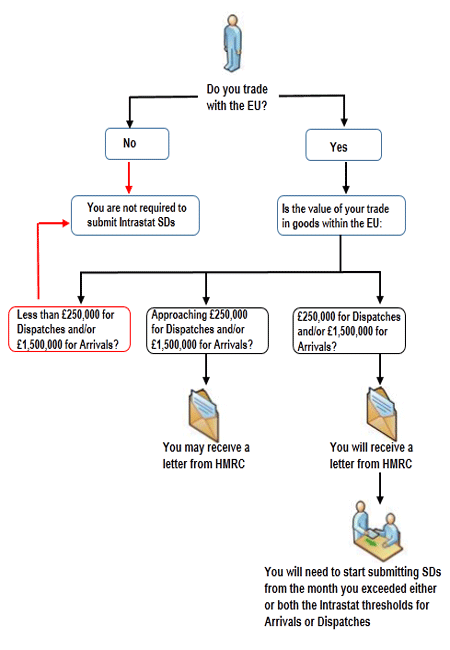
Something similar to reverse charge; called acquisition tax, applies to goods purchased from other EC Member States. These are known as acquisitions (they are imports if the goods come from outside the EC and different rules apply). The full value of the goods is subject to output tax and the associated input tax may be recovered by the business acquiring if the goods are used for taxable purposes. If you‘re not already registered for VAT in the UK and acquire goods worth £82,000 or more in the UK from other EC countries, you will have to register for VAT in the UK on the strength of the value of the acquisition tax. A business will also have to complete an Intrastat Supplementary Declaration (SDs) if its acquisitions of goods from the EC exceed an annual amount – currently £1.5 million.

Intrastat_flow_diagramMore details on Intrastat Supplementary Declarations here
Deregistration

Any goods on hand at deregistration with a total value of over £1,000 on which input tax has been claimed are subject to a self supply. This is a similar mechanism to a reverse charge in that the goods are deemed to be supplied to the business by the business and output tax is due. However, in these circumstances it is not possible to recover any input tax on the self supply.

Flat Rate Scheme

There is a self supply of capital items on which input tax has been claimed when a business leaves the flat rate scheme (and remains VAT registered).

Mobile telephones

In order to counter missing trader intra-community fraud (‘MTIC’), supplies of mobile ‘phones and computer chips which are made by one VAT registered business to another and valued at £5,000 and over are subject to the reverse charge. This means that the purchaser rather than the seller is responsible for accounting for VAT due.

Land and buildings…. and motor cars

There are certain circumstances where land and buildings must be treated as a self supply… but that is a whole new subject in itself… as is supplies in the motor trade.

Even if the result of a self-supply or reverse charge is VAT neutral HMRC is within its rights to assess and levy penalties and interest in cases where the charge has not been applied; which always seems unfair.  However, more often than not simple accounting entries will deal with the matter…. if the circumstances are recognised and it is remembered to actually make the entries!

VAT treatment of vouchers, gifts and discounts – How business promotions work

By   25 June 2015

Business promotions are an area of VAT which continues to prove complex.  This is further exacerbated by changes to the legislation at EC and domestic level and ongoing case law.

The VAT position is summarised here. Part of this commentary has been taken directly from HMRC guidance on the subject and is the most up to date authority on the matter.  I thought it may be useful if the VAT treatment of various business promotion schemes is summarised in one place.

…I recall a statement from an old mentor of mine; “if you have a marketing department you have a VAT problem!”


Summary

Offer How to charge VAT
Discounts Charged on the discounted price (not the full price)
Gifts Charged on the gift’s full value – there are some exceptions listed below
Multi-buys Charged on the combined price if all the items have the same VAT rate. If not, VAT is ‘apportioned’ as mixed-rate goods
Money-off coupons, vouchers etc No VAT due if given away free at time of a purchase. If not, VAT due on the price charged
Face value vouchers that can be used for more than one type of good or service (multi-purpose) No VAT due, if sold at or below their monetary value
Face value vouchers that can only be used for one type of good or service (single-purpose) VAT due on the value of the voucher when issued
Redeemed face value vouchers Charged on the full value of the transaction at the appropriate rate of the goods provided in return for the voucher

 Exceptions for gifts

There’s no VAT due on gifts given to the same person if their total value in a 12 month period is less than £50.

Free goods and services

You don’t have to pay VAT on things like free samples if they meet certain conditions.

Supplies Condition to meet so no VAT due
Free samples Used for marketing purposes and provided in a quantity that lets potential customers test the product
Free loans of business assets The cost of hiring the asset is included in something else you sell to the customer
Free gifts The total cost of all gifts to the same person is less than £50 in a 12 month period
Free services You don’t get any payment or goods or services in return

Background

Face value vouchers

Recent changes, radically alter the UK rules for face value vouchers. Face value vouchers are vouchers, tokens, stamps (physical or electronic) which entitle the holder to certain goods or services up to the value on the face of the vouchers from the supplier of those goods or services.

Examples of face value vouchers would include vouchers sold by popular group discount websites, vouchers sold by high street retailers, book tokens, stamps and various high street vouchers.

Single or multi-purpose

The most important distinction for face value vouchers is whether a voucher is a single purpose voucher or multi-purpose voucher. If it is a multi-purpose voucher then little has changed. If it is a single purpose voucher, however, HMRC will now charge VAT when it is issued.

Single purpose vouchers are vouchers which carry the right to receive only one type of goods or services which are all subject to a single rate of VAT. Multi-purpose vouchers are anything else. The differences can be quite subtle.

For example:

  • a voucher which entitles you to download an e-book from one seller will be a single purpose voucher. A voucher which entitles you to either books (zero rated) or an e-book download (standard rated) from the same seller will be multi-purpose
  • a voucher which entitles you to £10 of food at a restaurant which does not sell takeaways is probably single purpose, whereas if the restaurant has a cold salad bar and you can buy a take away with the voucher (or hot food) then it would be multi-purpose. 

The above means that for single purpose vouchers VAT is due whether the voucher is actually redeemed or not; which seems an unfair result. There is no way to reduce output tax previously accounted for if the voucher is not used. 

VAT – Retrospective input tax claim opportunity for charities and not for profit bodies.

By   22 June 2015

The Upper Tribunal has decided In the University Of Cambridge case that costs incurred on running its endowment fund relate to the university’s overall economic activity in general and consequently it is possible to recover an element of it.  The full judgement here

This will impact on all charities and similar bodies which have non-business activities that support their business activities. 

Please contact us if your charity is in a similar position because if past input tax claims have been restricted as a result of HMRC’s interpretation (which is highly likely) it is possible to make a claim which covers the last four years’ VAT costs.

VAT on Crowdfunding?

By   28 May 2015

The EC is has begun an investigation into whether VAT should apply to crowdfunding activities.

An alternative is for the Commission to consider whether crowdfunding should be covered by the exemption for financial services.  In my view this seems unlikely.

So what could the outcome be if VAT is applicable to crowdfunding?  Well, a large number of UK projects will face a 20% VAT liability on investor returns. This is especially relevant to the popular “rewards crowdfunding”, where payments by investors are made in return for products or services to be developed as a result of the fundraising. These rewards projects may include; films, albums, or software development, which are offered “free” or at a reduced rate. It would appear that in these cases, consideration is flowing in both directions.

The Commission may also decide that crowdfunding intermediary services offered by many platforms will become liable to VAT.

The current position is that the Commission has now referred the question of crowdfunding to the EU VAT Committee.

More on this subject as soon as we have it.

VAT – Compound interest now payable on retrospective claims. Littlewoods Court of Appeal decision

By   21 May 2015

If your business have ever submitted a retrospective claim to HMRC on the basis of UK law being incompatible with EC legislation, it is possible to claim compound interest.

Full judgement here:  https://emeia.ey-vx.com/730/28558/landing-pages/littlewoods-coa-judgment-21-may-2015.pdf

Please contact us if you require any further information or assistance.

VAT – The Future for the EC Digital Single Market

By   11 May 2015

VAT – The Future for the EC Digital Single Market

The EC has announced its plans for its VAT digital single market in respect of online sales. Full details are here and here.

The highlights are:

• Extension of MOSS to intra-EC and third country online B2C sales of goods.

• Introduction of a new EC-wide VAT threshold to help start-up businesses.

• Ending current distance selling thresholds.

• Allowing for domestic controls, including a single audit of cross-border sales.

• Removal of the VAT exemption for the import of small consignments form third countries.

• Removal of barriers to cross-border sales eg; geo-blocking and costs.

This is likely to have a huge impact on the way businesses deal with VAT on sales of goods to individuals overseas. If the introduction of MOSS is anything to go by, we may be in for a bumpy ride.

VAT – Business Entertainment Flowchart. What input tax may I recover?

By   11 May 2015

VAT – Recovery of input tax incurred on entertainment

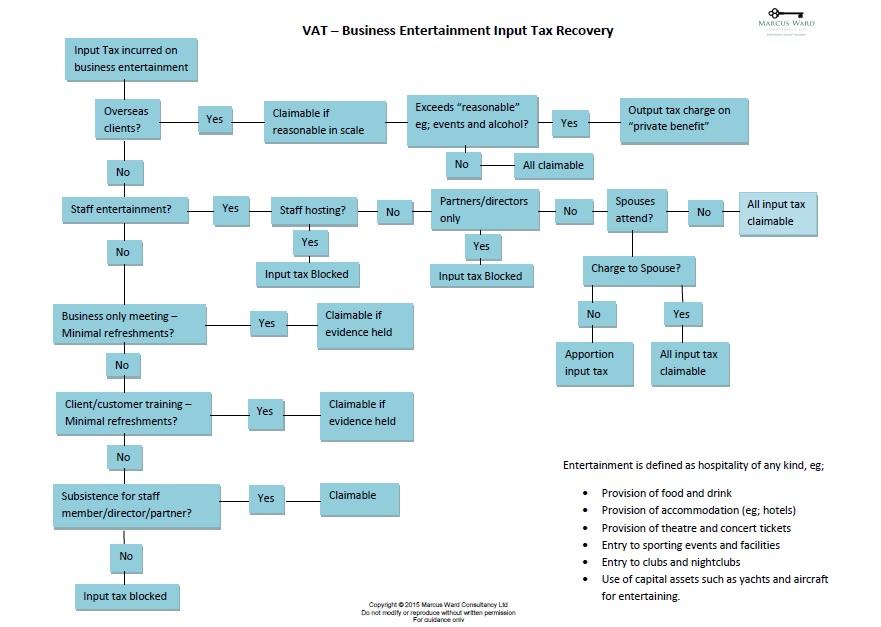
One of the most common questions asked on “day-to-day” VAT is whether input tax incurred on entertainment is claimable.  The answer to this seemingly straightforward question has become increasingly complex as a result of; HMRC policy, EC involvement and case law.  Different rules apply to entertaining; clients, contacts, staff, partners and directors depending on the circumstances.  It seems reasonable to treat entertaining costs as a valid business expense.  After all, a business, amongst other things, aims to increase sales and reduce costs as a result of these meetings.  However, HMRC sees things differently and there is a general block on business entertainment.  It seems like HMRC does not like watching people enjoying themselves at the government’s expense!

If, like me, you think in pictures, then a flowchart may be useful for deciding whether to claim entertainment VAT.  It covers all scenarios, but if you have a unique set of circumstances or require assistance with some of the definitions, please contact me.

I thank my friend and colleague Leila Ong for help with this, and also with the series of presentations we have recently carried out and which, amongst other subjects, covered business entertainment. Should you require VAT training or presentations, don’t forget our comprehensive service here which can be tailored to your needs.

VAT -Business Entertainment Flowchart

Business Entertainment flow chart

Download here: VAT Business Entertainment Input tax recovery flowchart

VAT- Is the Upper Tribunal bound by High Court decisions?

By   6 May 2015

Upper Tribunal versus High Court

In the recent case of Meena Seddon Settlement which involved Inheritance Tax, the First Tier Tribunal (FTT) was required to decide whether the Upper Tribunal is bound by decisions made in the High Court. The FTT decision will doubtless affect VAT cases in the future.

It decided to follow a precedent set by the Upper Tribunal over an earlier decision by the High Court.

The taxpayer contended that the matter should be decided on the basis of a previous High Court decision. HMRC argued on the basis of a later Upper Tribunal decision. In normal circumstances, a later decision should take precedence over the earlier if both decisions have the same authority and have fully considered the previous judgments. However, if the taxpayer was correct to say that the Upper Tribunal was bound by precedents set by the High Court, the later decision could be disregarded as being wrong in law.

The FTT decided that it was the intention of Parliament that the Upper Tribunal was not bound to follow High Court precedents. This was notwithstanding the fact that a High Court could have a supervisory role over the Upper Tribunal in cases of judicial review. Therefore, it determined the case on the authority of the later Upper Tribunal decision in favour of HMRC.

VAT: Global Accounting simplification

By   27 April 2015

VAT: Second Hand Scheme  – Global Accounting simplification

Overview

The problem with the VAT Second-Hand Goods Scheme is that details of each individual item purchased, and then later sold, has to be recorded. This requirement can lead to a lot of paperwork and an awful lot of administration which, obviously, many businesses are not too keen to comply with.

Global Accounting is an optional, simplified variation of the Second Hand Margin Scheme (Margin Scheme).

It differs from the standard Margin Scheme because rather than accounting for the margin achieved on the sale of individual items VAT is calculated on the margin achieved between the total purchases and total sales in a particular accounting period without the requirement to establish the mark up on each individual item.  It is beneficial if a business buys and sells bulk volume, low value eligible goods, and is unable to maintain the detailed records required of businesses who use the standard Margin Scheme

There two significant differences in respect of Global Accounting compared to the standard Margin Scheme. The first difference is that losses on an item are automatically offset against profits on items. Thus losses and profits are offset together in the period. In the standard Margin Scheme no VAT is due if a loss is made on an item, but that loss cannot be offset against any other profit.  There is also a timing advantage with Global Accounting because all purchases made in the period are included, even if those goods are not actually sold in the same period.

Goods which may be included in Global Accounting

Global Accounting can be used for all items which are eligible under the standard Margin Scheme.  However, the following goods cannot be included in Global Accounting:

  • individual items costing more than £500 (although these can be accounted for via the standard Margin Scheme)
  • aircraft, boats and outboard motors,
  • caravans and motor caravans,
  • horses and ponies, and
  • motor vehicles, including motorcycles; except those broken up for scrap.

Starting to use the scheme

When a business starts using Global Accounting, it may find that it already has eligible stock on hand.  It may include the value of this stock when it calculates the total purchases at the end of the first period.  If a business does not take its stock on hand into account, it will have to pay VAT on the full price, rather than on the margin achieved, when it is sold.

Valuation of stock

A business must be able to identify:

  • stock which is eligible for Global Accounting, and
  • its purchase value

It would normally be possible to establish the value from the original purchase documentation, ie; invoices.

But if a business is newly VAT registered, or it does not have original purchase records it may determine the purchase value using another method.   There is no set way of doing this, but a business must be able to demonstrate that the method used has produced a fair and reasonable total.

Note: any goods bought on an invoice which shows a separate VAT figure are not eligible for resale under the scheme.

The calculation

VAT is calculated at the end of each tax period. Because you can take account of opening stock in your scheme calculations, you may find that you produce a negative margin at the end of several periods. In other words, your total purchases may exceed your total sales. In such cases, no VAT is due. But you must carry the negative margin forward to the next period as in the following example:

Period One

a)      Total purchase value of stock on hand 10,000

b)      Total purchases 2,000

c)      Total sales 8,000

Margin = c – (a+b) = (4,000)

Because this is a negative margin there is no VAT to pay.  However, negative margin must be carried forward into the next period as follows:

Period Two

a)      Negative margin from previous period 4,000

b)      Total purchases 1,000

c)      Total sales 7,000

d)      Margin = c – (a + b), sales minus (purchases plus negative margin), £7,000 – (£1,000 + £4,000) 2,000

e)      VAT due = margin (£2,000) × VAT fraction (1/6) 333.33

There is no negative margin to carry forward this time. Therefore, in the third period, the margin is calculated solely by reference to sales less purchases.

The negative margin may only be offset against the next Global Accounting margin. It cannot be offset against any other figure or record.

Global Accounting Records and Accounts

A business does not need to keep all the detailed records which are required under the normal Margin Scheme – for instance, you do not have to maintain a detailed stock book.

Global Accounting records do not have to be kept in any set way but they must be complete, up to date and clearly distinguishable from any other records.  A business must keep records of purchases and sales as set out below, together with the workings used to calculate the VAT due.

If we HMRC cannot check the margins declared from the records, VAT will be due on the full selling price of the goods sold, even if they were otherwise eligible for the scheme.

Buying goods under Global Accounting

When a business buys goods which it intends to sell under Global Accounting it must:

  • check that the goods are eligible for Global Accounting
  • obtain a purchase invoice. If a business buys from a private individual or an unregistered entity, the purchaser should make out the invoice at the time the goods are purchased.  If purchased from another VAT-registered dealer, the dealer must make out the invoice at the time of sale, and
  • enter the purchase details of the goods in your Global Accounting purchase records.  The purchase price must be the price on the invoice which has been agreed between you and the seller.

You cannot use the scheme if VAT is shown separately on the invoice.

Details to be included on purchase invoices

 Purchase invoices must include:

your name and address

  • the seller’s name and address
  • invoice number
  • date of transaction
  • description of goods (this must be sufficient to enable HMRC to verify that the goods are eligible for Global Accounting)
  • total price, you must not show VAT separately, and
  • for goods purchased from another VAT-registered dealer: the statement “Global Accounting Invoice”

Remember: if you are buying from a private individual or an unregistered business, you must make out the purchase invoice yourself.

When selling goods under Global Accounting

If the purchase conditions above apply, Global Accounting may be used when the goods are sold by:

  • recording the sale in the usual way
  • issuing a sales invoice for sales to other VAT-registered dealers and keeping a copy of the invoice, and
  • transferring totals of copy invoices to the Global Accounting sales record or summary
  • you must be able to distinguish at the point of sale between sales made under Global Accounting and other types of transaction

Details to be included on sales invoices

 A sales invoice must be issued to other VAT-registered customers.  These invoices and any other Global Accounting sales invoice issued must show the following details:

  •  your name, address and VAT registration number
  • the buyer’s name and address
  • invoice number
  • date of sale
  • description of goods (this must be sufficient to enable HMRC to verify that the goods are eligible for Global Accounting)
  • total price – you must not show VAT separately
  • the statement “Global Accounting Invoice”
  • you are selling an item for more than £500 and you don’t want the purchaser to know that you bought it under Global Accounting, you may use one of the Margin Scheme sales invoice statements.

 Details to be included in purchase and sales summaries

 Although a business does not have to keep purchase and sales records or summaries in any particular way, they must include the following details taken from the purchase invoices and any sales invoices you issue:

  •  invoice number (where the purchase invoice shows one)
  • date of purchase/sale
  • description of goods, and total price

 Cessation of using the scheme

If a business stops using Global Accounting for any reason, it must make a closing adjustment to take account of purchases for which it has taken credit, but which have not been sold (closing stock on hand). The adjustment required does not apply if the total VAT due on stock on hand is £1,000 or less. In the final period for which the business uses the scheme, it must add the purchase value of its closing stock to the sales figure for that period.  In this way VAT will be paid (at cost price) on the stock for which the business previously had credit under the scheme.

Here is an example of a closing adjustment under Global Accounting: At the end of the period calculate:

(a)    value of purchases during the period – £5,000

(b)    value of sales during the period – £10,000

(c)    purchase value of closing stock – £8,000

(d)    add purchase value of closing stock to sales for period (c+b) – £18,000

(e)    subtract purchases in this period from sale (d-a) – £13,000

(f)     VAT due on margin (e x 1/6) – £2,166.66

You must make a similar adjustment if you transfer goods as part of a transfer of a going concern (TOGC). In that case, you should add the purchase value of goods included in the scheme to your sales figure for the period in which the TOGC takes place.  This adjustment is separate from the TOGC itself, which is not subject to VAT.

Items sold outside the scheme

If goods are sold which had been included in a business’ Global Accounting purchase (for example, they are exported), a business must adjust its records accordingly.  This is done by subtracting the purchase value of the goods sold outside the scheme from the total purchases at the end of the period.

Stolen or destroyed goods

If a business loses any goods through breakage, theft or destruction, it must subtract their purchase price from your Global Accounting purchase record.

Repairs and restoration costs?

A business may reclaim the VAT it is charged on any business overheads, repairs, restoration costs, etc. But it must not add any of these costs to the purchase price of the goods sold under the scheme.

EC Sales List, Intrastat and VAT returns

VAT registered businesses in the UK who make supplies of goods to VAT-registered businesses in other EC Member States are required to complete lists (form VAT 101) of their EC supplies.

But a business should not include any margin schemes transactions on an EC Sales list because they will be subject to VAT in the UK.

Intrastat is the system for collecting statistics on the trade in goods between EC Member States. But, because margin scheme goods are subject to VAT in the country of origin, there is no requirement either:

  • to include margin scheme purchases or sales in boxes 8 and 9 of your VAT return, or
  • to complete a supplementary declaration

For further advice on any global accounting, used goods schemes, or any other special VAT schemes please contact me.

© Marcus Ward Consultancy Ltd

VAT and Customs Duties. Bringing goods into the UK – A brief guide.

By   16 April 2015

VAT and duty on and imports and acquisitions 

If you are bringing goods into the UK it is important to recognise important VAT and duty rules and procedures.  You must ensure that you pay the right amount of VAT and import duties via the correct mechanism.

Goods brought into the UK from other EC countries are called acquisitions rather than imports, and this is an important distinction as we shall see below.

The details and practicalities can be complex and you may want to seek advice or use an agent or freight forwarder to handle your responsibilities, particularly if you are new to international trade or only need to bring goods here occasionally.

Acquisition of goods from EC Member States

EC Member States

The 28 EC countries are: Austria, Belgium, Bulgaria, Croatia, Republic of Cyprus, Czech Republic, Denmark, Estonia, Finland, France, Germany, Greece, Hungary, Ireland, Italy, Latvia, Lithuania, Luxembourg, Malta, Netherlands, Poland, Portugal, Romania, Slovakia, Slovenia, Spain, Sweden and the UK.

Information

If you are UK VAT registered you need to give your supplier your VAT number. This allows the supplier to treat the sale to you as VAT free.  You will need a VAT invoice as with any other purchase. If not UK VAT registered you will pay VAT applicable in the Member State of the supplier.

Accounting for VAT 

You must account for VAT on acquisitions (“acquisition tax”) on your VAT return. VAT is charged at the normal UK rate of VAT for those goods.  You reclaim this acquisition tax in the same way as you reclaim input tax on purchases of supplies within the UK.  So for most businesses the effect is VAT neutral.  In this way there is no difference between buying the goods in the UK or another EC Member State so it rules out cross-border “VAT rate shopping”. There are no Customs Duties to pay on acquisitions

Reporting

All VAT-registered businesses must show the total value of goods acquired from other EU Member States in box 9 of their VAT Return.

In addition, those who trade in the EC above the Intrastat exemption threshold in force during the year must also complete a monthly Supplementary Declaration (SD). The threshold is £1.5 million.

Importing goods from outside the EC

Your responsibilities for imports

You are normally responsible for clearing the goods through UK customs and paying any taxes and duties. Your supplier needs to provide the documentation you need to clear the goods through Customs. If you are importing you may have to pay import duty.

You will need to decide whether to use an agent to handle your responsibilities.  Freight forwarders can handle Customs clearance as well as transport. You can find reputable freight forwarders through the British International Freight Association: here 

You need to check what import duty applies.

Import duty is based on the type of goods you are importing, the country they originate from and their value. HMRC’s Integrated Tariff sets out the classification of goods and the rates of duty in detail: here

Confirm what paperwork you require from the supplier for Customs clearance

This normally includes an invoice and a copy of the transport documents.  You may need proof of the origin of the goods to claim reduced import duty for goods from certain countries. A valuation document is also normally required for imports above a set value.

Complete an import declaration.

You normally declare imports using the Single Administrative Document (SAD).  If you are registered for VAT in the UK you will need an EORI (Economic Operator Registration & Identification) to enable your inbound commercial shipments to be cleared through the automated  CHIEF (Customs Handling of Import and Export Freight). This is made up of your VAT number, plus a further three digits.

Release of goods

You will need to pay VAT and duty to get the goods released.You pay VAT at the normal UK rate for those goods when sold in the UK.

Deferment

Regular importers are able to defer payment of VAT and duty by opening a deferment account with HMRC. You need to provide security and must agree to pay by direct debit. It is also possible to use your agent or freight forwarder’s deferment account.

Accounting for VAT

If you import works of art, antiques and collectors’ items they are entitled to a reduced rate of VAT.

HMRC will send you a monthly C79 certificate showing the import VAT you have paid. You must retain this.  Certificates cover accounting transactions made in each calendar month should be received around the 24th of each month following imports logged the previous month. 

You can reclaim VAT paid on imports on a C79 in the same way as you reclaim input tax on purchases of supplies within in the UK.  It is not possible to reclaim VAT on any other document, eg; an invoice.  Shipping or forwarding agents can’t reclaim this input tax because the goods weren’t imported to be used in part of their business.

You cannot reclaim import duty.

Be aware of special cases

Check whether any goods you are buying are subject to Excise Duty.

Excise duty is charged on fuel, alcohol and tobacco products.

Excise duty is charged on acquisitions from within the EU as well as imports from countries outside the EC.

If goods are subject to excise duty, you pay this at the same time as you pay VAT and import duty.

VAT is charged on the value of the goods plus excise duty.

Warehousing

You may want to consider using a Customs warehouse if you expect to store imports for a long time. If you store goods in a Customs warehouse, you will not need to pay import duty and VAT until you remove the goods from the warehouse.

Storage ‘in bond’ like this is often used for products subject to excise duty, such as wine and cigarettes, although it is not limited to these goods.

Re-exported goods

You will also find it beneficial to find out about tax relief if you are planning to re-export goods you import.  There are special Inward Processing Relief (IPR) rules so that you do not have to pay import duty and VAT.  This relief can apply to imports that you process before re-exporting them.

Valuation of imported goods for VAT and Duties

There are six methods of valuing imported goods, however, in the vast majority of cases (over 90%) the “Transaction Method” is used and, in fact, you must use this method wherever possible.

Transaction Value

This is the price paid or payable by the buyer to the seller for the goods when sold for export to the EC adjusted in accordance with certain specific rules.

This may also cover situations where goods are imported from a processor. The “transaction value” may be “built up” or “constructed” by reference to the cost of processing plus any items to be added commonly referred to as “assists”.

What items must be added to the price paid or payable?

You must add the following to the price you pay (unless they are already included):

(a) Delivery costs. – The costs of transport, insurance, loading or handling connected with delivering the goods to the EC border must be included.

(b) Commissions. – Certain payments of commission and brokerage, including selling commission, must be included.

But you can exclude buying commission if it is shown separately from the price paid or payable for the goods.

(c) Royalties and licence fees. – You must include these payments when they relate to the imported goods and are paid by you as a condition of the sale to you of those goods.

(d) Goods and services provided free of charge or at reduced cost by the buyer. –  If you provide, directly or indirectly, any of the following, you must include in the customs value any part of the cost or value not included in the price charged to you by the seller:

i.          materials, components, parts and similar items incorporated in the imported goods including price tags, kimball tags, labels

ii.          tools, dies, moulds and similar items used in producing the imported goods, for example, tooling charges. There are various ways of apportioning these charges

iii.          materials consumed in producing the imported goods, for example, abrasives, lubricants, catalysts, reagents etc which are used up in the manufacture of the goods but are not incorporated in them,

iv.          engineering, development, artwork, design work and plans and sketches carried out outside the EC and necessary for producing the imported goods. The cost of research and preliminary design                    sketches is not to be included.

(e) Containers and packing. Include:

  1. the cost of containers which are treated for customs purposes as being one with the goods being valued (that is not freight containers the hire-cost of which forms part of the transport costs), and
  2. the cost of packing whether for labour or materials

Where containers are for repeated use, for example, reusable bottles, you can spread their cost over the expected number of imports. If a number of the containers may not be re-exported, this must be allowed for.

(f) Proceeds of resale. – If you are to share with the seller (whether directly or indirectly) the profit on resale, use or disposal of the imported goods you must add the seller’s share to the price paid. If at the time of importation the amount of profit is not known, you must request release of the goods against a deposit or guarantee.

(g) Export duty & taxes paid in the country of origin or export. – When these taxes are incurred by the buyer they are dutiable. However, if you benefit from tax relief or repayment of these taxes they may be left out of the customs value.

Summary

If you are new to acquisitions or importing it may be worthwhile talking to an expert.  This article only scratches the surface of the subject. There can be significant savings made by accurately classifying goods and applying the correct procedures and rates will avoid assessments and penalties being levied.