Category Archives: Compliance

VAT Public Notice 700 Updated

By   25 August 2017

Notice 700: The VAT Guide has been updated.

This HMRC Notice is a “starting point” for general VAT information and provides a guide to all the main VAT rules and procedures. It also provides assistance with the problems faced by business and includes an index which helps users find further information by referring to a particular section or paragraph in one of HMRC’s other, more specialised publications. There have been over 30 changes to the Notice which was last updated in 2016.

A full list of changes is set out in the Notice, but the most salient are as follows:

  • Additional guidance on MOSS – para 4.8.4
  • Single and mixed supplies – para 8.1
  • Continuous supplies to connected persons – para 14.3.1
  • Various commentary on invoices (including electronic invoicing) – paras 16.6, 16.8, 17.7 17.8
  • Accounting schemes – para 19.2
  • Agents registered for VAT acting in their own name when the customer is not registered – para 1.2
  • Penalties for inaccuracies – para 27.3
  • Integrity of supply chains – para 27.5.2

The number of changes in just one year highlights the fast pace of the tax and the number of challenges which taxpayers have won. I cannot see this pace letting up in the future either.

As always, if you have any queries about the changes, please contact us.

Brexit: The future of Customs arrangements

By   21 August 2017

In a paper called Future Customs arrangements: A Future Partnership Paper the Government have given us some idea of what the UK’s relationship with the EU may look like after Brexit.

It is a paper which is part of a series which sets out the key issues and forms part of the Government’s stated vision for the relationship (called a “partnership” in the document) and is said to explore how the UK and EU will “work together” with respect to Customs. The aim is to facilitate the “most friction-less trade possible in goods between the UK and the EU”.  It is noted that this approach is purely “aspirational” and represents the first steps in exploring the position. However, it does inform on the Government’s thinking. The two main approaches may be summarised as:

  1. The Streamlined Arrangement

A highly streamlined customs arrangement between the UK and the EU, streamlining and simplifying requirements, leaving as few additional requirements on EU trade as possible. This would aim to;

  • continue some of the existing arrangements between the UK and the EU
  • put in place new negotiated and potentially unilateral facilitations to reduce and remove barriers to trade
  • implement technology-based solutions to make it easier to comply with Customs procedures

This approach involves utilising the UK’s existing third country processes for UK-EU trade building on EU and international precedents, and developing new innovative facilitations to deliver as friction-less a Customs border as possible.

  1. A New Partnership

A new customs partnership with the EU, aligning the UK’s approach to the Customs border in a way that removes the need for a UK-EU Customs border. One potential approach would involve the UK mirroring the EU’s requirements for imports from the rest of the world where their final destination is the EU.

This is of course unprecedented as an approach and could be challenging to implement and the UK Government will look to explore the principles of this with business and the EU.

The document also considers that the Government would seek to introduce an interim period for implementing changes to Customs arrangements.

Discussions with affected businesses will continue before the publication of a Customs Bill in the autumn.

We will monitor this situation and bring you information on any developments. In the meantime, those businesses which carry out cross-border transactions in goods may want to review their current procedures in anticipation of the changes which will surely be introduced in one form or another.

Alas, as with anything Brexit related, nobody can be sure what the future holds and there will be a great deal of uncertainty until we know the actual outcome and consequently, the impact on business.

VAT EU Claims – A Reminder

By   9 August 2017

Refunds of VAT for UK businesses incurring other EC Member States

If a business incurs VAT in another EC Member State it is possible to recover it.  It is not claimed on a UK VAT return, but via a special claim procedure.  Details of how this process works and what may be claimed are set out in my previous article

The deadline for these claims is 30 September 2017.

Any applicant must not be registered or registrable in the Member State from which they are claiming a refund, nor must they have a permanent business establishment in that EU country. There are a number of other rules to be considered as well, so it pays to ensure that the claim is valid before time and effort is expended in compiling a claim.  We are happy to advise on this.

Applications relating to VAT incurred in the year 2016 must be submitted by 30th September 2017 and there is no leeway to extend this deadline.

VAT: Latest from the courts –zero rating of sub-contractors’ supplies

By   8 August 2017

In the First Tier Tribunal case of Summit Electrical Installations Ltd the issue was whether supplies in respect of student accommodation made by an electrical sub-contractor were eligible for zero rating as supplies in the course of construction of buildings designed as a series of dwellings. Alternatively, were they, as HMRC contended; standard rated supplies in the course of construction of a building used for a Relevant Residential Purpose (RRP)?

Background

The appellant was appointed as the electrical subcontractor working to a main contractor on a development known as Primus Place in Leicester. This development is a seven storey block of student accommodation comprising 140 studio flats and associated facilities. Floors one to six are similar in layout with the majority of the studio flats being the same size. There are also a number of larger studios on some floors. On the ground floor there is a communal reception, cycle store, and laundry. In addition management offices, stores, bins and plant rooms are situated on the ground floor. Each of the studio flats was fitted out with a bathroom pod (a unit including shower, sink and toilet) installed in the corner of the room. In addition there was a small kitchenette with dish washing sink, countertop, cooker, fridge and microwave. Through a doorless stud wall is an open plan sleeping area and walk in cupboard.

The planning permission was granted subject to one relevant condition which provided that at the development: “…no person other than a full time student attending the University of Leicester or DeMontfort University…shall occupy these flats at any time”.

The main contractor provided a zero rating certificate to the appellant. This certificate certified that the developer of the site intended to use the buildings for a relevant residential purpose, namely student living accommodation.

Technical

In this case the distinction between the construction of dwellings and RRPs is that sub-contractors may zero rate their supplies if the work is in respect of dwellings, but those same supplies are standard rated if what is being constructed is a RRP. It is useful to consider the distinction here.

Relevant Residential Purpose

RRP means use as:

(a) a home or other institution providing residential accommodation for children

(b) a home or other institution providing residential accommodation with personal care for persons in need of personal care by reason of old age, disablement, past or present dependence on alcohol or drugs or past or present mental disorder

(c) a hospice

(d) residential accommodation for students or school pupils

(e) residential accommodation for members of any of the armed forces

(f) a monastery, nunnery or similar establishment, or

(g) an institution which is the sole or main residence of at least 90 per cent. of its residents

but not use as a:

hospital or similar institution

prison or similar institution, or

hotel, inn or similar establishment

Clearly, by the above definition, student accommodation is deemed to be a RRP. Therefore, the Tribunal was asked to consider whether the accommodation would also qualify as dwellings, and if so, whether “designed as a dwelling” takes precedence. The definition of a dwelling is as follows (“Note 2” as referred to below).

Dwellings

A building is designed as a dwelling or a number of dwellings where in relation to each dwelling the following conditions are satisfied:

(a) the dwelling consists of self-contained living accommodation;

(b) there is no provision for direct internal access from the dwelling to any other dwelling or part of a dwelling;

(c) the separate use, or disposal of the dwelling is not prohibited by the term of any covenant, statutory planning consent or similar provision; and

(d) statutory planning consent has been granted in respect of that dwelling and its construction or conversion has been carried out in accordance with that consent.

Decision

The judge ruled that the accommodation qualified as dwellings for the purpose of zero rating such that the sub-contractors supplies could also be zero rated. This was the case even though the planning permission contained a condition restricting their use to students of the universities only. The building also qualified as a RRP but via VAT Act 1994, Schedule 8, Group 5, note 2 – designed as a dwelling takes precedence over RRP.

NB: The Tribunal also found that HMRC guidance which sets out that in similar circumstances it is the main contractor who determines which type of zero rating applies to a particular development has no basis in law. It is the responsibility of the sub-contractor to determine whether it is working on a dwelling or a RRP building regardless of the main contractor’s position.

Commentary

HMRC appeared to have relied solely on para (c) of Note 2 (above) to disqualify the accommodation from being dwellings, on the basis that the planning permission prohibited occupation by any other person than students of the universities, but the judge was having none of that. The decision was hardly unexpected, but the comments on there being no legal basis to support HMRC’s published guidance is helpful and provides clarity.

As always, when analysing supplies of construction services (plus associated goods) and transactions involving land and property it pays to get proper VAT advice. There are many traps for the unwary and the values involved are usually high.  The cost of getting it wrong can be very harmful to a business.

VAT: Latest from the courts – extent of education exemption

By   7 August 2017

In the case of SAE Education Ltd (SAE) at the Court of Appeal, the court was required to decide on whether the exemption for education services extended to a “Special Associate College”.

Background

At the relevant time here was relationship between SAE and Middlesex University which has existed since 1998 when the first Memorandum of Co-operation was signed.  This was a contractual document which provided for certain BA courses to be taught by SAE at specified campuses as “validated collaborative programs” of the university. Subsequently the university and SAE entered into further Memoranda of Co-operation which replaced the earlier agreement and provided for the validation of additional courses. Tuition was provided by SAE subject to quality assurance safeguards. SAE provided library, computer and other facilities but SAE students would not normally be entitled to access or use of the university’s Learning and Resource Services unless negotiated at extra cost. Nor were they to be entitled to access university’s accommodation and other social welfare services or to apply for financial support from the University’s Access to Learning Fund. They were however, entitled to access the university’s Disability Support Services but again at an additional cost.

In 2010 a decision by the university to grant SAE accredited status was made. This meant that SAE was accredited to validate, monitor and review courses of study leading to university undergraduate awards in certain subjects. This gave SAE the ability to validate the specified programmes itself (although Middlesex University staff continued to be involved in the assessment of the programmes).

The issue

SAE claimed that its supplies were exempt on the basis that it was a college of Middlesex University and therefore an “eligible body” (see below) and that the services supplied were educational as the university outsourced certain courses to it.

HMRC disagreed and assessed for output tax on the appellant’s services on the basis that exemption did not apply and the supplies were standard rated.

Legislation

The relevant legislation: VAT Act 1994, Schedule 9, Group 6, item 1 insists that in order for exemption to apply the provision of education (inter alia) must be by an “eligible body”. The matter to be considered therefore was; is SAE Education Ltd an eligible body. An “Eligible body” is defined in Note (1). It includes a long list of different types of school and higher education establishments but the appeal concerned paragraph (b): “a United Kingdom university, and any college, institution, school or hall of such a university;”

Decision

So was the appellant a UK university, college, instruction, school or hall of such a university?  The judges concluded that it was not.

It was decided that although Middlesex University outsourced certain courses to it, and that SAE  was appointed as a Special Associate College,  this fell short of making it a college in a constitutional or structural sense. In their view a college means entities which are a constituent part of an university. The example given was of Cambridge and Oxford colleges which have been organised for centuries on a federal system under which the colleges and private halls, although legally independent and self-governing, have provided the students of the university and have assumed the primary responsibility for their tuition. The universities themselves are corporations and are regulated by statute with their own separate legal identity and status. “The colleges and private halls are therefore an integral part of the structure of the university and their members make up the university’s teaching staff and students.”

Commentary

It would appear that as a result of the approach in this case, the exemption for education may be more restrictive than previously understood. It is vital that providers of education review their VAT status as soon as possible.  I would advise that a VAT consultant is used because this is an area where small details may affect the VAT treatment of the services. The ruling in this case is not helpful.

VAT treatment of vouchers, gifts and discounts – How business promotions work

By   17 July 2017

Business promotions are an area of VAT which continues to prove complex.  This is further exacerbated by changes to the legislation at EC and domestic level and ongoing case law.

The VAT position is summarised here. Part of this commentary has been taken directly from HMRC guidance on the subject and is the most up to date authority on the matter.  I thought it may be useful if the VAT treatment of various business promotion schemes is summarised in one place.

…I recall a statement from an old mentor of mine; “if you have a marketing department you have a VAT problem!”

 Summary

Offer How to charge VAT
Discounts Charged on the discounted price (not the full price)
Gifts Charged on the gift’s full value – there are some exceptions listed below
Multi-buys Charged on the combined price if all the items have the same VAT rate. If not, VAT is ‘apportioned’ as mixed-rate goods
Money-off coupons, vouchers etc No VAT due if given away free at time of a purchase. If not, VAT due on the price charged
Face value vouchers that can be used for more than one type of good or service (multi-purpose) No VAT due, if sold at or below their monetary value
Face value vouchers that can only be used for one type of good or service (single-purpose) VAT due on the value of the voucher when issued
Redeemed face value vouchers Charged on the full value of the transaction at the appropriate rate of the goods provided in return for the voucher

 Exceptions for gifts

There’s no VAT due on gifts given to the same person if their total value in a 12 month period is less than £50.

Free goods and services

You don’t have to pay VAT on things like free samples if they meet certain conditions.

Supplies Condition to meet so no VAT due
Free samples Used for marketing purposes and provided in a quantity that lets potential customers test the product
Free loans of business assets The cost of hiring the asset is included in something else you sell to the customer
Free gifts The total cost of all gifts to the same person is less than £50 in a 12 month period
Free services You don’t get any payment or goods or services in return

Face value vouchers

Recent changes, radically alter the UK rules for face value vouchers. Face value vouchers are vouchers, tokens, stamps (physical or electronic) which entitle the holder to certain goods or services up to the value on the face of the vouchers from the supplier of those goods or services.

Examples of face value vouchers would include vouchers sold by popular group discount websites, vouchers sold by high street retailers, book tokens, stamps and various high street vouchers.

Single or multi-purpose

The most important distinction for face value vouchers is whether a voucher is a single purpose voucher or multi-purpose voucher. If it is a multi-purpose voucher then little has changed. If it is a single purpose voucher, however, HMRC will now charge VAT when it is issued.

Single purpose vouchers are vouchers which carry the right to receive only one type of goods or services which are all subject to a single rate of VAT. Multi-purpose vouchers are anything else. The differences can be quite subtle.

For example:

  • a voucher which entitles you to download an e-book from one seller will be a single purpose voucher. A voucher which entitles you to either books (zero rated) or an e-book download (standard rated) from the same seller will be multi-purpose
  • a voucher which entitles you to £10 of food at a restaurant which does not sell takeaways is probably single purpose, whereas if the restaurant has a cold salad bar and you can buy a take away with the voucher (or hot food) then it would be multi-purpose. 

The above means that for single purpose vouchers VAT is due whether the voucher is actually redeemed or not; which seems an unfair result. There is no way to reduce output tax previously accounted for if the voucher is not used.

The situations set out above are often further complicated when three or more parties are involved, but that’s a detailed article for another day….

Is the Upper Tribunal bound by High Court decisions?

By   11 July 2017

Upper Tribunal versus High Court

In the case of Meena Seddon Settlement which actually involved Inheritance Tax, the First Tier Tribunal (FTT) was required to decide whether the Upper Tribunal is bound by decisions made in the High Court. The FTT decision will doubtless affect VAT cases in the future.

It decided to follow a precedent set by the Upper Tribunal over an earlier decision by the High Court.

The taxpayer contended that the matter should be decided on the basis of a previous High Court decision. HMRC argued on the basis of a later Upper Tribunal decision. In normal circumstances, a later decision should take precedence over the earlier if both decisions have the same authority and have fully considered the previous judgments. However, if the taxpayer was correct to say that the Upper Tribunal was bound by precedents set by the High Court, the later decision could be disregarded as being wrong in law.

The FTT decided that it was the intention of Parliament that the Upper Tribunal was not bound to follow High Court precedents. This was notwithstanding the fact that a High Court could have a supervisory role over the Upper Tribunal in cases of judicial review. Therefore, it determined the case on the authority of the later Upper Tribunal decision in favour of HMRC.

VAT: More on agent/principal – Latest from the courts

By   3 July 2017

Lowcost Holidays Ltd

There is a very important distinction in VAT terms between agent and principal as it dictates whether output tax is due on the entire amount received by a “middle-man” or just the amount which the middle-man retains (usually a commission). It is common for the relationship between parties to be open to interpretation and thus create VAT uncertainty in many transactions.

It appears to me that this uncertainty has increased as a result of the growing amount of on-line sales and different parties being involved in a single sale.

By way of background, I looked at this issue at the end of last year here

The case

On a similar theme, the First Tier Tribunal (FTT) case of Lowcost Holidays Ltd the issue was whether the Tour Operators’ Margin Scheme (TOMS) applied to Lowcost’s activities.

Background

Lowcost was a travel agent offering holiday accommodation in ten other EU Member States, and other countries outside the EU, for the most part to customers based in the UK. The issue between the parties is whether Lowcost provided holiday accommodation to customers as a principal, dealing in its own name, under article 306 of Directive 2006/112, the Principal VAT Directive and therefore came within TOMS or whether it acted solely as an intermediary or agent (in which case TOMS would not apply and the general Place Of Supply rules apply).

Decision

The FTT found in favour of the appellant. HMRC had argued that Lowcost was buying and selling travel and accommodation as principal, however, the FTT decided that the contracts which Lowcost entered into with; hotels, transport providers and holidaymakers were clear that the arrangement was for the appellant acting as agent. The helpful Supreme Court case of SecretHotels2 (which I commented on here) was applied in this case. The main point being that the nature of a supply is to be determined by the construction of the contract – unless it is a ‘sham’ and great weight was given to the terms of Lowcost’s contracts rather than what HMRC often call the “economic reality”.  Specifically highlighted to the court was the fact that Lowcost set the prices for the holidays, which HMRC pointed out would be inconsistent with an agency arrangement. The FTT decided that this was outweighed by the actual terms of the contracts.

Consequently, as Lowcost acted as agent (for the providers of the services not the holidaymaker) the Place Of Supply was determined by reference to where the supply was received under the general rule.  In this case, this is VAT free when the services were received by principals located outside the UK.

As with all TOMS and agent/principal matters it really does pay to obtain professional advice.

VAT – Extent of healthcare exemption. Latest from the courts

By   26 June 2017

In the First Tier Tribunal (FTT) the case of The Learning Centre (Romford) Ltd (TLC)  the exemption for healthcare was considered.

Background

The appellant provides day-care to vulnerable adults with learning difficulties (referred to as students). Both directors have relevant qualifications and a great deal of experience in providing the care which the company provides. The taxpayer provided their students with education, activities, and entertainment during working hours Monday to Friday, providing meals and, where required, assistance with eating, administering medication, and personal care. They also provided the transport to bring the students to and from their homes and the facility. The education provided was geared towards teaching the students independent living.

While HMRC accepted that what the appellant provided was ‘welfare services’ within the meaning of the Value Added Tax Act 1994, Schedule 9, Group 7 Item 9 and Note (6), exemption applied only where it was supplied by a specified type of entity. Those entities are:

1) A charity

2) A state-regulated private welfare institution or agency, or

3) A public body.

The appellant was not a charity: it was a company which ran the business for profit. As a privately owned company, it was not a public body either. The only possible category for the appellant was ‘a state-regulated private welfare institution or agency’ and HMRC did not accept that the appellant fell within that category.  Day-care is not regulated in England and as a consequence HMRC decided it is not covered by the exemption.

Decision

The FTT found for the appellant. It was noted that day-care is regulated in Scotland and it would be a breach of fiscal neutrality if the VAT treatment of day-care was different North and South of the border.  TLC could rely on the direct effect of the Principal VAT Directive and, as a consequence, could treat its supplies as exempt and deregister from VAT.

Commentary

It was a logical decision, however, logic does not always play a part in VAT…. It sought to level a playing field that was far from that.  If the decision had been in favour of HMRC the VAT treatment would have been different if the supply had been made:

  • in other areas of the UK
  • by the Local Authority
  • by a charity

contrary to EC law.

There are many businesses which provide similar services and it is imperative that they review their VAT position immediately. We can assist with this.

VAT – Business Entertainment Flowchart. What input tax may I recover?

By   26 June 2017

VAT – Recovery of input tax incurred on entertainment

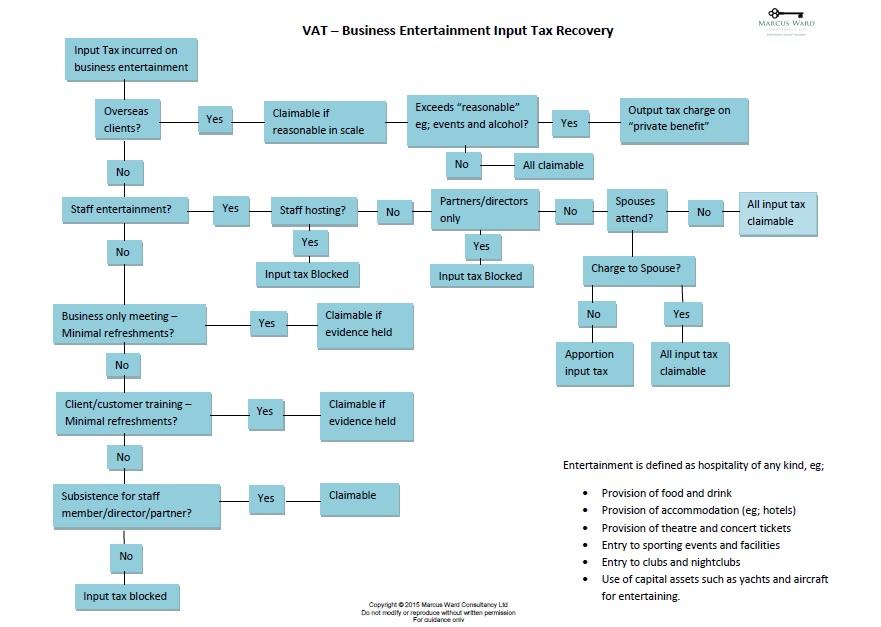
One of the most common questions asked on “day-to-day” VAT is whether input tax incurred on entertainment is claimable.  The answer to this seemingly straightforward question has become increasingly complex as a result of; HMRC policy, EC involvement and case law.

Different rules apply to entertaining; clients, contacts, staff, partners and directors depending on the circumstances.  It seems reasonable to treat entertaining costs as a valid business expense.  After all, a business, amongst other things, aims to increase sales and reduce costs as a result of these meetings.  However, HMRC sees things differently and there is a general block on business entertainment.  It seems like HMRC does not like watching people enjoying themselves at the government’s expense!

If, like me, you think in pictures, then a flowchart may be useful for deciding whether to claim entertainment VAT.  It covers all scenarios, but if you have a unique set of circumstances or require assistance with some of the definitions, please contact me.

We have recently carried out a series of presentations, which, amongst other subjects, covered business entertainment. Should you require VAT training or presentations, don’t forget our comprehensive service here which can be tailored to your needs.

VAT -Business Entertainment Flowchart

Business Entertainment flow chart

Download here: VAT Business Entertainment Input tax recovery flowchart