Category Archives: Small Businesses

Small business: Should I register for VAT voluntarily?

By   12 January 2016

OK, so why would a business choose to VAT register when it need not (let’s say it’s turnover is under the VAT registration limit of £82,000)?  Isn’t it best just to avoid the VATman if at all possible?

This is not an article which considers whether a business MUST register, but rather it looks at whether it is a good idea to register on a voluntary basis if it is not compulsory.

As a general rule of thumb; if you sell to the public (B2C) then probably not.  If you sell to other VAT registered businesses (B2B) then it is more likely to be beneficial.

If you sell B2B to customers overseas it is almost certain that VAT registration would be a good thing, as it would if you supply zero rated goods or services in the UK.  This is because there is no output tax on sales, but full input tax recovery on costs; VAT nirvana!  A distinction must be made between zero rated supplies and exempt supplies.  If only exempt supplies are made, a business cannot register for VAT.

Apart from the economic considerations, we have found that small businesses are sometimes put off  VAT registration by the added compliance costs and the potential penalties being in the VAT club can bring.  Weighed against this, there is a certain kudos or prestige for a business and it does convey a degree of seriousness of a business undertaking. It may also make life simpler (and reduce costs) if a business buys goods or services from other EC Member States.  We also come across situations where a customer will only deal with suppliers who are VAT registered.

The key to registration is that, once registered, a business may recover the VAT it incurs on its expenditure (called input tax).  So let us look at some simple examples of existing businesses for comparison:

Example 1

A business sells office furniture to other VAT registered business (B2B).

It buys stock for 10,000 plus VAT of 2,000

It incurs VAT on overheads (rent, IT, telephones, light and heat etc) of 2,000 plus 400 VAT

It makes sales of 20,000.

If not registered, its profit is 20,000 less 12,000 less 2400 = 5600

If VAT registered, the customer can recover any VAT charged, so VAT is not a disincentive to him.

Sales 20,000 plus 4000 VAT (paid to HMRC)

Input tax claimed = 2400 (offset against payment to HMRC)

Result: the VAT is neutral and not a cost, so profit is 20,000 less 12,000 = 8000, a saving of 2400 as compared to the business not being registered.  The 2400 clearly equals the input tax recovered on expenditure.

Example 2

A “one-man band consultant” provides advice B2B and uses his home as his office.  All of his clients are able to recover any VAT charged.

He has very little overheads that bear VAT as most of his expenditure is VAT free (staff, train fares, use of home) so his input tax amounts to 100.

He must weigh up the cost (time/admin etc) of VAT registration against reclaiming the 100 of input tax.  In this case it would probably not be worthwhile VAT registering (although the Flat Rate Scheme may be attractive, please see article here

Example 3

A retailer sells adult clothes to the public from a shop. She pays VAT on the rent and on the purchase of stock as well as the usual overheads.  The total amount she pays is 20,000 with VAT of 4000.

Her sales total 50,000.

If not VAT registered her profit is 50,000 less 24,000 = 26,000

If VAT registered she will treat the value of sales as VAT inclusive, so of the 50,000 income 8333 represents VAT she must pay to HMRC.  She is able to offset her input tax of 4000.

This means that her profit if VAT registered is 50,000 less the VAT of 8333  = 41,667 less the net costs of 20,000 = 21,667.

Result: a loss of 4333 in profit.

As may be seen, if a business sells to the public it is nearly always disadvantageous to be voluntarily VAT registered. It may be possible to increase her prices by circa 20%, but for a lot of retailers, this is unrealistic.

Intending traders

If a business has not started trading, but is incurring input tax on costs, it is possible to VAT register even though it has not made any taxable supplies.  This is known by HMRC as an intending trader registration.  A business will need to provide evidence of the intention to trade and this is sometimes a stumbling block, especially in the area of land and property.  Choosing to register before trading may avoid losing input tax due to the time limits (very generally a business can go back six months for services and four years for goods on hand to recover the VAT).  Also cashflow will be improved if input tax is recovered as soon as possible.

Action

Careful consideration should be given to the VAT status of a small or start-up business.  This may be particularly relevant to start-ups as they typically incur more costs as the business begins and the recovery of the VAT on these costs may be important.

This is a basic guide and there are many various situations that require further consideration of the benefits of voluntary VAT registration.  We would, of course, be pleased to help.

VAT – Building your new home. Claiming VAT on costs

By   14 December 2015

Building your own home is becoming increasingly popular.  There are many things to think about, and budgeting is one of the most important.

The recovery of VAT on the project has a huge impact on the budget and care must be taken to ensure that a claim is made properly and within the time limits.  You don’t have to be VAT registered to make a claim, this is done via a mechanism known as The DIY Housebuilders’ Scheme.  It has specific rules which must be adhered to otherwise the claim will be rejected.

If you buy a new house from a property developer, you will not be charged VAT. This is because the sale of the house to you will be zero-rated. This allows the developer to reclaim the VAT paid on building materials from HMRC. However, if you build a house yourself, you will not be able to benefit from the zero-rating. The DIY Housebuilder’ Scheme puts you in a similar position to a person who buys a zero-rated house built by a property developer.

Who can make a claim?

You can apply for a VAT refund on building materials and services if you are:

  • building a new home in which you will live
  • converting a building into a home
  • building a non-profit communal residence, eg; a hospice
  • building a property for a charity.

Eligibility

New homes

The house must:

  • be separate and self-contained (eg; not an extension)
  • be for you or your family to live or holiday in (not for sale when complete)
  • not be for business purposes (you can use one room as a work from home office)
  • not be prevented from sale independently to another building by planning permission or similar (eg; a granny annexe).

A claim may also be made for garages built at the same time as the house and to be used with the house.

Contractors working on new residential buildings should zero rate their supplies to you, so you won’t pay any VAT on these.

Conversions

The building being converted must usually be a non-residential building (eg; a barn conversion). Residential also buildings qualify if they haven’t been lived in for at least 10 years.

You may claim a refund for builders’ work on a conversion of non-residential building into home. These supplies will be charged at the reduced rate of 5% for conversion works.  If the standard rate of 20% s charged incorrectly, you will not be able to claim the standard rated amount. Care should be taken that the contractor understands the VAT rules for conversions as these can be complex.

Communal and charity buildings

You may get a VAT refund if the building is for one of the following purposes:

  • non-business – you can’t charge a fee for the use of the building
  • charitable, eg; a hospice
  • residential, eg; a children’s home

What can you claim on?

Building materials

You may claim a VAT refund for building materials that are incorporated into the building and can’t be removed without tools or damaging the building.

What doesn’t qualify

You cannot claim for:

  • building projects outside the UK
  • materials or services that don’t have any VAT, eg;  were zero-rated or exempt
  • professional or supervisory fees, eg architects and surveyors
  • the hire of plant, tools and equipment, eg; generators, scaffolding and skips
  • building materials that aren’t permanently attached to or part of the building itself
  • some fitted furniture, electrical and gas appliances, carpets or garden ornaments
  • supplies for which you do not have a VAT invoice

Examples of items you can, and cannot claim for are listed below.

How to claim

To claim a VAT refund, send form 431NB or 431C to HMRC

Local Compliance National DIY Team
SO987
Newcastle
NE98 1ZZ

What you need to know

You must claim within 3 months of the building work being completed.

You will usually get the refund in 30 working days of sending the claim.

You must include the following with your claim:

  • bank details
  • planning permission
  • proof the building work is finished – eg a letter from your local authority
  • a full set of building plans
  • invoices – including tenders or estimations if the invoice isn’t itemised
  • bills and any credit notes

VAT invoices must be valid and show the correct rate of VAT or they will not be accepted in the claim.

HMRC usually examine every claim closely and often query them, so it pays to ensure that the claim is as accurate as possible first time.  We find a review by us before submission ensures the maximum amount is claimed and delays are avoided.

Payments made after completion of the house cannot be claimed, and only one claim can be made for the whole project, so cashflow may be an issue.

Examples of items that you can claim for
The items listed below are accepted as being ‘ordinarily’ incorporated in a building (or its site). This is not a complete list.
  • Air conditioning
  • Building materials that make up the fabric of the property (for example, bricks, cement, tiles, timber, etc)
  • Burglar and fire alarms
  • Curtain poles and rails
  • Fireplaces and surrounds
  • Fitted kitchen furniture, sinks, and work surfaces
  • Flooring materials (other than carpets and carpet tiles)
  • Some gas and electrical appliances when wired-in or plumbed-in
  • Heating and ventilation systems including solar panels
  • Light fittings (including chandeliers and outside lights)
  • Plumbing materials, including electric showers, ‘in line’ water softeners and sanitary ware
  • Saunas
  • Turf, plants, trees (to the extent that they are detailed on scheme approved by a Planning Permission) and fencing permanently erected around the boundary of the dwelling
  • TV aerials and satellite dishes
Examples of items that you cannot claim for
This is not a complete list.
    • Aga/range cookers (Unless they are solid fuel, oil-fired or designed to heat space or water. Note: not all cookers are ‘space heaters’ because they incidentally radiate heat while operating. To be classified as such they must be fitted to a heating module or boiler)
    • Free-standing and integrated appliances such as: cookers, fridges, freezers, dishwashers, microwaves, washing machines, dryers, coffee machines
    • Audio equipment (including remote controls), built-in speakers, intelligent lighting systems, satellite boxes, Freeview boxes, CCTV, telephones
    • Consumables (for example, sandpaper, white spirit)
    • Electrical components for garage doors and gates (including remote controls)
    • Bedroom furniture (unless they are basic wardrobes) bathroom furniture (for example, vanity units and free-standing units)
    • Curtains, blinds (unless they are integral, that is, blinds inside sealed double-glazed window units),
    • Carpets
  • Garden furniture and ornaments and sheds. 

Please contact us if you require assistance with a DIY Housebuild project.

VAT – Well, it is christmas…

By   7 December 2015

Dear Marcus 2013-12-01 Bury St Eds Xmas Fair0072

My business, if that is what it is, has become large enough for me to fear that HMRC might take an interest in my activities.  May I explain what I do and then you can write to me with your advice?  If you think a face to face meeting would be better I can be found in most decent sized department stores from mid September to 24 December.

First of all I am based in Greenland but I do bring a stock of goods, mainly toys, to the UK and I distribute them.  Am I making supplies in the UK?

The toys are of course mainly for children and I wonder if zero rating might apply?  I have heard that small T shirts are zero rated so what about a train set – it is small and intended for children. Does it matter if adults play with it?

My friend Rudolph has told me that there is a peculiar rule about gifts.  He says that if I give them away regularly and they cost more than £150 I might have to account for VAT.  Is that right?

My next question concerns barter transactions.  Dads often leave me a food item such as a mince pie and a drink and there is an unwritten rule that I should then leave something in return.  If I’m given Tesco’s own brand sherry I will leave polyester underpants but if I’m left a glass of Glenfiddich I will be more generous and leave best woollen socks.  Have I made a supply and what is the value please?  My feeling is that the food items are not solicited so VAT might not be due and, in any event; isn’t food zero-rated, or is it catering? Oh, and what if the food is hot?

Transport is a big worry for me.  Lots of children ask me for a ride on my airborne transport.  I suppose I could manage to fit 12 passengers in.  Does that mean my services are zero-rated?  If I do this free of charge will I need to charge air passenger duty?  Does it matter if I stay within the UK?  My transport is the equivalent of six horse power and if I refuel with fodder in the UK will I be liable for fuel scale charges?  After dropping the passengers off I suppose I will be accused of using fuel for the private journey back home.  Somebody has told me that if I buy hay labelled as animal food I can avoid VAT but if I buy the much cheaper bedding hay I will need to pay VAT.  Please comment.

Can I also ask about VAT registration?  I know the limit is £82,000 per annum but do blips count?  If I do make supplies at all, I do nothing for 364 days and then, in one day (well night really) I blast through the limit and then drop back to nil turnover.  May I be excused from registration?  If I do need to register should I use AnNOEL Accounting?  At least I can get only one penalty per annum if I get the sums wrong.

I would like to make a claim for input tax on clothing.  I feel that my red clothing not only protects me from the extreme cold but it is akin to a uniform and should be allowable.  These are not clothes that I would choose to wear except for my fairly unusual job.  If lady barristers can claim for black skirts I think I should be able to claim for red dress.  And what about my annual haircut?  That costs a fortune.  I only let my hair grow that long because it is expected of me.

Insurance worries me too.  You know that I carry some very expensive goods on my transport.  Play Stations, Mountain Bikes, i-pads and Accrington Stanley replica shirts for example.  My parent company in Greenland takes out insurance there and they make a charge to me.  If I am required to register for VAT in England will I need to apply the reverse charge?  This seems to be a daft idea if I understand it correctly.  Does it mean I have to charge myself VAT on something that is not VATable and then claim it back again?

Next you’ll be telling me that Father Christmas isn’t real……….

VAT – The Default Surcharge. What is it, is it fair and will the regime change?

By   1 December 2015

What is the Default Surcharge? 

Default Surcharge is a civil penalty to encourage businesses to submit their VAT returns and pay the tax due on time.

When will a Default Surcharge be issued?

A business is in default if it sends in its VAT return and or the VAT due late. No surcharge is issued the first time a business is late but a warning (a Surcharge Liability Notice) is issued. Subsequent defaults within the following twelve months (the “surcharge period”) may result in a surcharge assessment. Each time that a default occurs the surcharge period will be extended. There is no liability to a surcharge if a nil or repayment return is submitted late, or the VAT due is paid on time but the return is submitted late (although a default is still recorded).

How much is the surcharge?

The surcharge is calculated as a percentage of the VAT that is unpaid at the due date. If no return is submitted the amount of VAT due will be assessed and the surcharge based on that amount. The rate is set at 2 per cent for the first default following the Surcharge Liability Notice, and rises to 5 per cent, 10 per cent and 15 per cent for subsequent defaults within the surcharge period.  A surcharge assessment is not issued at the 2 per cent and 5 per cent rates if it is calculated at less than £200 but a default is still recorded and the surcharge period extended. At the 10 per cent and 15 per cent the surcharge will be the greater of the calculated amount or £30.

Specific issues

The default surcharge can be particularly swingeing for a fast growing company. Let’s say that a small company grows quickly. In the early days the administration was rather haphazard, as is often the case, and a number of returns and payments were submitted late. Fast forward and the turnover, and the VAT payable, has grown significantly. Being late at this time means that the amount of default surcharge is considerably higher than when the original default which created the surcharge took place.  This leads us onto whether the surcharge is proportionate.

A business with cashflow difficulties may well ask whether it should be penalised by HMRC for having those difficulties; which of course will add to the problem.

Proportionality

The existing, long-standing default surcharge regime has always had issues with the principle of proportionality.  The regime has regularly been challenged in the Courts.

Is it proportionate that a same penalty is applied for a payment which is one day late and one which is one year late? This is a matter which has concerned both HMRC and the Courts for a number of years.

In the Upper Tribunal case of Total Technology (Engineering) Ltd the Judge concluded that it was possible for an individual surcharge to be disproportionate, but that the system as a whole was not fundamentally flawed. It is also worth noting that in In Equoland judgment the judge stated that a penalty which is automatic and does not take into account the circumstances is at the least tending towards being disproportionate.  The default surcharge is automatic and it is one of the few penalties that cannot be mitigated in any circumstances.

Defence against a surcharge

In order to have a surcharge withdrawn it is necessary to demonstrate that a business had a reasonable excuse for the default.  

This is a subject of an article on its own.  Certain factors, like relaying on a third party are not accepted as a reasonable excuse. HMRC state that a business will not be in default if they, or the independent tribunal, agree that there is a reasonable excuse for failing to submit a VAT Return and/or payment on time.

There is no legal definition of reasonable excuse but HMRC will look closely at the circumstances that led to the default.

If the circumstance that led to the default were unforeseen and inescapable and a business is able to show that its conduct was that of a conscientious person who accepted the need to comply with VAT requirements, then it may amount to a reasonable excuse.

What sort of circumstances might count as reasonable excuse?

HMRC provide guidelines on circumstances where there might be a reasonable excuse for failing to submit a VAT Return and/or payment on time. These include:

  • computer breakdown
  • illness
  • loss of key personnel
  • unexpected cash crisis – where funds are unavailable to pay your tax due following the sudden reduction or withdrawal of overdraft facilities, sudden non-payment by a normally reliable customer, insolvency of a large customer, fraud or burglary. A simple lack of money is unlikely to be accepted as a reasonable excuse.
  • loss of records

Latest

A recent discussion document sought views from businesses and individuals on potential improvements to how HMRC applies penalties (including the default surcharge) for failing to pay what is owed or to meet deadlines for returns or registration.

HMRC is considering whether and how it should differentiate between those who deliberately and persistently fail to meet administrative deadlines or to pay what they should on time, and those who make occasional and genuine errors for which other responses might be more appropriate.

In the document HMRC highlight two issues with the current VAT default surcharge regime. The first is the concern that while the absence of penalty for the initial offence in a 12 month period gives business the chance to get processes right, some customers simply ignore this warning.

The second concern is the issue of proportionality which fails to distinguish between payments that are one or two days late or many months late.

In my view, it is likely that in the near future we will hear proposals for the system being amended.  I think we may anticipate the introduction of mitigation and suspension.

VAT Flat Rate Scheme – beware the hidden costs

By   5 November 2015

VAT Basics

Anything that makes VAT easier and that can even reduce the amount payable must be a good thing….right?

The Flat Rate Scheme (FRS) was introduced to simplify VAT accounting for small businesses (with an annual turnover under £150,000) and does away with the concept of input and output tax. Instead a flat rate is applied to a business’ VAT inclusive turnover. This means a business in the FRS cannot reclaim any VAT incurred on its purchases, but a lower (than 20%) rate of VAT is applied to its VAT inclusive income.

Additionally, there is an option to only account and pay VAT when the business itself has been paid by its customers; doing away with VAT bad debt issues and improving cashflow.

Now this certainly has its attractions in terms of reducing the administrative burden and some business find that it reduces the amount of VAT payable. However care should be taken to select the appropriate business category/rate. A simple exercise to compare VAT declared under the “normal” rules to that due under the FRS is clearly prudent. But, as with all things VAT, there can be a catch.

The two drawbacks to the scheme

1)      If a business incurs a significant amount of input tax then, unless the flat rate percentage benefit outweighs the loss of input tax, then the FRS is not for them.

2)      If a business makes any supplies at the zero rate, or that are exempt, or outside the scope of VAT this income is also included in the turnover for the FRS. The result is then that VAT has to be accounted for on sales that would be VAT free under the normal VAT rules.

This is a bad thing!

Examples of businesses which need to be particularly aware are ones which:

–        Export goods or services

–        Provide goods or services cross-border to other EC member States

–        Sell books, food, or children’s clothes

–        Build new homes

–        Provide transport

–        Let property

–        Are charities or Not For Profit entities

–        Provide financial or insurance services or brokerage

–        Provide health and/or welfare services

–        Provide education and/or training

–        Offer subscriptions to membership organisations

–        Provide sport services

–        Are usually in a repayment position with HMRC

(This list is not exhaustive).

The FRS should certainly be considered for smaller businesses especially start-ups; since a first year discount is available for those that are in their first year of VAT registration. These get a one per cent reduction in the flat rate percentage until the day before their first anniversary of becoming VAT registered.

It is important for advisers to consider whether a client would benefit from being in the FRS, or indeed, whether continuation of the scheme remains advantageous to the business.

The VAT flat rates

The VAT flat rate you use depends on the type of business. If the rate changes, a business must apply the new rate from the date it changes. Also, if the nature of a taxpayer’s business changes it is important to review its FRS position.

The applicable rates here

The detailed rules of the FRS here

VAT Distance Selling – avoidance structure now deemed ineffective

By   26 October 2015

The EC Commission’s VAT Committee has recently issued new guidelines to counter perceived avoidance of registering for Distance Selling by businesses.

In cases where the supplier is responsible for the delivery of goods B2C; typically mail-order and increasingly goods purchased online (so called “delivered goods”) the supplier is required to VAT register in the EC Member State of its customer(s) once a certain threshold is met. For full details of Distance Selling see here.

In order to avoid having to register, some business have sought to avoid their supply falling within the definition of delivered goods by splitting the sale of goods and the delivery.

The UK raised concerns about the planning and structures put in place to obviate the need to register in other EC Member States.  The VAT Committee has recognised these concerns and has today issued new guidelines on Distance Sales

In addition to the current rules (set out in Articles 32, 33 and 34 of the Principal VAT Directive) a Distance Sale will have occurred when goods have been “dispatched or transported by or on behalf of the supplier” in any cases where the supplier “intervenes directly or indirectly in the transport or dispatch of the goods.” The Committee has stated that it considers that the supplier shall be regarded as having intervened indirectly in the transport or dispatch of the goods if any of the following conditions apply:

(i)              The transport or dispatch of the goods is sub-contracted by the supplier to a third party who delivers the goods to the customer.

(ii)            The dispatch or transport of the goods is provided by a third party but the supplier bears totally or partially the responsibility for the delivery of the goods to the customer.

(iii)          The supplier invoices and collects the transport fees from the customer and further remits them to a third party that arranges the dispatch or transport of the goods.

The Committee further clarified that, in other cases of “intervention,” in particular where the supplier actively promotes the delivery services of a third party to the customer, puts the customer and the third party in contact and provides to the third party the information needed for the delivery of the goods, the seller should likewise be regarded as having “intervened indirectly” in the transport or dispatch of the goods.

Note: These guidelines issued by the VAT Committee are merely views of an advisory committee, they do not constitute an official interpretation of EC law and therefore do not bind the Commission or the Member States. However, the Committee’s views are highly influential and it is likely that Member States will review their procedures and implement these guidelines.

Distance Selling VAT registration can apply retrospectively and assessments and penalties for late registration and underdeclaration of VAT are likely. Also, with different VAT rates applicable in different Member States even if VAT has (incorrectly) been charged at the rate applicable in the Member State where the supplier belongs (rather than the customer) this will likely be at the incorrect rate and recovery of this incorrectly paid VAT will also create issues.

Please contact us if the above changes will affect your business as action must be taken immediately.

VAT Payment Problems – Q & As

By   29 September 2015

If you can’t pay your VAT bill, please do not put your head in the sand, the problem will not go away.  Here are some answers to the most commonly asked VAT payment problems.

Q: I have received a demand notice for payment of VAT. Why?

A: HMRC have not received payment of the VAT liability that is described in the demand notice. You should therefore pay the outstanding debt without delay so as to avoid further recovery action. HMRC take prompt action to recover debts.

Q: I am not able to pay the debt immediately because of a temporary cash-flow problem. What should I do?

A: You should make urgent contact with your bank or your financial adviser to explore means of overcoming these temporary financial difficulties.

Q: I have consulted the bank/financial adviser but they are unable to help. What else can I do?

A: Without further delay contact the Regional Debt Management Unit whose address appears on the demand notice. They may be able to help you by agreeing a brief period in which to pay the debt. They are usually helpful and will consider carefully all practical options for settlement. However, if these do not produce a solution or they do not receive a response to their request for payment, they may, like other creditors, take action to recover the money they are owed.

Q: What is the Default Surcharge?

A: Default Surcharge is a civil penalty to encourage businesses to submit their VAT returns and pay the tax due on time.

Q: When will a Default Surcharge be issued?

A: A business is in default if it sends in its VAT return and or the VAT due late. No surcharge is issued the first time a business is late but a warning (a Surcharge Liability Notice) is issued. Subsequent defaults within the following twelve months (the “surcharge period”) may result in a surcharge assessment. Each time that a default occurs the surcharge period will be extended. There is no liability to a surcharge if a nil or repayment return is submitted late, or the VAT due is paid on time but the return is submitted late (although a default is still recorded).

Q: How much is it?

A: The surcharge is calculated as a percentage of the VAT that is unpaid at the due date. If no return is submitted the amount of VAT due will be assessed and the surcharge based on that amount. The rate is set at 2 per cent for the first default following the Surcharge Liability Notice, and rises to 5 per cent, 10 per cent and 15 per cent for subsequent defaults within the surcharge period.  A surcharge assessment is not issued at the 2 per cent and 5 per cent rates if it is calculated at less than £200 but a default is still recorded and the surcharge period extended. At the 10 per cent and 15 per cent the surcharge will be the greater of the calculated amount or £30.

Q: What sort of assessments are sent out?

A: An assessment may be issued if a VAT return is not submitted by the due date. The amount may be based on previous returns. If a business does not submit its returns time after time, the assessment value will increase. An officer may also issue an assessment after a visit, if they have found errors in the amount of tax declared on previous returns.

Both types are included in the traders’ debt and are collected in the normal way if they are not paid promptly.

Help 

There are a number of schemes available which may help cashflow or possibly reduce the amount of VAT you pay.

Cash Accounting – where you only pay VAT to HMRC when you have received payment from your customer.
Annual Accounting – where you make set monthly payments and make one return a year with an adjusting payment.
Flat Rate Scheme – where you pay a set percentage of your turnover rather than calculating output tax less input tax.
Bad Debt Relief – where you are able to reclaim VAT relief on your bad debts.

Please contact us if VAT payments are proving a problem for your business.  Negotiation with HMRC is possible.

Very basic VAT Q & As for a fledgling business

By   25 August 2015

There is a lot of information about VAT on the web, but some of it may seem confusing or conflicting.  I hope my simple VAT guide to a complex tax may be of help.

Q: I run a business – do I have to charge VAT on my sales?

A: If a business’s turnover exceeds £82,000 in any 12 month period it is likely that it ought to be VAT-registered and charging VAT on its income. It is the business’s responsibility to monitor its turnover and register with HM Revenue & Customs if necessary. However, not all income counts towards the turnover limit, for instance you can ignore exempt income (see below for a description of exempt sales).

VAT registration may also be necessary if you know that your income will exceed the limit in the next 30 days (the future test). This may because you have signed a contract for work for instance.

A business can also VAT register voluntarily.  This is usually done to reclaim VAT it has incurred.

Finally, a business must VAT register if it receives certain goods and services form overseas worth more than £82,000.

Q: What happens if I don’t register for VAT when I should?

A: In addition to paying VAT from the date a business should have registered, there will be penalties and interest to pay. HM Revenue & Customs may carry out further investigations if they consider that failure to register was more than an innocent error.

Q: Why is paperwork so important in VAT?

A: Since VAT is a transaction-based tax, it is important to have evidence of those transactions.

Q: Are there any benefits to being VAT-registered?

A: Yes, you will usually be able to claim the VAT you incur on expenditure for your business.

Q: Can’t I recover all the VAT I incur?

A: Some VAT is specifically blocked, such as: cars for most businesses and business entertainment. In addition, if a business makes exempt supplies, it is usually unable to recover any VAT it incurs in relation to those supplies. Apart from this, as long as the expenditure is for business (not private) purposes, and the business has supporting documentation to support the claim, most VAT is recoverable from HMRC.

Q: Do I charge VAT on everything?

A: No, some sales such as food, books and children’s clothing are zero-rated, and some activities including certain property rental and sales, insurance and health services are exempt from VAT. In addition, sales to most overseas business purchasers may be treated as VAT-free. The difference between exempt and zero-rated is that there is no block on the recovery of VAT incurred in relation to zero-rated supplies so usually a business making solely or substantially zero-rated supplies will actually receive payments from HMRC.

Q: Are there any short-cuts to accounting for, and paying VAT?

A: There are a number of schemes aimed at simplifying VAT. These range from annual (rather than the more usual quarterly) returns, cash accounting (where you don’t need to pay HMRC until you have been paid) to simplified flat rate schemes whereby you pay over an element of your turnover without the need for further calculations

Q: What if I get it wrong?

A: Unfortunately, as with everything connected to VAT, there are penalties and interest for even innocent errors. If HMRC find an error before you have notified them of it, there can be quite swingeing extra amounts to pay over. If HMRC consider that there is deliberate evasion, and evidence is found, a prison sentence of up to seven years is possible.

Q: What should I do if I am uncertain about what the VAT treatments of my sales are, or when I should register for VAT?

A: Please contact me!  Not only can I assist with the technical side, but there is often planning that may be put in place to mitigate the cost of VAT or penalties.

VAT – The Future for the EC Digital Single Market

By   11 May 2015

VAT – The Future for the EC Digital Single Market

The EC has announced its plans for its VAT digital single market in respect of online sales. Full details are here and here.

The highlights are:

• Extension of MOSS to intra-EC and third country online B2C sales of goods.

• Introduction of a new EC-wide VAT threshold to help start-up businesses.

• Ending current distance selling thresholds.

• Allowing for domestic controls, including a single audit of cross-border sales.

• Removal of the VAT exemption for the import of small consignments form third countries.

• Removal of barriers to cross-border sales eg; geo-blocking and costs.

This is likely to have a huge impact on the way businesses deal with VAT on sales of goods to individuals overseas. If the introduction of MOSS is anything to go by, we may be in for a bumpy ride.

VAT – Business Entertainment Flowchart. What input tax may I recover?

By   11 May 2015

VAT – Recovery of input tax incurred on entertainment

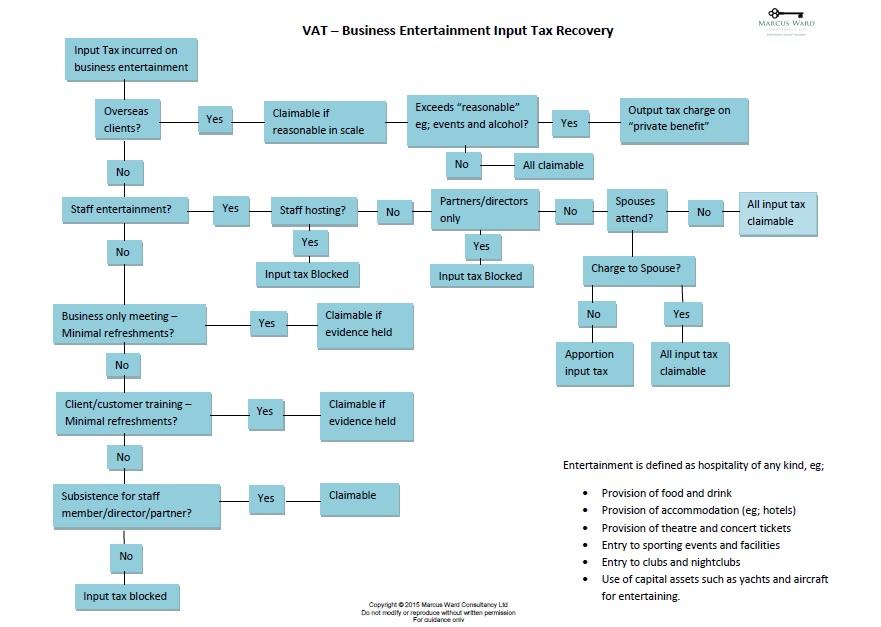
One of the most common questions asked on “day-to-day” VAT is whether input tax incurred on entertainment is claimable.  The answer to this seemingly straightforward question has become increasingly complex as a result of; HMRC policy, EC involvement and case law.  Different rules apply to entertaining; clients, contacts, staff, partners and directors depending on the circumstances.  It seems reasonable to treat entertaining costs as a valid business expense.  After all, a business, amongst other things, aims to increase sales and reduce costs as a result of these meetings.  However, HMRC sees things differently and there is a general block on business entertainment.  It seems like HMRC does not like watching people enjoying themselves at the government’s expense!

If, like me, you think in pictures, then a flowchart may be useful for deciding whether to claim entertainment VAT.  It covers all scenarios, but if you have a unique set of circumstances or require assistance with some of the definitions, please contact me.

I thank my friend and colleague Leila Ong for help with this, and also with the series of presentations we have recently carried out and which, amongst other subjects, covered business entertainment. Should you require VAT training or presentations, don’t forget our comprehensive service here which can be tailored to your needs.

VAT -Business Entertainment Flowchart

Business Entertainment flow chart

Download here: VAT Business Entertainment Input tax recovery flowchart