Category Archives: VAT Planning

Incoterms. What are they, how can they be of use for VAT?

By   3 August 2017
VAT – Cross border sales of goods

Incoterms stands for International Commercial Terms. These are published by the International Chamber of Commerce (ICC) and describe agreed commercial terms. These rules set out the responsibilities of buyers and sellers for the supply of goods under a contract. They are very commonly used in cross-border commercial transactions in order that both sides in a transaction are aware of the contractual position. They help businesses avoid costly misunderstandings by clarifying the tasks, costs and risks involved in the delivery of goods from sellers to buyers. The latest terms were published in 2010 and came into effect in 2011.

The use of Incoterms for assistance for VAT purposes

One of the most difficult areas of providing VAT advice is obtaining sufficient detailed information to advise accurately and comprehensively.  Quite often advisers are given what a client believes to be the arrangements for a transaction. This may differ from the actual facts, or the understanding of the other party in the transaction.

Pragmatically, this uncertainty about the details may be increased if; a number of different people within an organisation are involved, it is a new or one-off type of transaction, there are language difficulties, or communication and documentation is less than ideal. In such cases, incoterms will provide invaluable information which gives clarity and certainty and usually give a sound basis on which to advise. This enables the adviser to establish the place of supply (POS) and therefore what VAT treatment needs to be applied.

So what is this set of pre-defined international contract terms?

They are 11 pre-defined terms which are subdivided into two categories:

Group 1 – Incoterms that apply to any mode of transport are:

EXW – Ex Works (named place)

The seller makes the goods available at their premises. This term places the maximum obligation on the buyer and minimum obligations on the seller. EXW means that a buyer incurs the risks for bringing the goods to their final destination. The buyer arranges the pickup of the freight from the supplier’s designated ship site, owns the in-transit freight, and is responsible for clearing the goods through Customs. The buyer is also responsible for completing all the export documentation.

Most jurisdictions require companies to provide proof of export for VAT purposes. In an EXW shipment, the buyer is under no obligation to provide such proof, or indeed to even export the goods. It is therefore of utmost importance that these matters are discussed with the buyer before the contract is agreed.

FCA – Free Carrier (named place of delivery)

The seller delivers the goods, cleared for export, at a named place. This can be to a carrier nominated by the buyer, or to another party nominated by the buyer.

It should be noted that the chosen place of delivery has an impact on the obligations of loading and unloading the goods at that place. If delivery occurs at the seller’s premises, the seller is responsible for loading the goods on to the buyer’s carrier. However, if delivery occurs at any other place, the seller is deemed to have delivered the goods once their transport has arrived at the named place; the buyer is responsible for both unloading the goods and loading them onto their own carrier.

CPT – Carriage Paid To (named place of destination)

The seller pays for the carriage of the goods up to the named place of destination. Risk transfers to buyer upon handing goods over to the first carrier at the place of shipment in the country of Export. The Shipper is responsible for origin costs including export clearance and freight costs for carriage to named place (usually a destination port or airport). The shipper is not responsible for delivery to the final destination (generally the buyer’s facilities), or for buying insurance. If the buyer does require the seller to obtain insurance, the Incoterm CIP should be considered.

CIP – Carriage and Insurance Paid to (named place of destination)

This term is broadly similar to the above CPT term, with the exception that the seller is required to obtain insurance for the goods while in transit. CIP requires the seller to insure the goods for 110% of their value.

DAT – Delivered At Terminal (named terminal at port or place of destination)

This term means that the seller covers all the costs of transport (export fees, carriage, unloading from main carrier at destination port and destination port charges) and assumes all risk until destination port or terminal. The terminal can be a Port, Airport, or inland freight interchange. Import duty/VAT/customs costs are to be borne by the buyer.

DAP – Delivered At Place (named place of destination)

The seller is responsible for arranging carriage and for delivering the goods, ready for unloading from the arriving conveyance, at the named place. Duties are not paid by the seller under this term. The seller bears all risks involved in bringing the goods to the named place.

DDP – Delivered Duty Paid (named place of destination)

The seller is responsible for delivering the goods to the named place in the country of the buyer, and pays all costs in bringing the goods to the destination including import duties and VAT. The seller is not responsible for unloading. This term places the maximum obligations on the seller and minimum obligations on the buyer. With the delivery at the named place of destination all the risks and responsibilities are transferred to the buyer and it is considered that the seller has completed his obligations.

Group 2 – Incoterms that apply to sea and inland waterway transport only:

FAS – Free Alongside Ship (named port of shipment)

The seller delivers when the goods are placed alongside the buyer’s vessel at the named port of shipment. This means that the buyer has to bear all costs and risks of loss of or damage to the goods from that moment. The FAS term requires the seller to clear the goods for export. However, if the parties wish the buyer to clear the goods for export, this should be made clear by adding explicit wording to this effect in the contract of sale. This term can be used only for sea or inland waterway transport.

FOB – Free On Board (named port of shipment)

FOB means that the seller pays for delivery of goods to the vessel including loading. The seller must also arrange for export clearance. The buyer pays cost of marine freight transport, insurance, unloading and transport cost from the arrival port to destination. The buyer arranges for the vessel, and the shipper must load the goods onto the named vessel at the named port of shipment. Risk passes from the seller to the buyer when the goods are loaded aboard the vessel.

CFR – Cost and Freight (named port of destination)

The seller pays for the carriage of the goods up to the named port of destination. Risk transfers to buyer when the goods have been loaded on board the ship in the country of export. The shipper is responsible for origin costs including export clearance and freight costs for carriage to named port. The shipper is not responsible for delivery to the final destination from the port (generally the buyer’s facilities), or for buying insurance. CFR should only be used for non-containerised sea freight, for all other modes of transport it should be replaced with CPT.

CIF – Cost, Insurance and Freight (named port of destination)

This term is broadly similar to the above CFR term, with the exception that the seller is required to obtain insurance for the goods while in transit to the named port of destination. CIF requires the seller to insure the goods for 110% of their. CIF should only be used for non-containerised sea freight; for all other modes of transport it should be replaced with CIP.

 Allocations of costs to buyer/seller via incoterms

Summary Chart
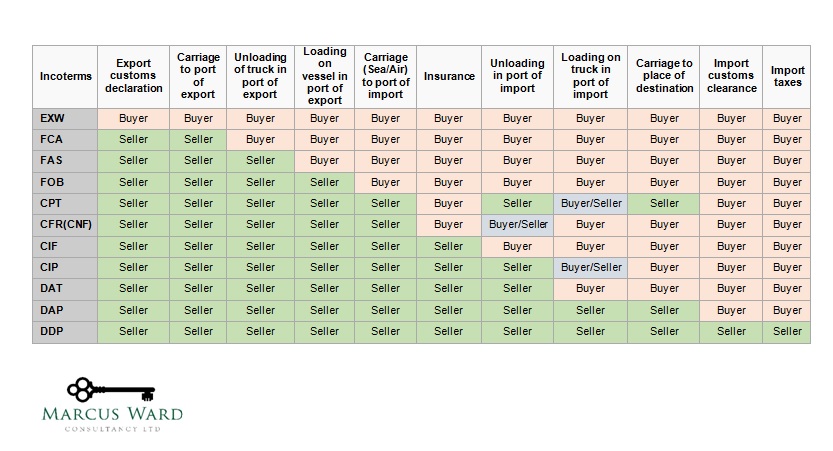
Incoterms Chart

VAT treatment of vouchers, gifts and discounts – How business promotions work

By   17 July 2017

Business promotions are an area of VAT which continues to prove complex.  This is further exacerbated by changes to the legislation at EC and domestic level and ongoing case law.

The VAT position is summarised here. Part of this commentary has been taken directly from HMRC guidance on the subject and is the most up to date authority on the matter.  I thought it may be useful if the VAT treatment of various business promotion schemes is summarised in one place.

…I recall a statement from an old mentor of mine; “if you have a marketing department you have a VAT problem!”

 Summary

Offer How to charge VAT
Discounts Charged on the discounted price (not the full price)
Gifts Charged on the gift’s full value – there are some exceptions listed below
Multi-buys Charged on the combined price if all the items have the same VAT rate. If not, VAT is ‘apportioned’ as mixed-rate goods
Money-off coupons, vouchers etc No VAT due if given away free at time of a purchase. If not, VAT due on the price charged
Face value vouchers that can be used for more than one type of good or service (multi-purpose) No VAT due, if sold at or below their monetary value
Face value vouchers that can only be used for one type of good or service (single-purpose) VAT due on the value of the voucher when issued
Redeemed face value vouchers Charged on the full value of the transaction at the appropriate rate of the goods provided in return for the voucher

 Exceptions for gifts

There’s no VAT due on gifts given to the same person if their total value in a 12 month period is less than £50.

Free goods and services

You don’t have to pay VAT on things like free samples if they meet certain conditions.

Supplies Condition to meet so no VAT due
Free samples Used for marketing purposes and provided in a quantity that lets potential customers test the product
Free loans of business assets The cost of hiring the asset is included in something else you sell to the customer
Free gifts The total cost of all gifts to the same person is less than £50 in a 12 month period
Free services You don’t get any payment or goods or services in return

Face value vouchers

Recent changes, radically alter the UK rules for face value vouchers. Face value vouchers are vouchers, tokens, stamps (physical or electronic) which entitle the holder to certain goods or services up to the value on the face of the vouchers from the supplier of those goods or services.

Examples of face value vouchers would include vouchers sold by popular group discount websites, vouchers sold by high street retailers, book tokens, stamps and various high street vouchers.

Single or multi-purpose

The most important distinction for face value vouchers is whether a voucher is a single purpose voucher or multi-purpose voucher. If it is a multi-purpose voucher then little has changed. If it is a single purpose voucher, however, HMRC will now charge VAT when it is issued.

Single purpose vouchers are vouchers which carry the right to receive only one type of goods or services which are all subject to a single rate of VAT. Multi-purpose vouchers are anything else. The differences can be quite subtle.

For example:

  • a voucher which entitles you to download an e-book from one seller will be a single purpose voucher. A voucher which entitles you to either books (zero rated) or an e-book download (standard rated) from the same seller will be multi-purpose
  • a voucher which entitles you to £10 of food at a restaurant which does not sell takeaways is probably single purpose, whereas if the restaurant has a cold salad bar and you can buy a take away with the voucher (or hot food) then it would be multi-purpose. 

The above means that for single purpose vouchers VAT is due whether the voucher is actually redeemed or not; which seems an unfair result. There is no way to reduce output tax previously accounted for if the voucher is not used.

The situations set out above are often further complicated when three or more parties are involved, but that’s a detailed article for another day….

VAT: More on agent/principal – Latest from the courts

By   3 July 2017

Lowcost Holidays Ltd

There is a very important distinction in VAT terms between agent and principal as it dictates whether output tax is due on the entire amount received by a “middle-man” or just the amount which the middle-man retains (usually a commission). It is common for the relationship between parties to be open to interpretation and thus create VAT uncertainty in many transactions.

It appears to me that this uncertainty has increased as a result of the growing amount of on-line sales and different parties being involved in a single sale.

By way of background, I looked at this issue at the end of last year here

The case

On a similar theme, the First Tier Tribunal (FTT) case of Lowcost Holidays Ltd the issue was whether the Tour Operators’ Margin Scheme (TOMS) applied to Lowcost’s activities.

Background

Lowcost was a travel agent offering holiday accommodation in ten other EU Member States, and other countries outside the EU, for the most part to customers based in the UK. The issue between the parties is whether Lowcost provided holiday accommodation to customers as a principal, dealing in its own name, under article 306 of Directive 2006/112, the Principal VAT Directive and therefore came within TOMS or whether it acted solely as an intermediary or agent (in which case TOMS would not apply and the general Place Of Supply rules apply).

Decision

The FTT found in favour of the appellant. HMRC had argued that Lowcost was buying and selling travel and accommodation as principal, however, the FTT decided that the contracts which Lowcost entered into with; hotels, transport providers and holidaymakers were clear that the arrangement was for the appellant acting as agent. The helpful Supreme Court case of SecretHotels2 (which I commented on here) was applied in this case. The main point being that the nature of a supply is to be determined by the construction of the contract – unless it is a ‘sham’ and great weight was given to the terms of Lowcost’s contracts rather than what HMRC often call the “economic reality”.  Specifically highlighted to the court was the fact that Lowcost set the prices for the holidays, which HMRC pointed out would be inconsistent with an agency arrangement. The FTT decided that this was outweighed by the actual terms of the contracts.

Consequently, as Lowcost acted as agent (for the providers of the services not the holidaymaker) the Place Of Supply was determined by reference to where the supply was received under the general rule.  In this case, this is VAT free when the services were received by principals located outside the UK.

As with all TOMS and agent/principal matters it really does pay to obtain professional advice.

VAT – Business Entertainment Flowchart. What input tax may I recover?

By   26 June 2017

VAT – Recovery of input tax incurred on entertainment

One of the most common questions asked on “day-to-day” VAT is whether input tax incurred on entertainment is claimable.  The answer to this seemingly straightforward question has become increasingly complex as a result of; HMRC policy, EC involvement and case law.

Different rules apply to entertaining; clients, contacts, staff, partners and directors depending on the circumstances.  It seems reasonable to treat entertaining costs as a valid business expense.  After all, a business, amongst other things, aims to increase sales and reduce costs as a result of these meetings.  However, HMRC sees things differently and there is a general block on business entertainment.  It seems like HMRC does not like watching people enjoying themselves at the government’s expense!

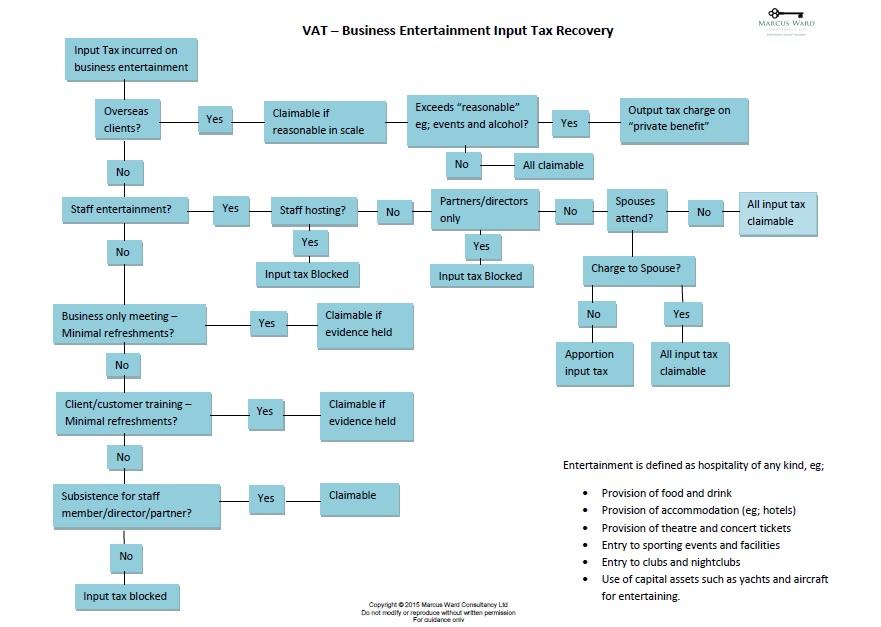
If, like me, you think in pictures, then a flowchart may be useful for deciding whether to claim entertainment VAT.  It covers all scenarios, but if you have a unique set of circumstances or require assistance with some of the definitions, please contact me.

We have recently carried out a series of presentations, which, amongst other subjects, covered business entertainment. Should you require VAT training or presentations, don’t forget our comprehensive service here which can be tailored to your needs.

VAT -Business Entertainment Flowchart

Business Entertainment flow chart

Download here: VAT Business Entertainment Input tax recovery flowchart

VAT and Customs Duties. Bringing goods into the UK – A brief guide

By   12 June 2017

VAT and duty on and imports and acquisitions 

The rules covering bringing goods into the UK are complex and set out in different areas of the legislation and HMRC guidance. I thought it may be helpful bring some of the most salient rules together in one place. Of course, with Brexit, some of the information below may be subject to change. Most likely, acquisitions will take on more of the rules applicable to imports, but we shall see…

If you are bringing goods into the UK it is important to recognise the VAT and duty rules and procedures.  You must ensure that you pay the right amount of VAT and import duties via the correct mechanism.

Goods brought into the UK from other EC countries are called acquisitions rather than imports, and this is an important distinction as we shall see below.

The details and practicalities can be complex and you may want to seek advice or use an agent or freight forwarder to handle your responsibilities, particularly if you are new to international trade or only need to bring goods here occasionally.

Acquisition of goods from EC Member States

The EC Member States

The 28 EC countries are: Austria, Belgium, Bulgaria, Croatia, Republic of Cyprus, Czech Republic, Denmark, Estonia, Finland, France, Germany, Greece, Hungary, Ireland, Italy, Latvia, Lithuania, Luxembourg, Malta, Netherlands, Poland, Portugal, Romania, Slovakia, Slovenia, Spain, Sweden and the UK.

Information

If you are UK VAT registered you need to give your supplier your VAT number. This allows the supplier to treat the sale to you as VAT free.  You will need a VAT invoice as with any other purchase. If not UK VAT registered you will pay VAT applicable in the Member State of the supplier.

Accounting for VAT 

You must account for VAT on acquisitions (“acquisition tax”) on your VAT return. VAT is charged at the normal UK rate of VAT for those goods.  You reclaim this acquisition tax in the same way as you reclaim input tax on purchases of supplies within the UK.  So for most businesses the effect is VAT neutral.  In this way there is no difference between buying the goods in the UK or another EC Member State so it rules out cross-border “VAT rate shopping”. There are no Customs Duties to pay on acquisitions.

Reporting

All VAT-registered businesses must show the total value of goods acquired from other EU Member States in box 9 of their VAT Return.

In addition, those who trade in the EC above the Intrastat exemption threshold in force during the year must also complete a monthly Supplementary Declaration (SD). The threshold is £1.5 million.

Importing goods from outside the EC

Your responsibilities for imports

You are normally responsible for clearing the goods through UK customs and paying any taxes and duties. Your supplier needs to provide the documentation you need to clear the goods through Customs. If you are importing you may have to pay import duty.

You will need to decide whether to use an agent to handle your responsibilities.  Freight forwarders can handle Customs clearance as well as transport. You can find reputable freight forwarders through the British International Freight Association: here 

You need to check what import duty applies

Import duty is based on the type of goods you are importing, the country they originate from and their value. HMRC’s Integrated Tariff sets out the classification of goods and the rates of duty in detail: here

Confirm what paperwork you require from the supplier for Customs clearance

This normally includes an invoice and a copy of the transport documents.  You may need proof of the origin of the goods to claim reduced import duty for goods from certain countries. A valuation document is also normally required for imports above a set value.

Complete an import declaration

You normally declare imports using the Single Administrative Document (SAD).  If you are registered for VAT in the UK you will need an EORI (Economic Operator Registration & Identification) to enable your inbound commercial shipments to be cleared through the automated  CHIEF (Customs Handling of Import and Export Freight). This is made up of your VAT number, plus a further three digits.

Release of goods

You will need to pay VAT and duty to get the goods released. You pay VAT at the normal UK rate for those goods when sold in the UK.

Deferment

Regular importers are able to defer payment of VAT and duty by opening a deferment account with HMRC. You need to provide security and must agree to pay by direct debit. It is also possible to use your agent or freight forwarder’s deferment account.

Accounting for VAT

HMRC will send you a monthly C79 certificate showing the import VAT you have paid. You must retain this.  Certificates cover accounting transactions made in each calendar month should be received around the 24th of each month following imports logged the previous month.

You can reclaim VAT paid on imports on a C79 in the same way as you reclaim input tax on purchases of supplies within in the UK.  It is not possible to reclaim VAT on any other document, eg; an invoice.  Shipping or forwarding agents can’t reclaim this input tax because the goods weren’t imported to be used in part of their business.

NB: If you import works of art, antiques and collectors’ items they are entitled to a reduced rate of VAT.

You cannot reclaim import duty.

Be aware of special cases

Check whether any goods you are buying are subject to Excise Duty

Excise duty is charged on fuel, alcohol and tobacco products. It is charged on acquisitions from within the EU as well as imports from countries outside the EC. If goods are subject to excise duty, you pay this at the same time as you pay VAT and import duty.

VAT is charged on the value of the goods plus excise duty.

Warehousing

You may want to consider using a Customs warehouse if you expect to store imports for a long time. If you store goods in a Customs warehouse, you will not need to pay import duty and VAT until you remove the goods from the warehouse.

Storage ‘in bond’ like this is often used for products subject to excise duty, such as wine and cigarettes, although it is not limited to these goods.

Re-exported goods

You will also find it beneficial to find out about tax relief if you are planning to re-export goods you import.  There are special Inward Processing Relief (IPR) rules so that you do not have to pay import duty and VAT.  This relief can apply to imports that you process before re-exporting them.

Valuation of imported goods for VAT and Duties

There are six methods of valuing imported goods, however, in the vast majority of cases (over 90%) the “Transaction Method” is used and, in fact, you must use this method wherever possible.

Transaction Value

This is the price paid or payable by the buyer to the seller for the goods when sold for export to the EC adjusted in accordance with certain specific rules.

This may also cover situations where goods are imported from a processor. The “transaction value” may be “built up” or “constructed” by reference to the cost of processing plus any items to be added commonly referred to as “assists”.

What items must be added to the price paid or payable?

You must add the following to the price you pay (unless they are already included):

(a) Delivery costs. – The costs of transport, insurance, loading or handling connected with delivering the goods to the EC border must be included.

(b) Commissions. – Certain payments of commission and brokerage, including selling commission, must be included.

But you can exclude buying commission if it is shown separately from the price paid or payable for the goods.

(c) Royalties and licence fees. – You must include these payments when they relate to the imported goods and are paid by you as a condition of the sale to you of those goods.

(d) Goods and services provided free of charge or at reduced cost by the buyer. –  If you provide, directly or indirectly, any of the following, you must include in the customs value any part of the cost or value not included in the price charged to you by the seller:

  1. materials, components, parts and similar items incorporated in the imported goods including price tags, kimball tags, labels
  2. tools, dies, moulds and similar items used in producing the imported goods, for example, tooling charges. There are various ways of apportioning these charges

iii.          materials consumed in producing the imported goods, for example, abrasives, lubricants, catalysts, reagents etc which are used up in the manufacture of the goods but are not incorporated in them,

  1. engineering, development, artwork, design work and plans and sketches carried out outside the EC and necessary for producing the imported goods. The cost of research and preliminary design sketches is not to be included.

(e) Containers and packing. Include:

  1. the cost of containers which are treated for customs purposes as being one with the goods being valued (that is not freight containers the hire-cost of which forms part of the transport costs), and
  2. the cost of packing whether for labour or materials

Where containers are for repeated use, for example, reusable bottles, you can spread their cost over the expected number of imports. If a number of the containers may not be re-exported, this must be allowed for.

(f) Proceeds of resale. – If you are to share with the seller (whether directly or indirectly) the profit on resale, use or disposal of the imported goods you must add the seller’s share to the price paid. If at the time of importation the amount of profit is not known, you must request release of the goods against a deposit or guarantee.

(g) Export duty & taxes paid in the country of origin or export. – When these taxes are incurred by the buyer they are dutiable. However, if you benefit from tax relief or repayment of these taxes they may be left out of the customs value.

Summary

If you are new to acquisitions or importing it may be worthwhile talking to an expert.  This article only scratches the surface of the subject. There can be significant savings made by accurately classifying goods and applying the correct procedures and rates will avoid assessments and penalties being levied. Planning may also be available to defer when tax is paid on imports and acquisitions.

VAT treatment of deposits and advance payments

By   5 June 2017

One query that constantly reappears is that of the VAT treatment of deposits.

This may be because there are different types of deposits with different VAT rules for each. I thought that it would be helpful for all the rules to be set out in one place, and some comments on how certain transactions are structured, so…

Broadly, we are looking at the tax point rules. The tax point is the time at which output tax is due and input tax recoverable. More on tax points here 

A business may have various commercial arrangements for payments such as:

  • receiving advance payments
  • being paid in instalments
  • credit sales
  • periodic payments for continuous supplies
  • security deposits for goods hired

I consider these below, as well as some specific arrangements:

Advance payments and deposits

An advance payment, or deposit, is a proportion of the total selling price that a customer pays a business before it supplies them with goods or services.

The tax point if an advance payment is made is whichever of the following happens first:

  • the date a VAT invoice for the advance payment is issued
  • the date you the advance payment is received

The VAT due on the value of the advance payment (only, not the full value of the overall supply) is included on the VAT return for the period when the tax point occurs.

If the customer pays the remaining balance before the goods are delivered or the services are performed, a further tax point is created when whichever of the following happens first:

  • the date a VAT invoice for the balance is issued
  • payment of the balance is received

So VAT is due on the balance on the return for when the further tax point occurs.

Returnable deposits

A business may ask its customers to pay a deposit when they hire goods. No VAT is due if the deposit is either:

  • refunded in full to the customer when they return the goods safely
  • kept by you to compensate you for loss or damage

Forfeit deposits

If a customer is asked for a deposit against goods or services but they then don’t buy them or use the services, it may be decided to retain the deposit. Usually the arrangement is that the customer is told/agrees in advance and it is part of the conditions for the sale. This arrangement is known as forfeit deposit. It often occurs when, for example, an hotel business makes a charge for reserving a room.

VAT should be declared on receipt of the deposit or when a VAT invoice is issued, whichever happens first.

If the deposit is retained (because the customer changes their mind about the goods or service and doesn’t want them any more) there is no VAT due as no supply has been made. If output tax has already been declared, the business needs to adjust for the amount of the retained deposit on the next VAT return. If the sale goes ahead, the rules for advance payments above applies.

Continuous supplies

If you supply services on a continuous basis and you receive regular or occasional payments, a tax point is created every time a VAT invoice is issued or a payment received, whichever happens first. An article on tax planning for continuous supplies here

If payments are due regularly a business may issue a VAT invoice at the beginning of any period of up to a year for all the payments due in that period (as long as there’s more than one payment due). If it is decided to issue an invoice at the start of a period, no VAT is declared on any payment until either the date the payment is due or the date it is received, whichever happens first.

Credit and conditional sales

This is where the rules can get rather more complex.

  • A credit sale means the sale of goods which immediately become the property of the customer but where the price is paid in instalments.
  • A conditional sale is where goods are supplied to a customer but the goods remain the seller’s property until they are paid for in full.

The tax point for a credit sale or a conditional sale is created at the time you supply the goods or services to your customer. This is the basic tax point and is when you should account for the VAT on the full value of the goods.

This basic tax point may be over-ridden and an actual tax point created if a business:

  • issues a VAT invoice or receives payment before supplying the goods or services
  • issues a VAT invoice up to 14 days after the basic tax point

Credit sales where finance is provided to the customer

If goods are offered on credit to a customer and a finance company is not involved, the supplier is financing the credit itself. If the credit charge is shown separately on an invoice issued to the customer, it will be exempt from VAT. Other fees relating to the credit charge such as; administration, documentation or acceptance fees will also be exempt. VAT is declared on the full value of the goods that have been supplied on the VAT Return for that period.

If goods or services are supplied on interest free credit by arranging with a customer for them to pay over a set period without charging them interest then VAT is declared on the full selling price when you make the supplies.

Credit sales involving a finance company

When a business makes credit sales involving a finance company, the finance company either:

  • becomes the owner of the goods, eg; when a purchase is financed by a hire-purchase agreement
  • does not become the owner of the goods, eg; when a purchase is financed by a loan agreement

Hire purchase agreements

If the finance company becomes the owner of goods, the business is supplying the goods to the finance company and not the customer. There is no charge for providing the credit, so the seller accounts for VAT on the value of the goods at the time they are supplied to the finance company. Any commission received from the finance company for introducing them to the customer is usually subject to VAT.

Loan agreements

If the finance company does not become owner of the goods, the supplier is selling the goods directly to its customer. The business is not supplying the goods to the finance company, even though the finance company may pay the seller direct.  VAT is due on the selling price to the customer, even if the seller receives a lower amount from the finance company. The contract between the customer and the finance company for credit is a completely separate transaction to the sale of the goods.

Specific areas 

The following are areas where the rules on the treatment may differ

Cash Accounting Scheme

If a business uses the cash accounting scheme here it accounts for output tax when it receives payment from its customers unless it is a returnable deposit

Property

Care should be taken with deposits in property transactions.  This is especially important if property is purchased at auction.

These comments only apply to the purchase of property on which VAT is due (commercial property less than three years old or subject to the option to tax).  If a deposit is paid into a stakeholder, solicitor’s or escrow account (usually on exchange) and the vendor has no access to this money before completion no tax point is created. Otherwise, any advance payment is treated as above and creates a tax point on which output tax is due to the extent of the deposit amount. Vendors at auction can fall foul of these rules. If no other tax point has been created, output tax is due on completion.

Tour Operators’ Margin Scheme (TOMS)

TOMS has distinct rules on deposits.  Under normal VAT rules, the tax point is usually when an invoice is issued or payment received (as above).  Under TOMS, the normal time of supply is the departure date of the holiday or the first occupation of accommodation. However, in some cases this is overridden.  If the tour operator receives more than one payment, it may have more than one tax point. Each time a payment is received exceeding 20% of the selling price, a tax point for that amount is created. A tax point is also created each time the payments received to date (and not already accounted for) exceed 20% when added together. There are options available for deposits received when operating TOMS, so specific advice should be sought.

VAT Registration

In calculating turnover for registration, deposits must be included which create a tax point in the “historic” test.  Care should also be taken that a large deposit does not trigger immediate VAT registration by virtue of the “future” test. This is; if it is foreseeable at any time that receipts in the next 30 days on their own would exceed the turnover limit, currently £85,000, then the registration date would be the beginning of that 30-day period.

Flat Rate Scheme

A business applies the appropriate flat rate percentage to the value of the deposit received (unless it is a returnable deposit).  In most cases the issue of an invoice may be ignored if the option to use a version of cash accounting in the Flat Rate Scheme is taken. More on the FRS here and here

Please contact us if you have any queries on this article or would like your treatment of deposits reviewed to:

  • Ensure treatment is correct to avoid penalties, and/or;
  • Establish whether planning is available to properly defer payments of output tax under the tax point rules.

VAT: Latest from the courts – are services by a CIC business?

By   19 May 2017

This case considers the perpetual difficulty of deciding whether activities represent a business… or not.

In the First Tier Tribunal (FTT) case of Healthwatch Hampshire CIC (HH) here the issue was whether HH made taxable supplies by way of business to a Local Authority – Hampshire County Council (HCC)

Background

Under certain prescribed new arrangements, local authorities, including HCC, were required to enter into contractual arrangements with a body corporate, which was required to be a social enterprise and a Community Interest Company (CIC) for the provision of various services.

These services comprised, inter alia:

  • Promoting, and supporting, the involvement of local people in the commissioning, provision and scrutiny of local care services
  • Information, signposting and advice
  • Advocacy services

HH is a company limited by guarantee but is not a charity. It is however non-profit making in its objectives, and any profits which do arise can only be spent for the benefit of the local community.  HH was formed by a consortium comprising; three organisations all of which are charities. These charities effectively carried out the work via a sub-contract arrangement and charged HH with the addition of VAT.  The issue is the VAT treatment of HH’s charge to HCC. Was this a business activity on which VAT is charged? Or, as HMRC contended, was the money paid to HH was outside the scope of VAT because it represented something which was not consideration for taxable supplies and thus non-business.

This was important as if the services provided by the CIC are deemed to be non-business, the VAT charged to HH by the three consortium members would represent an absolute VAT cost as it could not be VAT registered and therefore not able to recover the input tax.

Technical Note

Because of the special VAT rules which apply to local authorities, input tax incurred by them may be recovered if it relates to their non-business activities (their statutory activities). This is via VAT Act 1994, s33 and this legislation turns “normal” VAT rules on their head. In this particular case, if HH charged HCC VAT, HCC would be in a position to recover it meaning that VAT would be neutral for all parties.

Decision

The matter of whether HH’s activities amounted to a business was considered with significant references to the Longridge On The Thames.  Case commentary here

As a starting point, the judge commented on previous CJEU cases that it “…would seem to be a clear demonstration that simply because an activity is normally carried on by the state does not automatically mean that, per se, it cannot be economic activity”.  It was also decided that we have come to the conclusion that HH is not a body governed by public law.”  So this strand of HMRC’s argument did not lead anywhere.

The court decided in the taxpayer’s favour; which appears to be common sense all round.  The supplies were by way of business despite the arrangements having features which may not necessarily be found in a more commercial environment (including the fact that LAs were legally required to outsource certain of its functions) . Ultimately, consideration was flowing in both directions; HCC paid for supplies which it required and those were supplied by a third party such that VAT was properly chargeable.  The fact that HCC met its statutory obligations in structuring transactions in this way did not preclude them being an economic activity.

Action

This case (and Longbridge) demonstrates that where charities, LAs, CICs, NFP entities and similar bodies are concerned, it is crucial to review all agreements from a VAT perspective. It is insufficient to assume the correct VAT treatment is how it is desired and slight differences in arrangements can, and do, produce different VAT outcomes. After Longbridge HMRC are looking more closely at similar arrangements (not limited to LAs) and we expect more of these types of cases to be heard in the future.

For more on the EC aspect of business/non-business please see here

VAT – Input tax recovery by holding companies

By   10 May 2017

HMRC has published updated guidance on the recovery of input tax incurred by holding companies.

The guidance may be found here

It is important for holding companies and/or their advisers to read and understand the changes to the VAT recovery rules as costs are often significant. The changes are a result of various UK and CJEU case law which, in general, considered; the definition of economic activity, the direct and immediate link to taxable supplies made by a holding company, the contractual and payment arrangements and the use of the input tax.

Key Points

The guidance considers:

  • When a shareholding is used as part of an economic activity
  • Is the Holding Company the recipient of the supply?
  • Is the Holding Company undertaking economic activity for VAT purposes?
  • Shareholding acquired as a direct, continuous and necessary extension
  • Intention to make taxable supplies
  • Contingent consideration for management services
  • The effect of a holding company joining a VAT Group
  • Stewardship costs
  • Mixed economic and non-economic activities

Generally

In order to recover the relevant input tax, it must be incurred by a taxable person in the course of an economic activity and have a direct and immediate link to taxable supplies made by that person. This has been a long settled definition and the guidance seeks to apply these tests to holding companies.  This means that, in order to receive a supply, a holding company must;

  • Contract for it
  • Use it
  • Be invoiced for it
  • Pay for it

Specifically

The publication considers previously disputed situations such as:

  • Services provided on contingent terms are not an economic activity because the necessary reciprocity between the obligations of the holding company and of the subsidiary is absent
  • How input tax incurred by holding companies which make taxable supplies to some subsidiaries and not to others and those that make taxable supplies and exempt loans should be dealt with
  • If a shareholding is acquired as a direct, continuous and necessary extension of a taxable economic activity of the holding company the input tax incurred on acquisition costs may be deducted even if management charges are not made
  • A holding company joining a VAT group cannot change a non-economic activity into an economic one or create an automatic link between holding company costs and the taxable outputs of other group members (For VAT to be deductible, the holding company must provide management services to the companies acquired in the VAT group, or earn interest from loans granted to them, and these must support taxable supplies made by the VAT group)
  • If a member of a VAT group incurs costs for non-economic (“business”) activity, the supplies are treated as being used by the representative member for non-economic purposes
  • Stewardship costs (group audit, legal, brand defence, bid defence etc) are costs for the purposes of the VAT group as a whole rather than for the purposes of the holding company activities

Action

The previous input tax position of holding companies should be reviewed in light of the above guidance and adjustments made as necessary.  In some cases, the guidance may provide additional opportunities to reclaim input tax which was previously thought to be barred, and conversely, it is possible that VAT claimed as a result of the understanding of the position at the time may need to be repaid.

We can assist in reviewing the input tax position of holding companies and advising on structures for future intended acquisitions.  The four year cap applies to such adjustments of input tax, so the clock is ticking for past transactions.

Image: company stamps

VAT Inspections …and how to survive them

By   5 May 2017

VAT Inspections

The first point to make is that inspections are usually quite standard and routine and generally there is nothing to worry about.  They are hardly enjoyable occasions, but with planning they can be made to go as smoothly as possible. As an inspector in my previous life, I am in a good position to look at the process from “both sides”.  If you are concerned that the inspection is not routine (for any reason) please contact us immediately.

Background

Typically, the initial meeting will begin with an interview with the business owner (and/or adviser) to go through the basic facts.  The inspector will seek to understand the business and how it operates and will usually assess the answers with specific tests (further tests will be applied to the records).  After the interview the inspector(s) will examine the records and will usually have further queries on these. More often than not they will carry out; bank reconciliations, cash reconciliations, mark-up exercises, and often “references” which are the testing of transactions using information obtained from suppliers and customers.  There are many other exercises that may be carried out depending on the type of business.  Larger businesses have more regular inspections where one part of the business is looked at each meeting.  The largest businesses have more or less perpetual inspections (as one would expect).  The length of the inspection usually depends on:

  • Size of the business
  • Complexity of the business
  • Type of business (HMRC often target; cash businesses, the construction industry, property investment, partially exempt businesses, charities and NFP entities, cross-border transactions and financial services providers amongst others)
  • Compliance history
  • Associated/past businesses
  • Intelligence received
  • Errors found
  • Credibility of the business owner and records

The above measurements will also dictate how often a business is inspected.

More details on certain inspections/investigations here

The initial inspection may be followed by subsequent meetings if required, although HMRC state that they aim is to conclude matters at the time of the first meeting.

The inspection – how to prepare 

  • Ensure that both the person who completes the VAT returns and the person who signs the VAT returns will be available for all of the day(s) selected
  • Arrange with your adviser, to be available to you and the inspector on the days of the inspection
  • Thoroughly review your VAT declarations and have ready, if relevant, any disclosures or other declarations you consider you need to make to HMRC at the start of the inspection (this should avoid penalties)
  • Have available all VAT returns and working papers for the last four years or the period since you were registered for VAT including:
    • Annual accounts
    • The VAT account and all related working papers
    • All books and accounts, cashbook, petty cashbook, sales and purchases day books
    • Sales and purchase invoices
    • All supporting documentation, eg; contracts, correspondence, etc.
    • Bank statements
    • VAT certificate and certificate of registration
    • Any other documentation relating to “taxable supplies”
  • Have available the full VAT correspondence files ensuring that they are fully up-to-date
  • Ensure you have full information on any; one-off, unusual or particularly high value transactions

 The inspection – during the visit 

  • Ask the inspector(s) to identify themselves by name on arrival (they carry identity cards)
  • Be polite, friendly and hospitable as far as possible
  • Make a desk or space available for them to work near to you – in this way you can oversee/overlook what they do
  • Only allow access to the files that form part of your “VAT Records”
  • Enable the VAT inspector, if they ask, to inspect your business premises (and have someone accompany them)
  • Be cautious with your answers to seemingly “innocent” questions and comments. If in doubt ask for time to check, or that the question be put in writing (never guess or provide an answer which you think HMRC want)
  • If something inconsistent is found (or suggested) ask for full details and take note of all of the documentation to which the query relates – this will enable you to provide necessary information to your adviser

The inspection – at the end of the visit

The inspector should:

  • Explain the main work they have done. For example which VAT accounting periods they reviewed
  • Explain any areas of concern they have, discuss them and seek to agree any future action that needs to be taken; and
  • Illustrate as fully as possible the size and reason for any adjustment to the VAT payable, and describe how the adjustment will be made

You should:

  • Obtain a summary of the inspection from HMRC (not always an easy task)
  • Ask the inspector to put all of HMRC’s concerns about your business to you in writing
  • Confirm with the inspector all time limits for providing additional information to HMRC

After the inspection

HMRC will write to you confirming:

  • Any issues identified
  • Further information required
  • Improvements required to record keeping
  • Any corrections required
  • Whether VAT has been over or under paid
  • Any penalties and interest which will be levied
  • Deadlines for payment.

On a final point: Never simply assume that the inspector is correct in his/her decision.  It always pays to seek advice and challenge the decision where possible.  Even if it is clear that an error has been made, mitigation may be possible.

We can provide a pre-inspection review as well as attending inspections if required.  It is quite often the case that many HMRC enquiries may be nipped in the bud at the time of the inspection rather than becoming long drawn out sagas. We can also act as negotiator with HMRC and handle disputes on your behalf.

VAT: Global Accounting simplification

By   2 May 2017

VAT: Second Hand Scheme  – Global Accounting simplification

Overview

The problem with the VAT Second-Hand Goods Scheme is that details of each individual item purchased, and then later sold, has to be recorded. This requirement can lead to a lot of paperwork and an awful lot of administration which, obviously, many businesses are not too keen to comply with.

Global Accounting is an optional, simplified variation of the Second Hand Margin Scheme (Margin Scheme).

It differs from the standard Margin Scheme because rather than accounting for the margin achieved on the sale of individual items VAT is calculated on the margin achieved between the total purchases and total sales in a particular accounting period without the requirement to establish the mark up on each individual item.  It is beneficial if a business buys and sells bulk volume, low value eligible goods, and is unable to maintain the detailed records required of businesses who use the standard Margin Scheme

There two significant differences in respect of Global Accounting compared to the standard Margin Scheme. The first difference is that losses on an item are automatically offset against profits on items. Thus losses and profits are offset together in the period. In the standard Margin Scheme no VAT is due if a loss is made on an item, but that loss cannot be offset against any other profit.  There is also a timing advantage with Global Accounting because all purchases made in the period are included, even if those goods are not actually sold in the same period.

Goods which may be included in Global Accounting

Global Accounting can be used for all items which are eligible under the standard Margin Scheme.  However, the following goods cannot be included in Global Accounting:

  • individual items costing more than £500 (although these can be accounted for via the standard Margin Scheme)
  • aircraft, boats and outboard motors,
  • caravans and motor caravans,
  • horses and ponies, and
  • motor vehicles, including motorcycles; except those broken up for scrap.

Starting to use the scheme

When a business starts using Global Accounting, it may find that it already has eligible stock on hand.  It may include the value of this stock when it calculates the total purchases at the end of the first period.  If a business does not take its stock on hand into account, it will have to pay VAT on the full price, rather than on the margin achieved, when it is sold.

Note: any goods bought on an invoice which shows a separate VAT figure are not eligible for resale under the scheme.

The calculation

VAT is calculated at the end of each tax period. Because you can take account of opening stock in your scheme calculations, you may find that you produce a negative margin at the end of several periods. In other words, your total purchases may exceed your total sales. In such cases, no VAT is due. But you must carry the negative margin forward to the next period as in the following example:

Period One

  1. a)      Total purchase value of stock on hand 10,000
  2. b)      Total purchases 2,000
  3. c)      Total sales 8,000

Margin = c – (a+b) = (4,000)

Because this is a negative margin there is no VAT to pay.  However, negative margin must be carried forward into the next period as follows:

Period Two

  1. a)      Negative margin from previous period 4,000
  2. b)      Total purchases 1,000
  3. c)      Total sales 7,000
  4. d)      Margin = c – (a + b), sales minus (purchases plus negative margin), £7,000 – (£1,000 + £4,000) 2,000
  5. e)      VAT due = margin (£2,000) × VAT fraction (1/6) 333.33

There is no negative margin to carry forward this time. Therefore, in the third period, the margin is calculated solely by reference to sales less purchases.

The negative margin may only be offset against the next Global Accounting margin. It cannot be offset against any other figure or record.

Global Accounting Records and Accounts

A business does not need to keep all the detailed records which are required under the normal Margin Scheme – for instance, you do not have to maintain a detailed stock book.

Global Accounting records do not have to be kept in any set way but they must be complete, up to date and clearly distinguishable from any other records.  A business must keep records of purchases and sales as set out below, together with the workings used to calculate the VAT due.

If HMRC cannot check the margins declared from the records, VAT will be due on the full selling price of the goods sold, even if they were otherwise eligible for the scheme.

Buying goods under Global Accounting

When a business buys goods which it intends to sell under Global Accounting it must:

  • check that the goods are eligible for Global Accounting
  • obtain a purchase invoice. If a business buys from a private individual or an unregistered entity, the purchaser should make out the invoice at the time the goods are purchased.  If purchased from another VAT-registered dealer, the dealer must make out the invoice at the time of sale, and
  • enter the purchase details of the goods in your Global Accounting purchase records.  The purchase price must be the price on the invoice which has been agreed between you and the seller.

You cannot use the scheme if VAT is shown separately on the invoice.

if you are buying from a private individual or an unregistered business, you must make out the purchase invoice yourself.

When selling goods under Global Accounting

If the purchase conditions above apply, Global Accounting may be used when the goods are sold by:

  • recording the sale in the usual way
  • issuing a sales invoice for sales to other VAT-registered dealers and keeping a copy of the invoice, and
  • transferring totals of copy invoices to the Global Accounting sales record or summary
  • you must be able to distinguish at the point of sale between sales made under Global Accounting and other types of transaction

Leaving the scheme

If a business stops using Global Accounting for any reason, it must make a closing adjustment to take account of purchases for which it has taken credit, but which have not been sold (closing stock on hand). The adjustment required does not apply if the total VAT due on stock on hand is £1,000 or less. In the final period for which the business uses the scheme, it must add the purchase value of its closing stock to the sales figure for that period.  In this way VAT will be paid (at cost price) on the stock for which the business previously had credit under the scheme.

Items sold outside the scheme

If goods are sold which had been included in a business’ Global Accounting purchase (for example, they are exported), a business must adjust its records accordingly.  This is done by subtracting the purchase value of the goods sold outside the scheme from the total purchases at the end of the period.

Stolen or destroyed goods

If a business loses any goods through breakage, theft or destruction, it must subtract their purchase price from your Global Accounting purchase record.

Repairs and restoration costs

A business may reclaim the VAT it is charged on any business overheads, repairs, restoration costs, etc. But it must not add any of these costs to the purchase price of the goods sold under the scheme.

For further advice on any global accounting, used goods schemes, or any other special VAT schemes please contact me.