Category Archives: VAT Planning

VAT EORI – What is it? Do I need one?

By   19 April 2017

What is an EORI?

EORI is an acronym for Economic Operator Registration & Identification.

An EORI number is assigned to importers and exporters by HMRC, and is used in the process of customs entry declarations and customs clearance for both import and export shipments travelling to or from the EU and countries outside the EU.

What is the EORI number for?

An EORI number is stored both nationally and on a central EU EORI database. The information it provides is used by customs authorities to exchange information, and to share information with government departments and agencies. It is used for statistical and security purposes.

Who needs an EORI number?

You will require an EORI number if you are planning to import or export goods with countries outside the EU.  Also, you may need an EORI number to trade with these countries in Europe: Andorra, Bosnia and Herzegovina, Gibraltar, Guernsey, Iceland, Jersey, Liechtenstein, Macedonia, Moldova, Norway, Switzerland.

Format of the EORI number

VAT registered companies will see the EORI as an extension of their VAT number. Your VAT nine digit VAT number will be prefixed with “GB” and suffixed with “000”.

How do I apply for an EORI Number?

Non VAT registered companies can apply using this link – FORM C220

VAT registered companies can apply using this link – FORM C220A

Once completed, your form should be emailed to:  eori@hmrc.gsi.gov.uk

How long will my EORI application take?

EORI applications take up to three working days to process.

Please contact us if you have any issues with importing or exporting.

Changes to the VAT Flat Rate Scheme – A reminder

By   31 March 2017

Flat Rate Scheme (FRS)

I have looked at the changes to the FRS and the impact of these here

This is a timely reminder for all businesses using the FRS as changes to the scheme come into effect tomorrow: 1 April 2017.

The first matter to consider is if your business is a “limited cost trader”. This may be done on the HMRC website here

Relevant costs, in this instance, only include goods (please see below). 

If not a limited cost trader no further action is required.

If a business qualifies as a limited cost trader (which is likely to include, but not limited to, labour-intensive businesses where very little is spent on goods) there are the following choices.

Options

  • Continue on the FRS but using the increased percentage of 16.5% (which is effectively equal to the 20% rate).
  • Leave the FRS and use conventional VAT accounting
  • Deregister for VAT if a business’ turnover is below that of the deregistration limit – which will be £83,000 pa from tomorrow.

Relevant Goods

It should be noted that the goods referred to above mean goods that are used exclusively for the purposes of a business, but do not include:

  • vehicle costs including fuel, unless you’re operating in the transport sector using your own, or a leased vehicle
  • food or drink for you or your staff
  • capital expenditure goods of any value
  • goods for resale, leasing, letting or hiring out if your main business activity doesn’t ordinarily consist of selling, leasing, letting or hiring out such goods
  • goods that you intend to re-sell or hire out unless selling or hiring is your main business activity
  • any services

As may seen, the definition is very restrictive.  Failure to recognise this change is likely to result in penalties and interest being levied.

If you would like any advice on this matter, please contact us as soon as possible considering the timing of the implementation.

VAT Triangulation – What is it? Is it a simple “simplification”?

By   24 March 2017

Unusually in the VAT world, Triangulation is a true simplification and is a benefit for businesses carrying out cross-border trade in goods.

What is it?

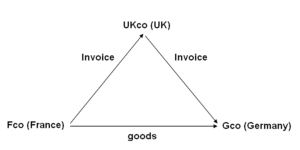
Triangulation is the term used to describe a chain of intra-EU supplies of goods involving three parties in three different Member States (MS). It applies in cases where, instead of the goods physically passing from one to the other, they are delivered directly from the first to the last party in the chain. Thus:

trig (2)In this example; a UK company (UKco) receives an order from a customer in Germany (Gco). To fulfil the order the UK supplier orders goods from its supplier in France (Fco). The goods are delivered from France to Germany.

Basic Treatment

Without simplification, UKco would be required to VAT register in either France or Germany to ensure that no VAT is lost.  That is; if registered in France, French VAT (TVA) would be charged to UKco, this would be recovered and the onward supply to Gco would be VAT free. The supply to Gco would be subject to acquisition tax in Germany.  VAT therefore is neutral to all parties.  Alternatively, UKco may choose to VAT register in Germany.  This would mean that it would be able to produce a German VAT number to Fco so to obtain the goods VAT free.  UKco would recover acquisition tax it applies to itself on the purchase and charge German VAT to Gco. Again, VAT is neutral to all parties.

Triangulation does away with these requirements.

To avoid creating a need for many companies to be structured in this way, Triangulation simplification was created via the EU VAT legislation (which is implemented across all MS) so, in this example, UKco is not required to register in any MS outside the EU.

Simplification

Under the simplification procedure Fco issues an invoice to UKco without charging VAT and quoting UKco’s VAT number. UKco, in turn, issues an invoice to Gco without charging VAT. The invoice is required to show the narrative “VAT Simplification Invoice Article 141 simplification”.  Gco should account for the purchase from UKco in its German VAT Return using the Reverse Charge mechanism. Details of the Reverse Charge here

The Conditions

EU VAT Directive 2006/112/EC, Article 141 sets out the conditions which must be met for Triangulation simplification to apply. Using the example above these may be summarised as:

  • There are three different parties (separate taxable persons) VAT registered in three different MS
  • The goods are transported directly from Fco to Gco
  • The invoice flow involves Fco selling the goods to UKco (the intermediate supplier)
  • UKco supplier in turn invoices its customer, Gco
  • UKco must obtain a valid VAT number from Gco (MS of destination) and quote this number on its invoice
  • UKco must quote “Article 141 simplification” on its invoice to Gco.

Impact on businesses

A business may be involved in triangulation as either:

  • the first supplier of the goods (Fco in the example above),
  • the intermediate supplier (UKco in the example above), or
  • the final consumer (Gco in the example above).

In whichever role, it is important to ensure all relevant details have been obtained and the documentation is correct.

And after Brexit?

As in many areas, we do not yet know how Brexit will affect the UK’s relationship with the EU. In general, the “worse” case scenario for UK business is that this simplification will be unavailable and all cross-border transactions will be treated as exports and imports similar to any other transactions with countries outside the EU and UK business will need to VAT register in one or more MS in the EU. This will add complexity and possibly delays at borders for goods moving to and from the UK. It is also likely to create additional cash flow issues.

In these uncertain times it makes sense to keep abreast of the (likely) changing requirements and take advantage of the simplification while it lasts.

VAT Latest from the courts – Employment businesses

By   21 March 2017

The Adecco case

In the Upper Tribunal (UT) case of Adecco the judge considered the tripartite situation between certain self-employed workers, employment businesses (Adecco) and the actual clients. Specifically, whether Adecco provides self-employed temporary workers to clients for the total consideration paid by client or only introductory services for commission retained by the employment business.  Broadly, whether temporary workers supply their services to Adecco or to the clients.

Background

Based on the Reed Employment Ltd v HMRC [2011] UKFTT 200 (TC) “Reed” case.  Reed also concerned the VAT treatment of supplies by an employment bureau in relation to the services of non-employed temps. The FTT in Reed concluded that the employment bureau was making supplies of introductory services to clients in respect of the placement of non-employed temps. The value of the introductory services was the commission charged to clients for the introduction of the temps and the employment bureau was only required to charge and account for VAT on its commission and not on the non-employed temps’ remuneration. Following Reed, Adecco made claims for repayment of the VAT which it had charged and accounted for in respect of payments representing the non-employed temps’ remuneration. HMRC rejected the claims. One of the reasons given for the rejection was that Adecco did not merely supply a service of introducing the non-employed temps to the clients but also supplied the non-employed temps’ services.

Decision

The UT found in favour of HMRC. It found that output tax is due on the full amount paid by the clients rather than the commission retained.  The full amount included earnings paid to the temporary workers.  The decision was based on the contracts in place in this instant case and it is possible that a different outcome would have occurred if a wider view was taken and/or if the relationship between contracts and economic reality had been considered.

Consequences

It is unlikely that this will be the definitive word on the matter and it is expected that further challenges to HMRC’s stance will be made given the two different outcomes in Reed and Adecco.  As always in these types of cases, it demonstrates the importance of contracts and careful consideration of the relationships between the parties.

For more on agent/principal relationships please see my articles on latest relevant court cases here and here

Please contact us if this case impacts on your business or that of your clients.

VAT Latest from the courts – Allocation of payments

By   13 March 2017

VAT payment problems

In the Upper Tribunal (UT) case of Swanfield Limited (Swanfield)

The matter was whether HMRC had the right to allocate payments made by the applicant to specific periods against the wishes of the taxpayer.

Background

Swanfield was late with returns/payments such that it was subject to the Default Surcharge (DS) mechanism.  Details of the DS regime here

HMRC issued DSs to Swanfield, many at the maximum rate 15%. The total involved was said to be over £290,000. However, if the payments made by Swanfield had been allocated in a certain way (broadly; to recent debts as desired by the taxpayer) it would have substantially reduced the amount payable. However, HMRC allocated the payments to previous, older periods which were not the subject of a DS.

The Issue

The issue was relatively straightforward; did HMRC have the authority to allocate payments as they deemed fit, or could the taxpayer make payments for specific periods as required?

The Decision

The UT found that Swanfield were entitled to allocate payments made to amounts which would become due on supplies made in the (then) current period, even though the due date had not yet arrived.  Additionally, HMRC did not have the authority to unilaterally allocate payments made by the taxpayer to historical liabilities as they saw fit, in cases where the taxpayer has explicitly made those payments in relation to current periods.  In cases where there is no specific instruction in respect of allocation of the payment, HMRC was entitled to allocate payment without any obligation to minimise DS. The UT remitted this case back to the First Tier Tribunal to decide, as a matter of fact, whether Swanfield had actually made the necessary allocation.

Commentary

This is a helpful case which sets out clearly the responsibilities of both parties.  It underlines the necessity of a taxpayer to focus on payments and how to manage a debt position to mitigate any penalties.  Staying silent on payments plays into the hands of HMRC. It is crucial to take a proper view of a business’ VAT payment position, especially if there is difficulties lodging returns of making payment. Planning often reduces the overall amount payable, or provides for additional time to pay (TTP).  A helpful overview of payment problems here

Things can be done if a business is getting into difficulties with VAT; whether they are; reporting, submitting returns, making payments, or if there are disputes with HMRC. There are also structures that may be put in place to assist with VAT cashflow.

We would always counsel a business not to bury its head in the sand if there are difficulties with HMRC.  Please make contact with us and, in almost all cases, we can improve the situation, along with providing some relief from worries. VAT may be payable, but there are ways of managing payments – as this case demonstrates.

Budget 2017 – VAT

By   8 March 2017

In today’s budget, the Chancellor of the Exchequer made the following announcements on VAT:

VAT Registration

The annual VAT registration limit has been increased from £83,000 to £85,000 in line with inflation.

The deregistration limit has been increased from £81,000 to £83,000.

Registration in respect of acquisitions from other Member States has also been increased to £85,000.

Notes:  The UK’s VAT registration threshold is the highest in the EU. Businesses trading below the threshold can choose to register voluntarily. This may be appropriate in order to recover input tax on purchases (where the addition of VAT on sales would not create issues).

It is understood that the increase in the threshold will prevent around 4,000 businesses from having to register for VAT by the end of the 2017 to 2018 financial year.

VAT: ‘Split Payment’ model

It was announced that: Some overseas traders avoid paying UK VAT, undercutting online and high street retailers and abusing the trust of UK consumers who purchase goods via online marketplaces. Building on the measures introduced in Budget 2016, the government will shortly publish a call for evidence on the case for a new VAT collection mechanism for online sales. This would harness technology to allow VAT to be extracted directly by the Exchequer from online transactions at the point of purchase. This is often referred to as a ‘Split Payment’ model. This is the next step in tackling the non-payment of VAT by some overseas traders selling goods online to UK consumers”.

Use and enjoyment provisions for business to consumer mobile phone services

The government will remove the VAT use and enjoyment provision for mobile phone services provided to consumers. The measure will bring those services used outside the EU within the scope of the tax. It will also ensure mobile phone companies can’t use the inconsistency to avoid UK VAT. This will bring UK VAT rules in line with the internationally agreed approach

Making Tax Digital for Business 

And that, in a nutshell, is all Philip Hammond had to say directly on VAT.  However, via the Making Tax Digital for Business (MTDfB) Policy Paper, it was announced that businesses, self-employed people and landlords will be required to start using the new digital service from:

  • April 2018 if they have profits chargeable to Income Tax and pay Class 4 National NICs and their turnovers are in excess of the VAT threshold
  • April 2019 if they have profits chargeable to Income Tax and pay Class 4 NICs and their turnovers are below the VAT threshold
  • April 2019 if they are registered for and pay VAT
  • from April 2020 if they pay Corporation Tax

Businesses, self-employed people and landlords with turnovers under £10,000 are exempt from these requirements.

It was further announced that a one year deferral from the mandating of MTDfB for unincorporated businesses and landlords with turnovers below the VAT threshold. This means that only those businesses with turnovers in excess of the VAT threshold with profits chargeable to Income Tax and that pay Class 4 NICs will be required to start using the new digital service from April 2018.

I suppose that we should be grateful that there were not too many changes to VAT announced (I’m sure there will be many more as a result of Brexit…….).

VAT Planning – The Four “A”s

By   6 March 2017

To a degree, VAT planning may be considered as something of an abstract concept.  It may be straightforward, or very complex, but what does all successful VAT planning have in common?  What process should be applied in order to get the right solution and to ensure that nothing is missed?   Well this is my technique and it helps me to focus on what is necessary:

The planning process may be broken down into four distinct elements:

Planning process – The four As

  • Ascertainment
  • Analysis
  • Alternatives
  • Action

One must initially obtain all relevant information and consider the appropriate legislation, case law and HMRC documents etc –

Ascertainment

In my experience, the most difficult part of this is obtaining all of the relevant information.  It is not always clear if you have received everything available – so it is often difficult to establish what is relevant and what is not.  The skill is asking the right questions of course.  Any competent VAT adviser should be able to “get the answer” if (s)he has the full picture.

Then one must analyse the information –

Analysis

Whether it is reading contracts closely, considering EC legislation, reviewing audit trails, searching case law, looking at documentation or carrying out calculations a full analysis is vital in the process of delivering accurate, useful and relevant advice.

The next step is to use the analysis to construct some various alternatives on how to proceed –

Alternatives

The most appropriate solution may present itself immediately, or various structures may need to be considered in detail in order to find some workable alternatives.  It is important not to miss anything at this point and to communicate properly with one’s client.  Consideration is required of a client’s attitude to, inter alia; complexity, risk, time invested and tax in general in order to properly tailor VAT advice.

Finally, consideration is given to the alternatives and a decision made on what action to take –

Action

This is another point at which good communication with one’s client is important.  The client needs to understand the technicalities, the risks, the impact on business, the resources required etc in order to make an informed decision.  A good adviser will also be aware of the appropriate level of assistance required with implementation. I also find it helps if the worst case scenario is explained in each alternative and the level of resistance from HMRC one is likely to encounter.  I also always bear in mind that most people do not “speak VAT jargon”, spend their waking hours studying indirect tax legislation or reviewing VAT cases, so clear and straightforward English is needed! (Also, I find my diagrams and flowcharts created at meetings a help, even if just to amuse clients with my artistic skills!)

The penalty regime…the dark side of VAT

By   20 February 2017
VAT Penalties

I have made a lot of references to penalties in other articles over the years. So I thought it would be a good idea to have a closer look; what are they, when are they levied, rights of appeal, and importantly how much could they cost if a business gets it wrong?

Overview

Making mistakes…

Broadly, a penalty is levied if the incorrect amount of VAT is declared, either by understating output tax due, overclaiming input tax, or accepting an assessment which is known to be too low.

Amount of penalty

HMRC detail three categories of inaccuracy. These are significant, as each has its own range of penalty percentages. If an error is found to fall within a lower band, then a lower penalty rate will apply. Where the taxpayer has taken ‘reasonable care,’ even though an error has been made, then no penalty will apply.

  • An error, when reasonable care not taken: 30%;
  • An error which is deliberate, but not concealed: 70%;
  • An error, which is deliberate and concealed: 100%.

Reasonable care

There is no definition of ‘reasonable care’. However, HMRC have said that they would not expect the same level of knowledge or expertise from a self-employed person, as from a large multi-national.

HMRC expect that, where an issue is unclear, advice is sought, and a record maintained of that advice. They also expect that, where an error is made, it is adjusted, and HMRC notified promptly. They have specifically stated that merely to adjust a return will not constitute a full disclosure of an error. Therefore a penalty may still be applicable. We advise that, even if an error is not required to be reported independently on a form VAT652 (usually if < £10,000 of VAT) a letter is sent to HMRC disclosing that the error has been adjusted on the return. We have a standard template available for this process.

What the penalty is based on

The amount of the penalty is calculated by applying the appropriate penalty rate (above) to the ‘Potential Lost Revenue’ or PLR. This is essentially the additional amount of VAT due or payable, as a result of the inaccuracy, or the failure to notify an under-assessment. Special rules apply where there are a number of errors, and they fall into different penalty bands.

Defending a penalty 

The percentage penalty may be reduced by a range of ‘defences”.  These are:

– Telling; this includes admitting the document was inaccurate, or that there was an under-assessment, disclosing the inaccuracy in full, and explaining how and why the inaccuracies arose;

– Helping; this includes giving reasonable help in quantifying the inaccuracy, giving positive assistance rather than passive acceptance, actively engaging in work required to quantify the inaccuracy, and volunteering any relevant information;

– Giving Access; this includes providing documents, granting requests for information, allowing access to records and other documents.

Further, where there is an ‘unprompted disclosure’ of the error, HMRC have power to reduce the penalty further. This measure is designed to encourage businesses to review their own VAT returns.

A disclosure is unprompted if it is made at a time when a person had no reason to believe that HMRC have discovered or are about to discover the inaccuracy. The disclosure will be treated as unprompted even if at the time it is made, the full extent of the error is not known, as long as fuller details are provided within a reasonable time.

HMRC have included a provision whereby a penalty can be suspended for up to two years. This will occur for a careless inaccuracy, not a deliberate inaccuracy. HMRC will consider suspension of a penalty where, given the imposition of certain conditions, the business will improve its accuracy. The aim is to improve future compliance, and encourage businesses which genuinely seek to fulfil their obligations. We have noticed that HMRC is increasingly using the penalty suspension mechanism.

Appealing a penalty 

HMRC have an internal reconsideration procedure, where a business should apply to in the first instance. If the outcome is not satisfactory, the business can pursue an appeal to the First Tier Tribunal. A business can appeal on the grounds of; whether a penalty is applicable, the amount of the penalty, a decision not to suspend a penalty, and the conditions for suspension.

The normal time limit for penalties to four years. Additionally, where there is deliberate action to evade VAT, a 20 year limit applies. In particular, this applies to a loss of VAT which arises as a result of a deliberate inaccuracy in a document submitted by that person.

These are just the penalties for making “errors” on VAT returns. HMRC have plenty more for anything from late registration to issuing the wrong paperwork.

Assistance

Our advice is always to check on all aspects of a penalty and seek assistance for grounds to challenge a decision to levy a penalty. We have a very high success rate in defending businesses against inappropriate penalties.  It is always worth running a penalty past us.

VAT Latest from the courts – Reverse Charge

By   13 February 2017

The First Tier Tribunal case of University Of Newcastle Upon Tyne is a useful reminder of the impact of the Reverse Charge.

A brief guide to the Reverse Charge is included below.

Background

As with many UK universities, Newcastle was keen to encourage applications to study from new students from overseas. This is an important form of income for the institution.  It used local (overseas) agents to recruit students. Some 40% of those students were studying as undergraduates, 40% as postgraduates on one year “taught” courses and 20% as postgraduate research students studying for doctorates.  In 2014 the University had agreements with more than 100 agents worldwide. The agents used their own resources to recruit students for universities around the world, including in the UK. The University entered into contractual arrangements with agents and paid commission to them. In 2008 the University paid agent commissions of £1.034m, rising to £2.214m in 2012.

The Tribunal was required to consider whether the services supplied by the agents were a single supply to University or separate supplies to both the University and students. If the entire supply is to the University then the Reverse Charge is applicable and, because the University is partly exempt, this would create a VAT cost to it. If the supplies are to both the students and the University, the Reverse Charge element would be less and the VAT cost reduced. (There were changes to the Place Of Supply legislation during the period under consideration, but I have tried to focus on the overall impact in this article.)

The University contended that agents made two supplies: a supply to the University of recruitment services and a supply to students of support services. The commission paid by the University should therefore be apportioned so as to reflect in part direct consideration paid by the University for supplies of services to it, and in part third party consideration for services supplied to the students. The supplies to students would not made in the UK and therefore were not subject to UK VAT.

Decision

After thorough consideration of all of the relevant material, the judge decided that the agents made a single supply of services to the University and make no supplies to students. This meant that the University must account for VAT on the full value of services received since 2010 under the Reverse Charge (although before 2010 different rules on place of supply applied).  Additionally,  it was decided the University was not entitled to recover as input tax VAT for which it is required to account by means of a Reverse Charge. There was no direct and immediate link between the commission paid to agents and any taxable output of the University or the economic activities of the University as a whole.

Commentary

It is understood that the way the University recruited students using overseas agents is common amongst most Universities in the UK, so this ruling will have a direct impact on them.  It was hardly a surprising decision, but underlines the need for all businesses to consider the impact of the application of the Reverse Charge.  Of course, the Reverse Charge will only create an actual VAT cost if a business is partly exempt, or involved in non-business activities.  The value of the Reverse Charge also counts towards the VAT registration threshold.  This means that if a fully exempt business receives Reverse Charge services from abroad, it may be required to VAT register (depending on value). Generally, this means an increased VAT cost. This situation may also affect a charity or a NFP entity.

The case also highlights the importance of contracts, documentation and website wording (should any more reminders be needed).  VAT should always be borne in mind when entering into similar arrangements. It may also be possible to structure arrangements to avoid or mitigate VAT costs if carried out at an appropriate time.

We can assist with any of the above and are happy to discuss this with you.

Guide – Reverse charge on services received from overseas
Normally, the supplier of a service is the person who must account to the tax authorities for any VAT due on the supply.  However, in certain situations, the position is reversed and it is the customer who must account for any VAT due.  This is known as the ‘Reverse Charge’ procedure.  Generally, the Reverse Charge must be applied to services which are received by a business in the UK VAT free from overseas. 
Accounting for VAT and recovery of input tax.
Where the Reverse Charge procedure applies, the recipient of the services must act as both the supplier and the recipient of the services.  On the same VAT return, the recipient must
  • account for output tax, calculated on the full value of the supply received, in Box 1;
  • (subject to partial exemption and non-business rules) include the VAT stated in box 1 as input tax in Box 4; and;
  • include the full value of the supply in both Boxes 6 and 7.
Value of supply.
The value of the deemed supply is to be taken to be the consideration in money for which the services were in fact supplied or, where the consideration did not consist or not wholly consist of money, such amount in money as is equivalent to that consideration.  The consideration payable to the overseas supplier for the services excludes UK VAT but includes any taxes levied abroad.
Time of supply.
The time of supply of such services is the date the supplies are paid for or, if the consideration is not in money, the last day of the VAT period in which the services are performed.
The outcome
The effect of the provisions is that the Reverse Charge has no net cost to the recipient if he can attribute the input tax to taxable supplies and can therefore reclaim it in full. If he cannot, the effect is to put him in the same position as if had received the supply from a UK supplier rather than from one outside the UK. Thus the charge aims to avoid cross border VAT rate shopping. It is not possible to attribute the input tax created directly to the deemed (taxable) supply. 

VAT (GST) Introduction in India delayed

By   23 January 2017

It was recently announced that the Indian version of VAT: Goods & Services Tax – GST is intended to be rolled out across the country on 1 July 2017 rather than the previously announced date of April 2017. This is after details of how the income will be shared between various authorities has been agreed.

It is anticipated that GST will follow the European model and that the tax base will be comprehensive, as virtually all goods and services will be taxable, with minimum exemptions.  GST will incorporate and replace all the various central taxes such as: Central Excise Duty, Additional Excise Duty, Service Tax, Additional Custom Duty and Special Additional Duty as well as state-level taxes such as Value Added Tax or Sales Tax, Central Sales Tax, Entertainment Tax, Entry Tax, Purchase Tax, Luxury Tax.

The introduction of GST is likely to bring in significant changes to doing business in India or with Indian suppliers/customers cross-border.

Please contact us should you have any queries on this matter.