
Tag Archives: output-tax

VAT treatment of deposits and advance payments

By   5 June 2017

One query that constantly reappears is that of the VAT treatment of deposits.

This may be because there are different types of deposits with different VAT rules for each. I thought that it would be helpful for all the rules to be set out in one place, and some comments on how certain transactions are structured, so…

Broadly, we are looking at the tax point rules. The tax point is the time at which output tax is due and input tax recoverable. More on tax points here 

A business may have various commercial arrangements for payments such as:

  • receiving advance payments
  • being paid in instalments
  • credit sales
  • periodic payments for continuous supplies
  • security deposits for goods hired

I consider these below, as well as some specific arrangements:

Advance payments and deposits

An advance payment, or deposit, is a proportion of the total selling price that a customer pays a business before it supplies them with goods or services.

The tax point if an advance payment is made is whichever of the following happens first:

  • the date a VAT invoice for the advance payment is issued
  • the date you the advance payment is received

The VAT due on the value of the advance payment (only, not the full value of the overall supply) is included on the VAT return for the period when the tax point occurs.

If the customer pays the remaining balance before the goods are delivered or the services are performed, a further tax point is created when whichever of the following happens first:

  • the date a VAT invoice for the balance is issued
  • payment of the balance is received

So VAT is due on the balance on the return for when the further tax point occurs.

Returnable deposits

A business may ask its customers to pay a deposit when they hire goods. No VAT is due if the deposit is either:

  • refunded in full to the customer when they return the goods safely
  • kept by you to compensate you for loss or damage

Forfeit deposits

If a customer is asked for a deposit against goods or services but they then don’t buy them or use the services, it may be decided to retain the deposit. Usually the arrangement is that the customer is told/agrees in advance and it is part of the conditions for the sale. This arrangement is known as forfeit deposit. It often occurs when, for example, an hotel business makes a charge for reserving a room.

VAT should be declared on receipt of the deposit or when a VAT invoice is issued, whichever happens first.

If the deposit is retained (because the customer changes their mind about the goods or service and doesn’t want them any more) there is no VAT due as no supply has been made. If output tax has already been declared, the business needs to adjust for the amount of the retained deposit on the next VAT return. If the sale goes ahead, the rules for advance payments above applies.

Continuous supplies

If you supply services on a continuous basis and you receive regular or occasional payments, a tax point is created every time a VAT invoice is issued or a payment received, whichever happens first. An article on tax planning for continuous supplies here

If payments are due regularly a business may issue a VAT invoice at the beginning of any period of up to a year for all the payments due in that period (as long as there’s more than one payment due). If it is decided to issue an invoice at the start of a period, no VAT is declared on any payment until either the date the payment is due or the date it is received, whichever happens first.

Credit and conditional sales

This is where the rules can get rather more complex.

  • A credit sale means the sale of goods which immediately become the property of the customer but where the price is paid in instalments.
  • A conditional sale is where goods are supplied to a customer but the goods remain the seller’s property until they are paid for in full.

The tax point for a credit sale or a conditional sale is created at the time you supply the goods or services to your customer. This is the basic tax point and is when you should account for the VAT on the full value of the goods.

This basic tax point may be over-ridden and an actual tax point created if a business:

  • issues a VAT invoice or receives payment before supplying the goods or services
  • issues a VAT invoice up to 14 days after the basic tax point

Credit sales where finance is provided to the customer

If goods are offered on credit to a customer and a finance company is not involved, the supplier is financing the credit itself. If the credit charge is shown separately on an invoice issued to the customer, it will be exempt from VAT. Other fees relating to the credit charge such as; administration, documentation or acceptance fees will also be exempt. VAT is declared on the full value of the goods that have been supplied on the VAT Return for that period.

If goods or services are supplied on interest free credit by arranging with a customer for them to pay over a set period without charging them interest then VAT is declared on the full selling price when you make the supplies.

Credit sales involving a finance company

When a business makes credit sales involving a finance company, the finance company either:

  • becomes the owner of the goods, eg; when a purchase is financed by a hire-purchase agreement
  • does not become the owner of the goods, eg; when a purchase is financed by a loan agreement

Hire purchase agreements

If the finance company becomes the owner of goods, the business is supplying the goods to the finance company and not the customer. There is no charge for providing the credit, so the seller accounts for VAT on the value of the goods at the time they are supplied to the finance company. Any commission received from the finance company for introducing them to the customer is usually subject to VAT.

Loan agreements

If the finance company does not become owner of the goods, the supplier is selling the goods directly to its customer. The business is not supplying the goods to the finance company, even though the finance company may pay the seller direct.  VAT is due on the selling price to the customer, even if the seller receives a lower amount from the finance company. The contract between the customer and the finance company for credit is a completely separate transaction to the sale of the goods.

Specific areas 

The following are areas where the rules on the treatment may differ

Cash Accounting Scheme

If a business uses the cash accounting scheme here it accounts for output tax when it receives payment from its customers unless it is a returnable deposit

Property

Care should be taken with deposits in property transactions.  This is especially important if property is purchased at auction.

These comments only apply to the purchase of property on which VAT is due (commercial property less than three years old or subject to the option to tax).  If a deposit is paid into a stakeholder, solicitor’s or escrow account (usually on exchange) and the vendor has no access to this money before completion no tax point is created. Otherwise, any advance payment is treated as above and creates a tax point on which output tax is due to the extent of the deposit amount. Vendors at auction can fall foul of these rules. If no other tax point has been created, output tax is due on completion.

Tour Operators’ Margin Scheme (TOMS)

TOMS has distinct rules on deposits.  Under normal VAT rules, the tax point is usually when an invoice is issued or payment received (as above).  Under TOMS, the normal time of supply is the departure date of the holiday or the first occupation of accommodation. However, in some cases this is overridden.  If the tour operator receives more than one payment, it may have more than one tax point. Each time a payment is received exceeding 20% of the selling price, a tax point for that amount is created. A tax point is also created each time the payments received to date (and not already accounted for) exceed 20% when added together. There are options available for deposits received when operating TOMS, so specific advice should be sought.

VAT Registration

In calculating turnover for registration, deposits must be included which create a tax point in the “historic” test.  Care should also be taken that a large deposit does not trigger immediate VAT registration by virtue of the “future” test. This is; if it is foreseeable at any time that receipts in the next 30 days on their own would exceed the turnover limit, currently £85,000, then the registration date would be the beginning of that 30-day period.

Flat Rate Scheme

A business applies the appropriate flat rate percentage to the value of the deposit received (unless it is a returnable deposit).  In most cases the issue of an invoice may be ignored if the option to use a version of cash accounting in the Flat Rate Scheme is taken. More on the FRS here and here

Please contact us if you have any queries on this article or would like your treatment of deposits reviewed to:

  • Ensure treatment is correct to avoid penalties, and/or;
  • Establish whether planning is available to properly defer payments of output tax under the tax point rules.
VAT: Latest from the courts – are services by a CIC business?

By   19 May 2017

This case considers the perpetual difficulty of deciding whether activities represent a business… or not.

In the First Tier Tribunal (FTT) case of Healthwatch Hampshire CIC (HH) here the issue was whether HH made taxable supplies by way of business to a Local Authority – Hampshire County Council (HCC)

Background

Under certain prescribed new arrangements, local authorities, including HCC, were required to enter into contractual arrangements with a body corporate, which was required to be a social enterprise and a Community Interest Company (CIC) for the provision of various services.

These services comprised, inter alia:

  • Promoting, and supporting, the involvement of local people in the commissioning, provision and scrutiny of local care services
  • Information, signposting and advice
  • Advocacy services

HH is a company limited by guarantee but is not a charity. It is however non-profit making in its objectives, and any profits which do arise can only be spent for the benefit of the local community.  HH was formed by a consortium comprising; three organisations all of which are charities. These charities effectively carried out the work via a sub-contract arrangement and charged HH with the addition of VAT.  The issue is the VAT treatment of HH’s charge to HCC. Was this a business activity on which VAT is charged? Or, as HMRC contended, was the money paid to HH was outside the scope of VAT because it represented something which was not consideration for taxable supplies and thus non-business.

This was important as if the services provided by the CIC are deemed to be non-business, the VAT charged to HH by the three consortium members would represent an absolute VAT cost as it could not be VAT registered and therefore not able to recover the input tax.

Technical Note

Because of the special VAT rules which apply to local authorities, input tax incurred by them may be recovered if it relates to their non-business activities (their statutory activities). This is via VAT Act 1994, s33 and this legislation turns “normal” VAT rules on their head. In this particular case, if HH charged HCC VAT, HCC would be in a position to recover it meaning that VAT would be neutral for all parties.

Decision

The matter of whether HH’s activities amounted to a business was considered with significant references to the Longridge On The Thames.  Case commentary here

As a starting point, the judge commented on previous CJEU cases that it “…would seem to be a clear demonstration that simply because an activity is normally carried on by the state does not automatically mean that, per se, it cannot be economic activity”.  It was also decided that “we have come to the conclusion that HH is not a body governed by public law.”  So this strand of HMRC’s argument did not lead anywhere.

The court decided in the taxpayer’s favour; which appears to be common sense all round.  The supplies were by way of business despite the arrangements having features which may not necessarily be found in a more commercial environment (including the fact that LAs were legally required to outsource certain of its functions) . Ultimately, consideration was flowing in both directions; HCC paid for supplies which it required and those were supplied by a third party such that VAT was properly chargeable.  The fact that HCC met its statutory obligations in structuring transactions in this way did not preclude them being an economic activity.

Action

This case (and Longbridge) demonstrates that where charities, LAs, CICs, NFP entities and similar bodies are concerned, it is crucial to review all agreements from a VAT perspective. It is insufficient to assume the correct VAT treatment is how it is desired and slight differences in arrangements can, and do, produce different VAT outcomes. After Longbridge HMRC are looking more closely at similar arrangements (not limited to LAs) and we expect more of these types of cases to be heard in the future.

For more on the EC aspect of business/non-business please see here

VAT: Latest from the courts – Brockenhurst College

By   19 May 2017

The Court of Justice of the European Union (CJEU) has released its decision in Brockenhurst College here

Unusually, it has gone against the Advocate General (AG) Kokott’s opinion (here) and concurs with previous decisions reached by the UK courts. This is good news for the taxpayer and other providers of educational services. The decision has been referred back to the Court of Appeal (CoA) for it to consider points such as the distortion of competition and the fulfilment of a separate function, however, it is likely that this will not affect the decision by the CJEU and HMRC’s appeal will be dismissed.

Background

The case considered two types of supply made by Brockenhurst College:

  • The supplies made from its restaurant, used for training chefs, restaurant managers and hospitality students. The claim was made on the basis that these were exempt supplies of education and not standard rated supplies of catering
  • Tickets for concerts and other live performances put on by students as part of their educational courses. These were similarly claimed to be exempt.

Students were enrolled in performing arts and catering and hospitality courses.  As part of their course of study they were required to run a restaurant and stage live performances. Persons not enrolled on the relevant courses would pay for and attend these events. The services were usually supplied to a limited public including; parents, siblings, friends etc, and were supplied at a reduced cost as part of the practical element of the students’ education. The appellant argued that the experience was invaluable to their studies and should be regarded as ‘closely related’ to the principal supply of education.  HMRC considered that the services in question were supplied to third parties in return for payment. Consequently, the services, whilst of benefit and practical experience to the students were separate VATable supplies made to third parties and the supplies cannot, therefore, be closely related to the supply of education to the student.

The First Tier Tribunal (FTT) concluded that the supplies in question were exempt as being closely linked to education because:

  • the College was an eligible body and so its principal supplies were exempt supplies of education
  • the supplies were integral and essential to those principal exempt supplies
  • the supplies were made at less than their cost
  • the supplies were not advertised to the general public. Instead, there was a database of local groups and individuals who might wish to attend the restaurant or performances
  • the supplies were not intended to create an additional source of income for the College

HMRC disagreed with the conclusion on the basis that the supplies were outside the education exemption because the students were not the beneficiaries of the supplies in question, but only benefitted from making them. HMRC appealed to the Upper Tribunal (UT).

The UT rejected HMRC’s argument and agreed with the FTT. It held that the supplies were closely related to the exempt supplies of education because they enabled the students to enjoy better education. The requirement in the domestic law for the supplies to be for the direct use of the student was met because they were of direct benefit to him.

HMRC subsequently appealed to the CoA which referred it to the CJEU.

The AG’s opinion was that closely related transactions are to be regarded as independent supplies to the principal supply, but do not include the supply of restaurant or training services supplied to third parties who are not themselves receiving the principal supply of training. The third parties pay for their own consumption (of either the catering or performance) and do not pay for the provision of education. It is very rare that the CJEU makes a decision that goes against the AG’s opinion.

CJEU Decision

The CJEU ruled that activities consisting of students of a higher education establishment supplying, for consideration and as part of their education, restaurant and entertainment services to third parties, may be regarded as supplies closely related to the principal supply of education and accordingly be exempt from VAT – provided that those services are essential to the students’ education and that their basic purpose is not to obtain additional income for that establishment by carrying out transactions which are in direct competition with those of commercial enterprises liable for VAT, which it is for the national court to determine.

Action

We understand that there are a number of cases stood behind Brockenhurst.  Any other colleges, FE, universities or other eligible bodies carrying out similar activities to Brockenhurst need to consider their tax position. It is possible that retrospective claims may be made, depending on specific circumstances. Treating such supplies as exempt may also impact on a body’s partial exemption position and could create business/non-business implications. This may also impact on activities like hairdressing, motor maintenance and beauty treatments which colleges provide on a similar basis to the activities in this instant case.

We are happy to discuss the implications of this case with you.

VAT: Global Accounting simplification

By   2 May 2017

VAT: Second Hand Scheme  – Global Accounting simplification

Overview

The problem with the VAT Second-Hand Goods Scheme is that details of each individual item purchased, and then later sold, has to be recorded. This requirement can lead to a lot of paperwork and an awful lot of administration which, obviously, many businesses are not too keen to comply with.

Global Accounting is an optional, simplified variation of the Second Hand Margin Scheme (Margin Scheme).

It differs from the standard Margin Scheme because rather than accounting for the margin achieved on the sale of individual items VAT is calculated on the margin achieved between the total purchases and total sales in a particular accounting period without the requirement to establish the mark up on each individual item.  It is beneficial if a business buys and sells bulk volume, low value eligible goods, and is unable to maintain the detailed records required of businesses who use the standard Margin Scheme

There two significant differences in respect of Global Accounting compared to the standard Margin Scheme. The first difference is that losses on an item are automatically offset against profits on items. Thus losses and profits are offset together in the period. In the standard Margin Scheme no VAT is due if a loss is made on an item, but that loss cannot be offset against any other profit.  There is also a timing advantage with Global Accounting because all purchases made in the period are included, even if those goods are not actually sold in the same period.

Goods which may be included in Global Accounting

Global Accounting can be used for all items which are eligible under the standard Margin Scheme.  However, the following goods cannot be included in Global Accounting:

  • individual items costing more than £500 (although these can be accounted for via the standard Margin Scheme)
  • aircraft, boats and outboard motors,
  • caravans and motor caravans,
  • horses and ponies, and
  • motor vehicles, including motorcycles; except those broken up for scrap.

Starting to use the scheme

When a business starts using Global Accounting, it may find that it already has eligible stock on hand.  It may include the value of this stock when it calculates the total purchases at the end of the first period.  If a business does not take its stock on hand into account, it will have to pay VAT on the full price, rather than on the margin achieved, when it is sold.

Note: any goods bought on an invoice which shows a separate VAT figure are not eligible for resale under the scheme.

The calculation

VAT is calculated at the end of each tax period. Because you can take account of opening stock in your scheme calculations, you may find that you produce a negative margin at the end of several periods. In other words, your total purchases may exceed your total sales. In such cases, no VAT is due. But you must carry the negative margin forward to the next period as in the following example:

Period One

  1. a)      Total purchase value of stock on hand 10,000
  2. b)      Total purchases 2,000
  3. c)      Total sales 8,000

Margin = c – (a+b) = (4,000)

Because this is a negative margin there is no VAT to pay.  However, negative margin must be carried forward into the next period as follows:

Period Two

  1. a)      Negative margin from previous period 4,000
  2. b)      Total purchases 1,000
  3. c)      Total sales 7,000
  4. d)      Margin = c – (a + b), sales minus (purchases plus negative margin), £7,000 – (£1,000 + £4,000) 2,000
  5. e)      VAT due = margin (£2,000) × VAT fraction (1/6) 333.33

There is no negative margin to carry forward this time. Therefore, in the third period, the margin is calculated solely by reference to sales less purchases.

The negative margin may only be offset against the next Global Accounting margin. It cannot be offset against any other figure or record.

Global Accounting Records and Accounts

A business does not need to keep all the detailed records which are required under the normal Margin Scheme – for instance, you do not have to maintain a detailed stock book.

Global Accounting records do not have to be kept in any set way but they must be complete, up to date and clearly distinguishable from any other records.  A business must keep records of purchases and sales as set out below, together with the workings used to calculate the VAT due.

If HMRC cannot check the margins declared from the records, VAT will be due on the full selling price of the goods sold, even if they were otherwise eligible for the scheme.

Buying goods under Global Accounting

When a business buys goods which it intends to sell under Global Accounting it must:

  • check that the goods are eligible for Global Accounting
  • obtain a purchase invoice. If a business buys from a private individual or an unregistered entity, the purchaser should make out the invoice at the time the goods are purchased.  If purchased from another VAT-registered dealer, the dealer must make out the invoice at the time of sale, and
  • enter the purchase details of the goods in your Global Accounting purchase records.  The purchase price must be the price on the invoice which has been agreed between you and the seller.

You cannot use the scheme if VAT is shown separately on the invoice.

if you are buying from a private individual or an unregistered business, you must make out the purchase invoice yourself.

When selling goods under Global Accounting

If the purchase conditions above apply, Global Accounting may be used when the goods are sold by:

  • recording the sale in the usual way
  • issuing a sales invoice for sales to other VAT-registered dealers and keeping a copy of the invoice, and
  • transferring totals of copy invoices to the Global Accounting sales record or summary
  • you must be able to distinguish at the point of sale between sales made under Global Accounting and other types of transaction

Leaving the scheme

If a business stops using Global Accounting for any reason, it must make a closing adjustment to take account of purchases for which it has taken credit, but which have not been sold (closing stock on hand). The adjustment required does not apply if the total VAT due on stock on hand is £1,000 or less. In the final period for which the business uses the scheme, it must add the purchase value of its closing stock to the sales figure for that period.  In this way VAT will be paid (at cost price) on the stock for which the business previously had credit under the scheme.

Items sold outside the scheme

If goods are sold which had been included in a business’ Global Accounting purchase (for example, they are exported), a business must adjust its records accordingly.  This is done by subtracting the purchase value of the goods sold outside the scheme from the total purchases at the end of the period.

Stolen or destroyed goods

If a business loses any goods through breakage, theft or destruction, it must subtract their purchase price from your Global Accounting purchase record.

Repairs and restoration costs

A business may reclaim the VAT it is charged on any business overheads, repairs, restoration costs, etc. But it must not add any of these costs to the purchase price of the goods sold under the scheme.

For further advice on any global accounting, used goods schemes, or any other special VAT schemes please contact me.

VAT evasion by non-EU online sellers

By   26 April 2017

Investigation by The National Audit Office (NAO) into overseas sellers failing to charge VAT on online sales.

The NAO have investigated concerns that online sellers outside the EU are avoiding charging VAT. Full report here

The NAO has published the findings from its investigation into the concern that online sellers based outside the EU are not charging VAT on goods located in the UK when sold to UK customers. Online sales accounted for 14.5% of all UK retail sales in 2016, just over half of these were non-store sales, mainly through online marketplaces.

VAT rules require that all traders based outside the EU selling goods online to customers in the UK should charge VAT if their goods are already in the UK at the point of sale. In these cases, sellers should pay import VAT and customs duties when the goods are imported into the UK and charge their customers VAT on the final selling price. The sellers should also be registered with HMRC and are required to submit regular VAT returns.

Some of the key findings of the investigation are as follows:

HMRC estimates that online VAT fraud and error cost between £1 billion and £1.5 billion in lost tax revenue in 2015-16 but this estimate is subject to a high level of uncertainty. This estimate represents between 8% and 12% of the total VAT gap (The VAT gap is the difference between the amount of VAT that should, in theory, be collected by HMRC, against what is actually collected) of £12.2 billion in 2015-16. UK trader groups believe the problem is widespread, and that some of the biggest online sellers of particular products are not charging VAT. These estimates exclude wider impacts of this problem such as the distortion of the competitive market landscape.

HMRC recognised online VAT fraud and error as a priority in 2014, although the potential risk from online trading generally was raised before this. In 2013 the NAO reported that HMRC had not yet produced a comprehensive plan to react to the emerging threat to the VAT system posed by online trading. The report found HMRC had developed tools to identify internet-based traders and launched campaigns to encourage compliance but had shown less urgency in developing its operational response. Trader groups claim that online VAT fraud has been a problem as early as 2009, which has got significantly worse in the past five years. The Chartered Trading Standards Institute shares this view. Based on the emergence of the fulfilment house (a warehouse where goods can be stored before delivery to the customer) model, HMRC recognised online VAT fraud and error as one of its key risks in 2014 and began to increase resources in this area in 2015.

HMRC’s assessment is that online VAT losses are due to a range of non-compliant behaviours, but has not yet been able to assess how much is due to lack of awareness, error or deliberate fraud. Amazon and eBay consider that lack of awareness of the VAT rules is a major element of the problem. Amazon and eBay have focused on educating overseas sellers and providing tools to assist with VAT reporting and compliance. HMRC’s strategic threat assessment, carried out in 2014, concluded it was highly likely that both organised criminal groups based in the UK and overseas sellers in China were using fulfilment houses to facilitate the transit of undervalued or misclassified goods, or both, from China to the UK for sale online.

HMRC introduced new legal powers to tackle online VAT fraud and error in September 2016. The new joint and several liability power gives HMRC a new way to tackle suspected non-compliance, and is the first time any country has introduced such a power for this purpose. The new powers include making online marketplaces potentially jointly and severally liable for non-payment of VAT when HMRC has informed them of an issue with a seller, and they do not subsequently take appropriate action.

Conclusion

Online VAT fraud and error causes substantial losses to the UK Exchequer and undermines the competitiveness of UK businesses. Compliance with the VAT rules is a legal requirement. Not knowing about the rules does not excuse non-compliance. The UK trader groups who raised the issue report having experienced the impact of this problem through progressively fewer sales. They consider HMRC has been slow in reacting to the emerging problem of online VAT fraud and error and that there do not seem to be penalties of sufficient severity to act as a substantial deterrent.

It is too soon to conclude on the effectiveness and impact of HMRC’s new powers and whether the resources devoted by HMRC to using them match the scale of the problem. We recognise that HMRC must consider effort and efficiency in collecting VAT but its enforcement approach to online trade appears likely to continue the existing unfair advantage as perceived by UK trader groups. This is contrary to HMRC’s policy of encouraging voluntary compliance and it does not take account of the powerful effect that HMRC’s enforcement approach has on the operation of the online market as a whole. We intend to return to this subject in the future.

Further to the above, this article suggests that HMRC should have acted even earlier.

VAT Implications of Transfer Pricing – Valuation

By   24 April 2017

The EC has recently published a paper on the possible VAT implications of Transfer Pricing (TP) here

This Working Paper considers when TP adjustments may affect the application of VAT. The main conflict is highlighted as the difference between how sales are valued. For TP purposes value is determined via arm’s length (open market value) versus the subjective value, ie; the price actually paid, for VAT purposes.

Transfer Pricing

The arm’s length principle is the international transfer pricing standard that Organisation for Economic Co-operation and Development (OECD) member countries have agreed, and which should be used for tax purposes by Multinational Enterprise Group (“MNE group”) and tax administrations, including the price, match comparable market conditions and that profits are fairly divided between the jurisdictions in which MNE operates.

According to the OECD TP Guidelines, by seeking to adjust profits by reference to the conditions which would have been obtained between independent enterprises for comparable transactions and under comparable circumstances, ie; in “comparable uncontrolled transactions” the arm’s length principle treats the members of an MNE group as entities operating separately rather than as inseparable parts of a single unified business. Because the separate entity approach treats the members of an MNE group as if they were independent entities, attention is focused on the nature of the transactions between those members and on whether the conditions thereof differ from those that would be obtained in comparable uncontrolled transactions.

VAT

It is not generally required for VAT purposes that the consideration which must be present in order for a transaction to be qualified as taxable, has to reflect the market value of the goods or services supplied. In fact, as to the concept of “consideration”, it is settled case law of the CJEU that the taxable amount for the supply of goods or services is represented by the consideration actually received for them.

I shan’t rehearse the details here as they are clearly set out in the paper linked to above.

However, it is an important area of tax and I strongly recommend reading the Working Paper for any business or adviser involved in international supplies. It is also an interesting read for students of the tax technical side of such supplies.

We have a strong global structure of skilled advisers which are able to assist if you have any queries.

VAT Update on Associated Newspapers case – treatment of vouchers

By   24 April 2017

Two months ago the Court of Appeal mainly ruled in favour of Associated Newspapers on the treatment of vouchers.  Commentary and links here

The decision consequently cast doubt on HMRC’s published guidance on the VAT treatment of vouchers.

HMRC have announced that they are seeking leave to appeal to the Supreme Court.  Although this further delays definitive rules on vouchers, it is hoped that if it goes to the Supreme Court we will get some sort of closure on this matter.

Changes to the VAT Flat Rate Scheme – A reminder

By   31 March 2017

Flat Rate Scheme (FRS)

I have looked at the changes to the FRS and the impact of these here

This is a timely reminder for all businesses using the FRS as changes to the scheme come into effect tomorrow: 1 April 2017.

The first matter to consider is if your business is a “limited cost trader”. This may be done on the HMRC website here

Relevant costs, in this instance, only include goods (please see below). 

If not a limited cost trader no further action is required.

If a business qualifies as a limited cost trader (which is likely to include, but not limited to, labour-intensive businesses where very little is spent on goods) there are the following choices.

Options

  • Continue on the FRS but using the increased percentage of 16.5% (which is effectively equal to the 20% rate).
  • Leave the FRS and use conventional VAT accounting
  • Deregister for VAT if a business’ turnover is below that of the deregistration limit – which will be £83,000 pa from tomorrow.

Relevant Goods

It should be noted that the goods referred to above mean goods that are used exclusively for the purposes of a business, but do not include:

  • vehicle costs including fuel, unless you’re operating in the transport sector using your own, or a leased vehicle
  • food or drink for you or your staff
  • capital expenditure goods of any value
  • goods for resale, leasing, letting or hiring out if your main business activity doesn’t ordinarily consist of selling, leasing, letting or hiring out such goods
  • goods that you intend to re-sell or hire out unless selling or hiring is your main business activity
  • any services

As may seen, the definition is very restrictive.  Failure to recognise this change is likely to result in penalties and interest being levied.

If you would like any advice on this matter, please contact us as soon as possible considering the timing of the implementation.

VAT Triangulation – What is it? Is it a simple “simplification”?

By   24 March 2017

Unusually in the VAT world, Triangulation is a true simplification and is a benefit for businesses carrying out cross-border trade in goods.

What is it?

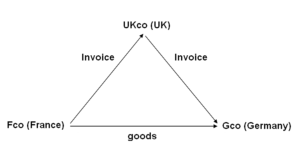
Triangulation is the term used to describe a chain of intra-EU supplies of goods involving three parties in three different Member States (MS). It applies in cases where, instead of the goods physically passing from one to the other, they are delivered directly from the first to the last party in the chain. Thus:

trig (2)In this example; a UK company (UKco) receives an order from a customer in Germany (Gco). To fulfil the order the UK supplier orders goods from its supplier in France (Fco). The goods are delivered from France to Germany.

Basic Treatment

Without simplification, UKco would be required to VAT register in either France or Germany to ensure that no VAT is lost.  That is; if registered in France, French VAT (TVA) would be charged to UKco, this would be recovered and the onward supply to Gco would be VAT free. The supply to Gco would be subject to acquisition tax in Germany.  VAT therefore is neutral to all parties.  Alternatively, UKco may choose to VAT register in Germany.  This would mean that it would be able to produce a German VAT number to Fco so to obtain the goods VAT free.  UKco would recover acquisition tax it applies to itself on the purchase and charge German VAT to Gco. Again, VAT is neutral to all parties.

Triangulation does away with these requirements.

To avoid creating a need for many companies to be structured in this way, Triangulation simplification was created via the EU VAT legislation (which is implemented across all MS) so, in this example, UKco is not required to register in any MS outside the EU.

Simplification

Under the simplification procedure Fco issues an invoice to UKco without charging VAT and quoting UKco’s VAT number. UKco, in turn, issues an invoice to Gco without charging VAT. The invoice is required to show the narrative “VAT Simplification Invoice Article 141 simplification”.  Gco should account for the purchase from UKco in its German VAT Return using the Reverse Charge mechanism. Details of the Reverse Charge here

The Conditions

EU VAT Directive 2006/112/EC, Article 141 sets out the conditions which must be met for Triangulation simplification to apply. Using the example above these may be summarised as:

  • There are three different parties (separate taxable persons) VAT registered in three different MS
  • The goods are transported directly from Fco to Gco
  • The invoice flow involves Fco selling the goods to UKco (the intermediate supplier)
  • UKco supplier in turn invoices its customer, Gco
  • UKco must obtain a valid VAT number from Gco (MS of destination) and quote this number on its invoice
  • UKco must quote “Article 141 simplification” on its invoice to Gco.

Impact on businesses

A business may be involved in triangulation as either:

  • the first supplier of the goods (Fco in the example above),
  • the intermediate supplier (UKco in the example above), or
  • the final consumer (Gco in the example above).

In whichever role, it is important to ensure all relevant details have been obtained and the documentation is correct.

And after Brexit?

As in many areas, we do not yet know how Brexit will affect the UK’s relationship with the EU. In general, the “worse” case scenario for UK business is that this simplification will be unavailable and all cross-border transactions will be treated as exports and imports similar to any other transactions with countries outside the EU and UK business will need to VAT register in one or more MS in the EU. This will add complexity and possibly delays at borders for goods moving to and from the UK. It is also likely to create additional cash flow issues.

In these uncertain times it makes sense to keep abreast of the (likely) changing requirements and take advantage of the simplification while it lasts.

VAT Latest from the courts – Employment businesses

By   21 March 2017

The Adecco case

In the Upper Tribunal (UT) case of Adecco the judge considered the tripartite situation between certain self-employed workers, employment businesses (Adecco) and the actual clients. Specifically, whether Adecco provides self-employed temporary workers to clients for the total consideration paid by client or only introductory services for commission retained by the employment business.  Broadly, whether temporary workers supply their services to Adecco or to the clients.

Background

Based on the Reed Employment Ltd v HMRC [2011] UKFTT 200 (TC) “Reed” case.  Reed also concerned the VAT treatment of supplies by an employment bureau in relation to the services of non-employed temps. The FTT in Reed concluded that the employment bureau was making supplies of introductory services to clients in respect of the placement of non-employed temps. The value of the introductory services was the commission charged to clients for the introduction of the temps and the employment bureau was only required to charge and account for VAT on its commission and not on the non-employed temps’ remuneration. Following Reed, Adecco made claims for repayment of the VAT which it had charged and accounted for in respect of payments representing the non-employed temps’ remuneration. HMRC rejected the claims. One of the reasons given for the rejection was that Adecco did not merely supply a service of introducing the non-employed temps to the clients but also supplied the non-employed temps’ services.

Decision

The UT found in favour of HMRC. It found that output tax is due on the full amount paid by the clients rather than the commission retained.  The full amount included earnings paid to the temporary workers.  The decision was based on the contracts in place in this instant case and it is possible that a different outcome would have occurred if a wider view was taken and/or if the relationship between contracts and economic reality had been considered.

Consequences

It is unlikely that this will be the definitive word on the matter and it is expected that further challenges to HMRC’s stance will be made given the two different outcomes in Reed and Adecco.  As always in these types of cases, it demonstrates the importance of contracts and careful consideration of the relationships between the parties.

For more on agent/principal relationships please see my articles on latest relevant court cases here and here

Please contact us if this case impacts on your business or that of your clients.