Tag Archives: tax-point

VAT: Events cancelled due to coronavirus

By   18 March 2020

Coronavirus measures

In these difficult times things aren’t as they usually are. While there have been no specific government announcements of any VAT reliefs, one issue has arisen.

Refunds

If a venue is required to cancel an event as a result of the government’s advice on coronavirus eg; live performances, seminars, weddings, festivals etc, and the venue suggests that ticket holders might like to donate the money previously paid to charity rather than receive a refund – we can confirm that no VAT is due on any of the transactions.

This is the case in situations where the;

  • event does not take place
  • customer is entitled to a full, unfettered refund
  • refund changes to a genuine voluntary donation

Adjustment

If output tax has been accounted for the next return may be adjusted to credit the tax previously paid. if a refund is made directly to the customer, again, no supply will have been made for VAT purposes and no output tax is due.

Commentary

In these difficult times we appreciate that tax is way down the list of people’s priorities. Many businesses will suffer and many will not survive. If we can help in any way possible, please let us know.

Also, we will report if there are any concessions on VAT payments or similar as soon as we are aware. We recommend that the HMRC guidance on coronavirus should be monitored for the latest news.

Good luck out there and stay safe.

VAT – Care with input tax claims

By   13 December 2019

Claim checklist

You have a purchase invoice showing VAT.  You are VAT registered, and you will use the goods or services purchased for your business… can you claim it?

Assuming a business is not partly exempt or not subject to a restriction of recovery of input tax due to non-business activities (and the claim is not for a motor car or business entertainment) the answer is usually yes.

However, HMRC is now, more than ever before, concerned with irregular, dishonest and inaccurate claims.  It is an unfortunate fact that some people see making fraudulent claims as an “easy” way to illegally obtain money and, as is often the case, honest taxpayers are affected as a result of the (understandable) concerns of the authorities.  Missing Trader Intra-Community (MTIC) or “carousel” fraud has received a lot of publicity over recent years with an estimate of £Billions of Treasury money being obtained by fraudsters.  While this has been generally addressed, HMRC consider that there is still significant leakage of VAT as a consequence of dishonest claims. HMRC’s interest also extends to “innocent errors” which result in input tax being overclaimed.

In order to avoid unwanted attention from HMRC, what should a business be watching for when claiming credit for input tax?  Broadly, I would counsel making “reasonable enquiries”.  This means making basic checks in order to demonstrate to HMRC that a business has taken care to ensure that a claim is appropriate.  This is more important in some transactions than others and most regular and straightforward transactions will not be in issue.  Here are some pointers that I feel are important to a business:

Was there a supply?

This seems an obvious question, but even if a business holds apparently authentic documentation; if no supply was made, no claim is possible.  Perhaps different parts of a business deal with checking the receipt of goods or services and processing documents.  Perhaps a business has been the subject of fraud by a supplier.  Perhaps the supply was to an individual rather than to the business.  Perhaps a transaction was aborted after the documentation was issued.  There may be many reasons for a supply not being made, especially when a third party is involved.  For example, Co A contracts with Co B to supply goods directly to Co C. Invoices are issued by Co B to Co A and by Co A to Co C.  It may not be clear to Co A whether the goods have been delivered, or it may be difficult to check.  A lot of fraud depends on “correct” paperwork existing without any goods or services changing hands.

Is the documentation correct?

The VAT regulations set out a long list of details that a VAT invoice must show.  Full details on invoicing here  If any one of these required items is missing HMRC will disallow a claim.  Beware of “suspicious” looking documents including manually amended invoices, unconvincing quality, unexpected names or addresses of a supplier, lack of narrative, “copied” logos or “clip-art” additions etc.  One of the details required is obviously the VAT number of the supplier.  VAT numbers can be checked for validity here

Additionally, imports of goods require different documentation to support a claim and this is a more complex procedure (which extends to checking whether supplies of goods have been made and physical access to them).  A lot of fraud includes a cross border element so extra care should be taken in checking the validity of both the import and the documentation.

Ultimately, it is easy to create a convincing invoice and HMRC is aware of this.

Timing

It is important to claim input tax in the correct period.  Even if a claim is a day out it may be disallowed and penalties levied. details of time of supply here

Is there VAT on a supply?

If a supplier charges VAT when they shouldn’t, eg; if a supply is zero rated or exempt or subject to the Transfer of A Going Concern rules (TOGC), it is not possible to reclaim this VAT even if the recipient holds an apparently “valid” invoice.  HMRC will disallow such a claim and will look to levy penalties and interest.  When in doubt; challenge the supplier’s treatment.

Place of supply

Only UK VAT may be claimed on a UK return, so it is important to check whether UK VAT is actually applicable to a supply.  The place of supply (POS) rules are notoriously complex, especially for services, if UK VAT is shown on an invoice incorrectly, and is claimed by the recipient, HMRC will disallow the claim and look to levy a penalty, so enquiries should be made if there is any uncertainty.  VAT incurred overseas can, in most cases be recovered, but this is via a different mechanism to a UK VAT return. Details on claiming VAT in other EC Member States here. (As with many things, this may change after Brexit).

One-off, unusual or new transactions

This is the time when most care should be taken, especially if the transaction is of high value.  Perhaps it is a new supplier, or perhaps it is a property transaction – if a purchase is out of the ordinary for a business it creates additional exposure to mis-claiming VAT.

To whom is the supply made?

It is only the recipient of goods or services who may make a claim; regardless of; who pays or who invoices are issued to.  Care is required with groups of companies and multiple VAT registrations eg; an individual may be registered as a sole proprietor as well as a part of a partnership or director of a limited company, As an illustration, a common error is in a situation where a report is provided to a bank (for example for financing requirements) and the business pays the reporting third party.  Although it may be argued that the business pays for the report, and obtains a business benefit from it, the supply is to the bank in contractual terms and the business cannot recover the VAT on the services, in fact, in these circumstances, nobody is able to recover the VAT. Other areas of uncertainty are; restructuring, refinancing or acquisitions, especially where significant professional costs are involved.

e-invoicing

There are additional rules for electronically issued invoices. Details here

A business may issue invoices electronically where the authenticity of the origin, integrity of invoice data, and legibility of invoice content can all be ensured, and the customer agrees to receive invoices electronically.

  • ‘Authenticity of the origin’ means the assurance of the identity of the supplier or issuer of the invoice
  • ‘Integrity of content’ means that the invoice content has not been altered
  • ‘Legibility’ of an invoice means that the invoice can be easily read.

A business is free to choose a method of ensuring authenticity, integrity, and legibility which suits its method of operation. e-invoicing provides additional opportunities for fraudsters, so a business needs to ensure that its processes are bulletproof.

HMRC’s approach 

If a claim is significant, or unusual for the business’ trading pattern, it is likely that HMRC will carry out a “pre-credibility” inspection where they check to see if the claim is valid before they release the money.  Another regular check is for HMRC to establish whether the supplier has declared the relevant output tax on the other side of the transaction (a so-called “reference”). Not unsurprisingly, they are not keen on making a repayment if, for whatever reason, the supplier has not paid over the output tax.

What should a business do?

In summary, it is prudent for a business to “protect itself” and raise queries if there is any doubt at all over making a claim. It also needs a robust procedure for processing invoices.  If enquiries have been made, ensure that these are properly documented for inspection by HMRC as this is evidence which may be used to mitigate any potential penalties, even if a claim is an honest mistake. A review of procedures often flushes out errors and can lead to increased claims being made.

As always, we are happy to assist.

VAT – A beginner’s practical guide

By   2 August 2019

I am often asked if there is a VAT beginner’s guide, I find HMRC guidance generally unhelpful for someone without a tax background, so, here is all the basic information you may need in one place.

 What is VAT?

Value Added Tax (VAT) is a tax charged on most business transactions made in the UK. It is charged on goods and services and is an ad valorem tax, which means it is proportionate to the value of the supply made.

All goods and services that are VAT rated (at any rate including zero) are called “taxable supplies”. VAT must be charged on taxable supplies from the date a business first needs to be registered. The value of these supplies is called the “taxable turnover”.

Exempt items

VAT does not apply to certain services because the law says these are exempt from VAT. These include some; financial services, property transactions, insurance education and healthcare. Supplies that are exempt from VAT do not form part of the taxable turnover.

The VAT rates

There are currently three rates of VAT in the UK:

  • 20% (standard rate) – Most items are standard rate unless they are specifically included in the lower rate categories.
  • 5% (reduced rate) – this applies to applies to certain items such as domestic fuel and power, installation of energy-saving materials, sanitary hygiene products and children’s car seats.
  • 0% (zero rate) – applies to specified items such as food, books and newspapers, children’s clothing, new houses and public transport.

VAT registration

A business is required to register for, and charge VAT, if:

  • the taxable turnover reaches or is likely to reach a set limit, known as the VAT registration threshold
  • a VAT registered business has been acquired as a going concern (TOGC)
  • potentially; goods or services have been purchased VAT free from non-UK countries (a self-supply)

Registration limit

The current VAT registration threshold is £85,000. If at the end of any month the value of taxable supplies made in the past twelve months is more than this figure a business MUST VAT register.  A business can opt to register for VAT if its taxable turnover is less than this. Please note that taxable turnover is the amount of income received by a business and not just profit. If a business does not register at the correct time it will be fined.

Additionally, if, at any time there are reasonable grounds to expect that the value of the taxable supplies will be more than the threshold in the next thirty days alone a business must register immediately.

What are the exceptions?

VAT is not chargeable on:

  • taxable supplies made by a business which is not, and is not required to be, registered for VAT
  • zero rated supplies
  • supplies deemed to be made outside the UK
  • exempt supplies

What if a business only makes exempt or zero-rated supplies?

Exempt

If a business only makes exempt supplies, it cannot be registered for VAT. If a business is registered for VAT and makes some exempt supplies, it may not be able to reclaim all of its input tax.

Zero rated

If a business only supplies goods or services which are zero-rated, it does not have to register for VAT, but, it may do so if it chooses.

What is input tax and output tax?

Input tax is the VAT a business pays to its suppliers for goods and services. It is VAT on goods or services coming into a business. In most cases, input tax is the VAT that registered businesses can reclaim (offset against output tax).

Output tax is the term used to describe the VAT charged on a business’ sales of goods or services. Output tax is the VAT a business collects from its customers on each sale it makes.

A full guide to VAT jargon here

Is there anything that will make VAT simpler for a small business?

There are a number of simplified arrangements to make VAT accounting easier for small businesses. These are:

  • Cash Accounting Scheme
  • Annual Accounting Scheme
  • Flat Rate Scheme
  • Margin schemes for second-hand goods
  • Global Accounting
  • VAT schemes for retailers
  • Tour Operators’ Margin Scheme
  • Bad Debt Relief

Details may be found here and here and here.

VAT calculation

  • A business adds VAT to the value of sales it makes to other businesses or customers
  • The VAT amount is reached by multiplying the sale amount by the VAT rate percentage, then adding that to the value of the sale.
  • The total of the VAT on sales for a VAT period is output tax
  • For a VAT period, a business will total all VAT it has been charged by suppliers (eg stock, repairs, rent, and general business expenses etc) – this is input tax.
  • On the VAT return for the period, the amount payable or reclaimable to HMRC is the output tax less input tax.

Records

A business must keep complete, up-to-date records that enable it to calculate the correct amount of VAT to declare on its returns. VAT records must be kept for at least six years, because a business will need to show them to HMRC when asked.

It is acceptable for ordinary business records to be the basis for VAT accounts. A business will need records of sales and purchases (and any adjustments such as credit notes) including details of how much VAT the business charged or paid. If trading internationally, records of imports and exports/dispatches and acquisitions with all overseas territories, including the EU must be recorded. VAT records must show details of any supplies a business has given away or taken for personal use.

VAT records must also include all invoices you have received and issued. Invoice requirements here

Records will also need to include a VAT account, showing how total input tax and output tax has been calculated to include in your VAT returns.

It is vital to ensure that the VAT records are accurate. Failure to do so can lead to significant tax penalties

MTD

For certain business, the new MTD rules apply and certain software must be used. Details here

Time of supply (tax point)

It is important to establish the time VAT is due. Full details here

VAT returns

A VAT registered business must submit returns on a regular basis (usually quarterly or monthly). A VAT return summarises a business’ sales and purchases and the VAT relating to them. All the information a business requires must be in its VAT records, specifically a VAT account.

Return requirements include:

  • sales total (excluding VAT)
  • output tax – this also includes VAT due on any other taxable transactions, eg; barters, non-monetary consideration, goods taken for personal use
  • value of purchases (excluding VAT)
  • input tax claimable
  • total of VAT payable/claimable
  • summary of trade with other EU Member States

Online VAT returns are due one month and seven days after the end of the VAT period. Payment of any VAT owed is due at the same time, although HMRC will collect direct debit payments three days later.

I have to charge myself VAT?!

By   9 July 2019
How comes?!

Well, normally, the supplier is the person who must account to the tax authorities for any VAT due on the supply. However, in certain situations, the position is reversed and it is the customer who must account for any VAT due. Don’t get caught out!

Here are just some of the situations when you have to charge yourself VAT:

Purchasing services from abroad

These will be obtained free of VAT from an overseas supplier. What is known as the ‘reverse charge’ procedure must be applied. Where the reverse charge procedure applies, the recipient of the services must act as both the supplier and the recipient of the services. On the same VAT return, the recipient must account for output tax, calculated on the full value of the supply received, and (subject to partial exemption and non-business rules) include the VAT charged as input tax. The effect of the provisions is that the reverse charge has no net cost to the recipient if he can attribute the input tax to taxable supplies and can therefore reclaim it in full. If he cannot, the effect is to put him in the same position as if had received the supply from a UK supplier rather than from one outside the UK. Thus creating a level playing field between purchasing from the UK and overseas.

Accounting for VAT and recovery of input tax.
Where the reverse charge procedure applies, the recipient of the services must act as both the supplier and the recipient of the services.  On the same VAT return, the recipient must
      1. account for output tax, calculated on the full value of the supply received, in Box 1;
      2. (subject to partial exemption and non-business rules) include the VAT stated in box 1 as input tax in Box 4; and;
      3. include the full value of the supply in both Boxes 6 and 7.
Value of supply: The value of the deemed supply is to be taken to be the consideration in money for which the services were in fact supplied or, where the consideration did not consist or not wholly consist of money, such amount in money as is equivalent to that consideration.  The consideration payable to the overseas supplier for the services excludes UK VAT but includes any taxes levied abroad.
Time of supply: The time of supply of such services is the date the supplies are paid for or, if the consideration is not in money, the last day of the VAT period in which the services are performed.

Purchasing goods from another EU Member States

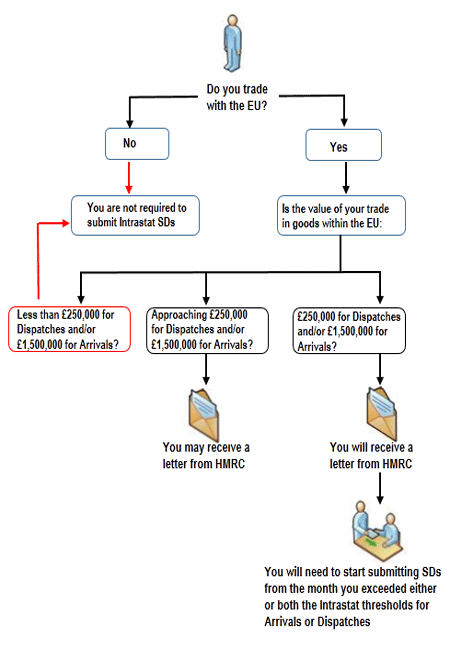
Something similar to reverse charge; called acquisition tax, applies to goods purchased from other EC Member States. These are known as acquisitions (they are imports if the goods come from outside the EU and different rules apply). The full value of the goods is subject to output tax and the associated input tax may be recovered by the business acquiring if the goods are used for taxable purposes. If you are not already registered for VAT in the UK and acquire goods worth £85,000 or more in the UK from other EC countries, you will have to register for VAT in the UK on the strength of the value of the acquisition tax. A business will also have to complete an Intrastat Supplementary Declaration (SDs) if its acquisitions of goods from the EC exceed an annual amount – currently £1.5 million.

Intrastat_flow_diagramMore details on Intrastat Supplementary Declarations here

Deregistration

Any goods on hand at deregistration with a total value of over £1,000 on which input tax has been claimed are subject to a self supply. This is a similar mechanism to a reverse charge in that the goods are deemed to be supplied to the business by the business and output tax is due. However, in these circumstances it is not possible to recover any input tax on the self supply.

Flat Rate Scheme

There is a self supply of capital items on which input tax has been claimed when a business leaves the flat rate scheme (and remains VAT registered).

Mobile telephones

In order to counter missing trader intra-community fraud (‘MTIC’), supplies of mobile telephones and computer chips which are made by one VAT registered business to another and valued at £5,000 and over are subject to the reverse charge. This means that the purchaser rather than the seller is responsible for accounting for VAT due.

And not forgetting the new domestic reverse charge for building and construction here.

Land and buildings…. and motor cars

There are certain circumstances where land and buildings must be treated as a self supply… but that is a whole new subject in itself… as is supplies in the motor trade.

Even if the result of a self-supply or reverse charge is VAT neutral HMRC is within its rights to assess and levy penalties and interest in cases where the charge has not been applied; which always seems unfair.  However, more often than not simple accounting entries will deal with the matter…. if the circumstances are recognised and it is remembered to actually make the entries!

VAT: Bad Debt Relief – The Total case

By   1 July 2019

Latest from the courts

Bad Debt Relief (BDR) is often an area that creates disputes with HMRC. The legislation has changed over the years and the current rules are described here.

Background

Broadly speaking, under normal VAT rules, a supplier is required to account for output tax, even if the supply has not been paid for (however, the use of cash accounting or certain retail schemes removes the problem of VAT on bad debts from the supplier). BDR, as the names suggests, is intended to provide relief on the VAT element of a bad debt. Output tax previously claimed may be “reclaimed” by using the BDR mechanism.

The law which governs the claiming of bad debt relief is The VAT Act 1994, Section 36, and Section 26A which covers the repayment of input tax when a customer fails to pay for supplies received within six months of the relevant date, and The VAT Regulations 1995, Parts XIX, XIXA and XIXB.

Conditions for claiming bad debt relief

  • A business must have accounted for the VAT on the supplies and paid it to HMRC
  • It must have been written off the debt in its day to day VAT accounts and transferred it to a separate bad debt account
  • The value of the supply must not be more than the customary selling price
  • The debt must not have been paid, sold or factored under a valid legal assignment
  • The debt must have remained unpaid for a period of six months after the date of the supply

The case

In the First Tier Tribunal (FTT) case of Total Catering Equipment Ltd [2019] TC 07184, heard on 4 June 2019, the issue was whether payments from customers which were diverted by a dishonest employee should be recognised as a payment for a supply of goods (no BDR available as the money was received then stolen) or whether the fact that the business did not actually receive the payment meant that a BDR was appropriate. Total supplied goods to customers, some of whom paid by credit or debit cards. The member of staff responsible for these transactions, set up a separate (from the business) bank account and fraudulently diverted customers; payments into his own account. A BDR claim was made by the appellant when the crime was discovered. The claim was refused by HMRC on the grounds that the employee had received payment “on behalf” of Total before making payment into his own account.

Decision

The judge found for the appellant. The appeal was allowed – it was decided that Total had never actually received payment for the goods supplied, so BDR was available. A distinction was made between the diversion of monies in this case (where the supplier was deemed to never had received the money) and a theft by an employee from, eg; a till or subsequent withdrawals from the business’ bank account (where a business would have received payment before the money was stolen).

Commentary

I have written about VAT and illegal activities here. There can be a fine line between taxable illegal activities and non-taxable illegal activities, and subtleties around tax points (time of supply) misrepresentation and consideration. If you, or your clients have been in the unfortunate position of being on the receiving end of crime, it would be adding insult to injury to have to account for tax on money you do not have. I would always advise that any demands from HMRC, or refusals to refund VAT should be properly reviewed.

VAT: When is the building of a house complete? (And why is it important?)

By   11 June 2019

Completion of a residential dwelling

A technical point which comes up surprisingly often and seems innocuous is: when is a building “complete”? The following case is helpful, and I thank Les Howard for bringing it to my attention.

The date that the construction of a dwelling is deemed to be complete is important for a number of reasons. The issue in the case of Mr and Mrs James was whether certain works could be zero rated via the VAT Act Schedule 8 Group 5 Item 2 (The supply in the course of the construction of a building designed as a dwelling…) or as HMRC contended, they were the reconstruction or alteration of an existing building and the work should be standard rated.

Background

The James used a contractor to plaster the entire interior of their house in the course of its construction. However, the work was demonstrably defective to such an extent that the James commenced legal proceedings. A surveyor advised that all of the old plaster needed to be hacked off and replaced by new plastering installed by a new firm. The stripping out and replacement works took place after the Certificate of Completion had been issued.

The James claimed input tax on the house construction via the DIY Housebuilders’ Scheme.

Technical

HMRC refused the James’ claim to have the remedial work zero-rated because, in their view, the re-plastering works amounted to the reconstruction or alteration of the house which was, when the supplies were made, an “existing building”. They proffered Note 16 of Schedule 5 which provides that “the construction of a building” does not include “(a) … the conversion, reconstruction or alteration of an existing building”.

They stated that zero-rating only applied if the work formed part of the construction of a zero-rated building. They had previously decided that the work of snagging or correction of faults carried out after the building had been completed could only be zero-rated if it was carried out by the original contractors and correction of faults formed part of the building contract. When the snagging is carried out by a different contractor, the work is to an existing building and does not qualify for zero rating.

The James stated that the Customs’ guidelines on snagging do not take into account extraordinary circumstances. Their contention was that the re-plastering works were zero rated because they had no choice but to engage the services of a different contractor other than the one who carried out the original works.

Decision

The judge found for the appellant – the re-plastering works were zero rated.

There was a query as to why The James applied for a Certificate of Completion before the plastering was completed. In nearly all cases such a certificate would crystallise the date the building was complete.

The reasons were given as:

  • the need for funds. The James could not remortgage the house without the certificate and they needed to borrow a substantial amount
  • they could not reclaim VAT under the DIY Housebuilders’ Scheme until the Certificate of Completion had been issued
  • they were aware that the building inspector was beginning to wonder why the building works were taking such a long time
  • they needed the house assessed for Council Tax which could only happen when the certificate had been issued
  • the Certificate was issued as part of the procedure required by the Building Act 1984 and the Building Regulations of 2000

These reasons were accepted by the judge.

Despite the respondents stating that:

  • for the reasons given above
  • the fact that the James had been living in the house for some time
  • they had obtained the Certificate of Completion
  • the new plastering work had been done by the new plasterer such that the house had been constructed before supply of the new plasterer’s services had been made
  • the house was an “existing building”

the judge was satisfied that in the circumstances the new plastering work was supplied in the course of the construction of the building as a dwelling house and that there was no reconstruction or alteration of an existing building in the sense contemplated by Note (16) to Group 5 Schedule 8.

He observed that the Certificate of Completion records that the substantive requirements of the Building Regulations have been satisfied. But to the naked eye the old plasterwork was obviously inadequate and dangerous ad he could not possibly consider that the construction project had finished until the new plasterwork was installed. The James’ construction project was to build a new dwelling house. Plasterwork of an acceptable standard was an integral part of the construction works. The new plasterwork was done at the earliest practicable opportunity.

Commentary

Care should be taken when considering when the completion of a house build takes place. There are time limits for DIY Housebuilders’ Scheme clams and clearly, as this case illustrates, usually work done to a house after completion does not qualify for zero rating. So, if the owner of a house is thinking of, say, building a conservatory for example, it is more prudent in VAT terms to construct it at the same time as a new house is built, and certainly before completion.

I would say that the appellant in this case achieved a surprisingly good result.

VAT: Treatment of vouchers, gifts and discounts – How business promotions work

By   24 May 2019
Business promotions are an area of VAT which continues to prove complex.  This is further exacerbated by changes to the legislation at EU and domestic level and ongoing case law. The main points are; whether there is a supply, and, if so, what is the value of that supply?

I hope that the VAT position is helpfully summarised here. I thought it may be useful if the VAT treatment of various business promotion schemes is summarised in one place.

…I recall a statement from an old mentor of mine; “if you have a marketing department you have a VAT issue!”

Summary

Offer How to charge VAT
Discounts Charged on the discounted price (not the full price)
Gifts Charged on the gift’s full value – there are some exceptions listed below
Multi-buys Charged on the combined price if all the items have the same VAT rate. If not, VAT is ‘apportioned’ as mixed-rate goods
Money-off coupons, vouchers etc No VAT due if given away free at time of a purchase. If not, VAT due on the price charged
Face value vouchers that can be used for more than one type of good or service (multi-purpose) No VAT due, if sold at or below their monetary value
Face value vouchers that can only be used for one type of good or service (single-purpose) VAT due on the value of the voucher when issued
Redeemed face value vouchers Charged on the full value of the transaction at the appropriate rate of the goods provided in return for the voucher

 Exceptions for gifts

There’s no VAT due on gifts given to the same person if their total value in a 12 month period is less than £50.

Free goods and services

A business is not required to account for VAT on things like free samples if they meet certain conditions.

Supplies Condition to meet so no VAT due
Free samples Used for marketing purposes and provided in a quantity that lets potential customers test the product
Free loans of business assets The cost of hiring the asset is included in something else you sell to the customer
Free gifts The total cost of all gifts to the same person is less than £50 in a 12 month period
Free services You don’t get any payment or goods or services in return

Background

Face value vouchers

Recent changes, radically alter the UK rules for face value vouchers (FVV). FVVs are; vouchers, tokens, stamps (physical or electronic) which entitle the holder to certain goods or services up to the value on the face of the vouchers from the supplier of those goods or services.

Examples of FVVs would include vouchers sold by popular group discount websites, vouchers sold by high street retailers, book tokens, stamps and various high street vouchers.

Single or multi-purpose

The most important distinction for FFVs is whether a voucher is a single purpose voucher or multi-purpose voucher. If it is a multi-purpose voucher then little has changed. If it is a single purpose voucher, however, HMRC will now required output tax to be accounted for at the date it is issued.

Single purpose vouchers are vouchers which carry the right to receive only one type of goods or services which are all subject to a single rate of VAT. Multi-purpose vouchers are anything else. The differences can be quite subtle.

For example:

  • a voucher which entitles you to download an e-book from one seller will be a single purpose voucher. A voucher which entitles you to either books (zero rated) or an e-book download (standard rated) from the same seller will be multi-purpose
  • a voucher which entitles you to £10 of food at a restaurant which does not sell takeaways is probably single purpose, whereas if the restaurant has a cold salad bar and you can buy a take away with the voucher (or hot food) then it would be multi-purpose. 

The above means that for single purpose vouchers VAT is due whether the voucher is actually redeemed or not; which seems an unfair result. There is no way to reduce output tax previously accounted for if the voucher is not used.

Please contact us if you, or your clients use this type of business promotion. of course, get it wrong, and there is likely to be a financial penalty!

VAT: Property – The Option To Tax

By   13 March 2019

Opting To Tax commercial property

Opting to tax provides a unique situation in the VAT world. It is the only example of where a supplier can choose to add VAT to a supply….. or not.

What is an option to tax?

The sale or letting of a property is, in most cases, exempt (VAT free) by default. However, it is possible to apply the option to tax (OTT) to commercial property. This has the result of turning an exempt supply into a taxable supply at the standard rate. It should be noted that an OTT made in respect of a residential property is disregarded and consequently, the supply of residential properties is always exempt.

Why opt?

Why would a supplier then deliberately choose to add VAT on a supply?

The only purpose of OTT is to enable the optor to recover or avoid input tax incurred in relation to the relevant land or property. The OTT is a decision solely for the property owner or landlord and the purchaser or tenant is not able to affect the OTT unless specific clauses are included in the lease or purchase contracts. Care should be taken to ensure that existing contracts permit the OTT to be taken.  Despite a lot of misleading commentary and confusion, it is worth bearing in mind that the recovery or avoidance of input tax is the sole reason to OTT.

Once made the OTT is usually irrevocable for a 20-year period (although there are circumstances where it may be revisited within six months of it being taken – see below).  There are specific rules for circumstances where the optor has previously made exempt supplies of the relevant land or property. In these cases, HMRC’s permission must usually be obtained before the option can be made.

What to consider

The important questions to be asked before a property transaction are:

  • Was VAT incurred on the purchase price?
  • Is the purchase with the benefit of an existing lease (will the tenant remain?) if so, it may be possible to treat the transaction as a VAT free TOGC (see below)
  • Is the property subject to the Capital Goods Scheme (CGS here)?
  • Is it intended to spend significant amounts on the property, eg; refurbishment?
  • What other costs will be incurred in respect of the property?
  • If renting the property out – will the lease granted be full tenant repairing?
  • Will the tenant or purchaser be in a position to recover any or all VAT charged on the rent/sale?

These are the basic questions to be addressed; further factors may need to be considered depending on the facts of a transaction.

Input tax recovery

Input tax relating to an exempt supply is usually irrecoverable. In fact, a business only making exempt supplies is unable to register for VAT. A guide to partial exemption here. So input tax incurred on, say; purchase, refurbishment, legal costs etc would be lost if a property was sold or rented on an exempt basis. In order to recover this tax, it must relate to a taxable supply. If an OTT is taken, the sale or rent of the property will be standard rated which represents a taxable supply. VAT on supply = input tax claim.

Two-part process

The OTT is a two-part process.

  • The first part is a decision of the business to take the OTT and it is prudent to minute this in Board meeting minutes or similar. Once the decision to OTT is taken VAT may be added to a sale price or rent and a valid tax invoice must be raised.
  • The second part is to formally notify HMRC. If the OTT is straightforward the form on which this is done is a VAT1614A. Here. In some cases, it is necessary to obtain HMRC’s permission in which case separate forms are required. HMRC guidance here – para 5.

There can be problems in cases where the OTT is taken, but not formally notified.

Timing

It is vital to ensure that an OTT is made at the correct time. Even one day late may affect the VAT treatment. Generally speaking, the OTT must be made before any use of the property, eg; sale or rent. Care should also be taken with deposits which can trigger a tax point before completion.

Disadvantages

As mentioned above (and bears repeating) the benefit of taking the OTT is the ability to recover input tax which would otherwise fall to be irrecoverable. However, there are a number of potential disadvantages.

  • opting a commercial property may reduce its marketability. It is likely that entities which are unable to recover VAT would be less inclined to purchase or lease an opted property. These entities may be; partly exempt business, those not VAT registered, or charities/NFP organisations.
  • the payment of VAT by the purchaser may necessitate obtaining additional funding. This may create problems, especially if a VAT charge was not anticipated. Even though, via opting, the VAT charge is usually recoverable, it still has to be paid for up-front.
  • an OTT will increase the amount of SDLT payable when a property is sold. This is always an absolute cost.

Transfer of a Going Concern (TOGC)

I always say that advice should be taken in all property transactions and always in cases of a TOGC or a possible TOGC. This is doubly important where an opted building is being sold, because TOGC treatment only applies to a sale of property when specific tests are met. A TOGC is VAT free but any input tax incurred is recoverable, so this is usually a benefit for all parties.

Revoking an Option To Tax

  • The cooling off period – If an OTT has been made and the opter changes his/her mind within six months it can be revoked. This is as long as no tax has become chargeable on a supply of the land, that no TOGC has occurred, and the OTT has actually been notified to HMRC. There are additional considerations in certain cases, so these always need to be checked.
  • No interest has been held for more than six yearsAn OTT is revoked where the opter has not held an interest in the opted building for a continuous period of six years. The revocation is automatic, and no notification is required.
  • 20 years – It is possible to revoke an OTT which was made more than 20 years ago. Certain conditions must be met, and advice should be taken on how such a revocation affects future input tax recovery.

Summary

Property transactions are high value and often complex. The cost of getting VAT wrong or overlooking it can be very swingeing indeed. I have also seen deals being aborted over VAT issues.  of course, if you get it wrong there are penalties to pay too. For these reasons, please seek VAT advice at an early stage of negotiations.

More on our land and property services here

VAT: More on the Mercedes Benz Financial Services case – PCP

By   1 March 2019

Further to my article on the Mercedes Benz Financial Services (MBFS) case on Personal Contract Purchase (PCP), HMRC has published a Briefing Note – Changes to the VAT treatment of PCPs

HMRC has fully implemented the findings in the MBFS CJEU case. In summary, HMRC state that:

The correct treatment of PCP and similar contracts depends on the level at which the final optional payment is set:

  • if, at the start of the contract, it is set at or above the anticipated market value of the goods at the time the option is to be exercised, the VAT treatment of the contract will follow the MBFS It is a supply of leasing services from the outset and VAT must be accounted for on the full value of each instalment, there is no advance, or credit, so there is no finance
  • if, at the start of the contract, it is set below the anticipated market value, such that a rational customer would buy the asset when they exercise the option, it is a supply of goods, with a separate supply of finance. VAT is due on the supply of goods in full at the outset of the contract, the finance is exempt from VAT”

This treatment must be used by 1 June 2019. Past declarations which have been in error must be adjusted per PN 700/45. Businesses affected by the changes may also need to consider adjustments to input tax claimed, or forgone in respect of partial exemption. A guide to partial exemption here.

VAT: New reverse charge for the construction industry

By   4 February 2019

Further to my article which sets out the basis of these changes, I look further at the measures which will be introduced on 1 October 2019. Time is running out for businesses in the building and construction sector to understand the impact of the new rules and to make arrangements to implement the required changes. These will include:

  • cashflow implications
  • accounting procedures
  • processes
  • tax compliance
  • documentation
  • systems

Background

HMRC will introduce the Reverse Charge (RC) to combat Missing Trader Fraud (MTF). The rules avoid suppliers charging and being paid VAT but failing to declare or pay this over to the government. HMRC has identified the building trade as an area where there has been considerable tax leakage in the past. The UK has introduced similar measures in response to criminal threats for mobile telephones, emissions allowances, gas, electricity and electronic communications. A domestic reverse charge only applies to supplies between UK taxable persons therefore unless the customer is registered or liable to be registered for VAT it will not apply.

The RC will make supplies of standard or reduced rated construction services between construction or building businesses subject to the domestic RC, which means that the recipient of the supply will be liable to account for VAT due, instead of the supplier. Consequently, the customer in the construction industry receiving the supply of construction services will be required to pay the VAT directly to HMRC rather than paying it to the supplier. It will be able to reclaim this VAT subject to the normal VAT rules. The RC will apply throughout the supply chain up to the point where the customer receiving the supply is no longer a business that makes supplies of construction services (a so-called end user, see below).

The supplies to which the RC will apply are set out here

Further information on the RC in general, including invoicing requirements are to be found in VAT Notice 735

Technical

As a general rule, it is the supplier of goods or services who is required to account for VAT on those supplies. However, the VAT Act 1994, section 55A requires the recipient, not the supplier, to account for and pay tax on the supply of any goods and services which are of a description specified in an order made by the Treasury for that purpose.

The final version of the draft legislation has now been published. In addition HMRC have issued guidance notes which include a helpful flowchart.

Mixed supplies

If there is a RC element in a supply, then the whole supply will be subject to the RC. This is to make it simpler for both supplier and customer and to avoid the need to apportion the supply.

End user

End users will usually be recipients who use the building or construction services for themselves, rather than sell the services on as part of their business of providing building or construction services.

VAT Returns

Suppliers

Suppliers applying the RC do not enter a figure for output tax in box 1 of the VAT Return, but should enter the value of such sales in box 6.

Customers

Customers must enter the output tax on purchases to which the RC applies in box 1 of the VAT Return, but must not enter the value of such purchases in box 6. They may reclaim the input tax on the RC purchases in box 4 of the VAT Return and include the value of the purchases in box 7, in the normal way.

Implementation

HMRC state that it understands the difficulties businesses may have in implementing the domestic RC and say it will apply a light touch in dealing with related errors that occur in the first six months after introduction.

 Action

It is prudent to check whether you, or your clients’ businesses will be affected by these changes. If so, plans need to be put in place; whether as a supplier or recipient, to ensure that VAT is not charged incorrectly (supplier) and the RC is applied correctly (recipient). It is likely that output tax incorrectly shown on an invoice will be due to HMRC but will not be recoverable by the recipient and the omission of levying the RC will lead to penalties. It will also be helpful for smaller construction providers affected by the RC to examine the impact on their cashflow.

Please contact us if you have any queries or require further information.