Tag Archives: vat-errors

VAT: Output tax on credits? A Tax point case

By   18 September 2017

Latest from the courts

In the Scottish Court of Session case of Findmypast Limited the issue was whether the sale of credits represented a taxable supply, the tax point of which was when payment was received.

Background

Findmypast carries on a business of providing access to genealogical and ancestry websites which it owns or for which it holds a licence. If a customer wishes to view or download most of the records on the website, they will be required to make a payment. This may be done by taking out a subscription for a fixed period, which confers unlimited use of the records during that period. Alternatively, the customer may use a system known as Pay As You Go. This involves the payment of a lump sum in return for which the customer receives a number of “credits”. The credits may be used to view records on the website, and each time a record is viewed some of the credits are used up. The credits are only valid for a fixed period, but unused credits may be revived if the customer purchases further credits within two years; otherwise they are irrevocably lost.

Technical

Findmypast accounted for output tax on the price of the credits at the time when they were sold.  As a consequence, VAT was paid, not only on credits which were used, but also on credits that were not redeemed (The tax point therefore similar to the current rules on the sale of single use face value vouchers. Rules here).

The taxpayer claimed repayment of the VAT accounted for on the sale of unredeemed vouchers during a period which ran up to May 2012 when the legislation was changed.

The question was whether output tax should have been accounted for at the time when the vouchers were sold or at the time the vouchers were redeemed. If the tax point was the date of redemption, then the claim would be valid. The court identified the following issues:

  • What is the nature of the supply made by the taxpayer to customers?
    • Was it was the supply of genealogical records selected by the customer and viewed or downloaded by them?
    • Or was the supply a package of rights and services, which conferred a right to search the records and download and print items from the taxpayer’s websites?

If the former is accurate, the supply only takes place if and when a particular record is viewed or downloaded.  If the latter, the supply includes a general right to search which is exercisable as soon as the credits are purchased, with the result that the supply takes place at that point.

A subtle distinction, but one which has an obviously big VAT impact.

Decision

The Court decided that where credits were not redeemed, the taxpayer is entitled to be repaid the output tax previously declared as no tax point was created. In the Court’s view, Findmypast was making the relevant documents available in return for payments received. HMRC’s contention that there was a complex, multiple supply of the facility to find and access genealogical documents such that payment created a tax point was dismissed. The court further found that the relevant payments did not qualify as prepayments (deposits) because it was not known at the time of purchase whether the credits would be redeemed (many were not) or indeed at what time they would be redeemed if they were.  It was also decided that the credits were not Face Value Vouchers per VAT Act 1994, Schedule 10A, paragraph 1(1) as they are rather mere credits that permit the customer to view and download particular documents on the taxpayer’s website, through the operation of the taxpayer’s accounting system.  And that they are not purchased for their own sake but as a means to view or download documents.

Commentary

Readers of my past articles will have identified that multiple/single supplies and tax points create have been hot topics recently, and this is the latest chapter in the story.

This case highlights that any payments received by a business must be analysed closely and the actual nature of them determined according to the legislation and case law. Not all payments received create a tax point and

Some will not represent consideration such that output tax is due. Careful consideration of the tax point rules is necessary.  Not only can the correct application of the rules aid cashflow, but in certain circumstances (such as set out in this case) it is possible to avoid paying VAT on receipts at all.

VAT – Do as HMRC say…. and if you do… they may still penalise you!

By   13 September 2017

Can you rely on a VAT ruling received from HMRC when they have been provided with full information in writing?

You would like to think so wouldn’t you? And in the past, you have been able to.

However, the long standing protection from assessments for deemed underdeclared VAT as a result of incorrect advice or actions by HMRC has been withdrawn. This was commonly known as “Sheldon Statement” protection. HMRC now state that there are some circumstances in which their primary duty is to collect tax according to the statute and it may mean that they can no longer be bound by advice they have given.  Despite all the publicity of their National Help Line and Advice Centre, plus the clearance procedures introduced to assist taxpayers with their obligations, HMRC can still renege on their advice! Even if you are fortunate enough to actually get a decision from HMRC (which is increasingly difficult and frustrating) you can’t necessarily rely on it. This is the case even if you have provided full information in writing (as required) and made a comprehensive disclosure of your position.

This makes it even more important to avoid errors and the increased risk of VAT penalties and interest. Details of the penalty regime here

This leaves the question as to whom businesses can rely on for accurate, cost effective VAT saving advice and guidance on getting VAT right?  The answer, clearly, is to contact their friendly local VAT consultant…

The Default Surcharge for late VAT payments

By   5 September 2017

A Default Surcharge is a civil penalty issued by HMRC to “encourage” businesses to submit their VAT returns and pay the tax due on time.

VAT registered businesses are required by law to submit their return and make the relevant payment of the VAT by the due date.

A default occurs if HMRC has not received your return and all the VAT due by the due date. The relevant date is the date that cleared funds reach HMRC’s bank account. If the due date is not a working day, payment must be received on the last preceding working day.

Payments on Account (POA)

If a business is required to make POA it must pay them and the balance due with the VAT Return by electronic transfer direct to HMRC’s bank account. The due dates for POA are the last working day of the second and third month of every quarterly accounting period. The due date for the balancing payment is the date shown on the business’ VAT Return. It is important to ensure that payments are cleared to HMRC’s bank by these dates or there will be a default.

Consequence of default

A business will receive a warning after the first default ‐ the Surcharge Liability Notice (SLN). Do not ignore this notice. If you fail to pay the VAT due on the due date within the next five quarters, the surcharge will be 2% of the outstanding tax. The surcharge increases to 5% for the next default, and then by 5% increments to a maximum of 15%.  Each default, whether it is late submission of the return or late payment, extends the surcharge liability period, but only late payment incurs a surcharge.

If you can’t pay the VAT you owe by the due date or are having difficulties, contact the Business Payment Support Service immediately.

Special arrangements for small businesses

There are special arrangements if a business’ taxable turnover is £150,000 or less to help if there are short term difficulties paying VAT on time. HMRC send a letter offering help and support rather than a Surcharge Liability Notice the first time there is a default. This aims to assist with any short-term difficulties before a business formally enters the Default Surcharge system. If the business defaults again within the following 12 months a Surcharge Liability Notice will be issued.

Minimum surcharges

There is a minimum of £30 for surcharges calculated at the 10% or 15% rates. There will not be a surcharge at the 2% and 5% rates if it is calculated it to be less than £400. However, a Surcharge Liability Notice Extension extending the surcharge period will be issued and the rate of surcharge if you default again within the surcharge period will be increased.

Circumstances when HMRC will not levy a surcharge

There’s no liability to surcharge if a business:

  • submits a nil or repayment return late
  • pays the VAT due on time but submit your return late

HMRC will not issue a surcharge in these circumstances because there is no late payment involved. If a business had defaulted previously HMRC will issue a Surcharge Liability Notice Extension extending the surcharge period because the return is late, but they will not increase the rate of surcharge.

Time limit

A business’ liability to surcharge will expire if a business submits all of its returns and payments for tax periods ending on or before the end of the surcharge liability period on time.

Reasonable excuse

If a business has a reasonable excuse for failing to pay on time, and it remedies this failure without unreasonable delay after the excuse ends, it will not be liable to a surcharge.

There’s no statutory definition of reasonable excuse and it will depend on the particular circumstances of a case. A reasonable excuse is something that prevented the business meeting a tax obligation on time which it took reasonable care to meet. The decision on whether a reasonable excuse exists depends upon the particular circumstances in which the failure occurred. There is a great deal of case law on this particular issue. Please contact us should there be doubt about a reasonable excuse.

Disagreement over a surcharge

If you disagree with a decision that you are liable to surcharge or how the amount of surcharge has been calculated, it is possible to:

  • ask HMRC to review your case
  • have your case heard by the Tax Tribunal

If you ask for a review of a case, a business will be required to write to HMRC within 30 days of the date the Surcharge Liability Notice Extension was sent. The letter should give the reasons why you disagree with the decision.

Examples when a review may be appropriate are if a business considers that:

  • it has a reasonable excuse for the default
  • HMRC applied the wrong rate of surcharge
  • HMRC used the wrong amount of VAT when calculating the surcharge
  • there are exceptional circumstances which mean the default should be removed

A business will still be able to appeal to the Tribunal if it disagrees with the outcome of the HMRC review.

We are very experienced in dealing with disputes over Default Surcharges, so if you feel that one has been applied unfairly, or wish to explore your rights, please let us know.

VAT Public Notice 700 Updated

By   25 August 2017

Notice 700: The VAT Guide has been updated.

This HMRC Notice is a “starting point” for general VAT information and provides a guide to all the main VAT rules and procedures. It also provides assistance with the problems faced by business and includes an index which helps users find further information by referring to a particular section or paragraph in one of HMRC’s other, more specialised publications. There have been over 30 changes to the Notice which was last updated in 2016.

A full list of changes is set out in the Notice, but the most salient are as follows:

  • Additional guidance on MOSS – para 4.8.4
  • Single and mixed supplies – para 8.1
  • Continuous supplies to connected persons – para 14.3.1
  • Various commentary on invoices (including electronic invoicing) – paras 16.6, 16.8, 17.7 17.8
  • Accounting schemes – para 19.2
  • Agents registered for VAT acting in their own name when the customer is not registered – para 1.2
  • Penalties for inaccuracies – para 27.3
  • Integrity of supply chains – para 27.5.2

The number of changes in just one year highlights the fast pace of the tax and the number of challenges which taxpayers have won. I cannot see this pace letting up in the future either.

As always, if you have any queries about the changes, please contact us.

VAT: Latest from the courts –zero rating of sub-contractors’ supplies

By   8 August 2017

In the First Tier Tribunal case of Summit Electrical Installations Ltd the issue was whether supplies in respect of student accommodation made by an electrical sub-contractor were eligible for zero rating as supplies in the course of construction of buildings designed as a series of dwellings. Alternatively, were they, as HMRC contended; standard rated supplies in the course of construction of a building used for a Relevant Residential Purpose (RRP)?

Background

The appellant was appointed as the electrical subcontractor working to a main contractor on a development known as Primus Place in Leicester. This development is a seven storey block of student accommodation comprising 140 studio flats and associated facilities. Floors one to six are similar in layout with the majority of the studio flats being the same size. There are also a number of larger studios on some floors. On the ground floor there is a communal reception, cycle store, and laundry. In addition management offices, stores, bins and plant rooms are situated on the ground floor. Each of the studio flats was fitted out with a bathroom pod (a unit including shower, sink and toilet) installed in the corner of the room. In addition there was a small kitchenette with dish washing sink, countertop, cooker, fridge and microwave. Through a doorless stud wall is an open plan sleeping area and walk in cupboard.

The planning permission was granted subject to one relevant condition which provided that at the development: “…no person other than a full time student attending the University of Leicester or DeMontfort University…shall occupy these flats at any time”.

The main contractor provided a zero rating certificate to the appellant. This certificate certified that the developer of the site intended to use the buildings for a relevant residential purpose, namely student living accommodation.

Technical

In this case the distinction between the construction of dwellings and RRPs is that sub-contractors may zero rate their supplies if the work is in respect of dwellings, but those same supplies are standard rated if what is being constructed is a RRP. It is useful to consider the distinction here.

Relevant Residential Purpose

RRP means use as:

(a) a home or other institution providing residential accommodation for children

(b) a home or other institution providing residential accommodation with personal care for persons in need of personal care by reason of old age, disablement, past or present dependence on alcohol or drugs or past or present mental disorder

(c) a hospice

(d) residential accommodation for students or school pupils

(e) residential accommodation for members of any of the armed forces

(f) a monastery, nunnery or similar establishment, or

(g) an institution which is the sole or main residence of at least 90 per cent. of its residents

but not use as a:

hospital or similar institution

prison or similar institution, or

hotel, inn or similar establishment

Clearly, by the above definition, student accommodation is deemed to be a RRP. Therefore, the Tribunal was asked to consider whether the accommodation would also qualify as dwellings, and if so, whether “designed as a dwelling” takes precedence. The definition of a dwelling is as follows (“Note 2” as referred to below).

Dwellings

A building is designed as a dwelling or a number of dwellings where in relation to each dwelling the following conditions are satisfied:

(a) the dwelling consists of self-contained living accommodation;

(b) there is no provision for direct internal access from the dwelling to any other dwelling or part of a dwelling;

(c) the separate use, or disposal of the dwelling is not prohibited by the term of any covenant, statutory planning consent or similar provision; and

(d) statutory planning consent has been granted in respect of that dwelling and its construction or conversion has been carried out in accordance with that consent.

Decision

The judge ruled that the accommodation qualified as dwellings for the purpose of zero rating such that the sub-contractors supplies could also be zero rated. This was the case even though the planning permission contained a condition restricting their use to students of the universities only. The building also qualified as a RRP but via VAT Act 1994, Schedule 8, Group 5, note 2 – designed as a dwelling takes precedence over RRP.

NB: The Tribunal also found that HMRC guidance which sets out that in similar circumstances it is the main contractor who determines which type of zero rating applies to a particular development has no basis in law. It is the responsibility of the sub-contractor to determine whether it is working on a dwelling or a RRP building regardless of the main contractor’s position.

Commentary

HMRC appeared to have relied solely on para (c) of Note 2 (above) to disqualify the accommodation from being dwellings, on the basis that the planning permission prohibited occupation by any other person than students of the universities, but the judge was having none of that. The decision was hardly unexpected, but the comments on there being no legal basis to support HMRC’s published guidance is helpful and provides clarity.

As always, when analysing supplies of construction services (plus associated goods) and transactions involving land and property it pays to get proper VAT advice. There are many traps for the unwary and the values involved are usually high.  The cost of getting it wrong can be very harmful to a business.

VAT: Latest from the courts – extent of education exemption

By   7 August 2017

In the case of SAE Education Ltd (SAE) at the Court of Appeal, the court was required to decide on whether the exemption for education services extended to a “Special Associate College”.

Background

At the relevant time here was relationship between SAE and Middlesex University which has existed since 1998 when the first Memorandum of Co-operation was signed.  This was a contractual document which provided for certain BA courses to be taught by SAE at specified campuses as “validated collaborative programs” of the university. Subsequently the university and SAE entered into further Memoranda of Co-operation which replaced the earlier agreement and provided for the validation of additional courses. Tuition was provided by SAE subject to quality assurance safeguards. SAE provided library, computer and other facilities but SAE students would not normally be entitled to access or use of the university’s Learning and Resource Services unless negotiated at extra cost. Nor were they to be entitled to access university’s accommodation and other social welfare services or to apply for financial support from the University’s Access to Learning Fund. They were however, entitled to access the university’s Disability Support Services but again at an additional cost.

In 2010 a decision by the university to grant SAE accredited status was made. This meant that SAE was accredited to validate, monitor and review courses of study leading to university undergraduate awards in certain subjects. This gave SAE the ability to validate the specified programmes itself (although Middlesex University staff continued to be involved in the assessment of the programmes).

The issue

SAE claimed that its supplies were exempt on the basis that it was a college of Middlesex University and therefore an “eligible body” (see below) and that the services supplied were educational as the university outsourced certain courses to it.

HMRC disagreed and assessed for output tax on the appellant’s services on the basis that exemption did not apply and the supplies were standard rated.

Legislation

The relevant legislation: VAT Act 1994, Schedule 9, Group 6, item 1 insists that in order for exemption to apply the provision of education (inter alia) must be by an “eligible body”. The matter to be considered therefore was; is SAE Education Ltd an eligible body. An “Eligible body” is defined in Note (1). It includes a long list of different types of school and higher education establishments but the appeal concerned paragraph (b): “a United Kingdom university, and any college, institution, school or hall of such a university;”

Decision

So was the appellant a UK university, college, instruction, school or hall of such a university?  The judges concluded that it was not.

It was decided that although Middlesex University outsourced certain courses to it, and that SAE  was appointed as a Special Associate College,  this fell short of making it a college in a constitutional or structural sense. In their view a college means entities which are a constituent part of an university. The example given was of Cambridge and Oxford colleges which have been organised for centuries on a federal system under which the colleges and private halls, although legally independent and self-governing, have provided the students of the university and have assumed the primary responsibility for their tuition. The universities themselves are corporations and are regulated by statute with their own separate legal identity and status. “The colleges and private halls are therefore an integral part of the structure of the university and their members make up the university’s teaching staff and students.”

Commentary

It would appear that as a result of the approach in this case, the exemption for education may be more restrictive than previously understood. It is vital that providers of education review their VAT status as soon as possible.  I would advise that a VAT consultant is used because this is an area where small details may affect the VAT treatment of the services. The ruling in this case is not helpful.

VAT – Business Entertainment Flowchart. What input tax may I recover?

By   26 June 2017

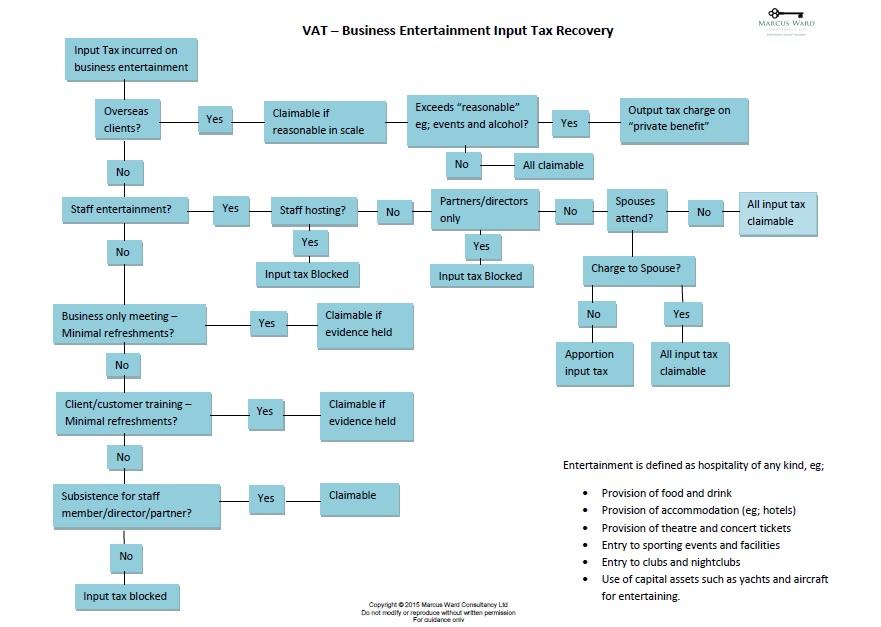
VAT – Recovery of input tax incurred on entertainment

One of the most common questions asked on “day-to-day” VAT is whether input tax incurred on entertainment is claimable.  The answer to this seemingly straightforward question has become increasingly complex as a result of; HMRC policy, EC involvement and case law.

Different rules apply to entertaining; clients, contacts, staff, partners and directors depending on the circumstances.  It seems reasonable to treat entertaining costs as a valid business expense.  After all, a business, amongst other things, aims to increase sales and reduce costs as a result of these meetings.  However, HMRC sees things differently and there is a general block on business entertainment.  It seems like HMRC does not like watching people enjoying themselves at the government’s expense!

If, like me, you think in pictures, then a flowchart may be useful for deciding whether to claim entertainment VAT.  It covers all scenarios, but if you have a unique set of circumstances or require assistance with some of the definitions, please contact me.

We have recently carried out a series of presentations, which, amongst other subjects, covered business entertainment. Should you require VAT training or presentations, don’t forget our comprehensive service here which can be tailored to your needs.

VAT -Business Entertainment Flowchart

Business Entertainment flow chart

Download here: VAT Business Entertainment Input tax recovery flowchart

VAT – Are overpayments subject to output tax?

By   19 June 2017

This was the question considered by the Upper Tribunal (UT) in the case of National Car Parks Limited

Latest from the courts

We’ve all been there. We’ve found a NCP pay and display car park and want to park for one hour.  We find a free space and go to the pay and display ticket machine. In this example, the prices stated on the tariff board next to the pay and display ticket machine are: Parking for up to one hour – £1.40. Parking for up to three hours – £2.10. The pay and display ticket machine states that change is not given but overpayments are accepted.

Guess what? As usual, we find that we don’t have the right money and only have a pound and a fifty pence piece, so we have to put them both in the machine.  The machine meter records the coins as they are fed into the machine, starting with the pound coin. When the fifty pence piece has been inserted and accepted by the machine, the machine flashes up ‘press green button for ticket’ which we customer do. The amount paid is printed on her ticket, as is the expiry time of one hour later and we wander off  to attend our business.

So, is VAT due on the overpayment of 10p?

The First Tier Tribunal (FTT) said “yes”.  It held that the excess payments made by the customer to NCP were not voluntary because the customer was required to pay at least the amount specified in order to park their vehicle and, if the customer did not have the correct change, the customer was required to pay an additional amount in order to obtain the right to park. The only sense in which the payment could be said to be “voluntary” is that the customer could decide not to buy a ticket which would mean not parking the car and having to go elsewhere. The taxpayer then appealed to the UT.

Law

Article 2(1)(c) of the Principal VAT Directive (PVD) provides that supplies of services for consideration within the territory of a Member State by a taxable person acting as such are subject to VAT. Article 73 of the PVD provides: “In respect of the supply of goods or services… the taxable amount shall include everything which constitutes consideration obtained or to be obtained by the supplier, in return for the supply, from the customer or a third party, including subsidies directly linked to the price of the supply.”  The provisions of the PVD have been implemented in UK law by the Value Added Tax Act 1994. Section 5(2)(a) of the VAT Act 1994 defines ‘supply’ to include all forms of supply but not anything done otherwise than for a consideration and section 19(4) provides: “Where a supply of any goods or services is not the only matter to which a consideration in money relates, the supply shall be deemed to be for such part of the consideration as is properly attributable to it.”

 Decision

The UT agreed with the FTT, and so the taxpayer’s appeal was dismissed.  A distinction was made between these overpayments and optional payments such as tips (which are VAT free).  It was stated that the PVD seeks to identify what consideration was received by NCP, not whether the customer could have obtained the same service for less. NCP retained the £1.50 in return for providing the car parking and this was consequently the value of the service provided.

Commentary

We have recently dealt with a number of cases which dealt with the topic of valuation and have been successful in obtaining a refund of overpaid VAT. Unfortunately for the appellant in this case, it seems that there was little chance of success and they didn’t get to keep all of value of the overpayments. All those 10ps add up…

VAT and Customs Duties. Bringing goods into the UK – A brief guide

By   12 June 2017

VAT and duty on and imports and acquisitions 

The rules covering bringing goods into the UK are complex and set out in different areas of the legislation and HMRC guidance. I thought it may be helpful bring some of the most salient rules together in one place. Of course, with Brexit, some of the information below may be subject to change. Most likely, acquisitions will take on more of the rules applicable to imports, but we shall see…

If you are bringing goods into the UK it is important to recognise the VAT and duty rules and procedures.  You must ensure that you pay the right amount of VAT and import duties via the correct mechanism.

Goods brought into the UK from other EC countries are called acquisitions rather than imports, and this is an important distinction as we shall see below.

The details and practicalities can be complex and you may want to seek advice or use an agent or freight forwarder to handle your responsibilities, particularly if you are new to international trade or only need to bring goods here occasionally.

Acquisition of goods from EC Member States

The EC Member States

The 28 EC countries are: Austria, Belgium, Bulgaria, Croatia, Republic of Cyprus, Czech Republic, Denmark, Estonia, Finland, France, Germany, Greece, Hungary, Ireland, Italy, Latvia, Lithuania, Luxembourg, Malta, Netherlands, Poland, Portugal, Romania, Slovakia, Slovenia, Spain, Sweden and the UK.

Information

If you are UK VAT registered you need to give your supplier your VAT number. This allows the supplier to treat the sale to you as VAT free.  You will need a VAT invoice as with any other purchase. If not UK VAT registered you will pay VAT applicable in the Member State of the supplier.

Accounting for VAT 

You must account for VAT on acquisitions (“acquisition tax”) on your VAT return. VAT is charged at the normal UK rate of VAT for those goods.  You reclaim this acquisition tax in the same way as you reclaim input tax on purchases of supplies within the UK.  So for most businesses the effect is VAT neutral.  In this way there is no difference between buying the goods in the UK or another EC Member State so it rules out cross-border “VAT rate shopping”. There are no Customs Duties to pay on acquisitions.

Reporting

All VAT-registered businesses must show the total value of goods acquired from other EU Member States in box 9 of their VAT Return.

In addition, those who trade in the EC above the Intrastat exemption threshold in force during the year must also complete a monthly Supplementary Declaration (SD). The threshold is £1.5 million.

Importing goods from outside the EC

Your responsibilities for imports

You are normally responsible for clearing the goods through UK customs and paying any taxes and duties. Your supplier needs to provide the documentation you need to clear the goods through Customs. If you are importing you may have to pay import duty.

You will need to decide whether to use an agent to handle your responsibilities.  Freight forwarders can handle Customs clearance as well as transport. You can find reputable freight forwarders through the British International Freight Association: here 

You need to check what import duty applies

Import duty is based on the type of goods you are importing, the country they originate from and their value. HMRC’s Integrated Tariff sets out the classification of goods and the rates of duty in detail: here

Confirm what paperwork you require from the supplier for Customs clearance

This normally includes an invoice and a copy of the transport documents.  You may need proof of the origin of the goods to claim reduced import duty for goods from certain countries. A valuation document is also normally required for imports above a set value.

Complete an import declaration

You normally declare imports using the Single Administrative Document (SAD).  If you are registered for VAT in the UK you will need an EORI (Economic Operator Registration & Identification) to enable your inbound commercial shipments to be cleared through the automated  CHIEF (Customs Handling of Import and Export Freight). This is made up of your VAT number, plus a further three digits.

Release of goods

You will need to pay VAT and duty to get the goods released. You pay VAT at the normal UK rate for those goods when sold in the UK.

Deferment

Regular importers are able to defer payment of VAT and duty by opening a deferment account with HMRC. You need to provide security and must agree to pay by direct debit. It is also possible to use your agent or freight forwarder’s deferment account.

Accounting for VAT

HMRC will send you a monthly C79 certificate showing the import VAT you have paid. You must retain this.  Certificates cover accounting transactions made in each calendar month should be received around the 24th of each month following imports logged the previous month.

You can reclaim VAT paid on imports on a C79 in the same way as you reclaim input tax on purchases of supplies within in the UK.  It is not possible to reclaim VAT on any other document, eg; an invoice.  Shipping or forwarding agents can’t reclaim this input tax because the goods weren’t imported to be used in part of their business.

NB: If you import works of art, antiques and collectors’ items they are entitled to a reduced rate of VAT.

You cannot reclaim import duty.

Be aware of special cases

Check whether any goods you are buying are subject to Excise Duty

Excise duty is charged on fuel, alcohol and tobacco products. It is charged on acquisitions from within the EU as well as imports from countries outside the EC. If goods are subject to excise duty, you pay this at the same time as you pay VAT and import duty.

VAT is charged on the value of the goods plus excise duty.

Warehousing

You may want to consider using a Customs warehouse if you expect to store imports for a long time. If you store goods in a Customs warehouse, you will not need to pay import duty and VAT until you remove the goods from the warehouse.

Storage ‘in bond’ like this is often used for products subject to excise duty, such as wine and cigarettes, although it is not limited to these goods.

Re-exported goods

You will also find it beneficial to find out about tax relief if you are planning to re-export goods you import.  There are special Inward Processing Relief (IPR) rules so that you do not have to pay import duty and VAT.  This relief can apply to imports that you process before re-exporting them.

Valuation of imported goods for VAT and Duties

There are six methods of valuing imported goods, however, in the vast majority of cases (over 90%) the “Transaction Method” is used and, in fact, you must use this method wherever possible.

Transaction Value

This is the price paid or payable by the buyer to the seller for the goods when sold for export to the EC adjusted in accordance with certain specific rules.

This may also cover situations where goods are imported from a processor. The “transaction value” may be “built up” or “constructed” by reference to the cost of processing plus any items to be added commonly referred to as “assists”.

What items must be added to the price paid or payable?

You must add the following to the price you pay (unless they are already included):

(a) Delivery costs. – The costs of transport, insurance, loading or handling connected with delivering the goods to the EC border must be included.

(b) Commissions. – Certain payments of commission and brokerage, including selling commission, must be included.

But you can exclude buying commission if it is shown separately from the price paid or payable for the goods.

(c) Royalties and licence fees. – You must include these payments when they relate to the imported goods and are paid by you as a condition of the sale to you of those goods.

(d) Goods and services provided free of charge or at reduced cost by the buyer. –  If you provide, directly or indirectly, any of the following, you must include in the customs value any part of the cost or value not included in the price charged to you by the seller:

  1. materials, components, parts and similar items incorporated in the imported goods including price tags, kimball tags, labels
  2. tools, dies, moulds and similar items used in producing the imported goods, for example, tooling charges. There are various ways of apportioning these charges

iii.          materials consumed in producing the imported goods, for example, abrasives, lubricants, catalysts, reagents etc which are used up in the manufacture of the goods but are not incorporated in them,

  1. engineering, development, artwork, design work and plans and sketches carried out outside the EC and necessary for producing the imported goods. The cost of research and preliminary design sketches is not to be included.

(e) Containers and packing. Include:

  1. the cost of containers which are treated for customs purposes as being one with the goods being valued (that is not freight containers the hire-cost of which forms part of the transport costs), and
  2. the cost of packing whether for labour or materials

Where containers are for repeated use, for example, reusable bottles, you can spread their cost over the expected number of imports. If a number of the containers may not be re-exported, this must be allowed for.

(f) Proceeds of resale. – If you are to share with the seller (whether directly or indirectly) the profit on resale, use or disposal of the imported goods you must add the seller’s share to the price paid. If at the time of importation the amount of profit is not known, you must request release of the goods against a deposit or guarantee.

(g) Export duty & taxes paid in the country of origin or export. – When these taxes are incurred by the buyer they are dutiable. However, if you benefit from tax relief or repayment of these taxes they may be left out of the customs value.

Summary

If you are new to acquisitions or importing it may be worthwhile talking to an expert.  This article only scratches the surface of the subject. There can be significant savings made by accurately classifying goods and applying the correct procedures and rates will avoid assessments and penalties being levied. Planning may also be available to defer when tax is paid on imports and acquisitions.

VAT treatment of deposits and advance payments

By   5 June 2017

One query that constantly reappears is that of the VAT treatment of deposits.

This may be because there are different types of deposits with different VAT rules for each. I thought that it would be helpful for all the rules to be set out in one place, and some comments on how certain transactions are structured, so…

Broadly, we are looking at the tax point rules. The tax point is the time at which output tax is due and input tax recoverable. More on tax points here 

A business may have various commercial arrangements for payments such as:

  • receiving advance payments
  • being paid in instalments
  • credit sales
  • periodic payments for continuous supplies
  • security deposits for goods hired

I consider these below, as well as some specific arrangements:

Advance payments and deposits

An advance payment, or deposit, is a proportion of the total selling price that a customer pays a business before it supplies them with goods or services.

The tax point if an advance payment is made is whichever of the following happens first:

  • the date a VAT invoice for the advance payment is issued
  • the date you the advance payment is received

The VAT due on the value of the advance payment (only, not the full value of the overall supply) is included on the VAT return for the period when the tax point occurs.

If the customer pays the remaining balance before the goods are delivered or the services are performed, a further tax point is created when whichever of the following happens first:

  • the date a VAT invoice for the balance is issued
  • payment of the balance is received

So VAT is due on the balance on the return for when the further tax point occurs.

Returnable deposits

A business may ask its customers to pay a deposit when they hire goods. No VAT is due if the deposit is either:

  • refunded in full to the customer when they return the goods safely
  • kept by you to compensate you for loss or damage

Forfeit deposits

If a customer is asked for a deposit against goods or services but they then don’t buy them or use the services, it may be decided to retain the deposit. Usually the arrangement is that the customer is told/agrees in advance and it is part of the conditions for the sale. This arrangement is known as forfeit deposit. It often occurs when, for example, an hotel business makes a charge for reserving a room.

VAT should be declared on receipt of the deposit or when a VAT invoice is issued, whichever happens first.

If the deposit is retained (because the customer changes their mind about the goods or service and doesn’t want them any more) there is no VAT due as no supply has been made. If output tax has already been declared, the business needs to adjust for the amount of the retained deposit on the next VAT return. If the sale goes ahead, the rules for advance payments above applies.

Continuous supplies

If you supply services on a continuous basis and you receive regular or occasional payments, a tax point is created every time a VAT invoice is issued or a payment received, whichever happens first. An article on tax planning for continuous supplies here

If payments are due regularly a business may issue a VAT invoice at the beginning of any period of up to a year for all the payments due in that period (as long as there’s more than one payment due). If it is decided to issue an invoice at the start of a period, no VAT is declared on any payment until either the date the payment is due or the date it is received, whichever happens first.

Credit and conditional sales

This is where the rules can get rather more complex.

  • A credit sale means the sale of goods which immediately become the property of the customer but where the price is paid in instalments.
  • A conditional sale is where goods are supplied to a customer but the goods remain the seller’s property until they are paid for in full.

The tax point for a credit sale or a conditional sale is created at the time you supply the goods or services to your customer. This is the basic tax point and is when you should account for the VAT on the full value of the goods.

This basic tax point may be over-ridden and an actual tax point created if a business:

  • issues a VAT invoice or receives payment before supplying the goods or services
  • issues a VAT invoice up to 14 days after the basic tax point

Credit sales where finance is provided to the customer

If goods are offered on credit to a customer and a finance company is not involved, the supplier is financing the credit itself. If the credit charge is shown separately on an invoice issued to the customer, it will be exempt from VAT. Other fees relating to the credit charge such as; administration, documentation or acceptance fees will also be exempt. VAT is declared on the full value of the goods that have been supplied on the VAT Return for that period.

If goods or services are supplied on interest free credit by arranging with a customer for them to pay over a set period without charging them interest then VAT is declared on the full selling price when you make the supplies.

Credit sales involving a finance company

When a business makes credit sales involving a finance company, the finance company either:

  • becomes the owner of the goods, eg; when a purchase is financed by a hire-purchase agreement
  • does not become the owner of the goods, eg; when a purchase is financed by a loan agreement

Hire purchase agreements

If the finance company becomes the owner of goods, the business is supplying the goods to the finance company and not the customer. There is no charge for providing the credit, so the seller accounts for VAT on the value of the goods at the time they are supplied to the finance company. Any commission received from the finance company for introducing them to the customer is usually subject to VAT.

Loan agreements

If the finance company does not become owner of the goods, the supplier is selling the goods directly to its customer. The business is not supplying the goods to the finance company, even though the finance company may pay the seller direct.  VAT is due on the selling price to the customer, even if the seller receives a lower amount from the finance company. The contract between the customer and the finance company for credit is a completely separate transaction to the sale of the goods.

Specific areas 

The following are areas where the rules on the treatment may differ

Cash Accounting Scheme

If a business uses the cash accounting scheme here it accounts for output tax when it receives payment from its customers unless it is a returnable deposit

Property

Care should be taken with deposits in property transactions.  This is especially important if property is purchased at auction.

These comments only apply to the purchase of property on which VAT is due (commercial property less than three years old or subject to the option to tax).  If a deposit is paid into a stakeholder, solicitor’s or escrow account (usually on exchange) and the vendor has no access to this money before completion no tax point is created. Otherwise, any advance payment is treated as above and creates a tax point on which output tax is due to the extent of the deposit amount. Vendors at auction can fall foul of these rules. If no other tax point has been created, output tax is due on completion.

Tour Operators’ Margin Scheme (TOMS)

TOMS has distinct rules on deposits.  Under normal VAT rules, the tax point is usually when an invoice is issued or payment received (as above).  Under TOMS, the normal time of supply is the departure date of the holiday or the first occupation of accommodation. However, in some cases this is overridden.  If the tour operator receives more than one payment, it may have more than one tax point. Each time a payment is received exceeding 20% of the selling price, a tax point for that amount is created. A tax point is also created each time the payments received to date (and not already accounted for) exceed 20% when added together. There are options available for deposits received when operating TOMS, so specific advice should be sought.

VAT Registration

In calculating turnover for registration, deposits must be included which create a tax point in the “historic” test.  Care should also be taken that a large deposit does not trigger immediate VAT registration by virtue of the “future” test. This is; if it is foreseeable at any time that receipts in the next 30 days on their own would exceed the turnover limit, currently £85,000, then the registration date would be the beginning of that 30-day period.

Flat Rate Scheme

A business applies the appropriate flat rate percentage to the value of the deposit received (unless it is a returnable deposit).  In most cases the issue of an invoice may be ignored if the option to use a version of cash accounting in the Flat Rate Scheme is taken. More on the FRS here and here

Please contact us if you have any queries on this article or would like your treatment of deposits reviewed to:

  • Ensure treatment is correct to avoid penalties, and/or;
  • Establish whether planning is available to properly defer payments of output tax under the tax point rules.