
Author Archives: Marcus Ward

VAT Reliefs for Charities. A brief guide.

By   3 August 2015

Charity and Not For Profit entities – a list of VAT reliefs.

Unfortunately, charities have to contend with VAT in much the same way as any business. However, because of the nature of a charity’s activities, VAT is not usually “neutral” and becomes an additional cost. VAT for charities often creates complex and time consuming technical issues which a “normal” business does not have to consider.

There are only a relatively limited number of reliefs specifically for charities and not for profit bodies, so it is important that these are taken advantage of. These are broadly:

    • Advertising services received by charities;
    • Purchase of qualifying goods for medical research, treatment or diagnosis;
    • New buildings constructed for residential or non-business charitable activities;
    • Self-contained annexes constructed for non-business charitable activities;
    • Building work to provide disabled access in certain circumstances;
    • Building work to provide washrooms and lavatories for disabled persons;
    • Supplies of certain equipment designed to provide relief for disabled or chronically sick persons;

There are also special exemptions available for charities:

    • Income from fundraising events;
    • Admissions to certain cultural events and premises;
    • Relief from “Options to Tax” on the lease and acquisition of buildings put to non-business use.
    • Membership subscriptions to certain public interest bodies and philanthropic associations;
    • Sports facilities provided by non-profit making bodies;

The reduced VAT rate (5%) is also available for charities in certain circumstances:

    • Gas and electricity in premises used for residential or non-business use by a charity;
    • Renovation work on dwellings that have been unoccupied for over two years;
    • Conversion work on dwellings to create new dwellings or change the number of dwellings in a building;
    • Installation of mobility aids for persons aged over 60.

Although treating certain income as exempt from VAT may seem attractive to a charity, it nearly always creates an additional cost as a result of the amount of input tax which may be claimed being restricted. Partial exemption is a complex area of the tax, as are calculations on business/non-business activities which fundamentally affect a charity’s VAT position. I strongly advise that any charity seeks assistance on dealing with VAT to ensure that no more tax than necessary is paid.  Charities have an important role in the world, and it is unfair that VAT should represent such a burden and cost to them.
VAT – Intrastat; what is it? If you don’t know, you may be committing a criminal offence…

By   15 July 2015

Although often viewed as a necessary evil, Intrastat can be used by a business to obtain valuable information on markets in the EC. …Oh, and it may be quite useful to understand it to avoid getting a criminal record!  In this article I summarise the basics, provide useful links and look at the pros and cons of the regime.

So, what is Intrastat?

Intrastat is the name given to the system used for collecting statistics on the trade in goods between all 28 Member States of the EC. If certain conditions are met a business must, by law, submit monthly Intrastat Supplementary Declarations (SDs). Intrastat does not cover services, nor is it required for exports to recipients outside the EC.

The data collected under the Intrastat system forms a large part of overall UK trade statistics totals which in turn are an important part of the UK Balance of Payment account and an important indicator of the health of ‘UK plc’. This data is published at uktradeinfo and is used by a wide range of government and international organisations and is particularly useful in helping businesses gauge import penetration and establish new markets for their goods.

Intrastat responsibilities

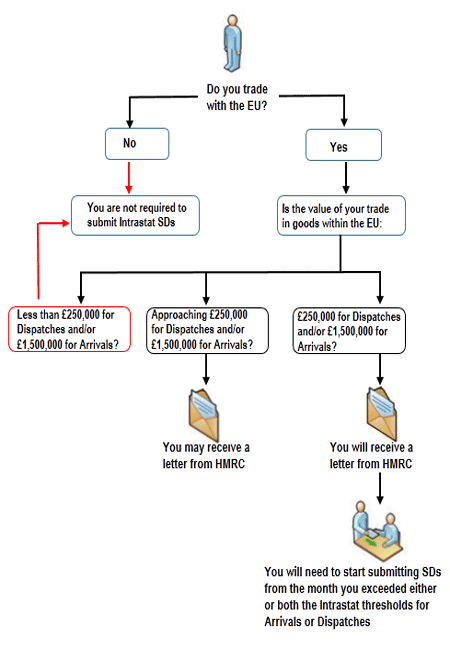
If a VAT registered business trades with any of the other EC Member States, it will have a responsibility to report the trade to HMRC. How detailed that report is required to be depends on the value of its trade with other EC Member States for either purchases (arrivals) or sales (dispatches). If a business’ trade in goods falls below the Intrastat thresholds then EC Sales Lists may be required.

Reporting Thresholds for SDs

The limits are:

  • £1,500,000 for arrivals, and;
  • £250,000 for dispatches

In a calendar year.

Intrastat should not be confused with EC Sales Lists which are used to collect information on all sales from UK VAT registered businesses to business recipients in other EC Member States.  A guide to EC Sales Lists here

Classification of goods for Intrastat

Finding the right commodity code for goods is one of the most important aspects of Intrastat. An online classification tool, the Intrastat Classification Nomenclature (ICN) is available to assist businesses find the right commodity code for its goods. Here

The ICN is a fully searchable facility which can be used by everyone from beginner to expert.

Value for SDs

Only the value of goods are included in SDs (plus any related freight or insurance charges where they form part of the invoice or contract price of the goods).

The value does not include:

  • Commission, legal and financial services
  • Insurance, freight and/or carriage (unless it is included with the cost of the goods)
  • Labour
  • Goods bought and sold within the EU but which do not actually enter or leave the UK
  • Maintenance costs
  • Repairs

Submission of SDs

This may be done online or offline (which is preferred for large amounts of data).

Online submission details here

Offline submissions are via pre-prepared Excel spreadsheets available here

Via an email attachment – the file must be converted into the message format Electronic Data Interchange for Commerce and Transport (EDIFACT). Details here

Deadlines for submission of SDs

Intrastat declarations must be submitted on a monthly basis. Complete and accurate declarations must be received by the 21st day of the month following the reference period to which they relate.

Now, the scary part.

Penalties

It is perhaps surprising that if you fail to submit SDs by the due date, or send data that is inaccurate, a business will be committing a criminal offence (Statistics of Trade [C&E] Regulations 1992).

Penalties may be levied in cases where SDs are persistently late, missing, inaccurate or incomplete.

Although the penalty regime is a criminal one and could result in proceedings in a Magistrates Court, HMRC state that it normally prefers to “compound” alleged offences. This involves the offer of an administrative fine in lieu of Court proceedings. However, an administrative fine is only offered when, after receiving a Warning of Possible Criminal Proceedings letter, a business has brought its Intrastat declarations completely up to date. If any declarations remain outstanding Court proceedings will be instigated.

The plus side.

How to use Intrastat for your business

It is possible for a business to find out about; trade markets, competition, suppliers, customers and competitors using data collected via Intrastat.  Additionally, the information may be used to create a bespoke data table to suit a business’ specific needs. Information here

Intrastat pros and cons

Yes, businesses are being used as unpaid providers of trade information as well as unpaid collectors of tax.  It then does seem rather draconian that HMRC “coerce” businesses to provide information on pain of a criminal record. But the information is then there for a business trading within the EC to use for its commercial advantage.  It’s another chore on the VAT checklist I’m afraid.

I have to charge myself VAT?!

By   1 July 2015

I have to charge MYSELF VAT?!

How comes?!

Well, normally, the supplier is the person who must account to the tax authorities for any VAT due on the supply. However, in certain situations, the position is reversed and it is the customer who must account for any VAT due. Don’t get caught out!

Here are just some of the situations when you have to charge yourself VAT:

Purchasing services from abroad

These will be obtained free of VAT from an overseas supplier. What is known as the ‘reverse charge’ procedure must be applied. Where the reverse charge procedure applies, the recipient of the services must act as both the supplier and the recipient of the services. On the same VAT return, the recipient must account for output tax, calculated on the full value of the supply received, and (subject to partial exemption and non-business rules) include the VAT charged as input tax. The effect of the provisions is that the reverse charge has no net cost to the recipient if he can attribute the input tax to taxable supplies and can therefore reclaim it in full. If he cannot, the effect is to put him in the same position as if had received the supply from a UK supplier rather than from one outside the UK. Thus creating a level playing field between purchasing from the UK and overseas.

Accounting for VAT and recovery of input tax.
Where the reverse charge procedure applies, the recipient of the services must act as both the supplier and the recipient of the services.  On the same VAT return, the recipient must
      1. account for output tax, calculated on the full value of the supply received, in Box 1;
      2. (subject to partial exemption and non-business rules) include the VAT stated in box 1 as input tax in Box 4; and;
      3. include the full value of the supply in both Boxes 6 and 7.
Value of supply: The value of the deemed supply is to be taken to be the consideration in money for which the services were in fact supplied or, where the consideration did not consist or not wholly consist of money, such amount in money as is equivalent to that consideration.  The consideration payable to the overseas supplier for the services excludes UK VAT but includes any taxes levied abroad.
Time of supply: The time of supply of such services is the date the supplies are paid for or, if the consideration is not in money, the last day of the VAT period in which the services are performed.

Purchasing goods from another EC Member States

Something similar to reverse charge; called acquisition tax, applies to goods purchased from other EC Member States. These are known as acquisitions (they are imports if the goods come from outside the EC and different rules apply). The full value of the goods is subject to output tax and the associated input tax may be recovered by the business acquiring if the goods are used for taxable purposes. If you‘re not already registered for VAT in the UK and acquire goods worth £82,000 or more in the UK from other EC countries, you will have to register for VAT in the UK on the strength of the value of the acquisition tax. A business will also have to complete an Intrastat Supplementary Declaration (SDs) if its acquisitions of goods from the EC exceed an annual amount – currently £1.5 million.

Intrastat_flow_diagramMore details on Intrastat Supplementary Declarations here

Deregistration

Any goods on hand at deregistration with a total value of over £1,000 on which input tax has been claimed are subject to a self supply. This is a similar mechanism to a reverse charge in that the goods are deemed to be supplied to the business by the business and output tax is due. However, in these circumstances it is not possible to recover any input tax on the self supply.

Flat Rate Scheme

There is a self supply of capital items on which input tax has been claimed when a business leaves the flat rate scheme (and remains VAT registered).

Mobile telephones

In order to counter missing trader intra-community fraud (‘MTIC’), supplies of mobile ‘phones and computer chips which are made by one VAT registered business to another and valued at £5,000 and over are subject to the reverse charge. This means that the purchaser rather than the seller is responsible for accounting for VAT due.

Land and buildings…. and motor cars

There are certain circumstances where land and buildings must be treated as a self supply… but that is a whole new subject in itself… as is supplies in the motor trade.

Even if the result of a self-supply or reverse charge is VAT neutral HMRC is within its rights to assess and levy penalties and interest in cases where the charge has not been applied; which always seems unfair.  However, more often than not simple accounting entries will deal with the matter…. if the circumstances are recognised and it is remembered to actually make the entries!

VAT treatment of vouchers, gifts and discounts – How business promotions work

By   25 June 2015

Business promotions are an area of VAT which continues to prove complex.  This is further exacerbated by changes to the legislation at EC and domestic level and ongoing case law.

The VAT position is summarised here. Part of this commentary has been taken directly from HMRC guidance on the subject and is the most up to date authority on the matter.  I thought it may be useful if the VAT treatment of various business promotion schemes is summarised in one place.

…I recall a statement from an old mentor of mine; “if you have a marketing department you have a VAT problem!”


Summary

Offer How to charge VAT
Discounts Charged on the discounted price (not the full price)
Gifts Charged on the gift’s full value – there are some exceptions listed below
Multi-buys Charged on the combined price if all the items have the same VAT rate. If not, VAT is ‘apportioned’ as mixed-rate goods
Money-off coupons, vouchers etc No VAT due if given away free at time of a purchase. If not, VAT due on the price charged
Face value vouchers that can be used for more than one type of good or service (multi-purpose) No VAT due, if sold at or below their monetary value
Face value vouchers that can only be used for one type of good or service (single-purpose) VAT due on the value of the voucher when issued
Redeemed face value vouchers Charged on the full value of the transaction at the appropriate rate of the goods provided in return for the voucher

 Exceptions for gifts

There’s no VAT due on gifts given to the same person if their total value in a 12 month period is less than £50.

Free goods and services

You don’t have to pay VAT on things like free samples if they meet certain conditions.

Supplies Condition to meet so no VAT due
Free samples Used for marketing purposes and provided in a quantity that lets potential customers test the product
Free loans of business assets The cost of hiring the asset is included in something else you sell to the customer
Free gifts The total cost of all gifts to the same person is less than £50 in a 12 month period
Free services You don’t get any payment or goods or services in return

Background

Face value vouchers

Recent changes, radically alter the UK rules for face value vouchers. Face value vouchers are vouchers, tokens, stamps (physical or electronic) which entitle the holder to certain goods or services up to the value on the face of the vouchers from the supplier of those goods or services.

Examples of face value vouchers would include vouchers sold by popular group discount websites, vouchers sold by high street retailers, book tokens, stamps and various high street vouchers.

Single or multi-purpose

The most important distinction for face value vouchers is whether a voucher is a single purpose voucher or multi-purpose voucher. If it is a multi-purpose voucher then little has changed. If it is a single purpose voucher, however, HMRC will now charge VAT when it is issued.

Single purpose vouchers are vouchers which carry the right to receive only one type of goods or services which are all subject to a single rate of VAT. Multi-purpose vouchers are anything else. The differences can be quite subtle.

For example:

  • a voucher which entitles you to download an e-book from one seller will be a single purpose voucher. A voucher which entitles you to either books (zero rated) or an e-book download (standard rated) from the same seller will be multi-purpose
  • a voucher which entitles you to £10 of food at a restaurant which does not sell takeaways is probably single purpose, whereas if the restaurant has a cold salad bar and you can buy a take away with the voucher (or hot food) then it would be multi-purpose. 

The above means that for single purpose vouchers VAT is due whether the voucher is actually redeemed or not; which seems an unfair result. There is no way to reduce output tax previously accounted for if the voucher is not used. 

VAT – Retrospective input tax claim opportunity for charities and not for profit bodies.

By   22 June 2015

The Upper Tribunal has decided In the University Of Cambridge case that costs incurred on running its endowment fund relate to the university’s overall economic activity in general and consequently it is possible to recover an element of it.  The full judgement here

This will impact on all charities and similar bodies which have non-business activities that support their business activities. 

Please contact us if your charity is in a similar position because if past input tax claims have been restricted as a result of HMRC’s interpretation (which is highly likely) it is possible to make a claim which covers the last four years’ VAT costs.

VAT on Crowdfunding?

By   28 May 2015

The EC is has begun an investigation into whether VAT should apply to crowdfunding activities.

An alternative is for the Commission to consider whether crowdfunding should be covered by the exemption for financial services.  In my view this seems unlikely.

So what could the outcome be if VAT is applicable to crowdfunding?  Well, a large number of UK projects will face a 20% VAT liability on investor returns. This is especially relevant to the popular “rewards crowdfunding”, where payments by investors are made in return for products or services to be developed as a result of the fundraising. These rewards projects may include; films, albums, or software development, which are offered “free” or at a reduced rate. It would appear that in these cases, consideration is flowing in both directions.

The Commission may also decide that crowdfunding intermediary services offered by many platforms will become liable to VAT.

The current position is that the Commission has now referred the question of crowdfunding to the EU VAT Committee.

More on this subject as soon as we have it.

VAT – Compound interest now payable on retrospective claims. Littlewoods Court of Appeal decision

By   21 May 2015

If your business have ever submitted a retrospective claim to HMRC on the basis of UK law being incompatible with EC legislation, it is possible to claim compound interest.

Full judgement here:  https://emeia.ey-vx.com/730/28558/landing-pages/littlewoods-coa-judgment-21-may-2015.pdf

Please contact us if you require any further information or assistance.

VAT – The Future for the EC Digital Single Market

By   11 May 2015

VAT – The Future for the EC Digital Single Market

The EC has announced its plans for its VAT digital single market in respect of online sales. Full details are here and here.

The highlights are:

• Extension of MOSS to intra-EC and third country online B2C sales of goods.

• Introduction of a new EC-wide VAT threshold to help start-up businesses.

• Ending current distance selling thresholds.

• Allowing for domestic controls, including a single audit of cross-border sales.

• Removal of the VAT exemption for the import of small consignments form third countries.

• Removal of barriers to cross-border sales eg; geo-blocking and costs.

This is likely to have a huge impact on the way businesses deal with VAT on sales of goods to individuals overseas. If the introduction of MOSS is anything to go by, we may be in for a bumpy ride.

VAT – Business Entertainment Flowchart. What input tax may I recover?

By   11 May 2015

VAT – Recovery of input tax incurred on entertainment

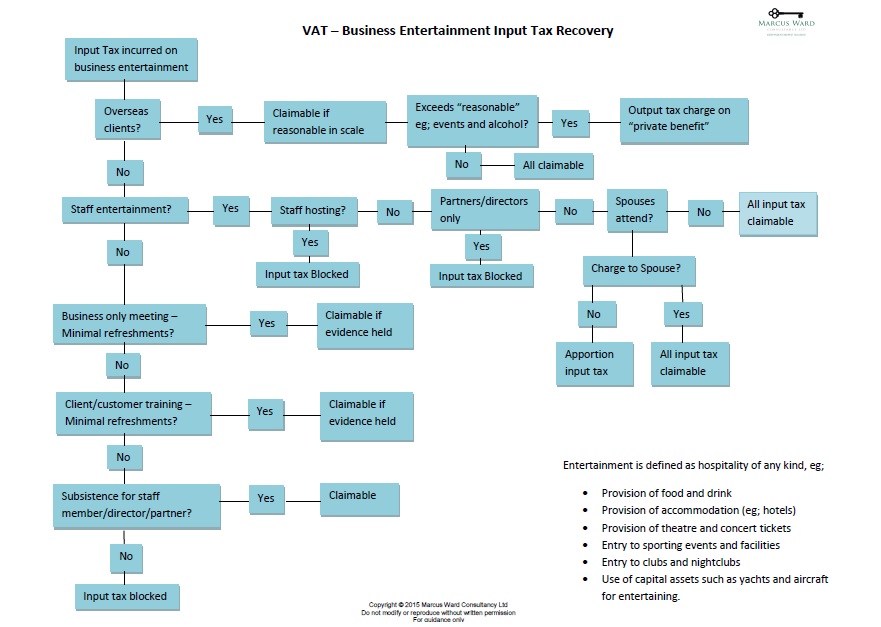
One of the most common questions asked on “day-to-day” VAT is whether input tax incurred on entertainment is claimable.  The answer to this seemingly straightforward question has become increasingly complex as a result of; HMRC policy, EC involvement and case law.  Different rules apply to entertaining; clients, contacts, staff, partners and directors depending on the circumstances.  It seems reasonable to treat entertaining costs as a valid business expense.  After all, a business, amongst other things, aims to increase sales and reduce costs as a result of these meetings.  However, HMRC sees things differently and there is a general block on business entertainment.  It seems like HMRC does not like watching people enjoying themselves at the government’s expense!

If, like me, you think in pictures, then a flowchart may be useful for deciding whether to claim entertainment VAT.  It covers all scenarios, but if you have a unique set of circumstances or require assistance with some of the definitions, please contact me.

I thank my friend and colleague Leila Ong for help with this, and also with the series of presentations we have recently carried out and which, amongst other subjects, covered business entertainment. Should you require VAT training or presentations, don’t forget our comprehensive service here which can be tailored to your needs.

VAT -Business Entertainment Flowchart

Business Entertainment flow chart

Download here: VAT Business Entertainment Input tax recovery flowchart

VAT- Is the Upper Tribunal bound by High Court decisions?

By   6 May 2015

Upper Tribunal versus High Court

In the recent case of Meena Seddon Settlement which involved Inheritance Tax, the First Tier Tribunal (FTT) was required to decide whether the Upper Tribunal is bound by decisions made in the High Court. The FTT decision will doubtless affect VAT cases in the future.

It decided to follow a precedent set by the Upper Tribunal over an earlier decision by the High Court.

The taxpayer contended that the matter should be decided on the basis of a previous High Court decision. HMRC argued on the basis of a later Upper Tribunal decision. In normal circumstances, a later decision should take precedence over the earlier if both decisions have the same authority and have fully considered the previous judgments. However, if the taxpayer was correct to say that the Upper Tribunal was bound by precedents set by the High Court, the later decision could be disregarded as being wrong in law.

The FTT decided that it was the intention of Parliament that the Upper Tribunal was not bound to follow High Court precedents. This was notwithstanding the fact that a High Court could have a supervisory role over the Upper Tribunal in cases of judicial review. Therefore, it determined the case on the authority of the later Upper Tribunal decision in favour of HMRC.