Category Archives: Penalties

VAT Public Notice 700 Updated

By   25 August 2017

Notice 700: The VAT Guide has been updated.

This HMRC Notice is a “starting point” for general VAT information and provides a guide to all the main VAT rules and procedures. It also provides assistance with the problems faced by business and includes an index which helps users find further information by referring to a particular section or paragraph in one of HMRC’s other, more specialised publications. There have been over 30 changes to the Notice which was last updated in 2016.

A full list of changes is set out in the Notice, but the most salient are as follows:

  • Additional guidance on MOSS – para 4.8.4
  • Single and mixed supplies – para 8.1
  • Continuous supplies to connected persons – para 14.3.1
  • Various commentary on invoices (including electronic invoicing) – paras 16.6, 16.8, 17.7 17.8
  • Accounting schemes – para 19.2
  • Agents registered for VAT acting in their own name when the customer is not registered – para 1.2
  • Penalties for inaccuracies – para 27.3
  • Integrity of supply chains – para 27.5.2

The number of changes in just one year highlights the fast pace of the tax and the number of challenges which taxpayers have won. I cannot see this pace letting up in the future either.

As always, if you have any queries about the changes, please contact us.

VAT – Business Entertainment Flowchart. What input tax may I recover?

By   26 June 2017

VAT – Recovery of input tax incurred on entertainment

One of the most common questions asked on “day-to-day” VAT is whether input tax incurred on entertainment is claimable.  The answer to this seemingly straightforward question has become increasingly complex as a result of; HMRC policy, EC involvement and case law.

Different rules apply to entertaining; clients, contacts, staff, partners and directors depending on the circumstances.  It seems reasonable to treat entertaining costs as a valid business expense.  After all, a business, amongst other things, aims to increase sales and reduce costs as a result of these meetings.  However, HMRC sees things differently and there is a general block on business entertainment.  It seems like HMRC does not like watching people enjoying themselves at the government’s expense!

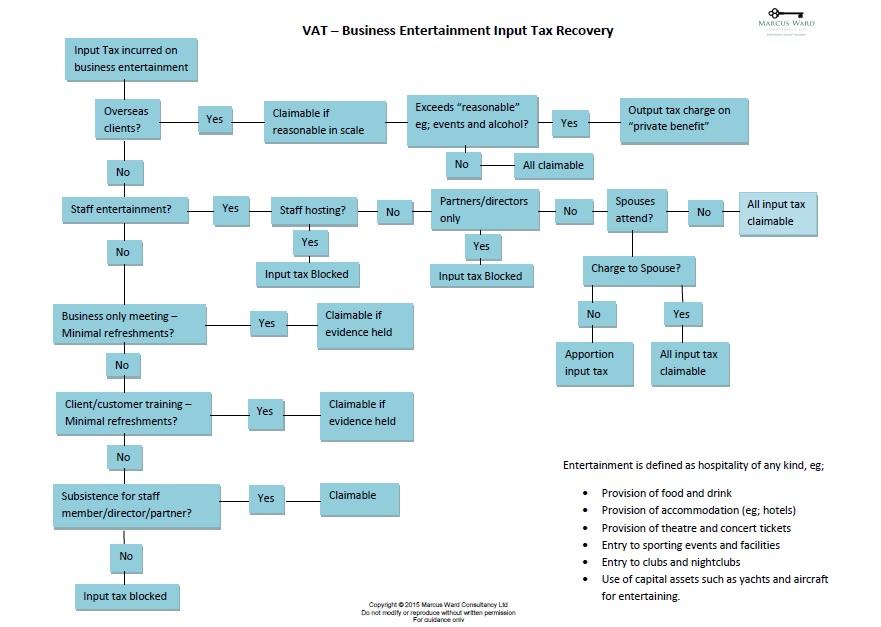
If, like me, you think in pictures, then a flowchart may be useful for deciding whether to claim entertainment VAT.  It covers all scenarios, but if you have a unique set of circumstances or require assistance with some of the definitions, please contact me.

We have recently carried out a series of presentations, which, amongst other subjects, covered business entertainment. Should you require VAT training or presentations, don’t forget our comprehensive service here which can be tailored to your needs.

VAT -Business Entertainment Flowchart

Business Entertainment flow chart

Download here: VAT Business Entertainment Input tax recovery flowchart

VAT: Hardship applications

By   15 May 2017

The recent case of Elbrook (Cash & Carry) Ltd here brings into focus the concept of “hardship”.  In this case Elbrook successfully appealed to the Upper Tribunal (UT) against HMRC decision that the appellant should seek additional finance to pay the VAT said to be due rather than allow the case to be heard without that payment on the grounds of hardship.

So what is the process and what is “hardship”?

Background

If a taxpayer wishes to appeal to the Tribunal against a decision made by HMRC he must pay any disputed VAT before the case can be heard. The reason for this is understandable, without this rule taxpayers could make an appeal merely to delay the payment of tax and it is a difficult test to satisfy. However, if the applicant is able to demonstrate that payment of the VAT would cause financial hardship the rule may be waived  by HMRC. This decision is an appealable matter. (NB: There is no requirement to pay interest or penalties before appealing but interest will continue to accumulate on an assessment).  If a business believes that paying the amount it wishes to appeal against would cause it hardship it can ask HMRC not to collect the payment due until the appeal has been considered by the tribunal. It will need to:

  • write to the officer who made the original decision
  • explain how paying this amount before the appeal hearing would cause the business hardship

Depending on the size of the business, the explanation should include detailed evidence of its financial position and the impact of paying the disputed tax. I have seen many applications fail as a result of incomplete evidence, or general statements that are not evidenced by documentation.  It pays to put a comprehensive application together and have this reviewed by an adviser before it is submitted.

HMRC will write and tell you whether or not they agree with delaying the payment. If they do not, the business can go to Tribunal

The law

The rules where applicable are set out in the VAT Act 1994, section 84(3)

 “Where the appeal is against a decision… it shall not be entertained unless—

 “(a) the amount which the Commissioners have determined to be payable as VAT has been paid or deposited; or

 (b) on being satisfied that the appellant would otherwise suffer hardship the Commissioners agree or the tribunal decides that it should be entertained notwithstanding that that amount has not been so paid or deposited.”

Section 84(3) is intended to strike a balance between, on the one hand, the desire to prevent abuse of the appeal mechanism by employing it to delay payment of the disputed tax, and on the other to provide relief from the stricture of an appellant having to pay or deposit the disputed sum as the price for entering the appeal process, where to do so would cause hardship.

 Hardship

Unhelpfully, this term is not defined in the legislation, nor in HMRC guidance. Consequently, we must look at case law.  The following comments in the “original” Elbrook case – (2016) UKFTT 0191 (citing various previous cases, mainly “ToTel 1 and 2”) assist in understanding a hardship appeal:

  • Decisions on hardship should not stifle meritorious appeals
  • The test is one of capacity to pay without financial hardship, not just capacity to pay
  • The time at which the question is to be asked is the time of the hearing. This may be qualified if the appellant has put themselves in a current position of hardship deliberately (eg; by extraction of funds otherwise readily available from a company by way of dividend), or if there is significant delay on the part of the appellant
  • The question should be capable of decision promptly from readily available material
  • The enquiry should be directed to the ability of an appellant to pay from resources which are immediately or readily available (a business is not expected to seek funding outside its normal sources, nor sell assets)
  • The test is all or nothing. The ability to pay part of the VAT without hardship does not matter
  • If the Tribunal has fixed a cut off point for the admission of material, it is not an error of law for the Tribunal to ignore any later furnished evidence
  • The absence of contemporaneous accounting information is a justification for the Tribunal to conclude that it can place little if any weight on the appellant’s assertion that it is unable to afford to pay

The onus of proof in such cases is on the taxpayer to demonstrate hardship and without persuasive evidence such applications are unlikely to succeed.

Action

If your business, or your client’s business is the subject of a disputed decision, it should review its financial position and consider appealing against the decision even if paying the disputed amount would cause hardship.  A business should not be put off appealing just because it would suffer hardship. We are able to assist in any review required.

VAT evasion by non-EU online sellers

By   26 April 2017

Investigation by The National Audit Office (NAO) into overseas sellers failing to charge VAT on online sales.

The NAO have investigated concerns that online sellers outside the EU are avoiding charging VAT. Full report here

The NAO has published the findings from its investigation into the concern that online sellers based outside the EU are not charging VAT on goods located in the UK when sold to UK customers. Online sales accounted for 14.5% of all UK retail sales in 2016, just over half of these were non-store sales, mainly through online marketplaces.

VAT rules require that all traders based outside the EU selling goods online to customers in the UK should charge VAT if their goods are already in the UK at the point of sale. In these cases, sellers should pay import VAT and customs duties when the goods are imported into the UK and charge their customers VAT on the final selling price. The sellers should also be registered with HMRC and are required to submit regular VAT returns.

Some of the key findings of the investigation are as follows:

HMRC estimates that online VAT fraud and error cost between £1 billion and £1.5 billion in lost tax revenue in 2015-16 but this estimate is subject to a high level of uncertainty. This estimate represents between 8% and 12% of the total VAT gap (The VAT gap is the difference between the amount of VAT that should, in theory, be collected by HMRC, against what is actually collected) of £12.2 billion in 2015-16. UK trader groups believe the problem is widespread, and that some of the biggest online sellers of particular products are not charging VAT. These estimates exclude wider impacts of this problem such as the distortion of the competitive market landscape.

HMRC recognised online VAT fraud and error as a priority in 2014, although the potential risk from online trading generally was raised before this. In 2013 the NAO reported that HMRC had not yet produced a comprehensive plan to react to the emerging threat to the VAT system posed by online trading. The report found HMRC had developed tools to identify internet-based traders and launched campaigns to encourage compliance but had shown less urgency in developing its operational response. Trader groups claim that online VAT fraud has been a problem as early as 2009, which has got significantly worse in the past five years. The Chartered Trading Standards Institute shares this view. Based on the emergence of the fulfilment house (a warehouse where goods can be stored before delivery to the customer) model, HMRC recognised online VAT fraud and error as one of its key risks in 2014 and began to increase resources in this area in 2015.

HMRC’s assessment is that online VAT losses are due to a range of non-compliant behaviours, but has not yet been able to assess how much is due to lack of awareness, error or deliberate fraud. Amazon and eBay consider that lack of awareness of the VAT rules is a major element of the problem. Amazon and eBay have focused on educating overseas sellers and providing tools to assist with VAT reporting and compliance. HMRC’s strategic threat assessment, carried out in 2014, concluded it was highly likely that both organised criminal groups based in the UK and overseas sellers in China were using fulfilment houses to facilitate the transit of undervalued or misclassified goods, or both, from China to the UK for sale online.

HMRC introduced new legal powers to tackle online VAT fraud and error in September 2016. The new joint and several liability power gives HMRC a new way to tackle suspected non-compliance, and is the first time any country has introduced such a power for this purpose. The new powers include making online marketplaces potentially jointly and severally liable for non-payment of VAT when HMRC has informed them of an issue with a seller, and they do not subsequently take appropriate action.

Conclusion

Online VAT fraud and error causes substantial losses to the UK Exchequer and undermines the competitiveness of UK businesses. Compliance with the VAT rules is a legal requirement. Not knowing about the rules does not excuse non-compliance. The UK trader groups who raised the issue report having experienced the impact of this problem through progressively fewer sales. They consider HMRC has been slow in reacting to the emerging problem of online VAT fraud and error and that there do not seem to be penalties of sufficient severity to act as a substantial deterrent.

It is too soon to conclude on the effectiveness and impact of HMRC’s new powers and whether the resources devoted by HMRC to using them match the scale of the problem. We recognise that HMRC must consider effort and efficiency in collecting VAT but its enforcement approach to online trade appears likely to continue the existing unfair advantage as perceived by UK trader groups. This is contrary to HMRC’s policy of encouraging voluntary compliance and it does not take account of the powerful effect that HMRC’s enforcement approach has on the operation of the online market as a whole. We intend to return to this subject in the future.

Further to the above, this article suggests that HMRC should have acted even earlier.

VAT Latest from the courts – Allocation of payments

By   13 March 2017

VAT payment problems

In the Upper Tribunal (UT) case of Swanfield Limited (Swanfield)

The matter was whether HMRC had the right to allocate payments made by the applicant to specific periods against the wishes of the taxpayer.

Background

Swanfield was late with returns/payments such that it was subject to the Default Surcharge (DS) mechanism.  Details of the DS regime here

HMRC issued DSs to Swanfield, many at the maximum rate 15%. The total involved was said to be over £290,000. However, if the payments made by Swanfield had been allocated in a certain way (broadly; to recent debts as desired by the taxpayer) it would have substantially reduced the amount payable. However, HMRC allocated the payments to previous, older periods which were not the subject of a DS.

The Issue

The issue was relatively straightforward; did HMRC have the authority to allocate payments as they deemed fit, or could the taxpayer make payments for specific periods as required?

The Decision

The UT found that Swanfield were entitled to allocate payments made to amounts which would become due on supplies made in the (then) current period, even though the due date had not yet arrived.  Additionally, HMRC did not have the authority to unilaterally allocate payments made by the taxpayer to historical liabilities as they saw fit, in cases where the taxpayer has explicitly made those payments in relation to current periods.  In cases where there is no specific instruction in respect of allocation of the payment, HMRC was entitled to allocate payment without any obligation to minimise DS. The UT remitted this case back to the First Tier Tribunal to decide, as a matter of fact, whether Swanfield had actually made the necessary allocation.

Commentary

This is a helpful case which sets out clearly the responsibilities of both parties.  It underlines the necessity of a taxpayer to focus on payments and how to manage a debt position to mitigate any penalties.  Staying silent on payments plays into the hands of HMRC. It is crucial to take a proper view of a business’ VAT payment position, especially if there is difficulties lodging returns of making payment. Planning often reduces the overall amount payable, or provides for additional time to pay (TTP).  A helpful overview of payment problems here

Things can be done if a business is getting into difficulties with VAT; whether they are; reporting, submitting returns, making payments, or if there are disputes with HMRC. There are also structures that may be put in place to assist with VAT cashflow.

We would always counsel a business not to bury its head in the sand if there are difficulties with HMRC.  Please make contact with us and, in almost all cases, we can improve the situation, along with providing some relief from worries. VAT may be payable, but there are ways of managing payments – as this case demonstrates.

Office of Tax Simplification reports on VAT

By   6 March 2017

The Office of Tax Simplification has recently published its interim report on VAT simplification.

Full details here

The main areas covered are:

  • The UK’s high VAT registration threshold
  • Incidental exempt supplies
  • Complexity of multiple rates
  • Option to Tax and Capital Goods Scheme
  • Treatment of VAT overpayments
  • Alternative Dispute Resolution (details of ADR here)
  • Non-Statutory clearances by HMRC
  • Special schemes eg; Flat rate Scheme and TOMS
  • Penalties

Please contact us should you have any queries on any of the issues covered by the report.

VAT – Claiming input tax on fuel. A warning

By   27 February 2017

In the First Tier Tribunal (FTT) case of Cohens Chemist the issue was whether VAT paid on employees’ mileage expenses was recoverable.

Background

The appellant offers a delivery service of prescription medicines.  This service was undertaken by the appellants’ employees, using their own vehicles. The employees buy the fuel which is to be used in their vehicles, with their own money, and later submit claims to the appellants for the payment of a mileage allowance related to the distance covered.  The allowance includes an element of reimbursement for the fuel used.  The appellant then claim credit for the input tax included in the cost of the fuel which they have reimbursed in this way. This is permissible via VAT (Input Tax) (Reimbursement by Employers of Employees’ Business Use of Road Fuel) Regulations 2005. HMRC sought to disallow these claims on the basis that there were no supporting invoices form the petrol stations and that the detailed records kept were not sufficient to support the recovery of VAT.

Decision

Unfortunately for the taxpayer,  it was decided that the failure by to retain fuel receipts in compliance with mandatory requirement of Regulations meant that the disallowance of the input tax claims was appropriate.  This was particularly costly for Cohens Chemist as the input tax at stake here was £67,000. Additionally, the Tribunal held that there was discretion to allow alternative evidence and that this discretion was reasonably exercised to reject the claim.

Commentary 

A very simple lesson to be learned from this case:

Always obtain and retain fuel receipts!  

Failure to do so can be very costly, and it does not matter how detailed and accurate your fuel records are.  You must check your system for the VAT treatment of fuel allowances.

The penalty regime…the dark side of VAT

By   20 February 2017
VAT Penalties

I have made a lot of references to penalties in other articles over the years. So I thought it would be a good idea to have a closer look; what are they, when are they levied, rights of appeal, and importantly how much could they cost if a business gets it wrong?

Overview

Making mistakes…

Broadly, a penalty is levied if the incorrect amount of VAT is declared, either by understating output tax due, overclaiming input tax, or accepting an assessment which is known to be too low.

Amount of penalty

HMRC detail three categories of inaccuracy. These are significant, as each has its own range of penalty percentages. If an error is found to fall within a lower band, then a lower penalty rate will apply. Where the taxpayer has taken ‘reasonable care,’ even though an error has been made, then no penalty will apply.

  • An error, when reasonable care not taken: 30%;
  • An error which is deliberate, but not concealed: 70%;
  • An error, which is deliberate and concealed: 100%.

Reasonable care

There is no definition of ‘reasonable care’. However, HMRC have said that they would not expect the same level of knowledge or expertise from a self-employed person, as from a large multi-national.

HMRC expect that, where an issue is unclear, advice is sought, and a record maintained of that advice. They also expect that, where an error is made, it is adjusted, and HMRC notified promptly. They have specifically stated that merely to adjust a return will not constitute a full disclosure of an error. Therefore a penalty may still be applicable. We advise that, even if an error is not required to be reported independently on a form VAT652 (usually if < £10,000 of VAT) a letter is sent to HMRC disclosing that the error has been adjusted on the return. We have a standard template available for this process.

What the penalty is based on

The amount of the penalty is calculated by applying the appropriate penalty rate (above) to the ‘Potential Lost Revenue’ or PLR. This is essentially the additional amount of VAT due or payable, as a result of the inaccuracy, or the failure to notify an under-assessment. Special rules apply where there are a number of errors, and they fall into different penalty bands.

Defending a penalty 

The percentage penalty may be reduced by a range of ‘defences”.  These are:

– Telling; this includes admitting the document was inaccurate, or that there was an under-assessment, disclosing the inaccuracy in full, and explaining how and why the inaccuracies arose;

– Helping; this includes giving reasonable help in quantifying the inaccuracy, giving positive assistance rather than passive acceptance, actively engaging in work required to quantify the inaccuracy, and volunteering any relevant information;

– Giving Access; this includes providing documents, granting requests for information, allowing access to records and other documents.

Further, where there is an ‘unprompted disclosure’ of the error, HMRC have power to reduce the penalty further. This measure is designed to encourage businesses to review their own VAT returns.

A disclosure is unprompted if it is made at a time when a person had no reason to believe that HMRC have discovered or are about to discover the inaccuracy. The disclosure will be treated as unprompted even if at the time it is made, the full extent of the error is not known, as long as fuller details are provided within a reasonable time.

HMRC have included a provision whereby a penalty can be suspended for up to two years. This will occur for a careless inaccuracy, not a deliberate inaccuracy. HMRC will consider suspension of a penalty where, given the imposition of certain conditions, the business will improve its accuracy. The aim is to improve future compliance, and encourage businesses which genuinely seek to fulfil their obligations. We have noticed that HMRC is increasingly using the penalty suspension mechanism.

Appealing a penalty 

HMRC have an internal reconsideration procedure, where a business should apply to in the first instance. If the outcome is not satisfactory, the business can pursue an appeal to the First Tier Tribunal. A business can appeal on the grounds of; whether a penalty is applicable, the amount of the penalty, a decision not to suspend a penalty, and the conditions for suspension.

The normal time limit for penalties to four years. Additionally, where there is deliberate action to evade VAT, a 20 year limit applies. In particular, this applies to a loss of VAT which arises as a result of a deliberate inaccuracy in a document submitted by that person.

These are just the penalties for making “errors” on VAT returns. HMRC have plenty more for anything from late registration to issuing the wrong paperwork.

Assistance

Our advice is always to check on all aspects of a penalty and seek assistance for grounds to challenge a decision to levy a penalty. We have a very high success rate in defending businesses against inappropriate penalties.  It is always worth running a penalty past us.

Oops! – Top Ten VAT howlers

By   16 December 2016
I am often asked what the most frequent VAT errors made by a business are. I usually reply along the lines of “a general poor understanding of VAT, considering the tax too late or just plain missing a VAT issue”.  While this is unquestionably true, a little further thought results in this top ten list of VAT horrors:
  1. Not considering that HMRC may be wrong. There is a general assumption that HMRC know what they are doing. While this is true in most cases, the complexity and fast moving nature of the tax can often catch an inspector out. Added to this is the fact that in most cases inspectors refer to HMRC guidance (which is HMRC’s interpretation of the law) rather to the legislation itself. Reference to the legislation isn’t always straightforward either, as often EC rather than UK domestic legislation is cited to support an analysis. The moral to the story is that tax is complicated for the regulator as well, and no business should feel fearful or reticent about challenging a HMRC decision.
  2. Missing a VAT issue altogether. A lot of errors are as a result of VAT not being considered at all. This is usually in relation to unusual or one-off transactions (particularly land and property or sales of businesses). Not recognising a VAT “triggerpoint” can result in an unexpected VAT bill, penalties and interest, plus a possible reduction of income of 20% or an added 20% in costs. Of course, one of the basic howlers is not registering at the correct time. Beware the late registration penalty, plus even more stringent penalties if HMRC consider that not registering has been done deliberately.
  3.  Not considering alternative structures. If VAT is looked at early enough, there is very often ways to avoid VAT representing a cost. Even if this is not possible, there may be ways of mitigating a VAT hit.
  4.  Assuming that all transactions with overseas customers are VAT free. There is no “one size fits all” treatment for cross border transactions. There are different rules for goods and services and a vast array of different rules for different services. The increase in trading via the internet has only added to the complexity in this area, and with new technology only likely to increase the rate of new types of supply it is crucial to consider the implications of tax; in the UK and elsewhere.
  5.  Leaving VAT planning to the last minute. VAT is time sensitive and it is not usually possible to plan retrospectively. Once an event has occurred it is normally too late to amend any transactions or structures. VAT shouldn’t wag the commercial dog, but failure to deal with it at the right time may be either a deal-breaker or a costly mistake.
  6.  Getting the option to tax wrong. Opting to tax is one area of VAT where a taxpayer has a choice. This affords the possibility of making the wrong choice, for whatever reasons. Not opting to tax when beneficial, or opting when it is detrimental can hugely impact on the profitability of a project. Not many businesses can carry the cost of, say, not being able to recover VAT on the purchase of a property, or not being able to recover input tax on a big refurbishment. Additionally, seeing expected income being reduced by 20% will usually wipe out any profit in a transaction.
  7.  Not realising a business is partly exempt. For a business, exemption is a VAT cost, not a relief. Apart from the complexity of partial exemption, a partly exempt business will not be permitted to reclaim all of the input tax it incurs and this represents an actual cost. In fact, a business which only makes exempt supplies will not be able to VAT register, so all input tax will be lost. There is a lot of planning that may be employed for partly exempt businesses and not taking advantage of this often creates additional VAT costs.
  8.  Relying on the partial exemption standard method to the business’ disadvantage. A partly exempt business has the opportunity to consider many methods to calculate irrecoverable input tax. The default method, the “standard method” often provides an unfair and costly result. I recommend that any partly exempt business obtains a review of its activities from a specialist. I have been able to save significant amounts for clients simply by agreeing an alternative partial exemption method with HMRC.
  9.  Not taking advantage of the available reliefs. There are a range of reliefs available, if one knows where to look. From Bad Debt Relief, Zero Rating (VAT nirvana!) and certain de minimis limits to charity reliefs and the Flat Rate Scheme, there are a number of easements and simplifications which could save a business money and reduce administrative and time costs.
  10.  Forgetting the impact of the Capital Goods Scheme. The range of costs covered by this scheme has been expanded recently. Broadly, VAT incurred on certain expenditure is required to be adjusted over a five or ten year period. Failure to recognise this could either result in assessments and penalties, or a position whereby input tax has been under-claimed. The CGS also “passes on” when a TOGC occurs, so extra caution is necessary in these cases.

So, you may ask: “How do I make sure that I avoid these VAT pitfalls?” – And you would be right to ask.

Of course, I would recommend that you engage a VAT specialist to help reduce the exposure to VAT costs!

VAT Splitting a business to avoid registration: Disaggregation

By   8 December 2016
I have a cunning plan to avoid registering for VAT…….

….I’ll simply split my business into separate parts which are all under the VAT registration turnover limit – ha!

I’ve heard this said many a time in “bloke in the pub” situations. But is it possible?

You will not be surprised to learn that HMRC don’t like such schemes and there is legislation and case law for them to use to attack such planning known as “disaggregation”. This simply means artificially splitting a business.

What HMRC will consider to be artificial separation:

HMRC will be concerned with separations which are a contrived device set up to circumvent the normal VAT registration rules. Whether any particular separation will be considered artificial will, in most cases, depend upon the specific circumstances. Accordingly it is not possible to provide an exhaustive list of all the types of separations that HMRC will view as artificial. However, the following are examples of when HMRC would at least make further enquiries:

Separate entities supply registered and unregistered customers

In this type of separation, the registered entity supplies any registered customers and the unregistered part supplies unregistered customers.

Same equipment/premises used by different entities on a regular basis

In this type of situation, a series of entities operates the same equipment and/or premises for a set period in any one-week or month. Generally the premises and/or equipment is owned by one of the parties who charges rent to the others. This situation may occur in launderettes and take-aways such as fish and chip shops or mobile catering equipment.

Splitting up of what is usually a single supply

This type of separation is common in the bed and breakfast trade where one entity supplies the bed and another the breakfast. Another is in the livery trade where one entity supplies the stabling and another, the hay to feed the animals. There are more complex examples, but the similar tests are applied to them too.

Artificially separated businesses which maintain the appearance of a single business

A simple example of this type of separation includes; pubs in which the bar and catering may be artificially separated. In most cases the customer will consider the food and the drinks as bought from the pub and not from two independent businesses. The relationship between the parties in such circumstances will be important here as truly franchised “shop within a shop” arrangements will not normally be considered artificial.

One person has a controlling influence in a number of entities which all make the same type of supply in diverse locations

In this type of separation a number of outlets which make the same type of supplies are run by separate companies which are under the control of the same person. Although this is not as frequently encountered as some of the other situations, the resulting tax loss may be significant.

The meaning of financial, economic and organisational links

Again each case will depend on its specific circumstances. The following examples illustrate the types of factors indicative of the necessary links, although there will be many others:

Financial links

  • financial support given by one part to another part
  • one part would not be financially viable without support from another part
  • common financial interest in the proceeds of the business

Economic links

  • seeking to realise the same economic objective
  • the activities of one part benefit the other part
  • supplying the same circle of customers

Organisational links

  •  common management
  • common employees
  • common premises
  • common equipment

HMRC often attack structures which were not designed simply to avoid VAT registration, so care should be taken when any entity VAT registers, or a conscious decision is made not to VAT register. Registration is a good time to have a business’ activities and structure reviewed by an adviser.

As with most aspects of VAT, there are significant and draconian penalties for getting registration wrong, especially if HMRC consider that it has been done deliberately to avoid paying VAT.