Category Archives: Small Businesses

VAT Distance Selling – avoidance structure now deemed ineffective

By   26 October 2015

The EC Commission’s VAT Committee has recently issued new guidelines to counter perceived avoidance of registering for Distance Selling by businesses.

In cases where the supplier is responsible for the delivery of goods B2C; typically mail-order and increasingly goods purchased online (so called “delivered goods”) the supplier is required to VAT register in the EC Member State of its customer(s) once a certain threshold is met. For full details of Distance Selling see here.

In order to avoid having to register, some business have sought to avoid their supply falling within the definition of delivered goods by splitting the sale of goods and the delivery.

The UK raised concerns about the planning and structures put in place to obviate the need to register in other EC Member States.  The VAT Committee has recognised these concerns and has today issued new guidelines on Distance Sales

In addition to the current rules (set out in Articles 32, 33 and 34 of the Principal VAT Directive) a Distance Sale will have occurred when goods have been “dispatched or transported by or on behalf of the supplier” in any cases where the supplier “intervenes directly or indirectly in the transport or dispatch of the goods.” The Committee has stated that it considers that the supplier shall be regarded as having intervened indirectly in the transport or dispatch of the goods if any of the following conditions apply:

(i)              The transport or dispatch of the goods is sub-contracted by the supplier to a third party who delivers the goods to the customer.

(ii)            The dispatch or transport of the goods is provided by a third party but the supplier bears totally or partially the responsibility for the delivery of the goods to the customer.

(iii)          The supplier invoices and collects the transport fees from the customer and further remits them to a third party that arranges the dispatch or transport of the goods.

The Committee further clarified that, in other cases of “intervention,” in particular where the supplier actively promotes the delivery services of a third party to the customer, puts the customer and the third party in contact and provides to the third party the information needed for the delivery of the goods, the seller should likewise be regarded as having “intervened indirectly” in the transport or dispatch of the goods.

Note: These guidelines issued by the VAT Committee are merely views of an advisory committee, they do not constitute an official interpretation of EC law and therefore do not bind the Commission or the Member States. However, the Committee’s views are highly influential and it is likely that Member States will review their procedures and implement these guidelines.

Distance Selling VAT registration can apply retrospectively and assessments and penalties for late registration and underdeclaration of VAT are likely. Also, with different VAT rates applicable in different Member States even if VAT has (incorrectly) been charged at the rate applicable in the Member State where the supplier belongs (rather than the customer) this will likely be at the incorrect rate and recovery of this incorrectly paid VAT will also create issues.

Please contact us if the above changes will affect your business as action must be taken immediately.

VAT Payment Problems – Q & As

By   29 September 2015

If you can’t pay your VAT bill, please do not put your head in the sand, the problem will not go away.  Here are some answers to the most commonly asked VAT payment problems.

Q: I have received a demand notice for payment of VAT. Why?

A: HMRC have not received payment of the VAT liability that is described in the demand notice. You should therefore pay the outstanding debt without delay so as to avoid further recovery action. HMRC take prompt action to recover debts.

Q: I am not able to pay the debt immediately because of a temporary cash-flow problem. What should I do?

A: You should make urgent contact with your bank or your financial adviser to explore means of overcoming these temporary financial difficulties.

Q: I have consulted the bank/financial adviser but they are unable to help. What else can I do?

A: Without further delay contact the Regional Debt Management Unit whose address appears on the demand notice. They may be able to help you by agreeing a brief period in which to pay the debt. They are usually helpful and will consider carefully all practical options for settlement. However, if these do not produce a solution or they do not receive a response to their request for payment, they may, like other creditors, take action to recover the money they are owed.

Q: What is the Default Surcharge?

A: Default Surcharge is a civil penalty to encourage businesses to submit their VAT returns and pay the tax due on time.

Q: When will a Default Surcharge be issued?

A: A business is in default if it sends in its VAT return and or the VAT due late. No surcharge is issued the first time a business is late but a warning (a Surcharge Liability Notice) is issued. Subsequent defaults within the following twelve months (the “surcharge period”) may result in a surcharge assessment. Each time that a default occurs the surcharge period will be extended. There is no liability to a surcharge if a nil or repayment return is submitted late, or the VAT due is paid on time but the return is submitted late (although a default is still recorded).

Q: How much is it?

A: The surcharge is calculated as a percentage of the VAT that is unpaid at the due date. If no return is submitted the amount of VAT due will be assessed and the surcharge based on that amount. The rate is set at 2 per cent for the first default following the Surcharge Liability Notice, and rises to 5 per cent, 10 per cent and 15 per cent for subsequent defaults within the surcharge period.  A surcharge assessment is not issued at the 2 per cent and 5 per cent rates if it is calculated at less than £200 but a default is still recorded and the surcharge period extended. At the 10 per cent and 15 per cent the surcharge will be the greater of the calculated amount or £30.

Q: What sort of assessments are sent out?

A: An assessment may be issued if a VAT return is not submitted by the due date. The amount may be based on previous returns. If a business does not submit its returns time after time, the assessment value will increase. An officer may also issue an assessment after a visit, if they have found errors in the amount of tax declared on previous returns.

Both types are included in the traders’ debt and are collected in the normal way if they are not paid promptly.

Help 

There are a number of schemes available which may help cashflow or possibly reduce the amount of VAT you pay.

Cash Accounting – where you only pay VAT to HMRC when you have received payment from your customer.
Annual Accounting – where you make set monthly payments and make one return a year with an adjusting payment.
Flat Rate Scheme – where you pay a set percentage of your turnover rather than calculating output tax less input tax.
Bad Debt Relief – where you are able to reclaim VAT relief on your bad debts.

Please contact us if VAT payments are proving a problem for your business.  Negotiation with HMRC is possible.

Very basic VAT Q & As for a fledgling business

By   25 August 2015

There is a lot of information about VAT on the web, but some of it may seem confusing or conflicting.  I hope my simple VAT guide to a complex tax may be of help.

Q: I run a business – do I have to charge VAT on my sales?

A: If a business’s turnover exceeds £82,000 in any 12 month period it is likely that it ought to be VAT-registered and charging VAT on its income. It is the business’s responsibility to monitor its turnover and register with HM Revenue & Customs if necessary. However, not all income counts towards the turnover limit, for instance you can ignore exempt income (see below for a description of exempt sales).

VAT registration may also be necessary if you know that your income will exceed the limit in the next 30 days (the future test). This may because you have signed a contract for work for instance.

A business can also VAT register voluntarily.  This is usually done to reclaim VAT it has incurred.

Finally, a business must VAT register if it receives certain goods and services form overseas worth more than £82,000.

Q: What happens if I don’t register for VAT when I should?

A: In addition to paying VAT from the date a business should have registered, there will be penalties and interest to pay. HM Revenue & Customs may carry out further investigations if they consider that failure to register was more than an innocent error.

Q: Why is paperwork so important in VAT?

A: Since VAT is a transaction-based tax, it is important to have evidence of those transactions.

Q: Are there any benefits to being VAT-registered?

A: Yes, you will usually be able to claim the VAT you incur on expenditure for your business.

Q: Can’t I recover all the VAT I incur?

A: Some VAT is specifically blocked, such as: cars for most businesses and business entertainment. In addition, if a business makes exempt supplies, it is usually unable to recover any VAT it incurs in relation to those supplies. Apart from this, as long as the expenditure is for business (not private) purposes, and the business has supporting documentation to support the claim, most VAT is recoverable from HMRC.

Q: Do I charge VAT on everything?

A: No, some sales such as food, books and children’s clothing are zero-rated, and some activities including certain property rental and sales, insurance and health services are exempt from VAT. In addition, sales to most overseas business purchasers may be treated as VAT-free. The difference between exempt and zero-rated is that there is no block on the recovery of VAT incurred in relation to zero-rated supplies so usually a business making solely or substantially zero-rated supplies will actually receive payments from HMRC.

Q: Are there any short-cuts to accounting for, and paying VAT?

A: There are a number of schemes aimed at simplifying VAT. These range from annual (rather than the more usual quarterly) returns, cash accounting (where you don’t need to pay HMRC until you have been paid) to simplified flat rate schemes whereby you pay over an element of your turnover without the need for further calculations

Q: What if I get it wrong?

A: Unfortunately, as with everything connected to VAT, there are penalties and interest for even innocent errors. If HMRC find an error before you have notified them of it, there can be quite swingeing extra amounts to pay over. If HMRC consider that there is deliberate evasion, and evidence is found, a prison sentence of up to seven years is possible.

Q: What should I do if I am uncertain about what the VAT treatments of my sales are, or when I should register for VAT?

A: Please contact me!  Not only can I assist with the technical side, but there is often planning that may be put in place to mitigate the cost of VAT or penalties.

VAT – The Future for the EC Digital Single Market

By   11 May 2015

VAT – The Future for the EC Digital Single Market

The EC has announced its plans for its VAT digital single market in respect of online sales. Full details are here and here.

The highlights are:

• Extension of MOSS to intra-EC and third country online B2C sales of goods.

• Introduction of a new EC-wide VAT threshold to help start-up businesses.

• Ending current distance selling thresholds.

• Allowing for domestic controls, including a single audit of cross-border sales.

• Removal of the VAT exemption for the import of small consignments form third countries.

• Removal of barriers to cross-border sales eg; geo-blocking and costs.

This is likely to have a huge impact on the way businesses deal with VAT on sales of goods to individuals overseas. If the introduction of MOSS is anything to go by, we may be in for a bumpy ride.

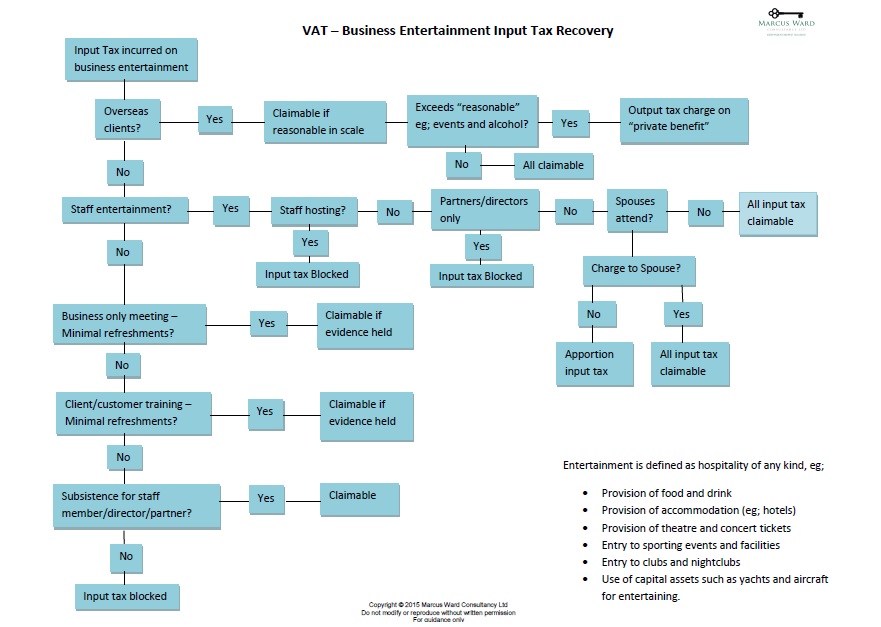
VAT – Business Entertainment Flowchart. What input tax may I recover?

By   11 May 2015

VAT – Recovery of input tax incurred on entertainment

One of the most common questions asked on “day-to-day” VAT is whether input tax incurred on entertainment is claimable.  The answer to this seemingly straightforward question has become increasingly complex as a result of; HMRC policy, EC involvement and case law.  Different rules apply to entertaining; clients, contacts, staff, partners and directors depending on the circumstances.  It seems reasonable to treat entertaining costs as a valid business expense.  After all, a business, amongst other things, aims to increase sales and reduce costs as a result of these meetings.  However, HMRC sees things differently and there is a general block on business entertainment.  It seems like HMRC does not like watching people enjoying themselves at the government’s expense!

If, like me, you think in pictures, then a flowchart may be useful for deciding whether to claim entertainment VAT.  It covers all scenarios, but if you have a unique set of circumstances or require assistance with some of the definitions, please contact me.

I thank my friend and colleague Leila Ong for help with this, and also with the series of presentations we have recently carried out and which, amongst other subjects, covered business entertainment. Should you require VAT training or presentations, don’t forget our comprehensive service here which can be tailored to your needs.

VAT -Business Entertainment Flowchart

Business Entertainment flow chart

Download here: VAT Business Entertainment Input tax recovery flowchart

VAT: Global Accounting simplification

By   27 April 2015

VAT: Second Hand Scheme  – Global Accounting simplification

Overview

The problem with the VAT Second-Hand Goods Scheme is that details of each individual item purchased, and then later sold, has to be recorded. This requirement can lead to a lot of paperwork and an awful lot of administration which, obviously, many businesses are not too keen to comply with.

Global Accounting is an optional, simplified variation of the Second Hand Margin Scheme (Margin Scheme).

It differs from the standard Margin Scheme because rather than accounting for the margin achieved on the sale of individual items VAT is calculated on the margin achieved between the total purchases and total sales in a particular accounting period without the requirement to establish the mark up on each individual item.  It is beneficial if a business buys and sells bulk volume, low value eligible goods, and is unable to maintain the detailed records required of businesses who use the standard Margin Scheme

There two significant differences in respect of Global Accounting compared to the standard Margin Scheme. The first difference is that losses on an item are automatically offset against profits on items. Thus losses and profits are offset together in the period. In the standard Margin Scheme no VAT is due if a loss is made on an item, but that loss cannot be offset against any other profit.  There is also a timing advantage with Global Accounting because all purchases made in the period are included, even if those goods are not actually sold in the same period.

Goods which may be included in Global Accounting

Global Accounting can be used for all items which are eligible under the standard Margin Scheme.  However, the following goods cannot be included in Global Accounting:

  • individual items costing more than £500 (although these can be accounted for via the standard Margin Scheme)
  • aircraft, boats and outboard motors,
  • caravans and motor caravans,
  • horses and ponies, and
  • motor vehicles, including motorcycles; except those broken up for scrap.

Starting to use the scheme

When a business starts using Global Accounting, it may find that it already has eligible stock on hand.  It may include the value of this stock when it calculates the total purchases at the end of the first period.  If a business does not take its stock on hand into account, it will have to pay VAT on the full price, rather than on the margin achieved, when it is sold.

Valuation of stock

A business must be able to identify:

  • stock which is eligible for Global Accounting, and
  • its purchase value

It would normally be possible to establish the value from the original purchase documentation, ie; invoices.

But if a business is newly VAT registered, or it does not have original purchase records it may determine the purchase value using another method.   There is no set way of doing this, but a business must be able to demonstrate that the method used has produced a fair and reasonable total.

Note: any goods bought on an invoice which shows a separate VAT figure are not eligible for resale under the scheme.

The calculation

VAT is calculated at the end of each tax period. Because you can take account of opening stock in your scheme calculations, you may find that you produce a negative margin at the end of several periods. In other words, your total purchases may exceed your total sales. In such cases, no VAT is due. But you must carry the negative margin forward to the next period as in the following example:

Period One

a)      Total purchase value of stock on hand 10,000

b)      Total purchases 2,000

c)      Total sales 8,000

Margin = c – (a+b) = (4,000)

Because this is a negative margin there is no VAT to pay.  However, negative margin must be carried forward into the next period as follows:

Period Two

a)      Negative margin from previous period 4,000

b)      Total purchases 1,000

c)      Total sales 7,000

d)      Margin = c – (a + b), sales minus (purchases plus negative margin), £7,000 – (£1,000 + £4,000) 2,000

e)      VAT due = margin (£2,000) × VAT fraction (1/6) 333.33

There is no negative margin to carry forward this time. Therefore, in the third period, the margin is calculated solely by reference to sales less purchases.

The negative margin may only be offset against the next Global Accounting margin. It cannot be offset against any other figure or record.

Global Accounting Records and Accounts

A business does not need to keep all the detailed records which are required under the normal Margin Scheme – for instance, you do not have to maintain a detailed stock book.

Global Accounting records do not have to be kept in any set way but they must be complete, up to date and clearly distinguishable from any other records.  A business must keep records of purchases and sales as set out below, together with the workings used to calculate the VAT due.

If we HMRC cannot check the margins declared from the records, VAT will be due on the full selling price of the goods sold, even if they were otherwise eligible for the scheme.

Buying goods under Global Accounting

When a business buys goods which it intends to sell under Global Accounting it must:

  • check that the goods are eligible for Global Accounting
  • obtain a purchase invoice. If a business buys from a private individual or an unregistered entity, the purchaser should make out the invoice at the time the goods are purchased.  If purchased from another VAT-registered dealer, the dealer must make out the invoice at the time of sale, and
  • enter the purchase details of the goods in your Global Accounting purchase records.  The purchase price must be the price on the invoice which has been agreed between you and the seller.

You cannot use the scheme if VAT is shown separately on the invoice.

Details to be included on purchase invoices

 Purchase invoices must include:

your name and address

  • the seller’s name and address
  • invoice number
  • date of transaction
  • description of goods (this must be sufficient to enable HMRC to verify that the goods are eligible for Global Accounting)
  • total price, you must not show VAT separately, and
  • for goods purchased from another VAT-registered dealer: the statement “Global Accounting Invoice”

Remember: if you are buying from a private individual or an unregistered business, you must make out the purchase invoice yourself.

When selling goods under Global Accounting

If the purchase conditions above apply, Global Accounting may be used when the goods are sold by:

  • recording the sale in the usual way
  • issuing a sales invoice for sales to other VAT-registered dealers and keeping a copy of the invoice, and
  • transferring totals of copy invoices to the Global Accounting sales record or summary
  • you must be able to distinguish at the point of sale between sales made under Global Accounting and other types of transaction

Details to be included on sales invoices

 A sales invoice must be issued to other VAT-registered customers.  These invoices and any other Global Accounting sales invoice issued must show the following details:

  •  your name, address and VAT registration number
  • the buyer’s name and address
  • invoice number
  • date of sale
  • description of goods (this must be sufficient to enable HMRC to verify that the goods are eligible for Global Accounting)
  • total price – you must not show VAT separately
  • the statement “Global Accounting Invoice”
  • you are selling an item for more than £500 and you don’t want the purchaser to know that you bought it under Global Accounting, you may use one of the Margin Scheme sales invoice statements.

 Details to be included in purchase and sales summaries

 Although a business does not have to keep purchase and sales records or summaries in any particular way, they must include the following details taken from the purchase invoices and any sales invoices you issue:

  •  invoice number (where the purchase invoice shows one)
  • date of purchase/sale
  • description of goods, and total price

 Cessation of using the scheme

If a business stops using Global Accounting for any reason, it must make a closing adjustment to take account of purchases for which it has taken credit, but which have not been sold (closing stock on hand). The adjustment required does not apply if the total VAT due on stock on hand is £1,000 or less. In the final period for which the business uses the scheme, it must add the purchase value of its closing stock to the sales figure for that period.  In this way VAT will be paid (at cost price) on the stock for which the business previously had credit under the scheme.

Here is an example of a closing adjustment under Global Accounting: At the end of the period calculate:

(a)    value of purchases during the period – £5,000

(b)    value of sales during the period – £10,000

(c)    purchase value of closing stock – £8,000

(d)    add purchase value of closing stock to sales for period (c+b) – £18,000

(e)    subtract purchases in this period from sale (d-a) – £13,000

(f)     VAT due on margin (e x 1/6) – £2,166.66

You must make a similar adjustment if you transfer goods as part of a transfer of a going concern (TOGC). In that case, you should add the purchase value of goods included in the scheme to your sales figure for the period in which the TOGC takes place.  This adjustment is separate from the TOGC itself, which is not subject to VAT.

Items sold outside the scheme

If goods are sold which had been included in a business’ Global Accounting purchase (for example, they are exported), a business must adjust its records accordingly.  This is done by subtracting the purchase value of the goods sold outside the scheme from the total purchases at the end of the period.

Stolen or destroyed goods

If a business loses any goods through breakage, theft or destruction, it must subtract their purchase price from your Global Accounting purchase record.

Repairs and restoration costs?

A business may reclaim the VAT it is charged on any business overheads, repairs, restoration costs, etc. But it must not add any of these costs to the purchase price of the goods sold under the scheme.

EC Sales List, Intrastat and VAT returns

VAT registered businesses in the UK who make supplies of goods to VAT-registered businesses in other EC Member States are required to complete lists (form VAT 101) of their EC supplies.

But a business should not include any margin schemes transactions on an EC Sales list because they will be subject to VAT in the UK.

Intrastat is the system for collecting statistics on the trade in goods between EC Member States. But, because margin scheme goods are subject to VAT in the country of origin, there is no requirement either:

  • to include margin scheme purchases or sales in boxes 8 and 9 of your VAT return, or
  • to complete a supplementary declaration

For further advice on any global accounting, used goods schemes, or any other special VAT schemes please contact me.

© Marcus Ward Consultancy Ltd

The penalty regime….the dark side of VAT!

By   9 February 2015

I have made a lot of references to penalties in my other articles. So what are they, and how much could they cost if a business gets it wrong?

HMRC detail three categories of inaccuracy. These are significant, as each has its own range of penalty percentages. If an error is found to fall within a lower band, then a lower penalty rate will apply. Where the taxpayer has taken ‘reasonable care,’ even though an error has been made, then usually HMRC will not apply a penalty.

Penalty Categories 

–  An error, when reasonable care not taken: 30%;

–  An error which is deliberate, but not concealed: 70%;

–  An error, which is deliberate and concealed: 100%.

Unhelpfully, there is no definition of ‘reasonable care’. However, HMRC have said that they would not expect the same level of knowledge or expertise from a self-employed person, as from a large multi-national.  HMRC expect that, where an issue is unclear, advice is sought, and a record maintained of that advice. They also expect that, where an error is made, it is adjusted, and HMRC notified promptly. They have specifically stated that merely to adjust a return will not constitute a full disclosure of an error. Therefore a penalty may still be applicable.

The amount of the penalty is calculated by applying the appropriate penalty rate (above) to the ‘Potential Lost Revenue’ or PLR. This is essentially the additional amount of VAT due or payable, as a result of the inaccuracy, or the failure to notify an under-assessment. Special rules apply where there are a number of errors, and they fall into different penalty bands.

Defending a penalty

The percentage penalty may be reduced by a range of ‘defences:’

–  Telling; this includes admitting the document was inaccurate, or that there was an under-assessment, disclosing the inaccuracy in full, and explaining how and why the inaccuracies arose;

–  Helping; this includes giving reasonable help in quantifying the inaccuracy, giving positive assistance rather than passive acceptance, actively engaging in work required to quantify the inaccuracy, and volunteering any relevant information;

–  Giving Access; this includes providing documents, granting requests for information, allowing access to records and other documents.

Further, where there is an ‘unprompted disclosure’ of the error, HMRC have power to reduce the penalty further. This measure is designed to encourage businesses to have their VAT returns reviewed.

A disclosure is unprompted if it is made at a time when a person had no reason to believe that HMRC have discovered or are about to discover the inaccuracy. The disclosure will be treated as unprompted even if at the time it is made, the full extent of the error is not known, as long as fuller details are provided within a reasonable time.

HMRC have included a provision whereby a penalty can be suspended for up to two years. This will occur for a careless inaccuracy, not a deliberate inaccuracy. HMRC will consider suspension of a penalty where, given the imposition of certain conditions, the business will improve its accuracy. The aim is to improve future compliance, and encourage businesses which genuinely seek to fulfil their obligations.

Appealing a penalty

HMRC have an internal reconsideration procedure. A business should apply to this in the first instance. If the outcome is not satisfactory, the business can pursue an appeal to the Tribunal. A business can appeal whether a penalty is applicable, the amount of the penalty, a decision not to suspend a penalty, and the conditions for suspension.

The normal time limit for penalties to four years. Additionally, where there is deliberate action to evade VAT, a 20 year limit applies. In particular, this applies to a loss of VAT which arises as a result of a deliberate inaccuracy in a document submitted by that person.  These are just the penalties for making errors on VAT returns. HMRC have plenty more for anything from late registration to issuing the wrong paperwork.

Help

In my view there is generally a very good chance of success in a business challenging a penalty.  Each case should at least be reviewed by an adviser, and experience insists that a robust defence often results in full or part mitigation.  We have a very good track record in appealing HMRC decisions and have taken cases right up to High Court.  However, most cases can be settled before they get to Tribunal, and indeed, the greatest chance of success is usually at the beginning of the process before HMRC become entrenched.

VAT implications of renewable energy sources

By   15 January 2015

If you own land and install solar panels (which we shall use as an example, although the rules apply equally to any way of generating renewable power), it is relatively straightforward; as you are either consuming the power, or are the provider supplying electricity back to the National Grid.

Where the position may get slightly more complicated is where a solar panel business buy the ‘space’ to install energy producing equipment from someone else. Many businesses are renting the roof space from others upon which to install the solar panels. The businesses may pay the roof owners with ‘free’ electricity in return for renting out this space. Supply of electricity to the owners of the site

For a solar panel business leasing a site, the supply of electricity to the owners of that site is deemed to be a supply of goods.

The business installing the solar panels is the taxable person (if they are, or should be registered for VAT) and they are supplying the owners of the site with a ‘cheap’ supply of electricity in the course of the furtherance of their business.

The supply of electricity for domestic use is a reduced-rate supply under Group 1 of Schedule 7A VATA 1994. The reduced rate of VAT is 5%. If the site owner is using the electricity for domestic purposes then the reduced rate of 5% should apply. If the electricity is being used for business purposes then the supply becomes standard-rated at 20%. However, if there is mixed use, then so long as more than 60% of the use is domestic then the whole supply will be treated as ‘qualifying use’ ie; domestic, and the 5% will apply to the entire amount. Generally speaking, VAT charged at 5% is fully or partly irrecoverable by the recipient.

So in this scenario, the land owner is providing something in exchange for this electricity use; the land owner is giving the solar panel business the use of his land. Therefore this is ‘consideration’ for a service; even if it is ‘non-monetary’ consideration.

This means that the solar panel business will have to calculate a value for this consideration and then charge 5% (or 20%) VAT as necessary, on this amount if they are VAT registered.

The value placed on this non-monetary consideration is not usually a concern for the land owner making the supplies of this land, as this land supply is itself exempt from VAT.

The supply of the land
This is a supply of land by the owner of the site. Unless the land has been ‘opted to tax’ (OTT) then this supply will be exempt from VAT. If the land has been OTT by the landowner – the parties will need to look at the valuation of the (non-monetary) consideration as this will be subject to VAT at 20%. If there is no OTT and the supply is exempt; for a non-VAT registered person, this will have no impact, and this income will not be included in taxable supplies which count towards the VAT registration threshold. If a VAT registered entity makes exempt supplies of land, consideration must be given to his partial exemption position.

VAT consequences of the Feed-In Tariff
In recognition of the higher cost of producing electricity in this manner, people participating in the Feed in Tariff scheme will receive payment under a “generation tariff”. This payment is not consideration for any supply and it is therefore outside the scope of VAT.

Supply of electricity to the electricity board
In addition to the Feed-In Tariff there is the additional income which you may receive from the electricity board ie; the “Export Tariff”. These payments are “consideration for supplies of electricity by people participating in the Feed in Tariff scheme to the electricity company, where they are made by taxable persons in the course of their business”. The export tariff is not outside the scope of VAT and therefore it is a supply of electricity made in the course of the furtherance of your business to the electricity supplier. It will attract standard rated VAT as it is not the supply for domestic use.

 Further…

A recent Court of Justice of the European Union (CJEU – the EU’s highest court) case has ruled in favour of the taxpayer after he argued that solar panels installed on his house constituted a business for VAT purposes. This is good news for any people who supply any energy into the grid and are paid a feed-in tariff (FiT) for doing so.

It means that anyone receiving the FiT can VAT register and reclaim (at least some) VAT incurred on the purchase and installation of solar panels plus input tax incurred on any other goods and services relating to the panels.

The supply and installation of “energy saving materials”, including solar panels, is currently subject to a reduced VAT rate of 5% in the UK. The European Commission is currently challenging this policy, arguing that the tax incentive goes beyond the scope of the law. The VAT Directive only allows Member States to apply reduced VAT rates to a limited number of goods and services, which are specified in an annex to the directive. So the cost of buying and installing solar panels may increase in the future.

It is anticipated that HMRC will need to deal with “thousands” of extra registration applications resulting in significant additional VAT repayments.

What is the value of a sale for VAT? – Prompt Payment Discounts

By   15 December 2014

The value of a supply is crucial for VAT.

The area of discounts has always been problematic, particularly in respect of prompt payments discounts (which customers sometimes do, and sometimes do not take advantage of).

HMRC has clarified the position and has published:  which confirms that from 1 April 2015, all businesses that offer Prompt Payment Discounts will be obliged to account for VAT on the sum actually received in return for the goods or services supplied (rather than the reduced value offered – as is the current position).

VAT MOSS (Mini One-Stop Shop) Update – Small businesses

By   8 December 2014

Further to my article on the introduction of new place of supply rules and the MOSS for B2C supplies of telecoms, broadcasting and other e-services HMRC have now stated its position on smaller businesses.

Under the initial rules, businesses which have income below the UK VAT registration turnover limit of (currently £81,000 pa) would be forced to either register for VAT in each EC Member State in which they made a sale (where the customer belongs), or registering for VAT in the UK in order to use the simplified MOSS procedure.

This would, of course, mean that such a business would lose the benefit of not being UK VAT registered and consequently having to do business in the UK with the addition of UK VAT.

HMRC has now indicated that these smaller businesses will be permitted to separate their UK and EC trading and register for VAT in the UK (so they can use the MOSS) without accounting for UK VAT on their domestic trading as long as their UK turnover remains below the VAT registration threshold.

This is curious (but welcome) since HMRC have always been against disaggregation.

For further information please see my new 2015 rules flowchart