Category Archives: VAT commentary

VAT – Top 10 Tax Point Planning Tips

By   24 February 2015

VAT Tax Point Planning

If a business cannot avoid paying VAT to the HMRC, the next best thing is to defer payment as long as legitimately possible. There are a number of ways this may be done, dependent upon a business’ circumstances, but the following general points are worth considering for any VAT registered entity.

A tax point (time of supply) is the time a supply is “crystallised” and the VAT becomes due to HMRC and dictates the VAT return period in which VAT must be accounted for.  Very broadly, this is the earliest of; invoice date, receipt of payment, goods transferred or services completed (although there are quite a few fiddly bits to these basic rules).

 The aims of tax point planning

1.            Deferring a supplier’s tax point where possible.  It is sometimes possible to avoid one of these events or defer a tax point by the careful timing of the issue of a tax invoice.

2.            Timing of a tax point to benefit both parties to a transaction wherever possible. Because businesses have different VAT “staggers” (their VAT quarter dates may not be the co-terminus) judicious timing may mean that the recipient business is able to recover input tax before the supplier needs to account for output tax.  This is often important in large or one-off transactions, eg; a property sale.

3.            Applying the cash accounting scheme. Output tax is usually due on invoice date, but under the cash accounting scheme VAT is only due when a payment is received.  Not only does this mean that a cash accounting business may delay paying over VAT, but there is also built in VAT bad debt relief.  A business may use cash accounting if its estimated VAT taxable turnover during the next tax year is not more than £1.35 million.

4.            Using specific documentation to avoid creating tax points for certain supplies. If a business supplies ongoing services (called continuous services – where there is no identifiable completion of those services) if the issue of a tax invoice is avoided, VAT will only be due when payment is received (or the service finally ends).

5.            Correctly identifying the nature of a supply to benefit from certain tax point rules. There are special tax point rules for specific types of supplies of goods and services.  Correctly recognising these rules may benefit a business, or present an opportunity for VAT planning.

6.            Generate output tax as early as possible in a VAT period, and incur input tax as late as possible. This will give a business use of VAT money for up to four months before it needs to be paid over, and of course, the earlier a claim for repayment of input tax can be made – the better for cashflow.

7.            Planning for VAT rate changes. Rate changes are usually announced in advance of the change taking place.  There are specific rules concerning what cannot be done, but there are options to consider when VAT rates go up or down.

8.            Ensure that a business does not incur penalties for errors by applying the tax point rules correctly. Right tax, right time; the best VAT motto!  Avoiding penalties for declaring VAT late is obviously a saving.

9.            Certain deposits create tax points, while other types of deposit do not.  It is important to recognise the different types of deposits and whether a tax point has been triggered by receipt of one. Also VAT planning may be available to avoid a tax point being created, or deferring one.

10.         And finally, consider discussing VAT timing planning for your specific circumstances with your adviser.

It should always be remembered that it is usually not possible to apply retrospective VAT planning as VAT is time sensitive, and never more so than tax point planning.

I have advised a lot of clients on how to structure their systems to create the best VAT tax point position.  Any business may benefit, but  I’ve found that those with the most to gain are; professional firms, building contractors, tour operators, hotels, hirers of goods and IT/internet businesses.

(c) Marcus Ward Consultancy Ltd 2015

VAT – Prompt Payment Discounts (PPD) changes to valuation from 1 April 2015

By   19 February 2015

VAT – Prompt Payment Discount Changes

Businesses don’t have much time to change their accounting procedures and systems to deal with the new PPD rules.  A recent survey has shown that over 13% of business will be affected by the changes which do not appear to have been given much publicity. These changes are necessary to align UK legislation with the EC Principal VAT Directive.  It is crucial that advisers and businesses are not caught out by the change in valuation of supplies offered at a discount.

The changes – summary

Old Rules

Under the previous rules output tax was due on the discounted price offered for prompt payment – regardless of whether the customer takes up the discount.

New Rules

From 1 April 2015 output tax is due on the full consideration actually paid by the customer when PPD is offered.

The new rules are required because HMRC is concerned that there was a difference between output tax paid on the discounted price, and the (higher) amount received if a PPD is not taken.  Historically, this was not so much of an issue because most PPD was offered B2B and the VAT was generally recoverable by the recipient of the supply.  However, increasingly, PPD is now offered B2C and therefore reduces “sticking tax” and the consequential VAT loss for HMRC.

A simple example

Old Rules

B2B PPD of 10% if invoice paid within 21 days.

Goods                                          £10,000

VAT 20% on £9,000                     £1,800

Invoice Total                               £11,800

Both parties post £1,800 to VAT account and there is no adjustment if discount not taken.

New Rules

Using the above figures:

Must assume discount is not taken so invoice total = £12,000

If customer actually takes up PPD a credit note is issued for both elements of the supply – £200 credit for the VAT.

Both parties process the new documentation to adjust the original invoice – VAT is neutral.

This increases a business’ administrative burden and also creates a significant additional risk of penalties and interest if businesses are ignorant of the change, or implement the changes incorrectly.

VAT – Splitting a business to avoid registration doesn’t work

By   30 January 2015

I have a cunning plan to avoid registering for VAT…….

….I’ll simply split my business into separate parts which are all under the VAT registration turnover limit – ha!

I’ve heard this said many a time in “bloke in the pub” situations. But is it possible?

You will not be surprised to learn that HMRC don’t like such schemes and there is legislation and case law for them to use to attack such planning known as “disaggregation”. This simply means artificially splitting a business.

What HMRC will consider to be artificial separation:

HMRC will be concerned with separations which are a contrived device set up to circumvent the normal VAT registration rules. Whether any particular separation will be considered artificial will, in most cases, depend upon the specific circumstances. Accordingly it is not possible to provide an exhaustive list of all the types of separations that HMRC will view as artificial. However, the following are examples of when HMRC would at least make further enquiries:

Separate entities supply registered and unregistered customers

In this type of separation, the registered entity supplies any registered customers and the unregistered part supplies unregistered customers.

Same equipment/premises used by different entities on a regular basis

In this type of situation, a series of entities operates the same equipment and/or premises for a set period in any one-week or month. Generally the premises and/or equipment is owned by one of the parties who charges rent to the others. This situation may occur in launderettes and take-aways such as fish and chip shops or mobile catering equipment.

Splitting up of what is usually a single supply

This type of separation is common in the bed and breakfast trade where one entity supplies the bed and another the breakfast. Another is in the livery trade where one entity supplies the stabling and another, the hay to feed the animals. There are more complex examples, but the similar tests are applied to them too.

Artificially separated businesses which maintain the appearance of a single business

A simple example of this type of separation includes; pubs in which the bar and catering may be artificially separated. In most cases the customer will consider the food and the drinks as bought from the pub and not from two independent businesses. The relationship between the parties in such circumstances will be important here as truly franchised “shop within a shop” arrangements will not normally be considered artificial.

One person has a controlling influence in a number of entities which all make the same type of supply in diverse locations

In this type of separation a number of outlets which make the same type of supplies are run by separate companies which are under the control of the same person. Although this is not as frequently encountered as some of the other situations, the resulting tax loss may be significant.

The meaning of financial, economic and organisational links

Again each case will depend on its specific circumstances. The following examples illustrate the types of factors indicative of the necessary links, although there will be many others:

Financial links

  • financial support given by one part to another part
  • one part would not be financially viable without support from another part
  • common financial interest in the proceeds of the business

Economic links

  • seeking to realise the same economic objective
  • the activities of one part benefit the other part
  • supplying the same circle of customers

Organisational links

  •  common management
  • common employees
  • common premises
  • common equipment

HMRC often attack structures which were not designed simply to avoid VAT registration, so care should be taken when any entity VAT registers, or a conscious decision is made not to VAT register. Registration is a good time to have a business’ activities and structure reviewed by an adviser.

As with most aspects of VAT, there are significant and draconian penalties for getting registration wrong, especially if HMRC consider that it has been done deliberately to avoid paying VAT.

Oops! – Top Ten VAT howlers

By   6 January 2015

I am often asked what the most frequent VAT errors made by a business are. I usually reply along the lines of “a general poor understanding of VAT, considering the tax too late or just plain missing a VAT issue”.  While this is unquestionably true, a little further thought results in this top ten list of VAT horrors:

  1. Not considering that HMRC may be wrong. There is a general assumption that HMRC know what they are doing. While this is true in most cases, the complexity and fast moving nature of the tax can often catch an inspector out. Added to this is the fact that in most cases inspectors refer to HMRC guidance (which is HMRC’s interpretation of the law) rather to the legislation itself. Reference to the legislation isn’t always straightforward either, as often EC rather than UK domestic legislation is cited to support an analysis. The moral to the story is that tax is complicated for the regulator as well, and no business should feel fearful or reticent about challenging a HMRC decision.
  2.  Missing a VAT issue altogether. A lot of errors are as a result of VAT not being considered at all. This is usually in relation to unusual or one-off transactions (particularly land and property or sales of businesses). Not recognising a VAT “triggerpoint” can result in an unexpected VAT bill, penalties and interest, plus a possible reduction of income of 20% or an added 20% in costs. Of course, one of the basic howlers is not registering at the correct time. Beware the late registration penalty, plus even more stringent penalties if HMRC consider that not registering has been done deliberately.
  3.  Not considering alternative structures. If VAT is looked at early enough, there is very often ways to avoid VAT representing a cost. Even if this is not possible, there may be ways of mitigating a VAT hit.
  4.  Assuming that all transactions with overseas customers are VAT free. There is no “one size fits all” treatment for cross border transactions. There are different rules for goods and services and a vast array of different rules for different services. The increase in trading via the internet has only added to the complexity in this area, and with new technology only likely to increase the rate of new types of supply it is crucial to consider the implications of tax; in the UK and elsewhere.
  5.  Leaving VAT planning to the last minute. VAT is time sensitive and it is not usually possible to plan retrospectively. Once an event has occurred it is normally too late to amend any transactions or structures. VAT shouldn’t wag the commercial dog, but failure to deal with it at the right time may be either a deal-breaker or a costly mistake.
  6.  Getting the option to tax wrong. Opting to tax is one area of VAT where a taxpayer has a choice. This affords the possibility of making the wrong choice, for whatever reasons. Not opting to tax when beneficial, or opting when it is detrimental can hugely impact on the profitability of a project. Not many businesses can carry the cost of, say, not being able to recover VAT on the purchase of a property, or not being able to recover input tax on a big refurbishment. Additionally, seeing expected income being reduced by 20% will usually wipe out any profit in a transaction.
  7.  Not realising a business is partly exempt. For a business, exemption is a VAT cost, not a relief. Apart from the complexity of partial exemption, a partly exempt business will not be permitted to reclaim all of the input tax it incurs and this represents an actual cost. In fact, a business which only makes exempt supplies will not be able to VAT register, so all input tax will be lost. There is a lot of planning that may be employed for partly exempt businesses and not taking advantage of this often creates additional VAT costs.
  8.  Relying on the partial exemption standard method to the business’ disadvantage. A partly exempt business has the opportunity to consider many methods to calculate irrecoverable input tax. The default method, the “standard method” often provides an unfair and costly result. I recommend that any partly exempt business obtains a review of its activities from a specialist. I have been able to save significant amounts for clients simply by agreeing an alternative partial exemption method with HMRC.
  9.  Not taking advantage of the available reliefs. There are a range of reliefs available, if one knows where to look. From Bad Debt Relief, Zero Rating (VAT nirvana!) and certain de minimis limits to charity reliefs and the Flat Rate Scheme, there are a number of easements and simplifications which could save a business money and reduce administrative and time costs.
  10.  Forgetting the impact of the Capital Goods Scheme. The range of costs covered by this scheme has been expanded recently. Broadly, VAT incurred on certain expenditure is required to be adjusted over a five or ten year period. Failure to recognise this could either result in assessments and penalties, or a position whereby input tax has been under-claimed. The CGS also “passes on” when a TOGC occurs, so extra caution is necessary in these cases.

So, you may ask: “How do I make sure that I avoid these VAT pitfalls?” – And you would be right to ask.

Of course, I would recommend that you engage a VAT specialist to help reduce the exposure to VAT costs!

VAT – Hard or soft? Stiff or floppy?

By   12 November 2014

Sssshh at the back, this is important!

Whether cakes and biscuits go hard or soft when stale helps to determine whether they are indeed cakes or biscuits (cakes go hard, biscuits go soft). This is the difference between VAT at 20% and zero rating for some products.

Whether printed matter is stiff or floppy can also result in either 20% or zero rated treatment. In this case, for single sheet products, eg; leaflets; limp is good and hard can result in the VAT hit.

What did you think I was talking about? Stop making your own jokes up!

VAT Jargon Buster!

By   5 November 2014

Unfortunately, VAT is littered with phrases, acronyms and jargon which can be impenetrable to people that have to deal with the tax.  I have explained the main terms used below and tried to demystify the gobbledygook!

Accounting period

This is the period of time reported in your VAT Return, usually three months.

Acquisitions

Goods brought into the UK from other EC countries (different from goods brought into the UK from outside of the EC; which are known as imports).

Capital Goods Scheme (CGS)

A mechanism for spreading the input tax incurred on computer equipment exceeding £50,000 or property exceeding £250,000 of standard-rated cost.

Consideration

Something that is done or given in exchange for something else. Consideration can be in monetary or non-monetary form. If there is no consideration there is no supply.

Corporate body

An incorporated body, eg; a limited company, limited liability partnership, friendly, industrial or provident society.

Distance sales

When a business in one EC country sells and ships goods directly to consumers in another EC country, eg; internet sales.

Exempt supply

A supply that is exempt from VAT by law eg; rent, insurance and financial services.  It is not a taxable supply and generally does not allow the recovery of VAT incurred on associated expenditure.

Exports

Goods sent to countries outside of the EC.

Despatches

Goods sent to another EC country.

Imports

Goods brought into the EC from countries outside of the EC.

Input tax

Refers to the VAT you pay on your purchases – goods or services you use when running your business.

New building

A commercial building less than three years old where a freehold disposal is compulsorily standard-rated.

Non-residential

A building not used as a dwelling.

Option to tax

Changes the supply of a commercial property from exempt to standard rated.  This is done solely to recover or avoid input tax attributable.

Output tax

Refers to the VAT you charge on your sales which your clients/customers pay you.

Outside the scope of VAT

Goods and services that are completely outside the scope of VAT altogether, eg; taxes, supplies in other countries, TOGCs and wages paid to employees.

Partial exemption

A business which incurs input tax relating to both taxable and exempt activities is partially exempt and will probably not be able to recover all of its input tax.

Place of supply

The country where a supply of goods or services is deemed to be made for VAT purposes. This is the country in which VAT must be accounted for.

Reduced rate

The rate applied to essential goods and services, such as gas and electricity for residential purposes. Currently at 5%.

Registration

Being VAT registered – accounting for output tax on sales and recovering input tax.  A business needs to VAT register when its turnover exceeds certain limits.

Self-billing

Where a customer raises a self-billing document and sends a copy to its supplier with its payment – rather than the supplier issuing an invoice.

Standard rate

A taxable supply subject to UK VAT at the current standard rate of 20%.

Supply

Providing goods or services in return for consideration, normally monetary.

Supply of goods

When exclusive ownership of goods passes from one person to another.

Supply of services

Supply, for consideration, of something provided which is not goods.

Tax period

(Also known as accounting period) The period of time covered by your VAT return. Usually quarterly or monthly.

Taxable person

Any business which supplies goods or services and is required to be registered for VAT.  This includes; individuals, partnerships, companies, clubs, associations and charities etc.

Taxable supplies

Goods and services supplied by a taxable person which are liable to VAT at the standard, reduced or zero rate. They usually permit the recovery of VAT incurred on the costs incurred in making them.

Taxable turnover

Taxable turnover is the total value, net of VAT, of the taxable supplies you make in the UK within one year.  It is used to establish whether registration is necessary.

Tax point (Time of supply)

The date when a business must account for VAT on supplies and when input tax may be reclaimed. This dictates on what VAT return the transaction is accounted for.

Transfer Of A Going Concern (TOGC)

A sale of a business which continues after transfer.  This is a VAT free transaction if certain tests are met.

Zero-rated

Is a taxable supply but subject to UK VAT at a rate of 0%.

© MWCL 2014

With the Scottish vote approaching….

By   10 September 2014

What happens if Scotland gains independence?

A VAT what if….

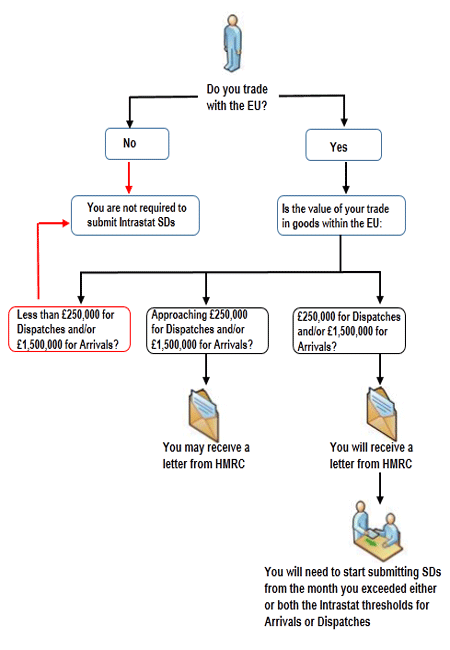
If the Scots vote for, and gain, full independence from the UK, it is likely that the country will become a separate Member State of the EU. According to David Cameron; It’s currency will become the Euro and it will need to form its own authority for administering VAT. Although cross border controls will not be introduced, the VAT treatment of cross-border transactions will change significantly. Apart from the usual currency exchange issues, UK businesses will also be required to complete additional EC Sales Lists, Intrastat Declarations, and potentially a lot of other administrative and statistical documentation.

UK businesses will also need to determine the status of its Scottish customer, which in turn will establish the place of supply, which will dictate whether UK VAT, Scottish VAT, or no VAT is chargeable. Then there are the Distance Selling rules to consider. Some UK businesses will be required to register in Scotland as well as the UK if they sell goods by mail order. And don’t forget the changed VAT treatment of goods and services purchased from Scotland; in most cases a UK reverse charge will be applicable. Depending on circumstances though, UK businesses and residents will incur Scottish VAT and if they do, only some will be able to recover it. This will not be via a usual UK VAT return, but via an alternative VAT claim method which also adds complexity. Then there is the increase in triangulation cases, never the most straightforward VAT subject!

A simple supply from Carlisle to Ayr would will need to be analysed with a massive amount more information required plus the additional bureaucratic form filling. This added complexity will also increase the possibility of errors on which penalties will be levied.

John Swinney, the cabinet secretary for finance in the Scottish Government has pointed out that an independent Scotland would be able to choose its own levels of income tax and VAT, as well as taking control of other sources of revenue such as alcohol and tobacco duty, air passenger duty and landfill tax.

From a practical point of view, will shops and other business establishments in the North of England start accepting both Sterling and Euros? Will invoices routinely show both Sterling and Euro values? Will excise and duty rates be similar to the UK? Will there be opportunities for enterprising individuals to take advantage of any differences? Will we see smugglers coming up against modern day Robert Burns in his Exciseman incarnation? At what rate will the Scots set VAT? Will it be possible that cross border VAT rate shopping will take place? Will the Scots lose the zero rating reliefs which they currently enjoy as part of the UK? Will the Scottish people be forced to pay VAT on new houses, food, books and children’s clothing after independence? One thing is for sure, the Scots will need a whole new set of domestic legislation to cover VAT and indirect taxes.

Also: What about groups of companies with Scottish and English subsidiaries currently in the same UK VAT Group? Were independence to happen, it would be a riot unpicking that lot.

Good luck everybody!

VAT bits. Is it the “EU” or the “EC”? Which term is correct?

By   11 August 2014

The European Union (EU) is a collective term. It does not, strictly speaking, have a legal personality.

With reference to Community legislation it is correct to refer to the European Community (EC).

Mind you, my Father has only just stopped calling it the Common Market……..

Some Odd VAT Facts

By   23 June 2014

We all know that the VAT rules throw up some oddities which are mainly the result of new products, technology and the way people live their lives now. I do think that the law needs a significant, consistent overhaul rather than a piecemeal approach, but let’s just consider some of the weird results the present system throws up. This is a MOSS* for all tabloid journalists….

* Mini One-Stop Shop

An odd rule applies to gingerbread men. No VAT is charged if the figure has two chocolate spots for its eyes, but any chocolate-based additions, such as buttons or a belt, mean VAT is payable.

The sale of a horse is standard rated. However, the sale of a dead one (for horse meat) is zero rated. I wouldn’t really want to dwell on the VAT planning aspects of this…

A downloaded purchase of the bible is standard rated while “saucy” top shelf magazines are VAT free.

So that’s what it’s called….. From HMRC guidance – “For the purposes of establishing the place of supply of services, stallion nominations (The right to nominate a mare to be covered by a stallion in one breeding season) and the covering of mares is treated as ‘work carried out on goods’”.

Food for wild birds is zero rated while food for caged birds is at 20%.

Well, what do you know?! Jaffa cakes are cakes, Pringles are crisps and now Lucozade Sport is a beverage. That’s what the Upper Tribunal has just ruled, so the drink is now subject to VAT. So now we know.

(And since this is VAT, we have to mention Jaffa cakes – again!) It was ruled as a fact that cakes go hard when stale whereas biscuits go soft.

Food that is too hot to eat can be classed as cold food for VAT purposes.

Orange juice is zero rated. Lemon juice is zero rated. Mix them, and you have a standard rated product.

Peanuts in shells are zero rated, salted peanuts are standard rated.

If your shop is burgled, it’s best to let the robbers take your stock. Goods lost to theft are not subject to VAT, but if cash (which customers have paid for goods) is taken from the till a VATable supply has still been made and VAT is due on it.

The sales of kangaroos are standard-rated but kangaroo steaks are zero-rated.

Rabbits are zero-rated, even if sold as pets. Sales of pets are standard rated.

The sales of counterfeit (illegal) goods are subject to 20% VAT, but the sale of counterfeit banknotes are not.

There was a planning scheme called the golden toothbrush, but it didn’t matter what colour the toothbrush was.

Ferret food has recently been ruled to be subject to 20% when it was VAT free from 1973.

Caviar is deemed a necessity in terms of VAT, while orange squash is a luxury item.

Buying a coffin is standard-rated but hiring a hearse is VAT free.

Children’s clothing with rabbit and gazelle fur (and even dog skin) is zero-rated but if it has Tibetan goat fur it is subject to VAT.

Tuition provided by a sole practitioner is exempt, but if the tutor incorporates then their supplies become standard-rated.

In the Spearmint Rhino case it was ruled that there is no VAT on lap dances.

Under some VAT schemes, zero rated and exempt supplies are subject to VAT (and even some which are “Outside the scope of UK VAT”).

Dog food for a poodle is subject to VAT but exactly the same food can be zero rated if it is for a Labrador.

New house builds to be subject to 20% VAT?

By   9 June 2014

Reports that a recently issued EC consultation document is proposing to harmonise VAT rates across Europe thus removing the UK’s zero rate have stirred up something of a hornet’s nest. Clearly, in this delicate (although slowly improving) climate for house builders an additional 20% cost could damage the market irrevocably adding £50,000 to the cost of a £250,000 house. Commentators in the trade have announced that it would be a disaster for new home buyers, the construction sector, and the UK economy in general.

However, are these reports in the national press all that they seem? Or is this another tabloid attack on the EC? Such consultation documents are issued regularly and they consider many aspects of VAT across the EC. An EC spokesman, when questioned about this issue, stated “the consultation was not pre-empting a move and considering VAT ‘in general’” Additionally, a spokesman for the Treasury announced “’The UK government has no intention of agreeing to such a proposal, and there is no consultation to change the zero tax rate”. Historically, UK authorities have fought doggedly to retain all of the UK’s zero rates because once they are removed, it is not possible under EC legislation, to reinstate them. The UK is unique in applying the zero rate to items such as food, new houses, books and newspapers and while it is not possible to widen or extend the scope of the zero rating, the UK is permitted, for the time being, to retain those which are in place. So, is there any truth in these “rumours”? It appears that the report was published by the Daily Mail, which in turn appears to have obtained the story from The Daily Express. Although there is a continuing will to harmonise VAT across the EC, I would be very surprised indeed if the UK was to be forced to standard rate new house builds. My personal view is that there appears to be a little mischief making here and the house building industry has enough to worry about rather than this imposed 20% price hike.

Please see here for our land and property services