
Tag Archives: VAT-cross-border

VAT: What are split payments?

By   9 January 2023

The term “split payment” is increasingly cropping up in conversations and in the media, so I thought it would be a good time to look at the concept.

Split payments, sometimes called real-time extraction, uses card payment technology to collect VAT on online sales and transfer it directly to HMRC rather than the seller collecting it from the buyer along with the payment for the supply, and then declaring it to HMRC on a return in the usual way.

Clearly, HMRC is very keen to introduce such a system, but there are significant hurdles, the biggest being the complexity for online sellers, payment processors, input tax systems, agents, advisers and HMRC itself.

Where are we on split payments?

At the end of the year HMRC published a Prior Information Notice (PIN) and associated Request for Information (RFI), seeking views on the outline requirements and proposed procurement process split payments. This should, inter alia, assist HMRC in:

  • identifying where it is intended that the purchased goods or services are to be delivered and/or consumed
  • the possibility to apply a split only above or below a certain value threshold
  • the feasibility for the splitting mechanism to calculate a composite VAT total across a mixed basket of goods and/ or services, each potentially with a different rate of VAT.

This builds on previous information gathering/consultations/discussions carried out a number of years ago.

Background

The expansion of the online shopping market has brought unprecedented levels of transactions. The results of digitalisation have also brought challenges for tax systems. Jurisdictions all over the world are currently grappling with the question of how to prevent large VAT losses, which can arise from cross-border online sales. This happens when consumers buy goods from outside their jurisdiction from sellers who, through fraud or ignorance, do not comply with their tax obligations. It is costing the UK tax authorities an estimated £1 billion to £1.5 billion (figures for 2015-16) a year. The UK government believes that intercepting VAT through intermediaries in the payment cycle, split payment potentially offers a powerful means of enforcing VAT compliance on sellers who are outside the UK’s jurisdiction.

Fraud

The fraud carried out by online sellers is not particularly sophisticated but is difficult to combat. Simply, sellers either use a fake VAT number to collect VAT without declaring it, or even more basically, collect the VAT and disappear.

Proposed spilt payment methods

The way in which payments are split represent difficult technical VAT issues, particularly when sales are at different VAT rates. The three proposals are:

  • Standard rate split. This assumes that all sales are liable to the standard rate VAT and does not recognise any input tax deduction. Extraction of 20% of tax, regardless of the actual liability (potentially, 5%, or zero) appears unfair and would be very difficult to impose. Cashflow would be negatively affected too.
  • Flat Rate Scheme (FRS). This is a proposal by HMRC to insist that online sellers overseas to use the FRS using a specific new rate for this purpose. The FRS threshold of £150,000 pa could be increased for overseas businesses, but this would potentially give overseas sellers an advantage over UK businesses, so politically, if nothing else, would prove to be a hard sell.
  • Net effective rate. This would mean an overseas business calculating its own exact net effective rate, based on its outputs and inputs from the previous year’s transactions (similar to TOMS).
  • Composite rate. A composite VAT total across a mixed range of goods or services, each potentially with a different rate of VAT. The mechanism for carrying this calculation out is unclear.

There may be more proposals forthcoming, but none of the above proposals appear reasonable and the complexity they would bring would seem to rule them out as matters stand – although this has not previously stopped HMRC introducing certain measures and the obvious benefits to the authorities cannot be ignored.

Overall

The technology for split payments currently exists and is being used in some Latin American countries (and Poland). The concept is part of a larger movement towards real-time taxation and MTD. Our view is that split payments are coming, but we do not know in which form or when.
VAT: Selling goods using an online marketplace – new guidance

By   3 January 2023

HMRC has published new guidance for use when a business sells goods using an online marketplace (an e-commerce site that connects sellers with buyers where transactions are managed by the website owner) or direct to customers in the UK.

It can be used to check when a seller is required to pay UK VAT.

It is important, especially for sellers based outside the UK, to understand the tax consequences when such marketplaces are used. It is not always possible to rely on the platforms to deal with output tax on sales made to UK recipients.

The guidance covers:

  • selling goods using an online marketplace
  • selling goods direct to customers in the UK
  • checks online marketplaces need to do
  • VAT when goods are returned to the seller

More on online business here.

Incoterms: What are they, and how can they be of use for VAT?

By   12 September 2022

VAT – Cross border sales of goods

Incoterms stands for International Commercial Terms.

These are published by the International Chamber of Commerce (ICC) and describe agreed commercial terms. These rules set out the responsibilities of buyers and sellers for the supply of goods under a contract. They are very commonly used in cross-border commercial transactions in order that both sides in a transaction are aware of the contractual position. They help businesses avoid costly misunderstandings by clarifying the tasks, costs and risks involved in the delivery of goods from sellers to buyers. The latest terms were published in 2010 and came into effect in 2011.

The use of Incoterms for assistance for VAT purposes

One of the most difficult areas of providing VAT advice is obtaining sufficient detailed information to advise accurately and comprehensively.  Quite often advisers are given what a client believes to be the arrangements for a transaction. This may differ from the actual facts, or the understanding of the other party in the transaction.

Pragmatically, this uncertainty about the details may be increased if; a number of different people within an organisation are involved, it is a new or one-off type of transaction, there are language difficulties, or communication and documentation is less than ideal. In such cases, incoterms will provide invaluable information which gives clarity and certainty and usually give a sound basis on which to advise. This enables the adviser to establish the place of supply (POS) and therefore what VAT treatment needs to be applied.

So what is this set of pre-defined international contract terms?

They are 11 pre-defined terms which are subdivided into two categories:

Group 1 – Incoterms that apply to any mode of transport are:

EXW – Ex Works (named place)

The seller makes the goods available at their premises. This term places the maximum obligation on the buyer and minimum obligations on the seller. EXW means that a buyer incurs the risks for bringing the goods to their final destination. The buyer arranges the pickup of the freight from the supplier’s designated ship site, owns the in-transit freight, and is responsible for clearing the goods through Customs. The buyer is also responsible for completing all the export documentation.

Most jurisdictions require companies to provide proof of export for VAT purposes. In an EXW shipment, the buyer is under no obligation to provide such proof, or indeed to even export the goods. It is therefore of utmost importance that these matters are discussed with the buyer before the contract is agreed.

FCA – Free Carrier (named place of delivery)

The seller delivers the goods, cleared for export, at a named place. This can be to a carrier nominated by the buyer, or to another party nominated by the buyer.

It should be noted that the chosen place of delivery has an impact on the obligations of loading and unloading the goods at that place. If delivery occurs at the seller’s premises, the seller is responsible for loading the goods on to the buyer’s carrier. However, if delivery occurs at any other place, the seller is deemed to have delivered the goods once their transport has arrived at the named place; the buyer is responsible for both unloading the goods and loading them onto their own carrier.

CPT – Carriage Paid To (named place of destination)

The seller pays for the carriage of the goods up to the named place of destination. Risk transfers to buyer upon handing goods over to the first carrier at the place of shipment in the country of Export. The Shipper is responsible for origin costs including export clearance and freight costs for carriage to named place (usually a destination port or airport). The shipper is not responsible for delivery to the final destination (generally the buyer’s facilities), or for buying insurance. If the buyer does require the seller to obtain insurance, the Incoterm CIP should be considered.

CIP – Carriage and Insurance Paid to (named place of destination)

This term is broadly similar to the above CPT term, with the exception that the seller is required to obtain insurance for the goods while in transit. CIP requires the seller to insure the goods for 110% of their value.

DAT – Delivered At Terminal (named terminal at port or place of destination)

This term means that the seller covers all the costs of transport (export fees, carriage, unloading from main carrier at destination port and destination port charges) and assumes all risk until destination port or terminal. The terminal can be a Port, Airport, or inland freight interchange. Import duty/VAT/customs costs are to be borne by the buyer.

DAP – Delivered At Place (named place of destination)

The seller is responsible for arranging carriage and for delivering the goods, ready for unloading from the arriving conveyance, at the named place. Duties are not paid by the seller under this term. The seller bears all risks involved in bringing the goods to the named place.

DDP – Delivered Duty Paid (named place of destination)

The seller is responsible for delivering the goods to the named place in the country of the buyer, and pays all costs in bringing the goods to the destination including import duties and VAT. The seller is not responsible for unloading. This term places the maximum obligations on the seller and minimum obligations on the buyer. With the delivery at the named place of destination all the risks and responsibilities are transferred to the buyer and it is considered that the seller has completed his obligations.

Group 2 – Incoterms that apply to sea and inland waterway transport only:

FAS – Free Alongside Ship (named port of shipment)

The seller delivers when the goods are placed alongside the buyer’s vessel at the named port of shipment. This means that the buyer has to bear all costs and risks of loss of or damage to the goods from that moment. The FAS term requires the seller to clear the goods for export. However, if the parties wish the buyer to clear the goods for export, this should be made clear by adding explicit wording to this effect in the contract of sale. This term can be used only for sea or inland waterway transport.

FOB – Free On Board (named port of shipment)

FOB means that the seller pays for delivery of goods to the vessel including loading. The seller must also arrange for export clearance. The buyer pays cost of marine freight transport, insurance, unloading and transport cost from the arrival port to destination. The buyer arranges for the vessel, and the shipper must load the goods onto the named vessel at the named port of shipment. Risk passes from the seller to the buyer when the goods are loaded aboard the vessel.

CFR – Cost and Freight (named port of destination)

The seller pays for the carriage of the goods up to the named port of destination. Risk transfers to buyer when the goods have been loaded on board the ship in the country of export. The shipper is responsible for origin costs including export clearance and freight costs for carriage to named port. The shipper is not responsible for delivery to the final destination from the port (generally the buyer’s facilities), or for buying insurance. CFR should only be used for non-containerised sea freight, for all other modes of transport it should be replaced with CPT.

CIF – Cost, Insurance and Freight (named port of destination)

This term is broadly similar to the above CFR term, with the exception that the seller is required to obtain insurance for the goods while in transit to the named port of destination. CIF requires the seller to insure the goods for 110% of their. CIF should only be used for non-containerised sea freight; for all other modes of transport it should be replaced with CIP.

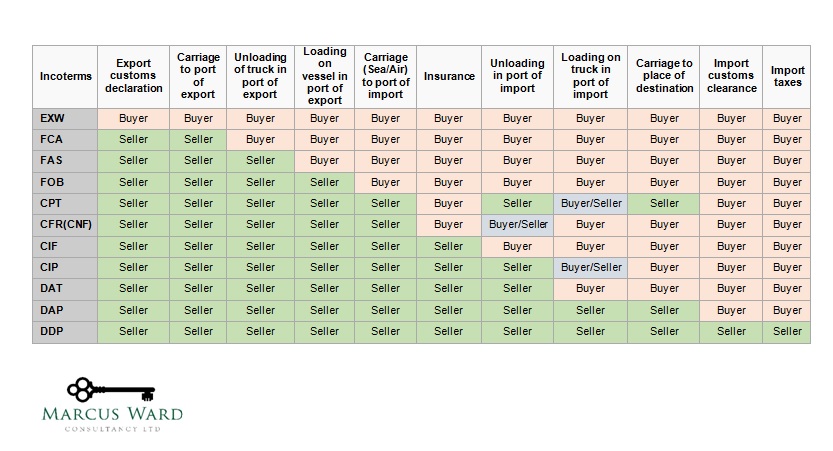
Allocations of costs to buyer/seller via incoterms

Once the Incoterm has been established, the VAT treatment is usually immediately apparent.

Summary Chart

Incoterms Chart

VAT & Customs Duty: Goodbye CHIEF, hello CDS

By   23 August 2022

Businesses who import into the UK currently use Customs Handling of Import and Export Freight (CHIEF) to declare goods.

There is also a separate scheme running concurrently, known as Customs Declaration Service (CDS).

From 1 October 2022 CHIEF will cease and importers must use CDS.

Exports

CHIEF is also currently used for exports and this will continue to a later date of: 31 March 2023.

Action

This change will significantly affect all businesses which import goods. Although it is likely that import agents will handle the majority of issues, an importer will be required to:

Failure to comply with these requirements will result in a business being unable to import goods.

VAT & Customs Duty – Valuation for import purposes

By   5 August 2022

Methods of calculating import value

There are six methods for calculating the value of imported goods to assess the amount of Customs Duty and import VAT a business to pay. The same value is also used for trade statistics.

All six methods are outlined below and should be tried in order. If Method 1 does not apply, try Method 2. If that does not apply, try 3 and so on. However, Method 5 can be tried before 4.

Method 1

The transaction value – the price payable to the seller. This is the most common valuation and is used in most cases.

Try Method 2 if there has been no sale of goods.

Method 2

The customs value of identical goods, produced in the same country as the imports.

Try Method 3 if there are no identical goods.

Method 3

The customs value of similar goods, which must be:

  • produced in the same country
  • able to carry out the same tasks and be
  • commercially interchangeable

Try Method 4 if there are no similar goods.

Method 4

The selling price of the goods (or identical or similar goods) in the UK.

Try Method 5 if there are no UK sales of the goods.

Method 5

The production cost of the goods, including the cost of any materials, manufacturing and any other processing used in production.

Try Method 6 if this production cost information is unavailable.

Method 6

Reasonably adapting one of the previous methods to fit unusual circumstances.

Legislation

In the UK valuation is covered by the Taxation (Cross-border Trade) Act 2018 & The Customs (Import Duty) (EU Exit) Regulations 2018 and The VAT Act 1994, Section 19.

What to include in the Method 1 calculation

If they are not already included in the seller’s price, the importer must add the costs of:

  • delivery to the EU border
  • most commissions (except buying commission)
  • royalties and licence fees paid by you on the imported goods as a condition of sale
  • containers and packing
  • any proceeds of resale the seller will receive
  • goods and services you provide to the seller for free or at a reduced cost – eg components incorporated in the imported goods, or development and design work carried out outside the EU and necessary for the production of the imports

If you import goods from a processor – ie a business that assembles or otherwise works on one or more sets of existing products to create your new imported products – transaction values can be built up by adding to the processing costs the value of any materials or components you provided to the processor.

What to exclude from your calculation

Items to be left out of the customs value if certain conditions are met include:

  • delivery costs within the EU
  • EU duties or taxes
  • taxes paid in the country of origin or export
  • quantity and trade discounts and those relating to cash and early settlement, that are valid at the time the goods are valued
  • dividend payments to the seller
  • marketing activities related to the imports
  • buying commission
  • export quota and licence costs
  • interest charges
  • rights of reproduction
  • post-importation work, eg construction or assembly
  • management fees

Further details here.

VAT: The Reverse Charge

By   24 June 2022

Normally, the supplier is the person who must account to the tax authorities for any VAT due on the supply. However, in certain situations, the position is reversed, and it is the customer who must account for any VAT due. Don’t get caught out!

Purchasing services from abroad

These will be obtained free of VAT from an overseas supplier. What is known as the ‘reverse charge’ (RC) procedure must be applied. Where the RC applies, the recipient of the services must act as both the supplier and the recipient of the services. On the same VAT return, the recipient must account for output tax, calculated on the full value of the supply received, and (subject to partial exemption and non-business rules) include the VAT charged as input tax.

The effect of these provisions is that the reverse charge has no net cost to the recipient if he can attribute the input tax to taxable supplies and can therefore reclaim it in full. If he cannot, the effect is to put him in the same position as if had received the supply from a UK supplier rather than from one outside the UK. Thus, creating a level playing field between purchasing from the UK and overseas.

Accounting for VAT and recovery of input tax.

Where the RC procedure applies, the recipient of the services must act as both the supplier and the recipient of the services.  On the same VAT return, the recipient must

  • account for output tax, calculated on the full value of the supply received, in Box 1
  • (subject to partial exemption and non-business rules) include the VAT stated in box 1 as input tax in Box 4
  • include the full value of the supply in both Boxes 6 and 7

Value of supply

The value of the deemed supply is to be taken to be the consideration in money for which the services were in fact supplied or, where the consideration did not consist or not wholly consist of money, such amount in money as is equivalent to that consideration.  The consideration payable to the overseas supplier for the services excludes UK VAT but includes any taxes levied abroad.

More on consideration here.

Time of supply

The time of supply of such services is the date the supplies are paid for or, if the consideration is not in money, the last day of the VAT period in which the services are performed.

Registration

If a business is not UK VAT registered, it must recognise the value of RCs in determining its turnover. That is; if its turnover is below the registration limit (currently £90,000 pa) but the value of its RCs supplies exceed this limit, it must register.

Supplies by UK businesses to overseas recipients

These supplies are also subject to a RC in the customer’s country, so no UK VAT is chargeable on them as the place of supply is not the UK (the supply is deemed to be supplied where received). 

Other RCs

The RC or similar procedures can also apply in the following situations:

Construction supplies

Import of goods (postponed accounting)

Deregistration

The Flat Rate Scheme (FRS)

Mobile telephones

Motor cars

Land and buildings

VAT: Electronic invoicing update

By   8 June 2022

HMRC has updated VAT Notice 700/63 – Electronic Invoicing in respect of “information required on a tax invoice” (para 3.2).

The Notice sets out what a business needs to do if it is sending, receiving and storing VAT invoices in an electronic format.

Electronic invoicing offers many advantages over traditional paper invoices. The rapid electronic transmission of documents in a secure environment may provide for:

  • structured data for auditing
  • improved traceability of orders
  • decreased reliance on paper reducing storage and handling costs
  • rapid access and retrieval
  • improved cash flow
  • security and easier dispute handling

A business does not need to inform, nor seek permission from, HMRC to use electronic invoicing.

We advise that any business periodically reviews its use of any invoicing system to ensure that:

  • invoices contain all of the required information
  • credit notes are properly issued and accounted for
  • the authenticity of the origin, integrity of invoice data, and legibility are all appropriate
  • its customers agree to receive invoices electronically
  • there is an interchange agreement between EDI (electronic data interchange) trading partners which makes provision for the use of procedures which guarantee the authenticity of the origin and integrity of the data
  • appropriate internal controls are in place
    • system controls, eg; a control which prevents a sales order being changed after the invoice has been issued
    • procedural controls, eg; a purchase order must be issued before an invoice is received
    • authorisation controls, eg; a user who has access to maintain supplier master data can not enter invoices from that supplier
  • the electronic invoice message format is acceptable. Examples include:
    • traditional EDI standards such as UN/EDIFACT, EANCOM and ODETTE
    • XML-based standards
    • comma-delimited ASCII, PDF (this list is not exhaustive)
  • the cross-border invoicing rules are adhered to
  • the conditions for electronic storage are met
  • HMRC can access required information
  • invoices meet all the other conditions in the above Notice

If a business cannot meet HMRC’s conditions for transmission and storage of electronic invoicing, it must issue paper invoices.

There are penalties for incorrect invoices or systems.

VAT Implications of Transfer Pricing – Valuation

By   21 April 2022

When can Transfer Pricing (TP) adjustments affect the application of VAT?

There is a continuing potential conflict between the way sales are valued. For TP purposes value is determined via arm’s length (open market value) versus the subjective value, ie; the price actually paid, for VAT purposes.

More detail on VAT valuation/consideration here.

Transfer Pricing

The arm’s length principle is the international transfer pricing standard that the Organisation for Economic Co-operation and Development (OECD) member countries have agreed, and which should be used for tax purposes by Multinational Enterprise Group (“MNE group”) and tax administrations, including the price, match comparable market conditions and that profits are fairly divided between the jurisdictions in which MNE operates.

According to the OECD TP Guidelines, by seeking to adjust profits by reference to the conditions which would have been obtained between independent enterprises for comparable transactions and under comparable circumstances, ie; in “comparable uncontrolled transactions” the arm’s length principle treats the members of an MNE group as entities operating separately rather than as inseparable parts of a single unified business. Because the separate entity approach treats the members of an MNE group as if they were independent entities, attention is focused on the nature of the transactions between those members and on whether the conditions thereof differ from those that would be obtained in comparable uncontrolled transactions.

VAT

It is not generally required for VAT purposes that the consideration which must be present in order for a transaction to be qualified as taxable, has to reflect the market value of the goods or services supplied. In fact, as to the concept of “consideration”, it is settled case law of the CJEU that the taxable amount for the supply of goods or services is represented by the consideration actually received for them.

It is an important area of tax and I recommend reading the EC Working Paper for any business or adviser involved in international supplies. It is also an interesting read for students of the tax technical side of such supplies.

We have a strong global structure of skilled advisers which are able to assist if you have any queries.

VAT: Place of belonging. The Berlin Chemie A Menarini case

By   13 April 2022

Latest from the courts

The place of belonging of a business or other person is an important tenet of the tax. I have considered this issue at length here and recent case law here.

A recent CJEU case involved a situation where a business had a registered office in one country and, potentially (hence the appeal) a fixed establishment in another.

Background

“Berlin” used a “third party” to receive certain services. Does this entry represent a fixed establishment for Berlin if it has a sufficient degree of permanence and a suitable structure in terms of technical and human resources? If yes, is it is necessary for those human and technical resources to belong to the company receiving the services or whether it is sufficient for that company to have immediate and permanent access to such resources through a related company, of which it is major shareholder?

Technical

The wording of Article 44 of the VAT Directive and Article 11(1) of Implementing Regulation No 282/2011 do not provide any details as to whether human and technical resources must belong to the company that receives the services.

Decision

The CEUJ ruled that, simple control or ownership, of another entity is insufficient to create a fixed establishment for VAT purposes. Consequently, a third party location does not inevitably represent a fixed establishment by dint of control/ownership.

Having made that comment, the court impressed that the decision should be made “in the context of the economic and commercial reality”.

The analysis of the place of belonging should recognise that it is not necessary for the fixed establishment to own the resources, but there should be control over these resources in the same way as an “owner”.  A fixed establishment is characterised by a suitable structure which enables a business to receive and use services supplied to them for their own needs and not by the decision power of a certain structure that businesses have put in place.

Commentary

Although an EU case, it could impact UK businesses who make supplies to EU recipients and particularly, if there is a “network” of offices or business locations in various EU Member States. Overseas suppliers to (potentially) UK business with various business premises and structures will need to recognise this ruling in order to establish the place of supply (and hence what country’s VAT and at what rate to apply).

This decision provides some helpful clarity, which may be summarised as: In principle, a subsidiary does not always create a fixed establishment.

VAT: Fulfilment House Due Diligence Scheme registered businesses list

By   16 February 2022

HMRC has issued updated guidance for businesses which need to check whether an entity which stores goods in the UK on its behalf is registered with the Fulfilment House Due Diligence Scheme (FHDDS).

The published list is alphabetical order by company name.

The list should be used if you are a business that is not established in the EU to see if the business that stores your goods in the UK is registered with the FHDDS.

If your business is outsourcing or considering outsourcing its fulfilment operations, then the fulfilment house you are using or intending to use of must be legally accredited by HMRC to do so.

Businesses that must be registered

Businesses are required to be registered if it stores any goods where all of the following apply:

  • the goods were imported from a country outside the EU
  • the goods are owned by, or stored on behalf of, someone established outside the EU
  • the goods are being offered for sale and have not been sold in the UK before

It is illegal to operate outside of the scheme and any fulfilment company found doing so will be prevented operating a fulfilment business and may be subject to a £10,000 penalty and a criminal conviction.