
Tag Archives: vat-mistakes

The penalty regime…the dark side of VAT

By   29 April 2026
VAT Penalties

I have made a lot of references to penalties in other articles over the years. So I thought it would be a good idea to have a closer look; what are they, when are they levied, rights of appeal, and importantly how much could they cost if a business gets it wrong?

Overview

Broadly, a penalty is levied if the incorrect amount of VAT is declared, either by understating output tax due, or overclaiming input tax, or accepting an assessment which is known to be too low.

Amount of penalty

HMRC detail three categories of inaccuracy. These are significant, as each has its own range of penalty percentages. If an error is found to fall within a lower band, then a lower penalty rate will apply. Where the taxpayer has taken ‘reasonable care,’ even though an error has been made, then no penalty will apply.

  • An error, when reasonable care not taken: 30%;
  • An error which is deliberate, but not concealed: 70%;
  • An error, which is deliberate and concealed: 100%.

Reasonable care

There is no definition of ‘reasonable care’. However, HMRC have said that they would not expect the same level of knowledge or expertise from a self-employed person, as from a large multi-national.

HMRC expect that, where an issue is unclear, advice is sought, and a record maintained of that advice. They also expect that, where an error is made, it is adjusted, and HMRC notified promptly. They have specifically stated that merely to adjust a return will not constitute a full disclosure of an error. Therefore, a penalty may still be applicable.

Notification
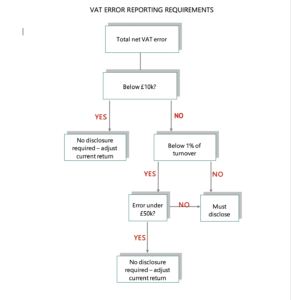
Further, where there is an ‘unprompted disclosure’ of the error, HMRC have power to reduce the penalty further. This measure is designed to encourage businesses to review their own VAT returns.

A disclosure is unprompted if it is made at a time when a person had no reason to believe that HMRC have discovered or are about to discover the inaccuracy. The disclosure will be treated as unprompted even if at the time it is made, the full extent of the error is not known, as long as fuller details are provided within a reasonable time.

What the penalty is based on

The amount of the penalty is calculated by applying the appropriate penalty rate (above) to the ‘Potential Lost Revenue’ or PLR. This is essentially the additional amount of VAT due or payable, as a result of the inaccuracy, or the failure to notify an under-assessment. Special rules apply where there are a number of errors, and they fall into different penalty bands.

Defending a penalty

The percentage penalty may be reduced by a range of ‘defences:’

– Telling; this includes admitting the document was inaccurate, or that there was an under-assessment, disclosing the inaccuracy in full, and explaining how and why the inaccuracies arose;

– Helping; this includes giving reasonable help in quantifying the inaccuracy, giving positive assistance rather than passive acceptance, actively engaging in work required to quantify the inaccuracy, and volunteering any relevant information;

– Giving Access; this includes providing documents, granting requests for information, allowing access to records and other documents.

HMRC have included a provision whereby a penalty can be suspended for up to two years. This will occur for a careless inaccuracy, not a deliberate inaccuracy. HMRC will consider suspension of a penalty where, given the imposition of certain conditions, the business will improve its accuracy. The aim is to improve future compliance and encourage businesses which genuinely seek to fulfil their obligations.

Appealing a penalty 

HMRC have an internal reconsideration procedure, where a business should apply to in the first instance. If the outcome is not satisfactory, the business can pursue an appeal to the First Tier Tribunal. A business can appeal on the grounds of; whether a penalty is applicable, the amount of the penalty, a decision not to suspend a penalty, and the conditions for suspension.

The normal time limit for penalties to four years. Additionally, where there is deliberate action to evade VAT, a 20 year limit applies. In particular, this applies to a loss of VAT which arises as a result of a deliberate inaccuracy in a document submitted by that person.

These are just the penalties for making “errors” on VAT returns. HMRC have plenty more for anything from late registration to issuing the wrong paperwork.

Even darker

There are even more severe penalties for deliberate acts, including significant terms of imprisonment. That is the subject of another article.

Assistance

My advice is always to check on all aspects of a penalty and seek assistance for grounds to challenge a decision to levy a penalty. We have a very high success rate in defending businesses against inappropriate penalties.  It is always worth running a penalty past us.

Common VAT mistakes

By   2 October 2025

VAT basics

None of us are perfect, and any business can make mistakes with VAT despite all intentions to take reasonable care. So what are the most common errors? Here’s a list of pitfalls to avoid:

Wrong rate of output tax charged

Land and property transactions

  • Misunderstanding the correct VAT treatment of a land and property transactions
  • Not recognising VAT issues
  • Issues with the Option To Tax
  • TOGC issues
  • A guide to triggerpoints here

Cross-border issues

  • Failing to meet the requirements to zero-rate exports
  • Incorrect import procedures
  • Ignoring the reverse charge

Inter-company charges

Partial exemption

Business entertainment

  • Different rules apply to the recovery of input tax on entertaining depending on the type of recipient, eg: clients, contacts, staff, partners and directors depending on the circumstances

Registration

VAT groups

  • Failing to VAT group when beneficial or failing to disband
  • Recovery of input tax
  • Timing of transactions
  • Partial exemption issues

Tax points (Time Of Supply)

  • Failing to recognise a tax point for output tax
  • Incorrect treatment of deposits
  • Incorrect treatment of forfeit deposits
  • Recovery of input tax at incorrect time

Bad Debt Relief issues

  • Failing to claim Bad Debt Relief
  • Failing to repay a claim to HMRC when payment from customer is received
  • Failing to repay input tax when a supplier is not paid (after six months)

Overseas issues

Claiming input tax without the correct documentation

  • A guide to alternative evidence here

Recovering irreclaimable input tax

  • A guide to what VAT is not claimable here

Return errors

  • A box-by-box guide here

Business promotion schemes

Composite or separate supplies

Changes to a business

  • Selling new products, acquisitions, share sales, disposals, re-structuring, and ceasing to trade can all have a VAT impact and this can be missed

Fuel and motoring costs

Special schemes

One-off transactions

  • Failing to recognise VAT issues of unusual or one-off transactions

Non-business (NB) and charitable activities

  • Failure to recognise NB activities
  • Failure to restrict input tax in connection with NB activities

Errors can lead to draconian penalties, and ignorance is not a defence.

A guide to VAT triggerpoints here .

Oops! Top Ten VAT howlers

By   8 May 2014

I am often asked what the most frequent VAT errors made by a business are. I usually reply along the lines of “a general poor understanding of VAT, considering the tax too late or just plain missing a VAT issue”.

While this is unquestionably true, a little further thought results in this top ten list of VAT horrors:

1 Not considering that HMRC may be wrong. There is a general assumption that HMRC know what they are doing. While this is true in most cases, the complexity and fast moving nature of the tax can often catch an inspector out. Added to this is the fact that in most cases inspectors refer to HMRC guidance (which is HMRC’s interpretation of the law) rather to the legislation itself. Reference to the legislation isn’t always straightforward either, as often EC rather than UK domestic legislation is cited to support an analysis. The moral to the story is that tax is complicated for the regulator as well, and no business should feel fearful or reticent about challenging a HMRC decision.

2 Missing a VAT issue altogether. A lot of errors are as a result of VAT not being considered at all. This is usually in relation to unusual or one-off transactions (particularly land and property or sales of businesses). Not recognising a VAT “triggerpoint” can result in an unexpected VAT bill, penalties and interest, plus a possible reduction of income of 20% or an added 20% in costs. Of course, one of the basic howlers is not registering at the correct time. Beware the late registration penalty, plus even more stringent penalties if HMRC consider that not registering has been done deliberately.

3 Not considering alternative structures. If VAT is looked at early enough, there is very often ways to avoid VAT representing a cost. Even if this is not possible, there may be ways of mitigating a VAT hit.

4 Assuming that all transactions with overseas customers are VAT free. There is no “one size fits all” treatment for cross border transactions. There are different rules for goods and services and a vast array of different rules for different services. The increase in trading via the internet has only added to the complexity in this area, and with new technology only likely to increase the rate of new types of supply it is crucial to consider the implications of tax; in the UK and elsewhere.

5 Leaving VAT planning to the last minute. VAT is time sensitive and it is not usually possible to plan retrospectively. Once an event has occurred it is normally too late to amend any transactions or structures. VAT shouldn’t wag the commercial dog, but failure to deal with it at the right time may be either a deal-breaker or a costly mistake.

6 Getting the option to tax wrong. Opting to tax is one area of VAT where a taxpayer has a choice. This affords the possibility of making the wrong choice, for whatever reasons. Not opting to tax when beneficial, or opting when it is detrimental can hugely impact on the profitability of a project. Not many businesses can carry the cost of, say, not being able to recover VAT on the purchase of a property, or not being able to recover input tax on a big refurbishment. Additionally, seeing expected income being reduced by 20% will usually wipe out any profit in a transaction.

Not realising a business is partly exempt. For a business, exemption is a VAT cost, not a relief. Apart from the complexity of partial exemption, a partly exempt business will not be permitted to reclaim all of the input tax it incurs and this represents an actual cost. In fact, a business which only makes exempt supplies will not be able to VAT register, so all input tax will be lost. There is a lot of planning that may be employed for partly exempt businesses and not taking advantage of this often creates additional VAT costs.

8 Relying on the partial exemption standard method to the business’ disadvantage. A partly exempt business has the opportunity to consider many methods to calculate irrecoverable input tax. The default method, the “standard method” often provides an unfair and costly result. I recommend that any partly exempt business obtains a review of its activities from a specialist. I have been able to save significant amounts for clients simply by agreeing an alternative partial exemption method with HMRC.

Not taking advantage of the available reliefs. There are a range of reliefs available, if one knows where to look. From Bad Debt Relief, Zero Rating (VAT nirvana!) and certain de minimis limits to charity reliefs and the Flat Rate Scheme, there are a number of easements and simplifications which could save a business money and reduce administrative and time costs.

10 Forgetting the impact of the Capital Goods Scheme. The range of costs covered by this scheme has been expanded recently. Broadly, VAT incurred on certain expenditure is required to be adjusted over a five or ten year period. Failure to recognise this could either result in assessments and penalties, or a position whereby input tax has been under-claimed.

So, you may ask: “How do I make sure that I avoid these VAT pitfalls?” – And you would be right to ask.

Of course, I would recommend that you engage a VAT specialist to help reduce the exposure to VAT costs!