Children’s clothing made from the skin of goats is zero rated, but only if not made from Yemen, Mongolian or Tibetan goats.

Children’s clothing made from the skin of goats is zero rated, but only if not made from Yemen, Mongolian or Tibetan goats.
Further to my article on the Domestic Reverse Charge (DRC) for builders being deferred, HMRC has announced a further delay from 1 October 2020 until 1 March 2021 due to the impact of the coronavirus on the construction sector.
Revenue and Customs Brief 7 (2020 sets out the details.
Changes
HMRC announced that there will be an amendment to the original legislation, which was laid in April 2019, to make it a requirement that for businesses to be excluded from the reverse charge because they are end users or intermediary suppliers, they must inform their sub-contractors in writing that they are end users or intermediary suppliers. Details of the DRC here and here.
HMRC has updated the following online toolkits for June 2020:
Output tax and
The Toolkits
These toolkits can be a useful resource. Although designed for agents and advisers, they can equally be of assistance to businesses when completing VAT returns. The contents are based on HMRC’s view of how tax law should be applied, so they should not be used as a substitute for proper professional advice. These toolkits set out areas of risk, provide general checklists, details of record keeping and links to HMRC information. Many find that these toolkits are more user friendly than “traditional” HMRC guidance and they address many contentious areas.
Overview
For a helpful general guide to input tax and checklist please see here. And an introduction to partial exemption here.
Latest from the courts
In the recent First Tier Tribunal (FTT) case of Aitmatov Academy an otherwise unremarkable case illustrates the care required when making input tax claims.
The quantum of the claim was low and the technical issues not particularly complex, however, it underlined some basic rules for making a VAT claim.
Background
A doctor organised a cultural event at the House of Lords for which no charge was made to attendees. The event organiser as shown on the event form was the doctor. Aitmatov Academy was shown as an organisation associated with the event. It was agreed that the attendees were not potential customers of Aitmatov Academy and that the overall purpose of the event was cultural and not advertising.
Issues
HMRC disallowed the claim. The issues were:
Decision
The FTT found that the Academy incurred the cost and consequently must have concluded that the Academy was the recipient of the supply, not the doctor.
However, the judge decided that the awards ceremony was not directly or indirectly linked to taxable supplies made or intended to be made by the Academy, and therefore that the referable input tax should not be allowed. Consequently, the court did not need to consider whether the event qualified as business entertainment.
On a separate point, the appellant contended that, as a similar claim had been paid by HMRC previously, she could not see the difference that caused input VAT in this case to be disallowed. The Tribunal explained that its role is to apply the law in this specific instance and as such it cannot look at what happened in an early case which is not the subject of an appeal.
Commentary
A helpful reminder of some of the tests that need to be passed in order for an input tax claim to be valid. I have written about some common issues with claims and provided a checklist. Broadly, in addition to the tests in this case, a business needs to consider:
I have also looked at which input tax is specifically barred.
Finally, “entertainment” is a topic all of its own. I have considered what is claimable here in article which includes a useful flowchart.
As always, the message is; if a business is to avoid penalties and interest, if there is any doubt over the validity of a claim, seek advice!
VAT Penalties
I have made a lot of references to penalties in other articles over the years. So I thought it would be a good idea to have a closer look; what are they, when are they levied, rights of appeal, and importantly how much could they cost if a business gets it wrong?
Overview
Broadly, a penalty is levied if the incorrect amount of VAT is declared, either by understating output tax due, or overclaiming input tax, or accepting an assessment which is known to be too low.
Amount of penalty
HMRC detail three categories of inaccuracy. These are significant, as each has its own range of penalty percentages. If an error is found to fall within a lower band, then a lower penalty rate will apply. Where the taxpayer has taken ‘reasonable care,’ even though an error has been made, then no penalty will apply.
Reasonable care
There is no definition of ‘reasonable care’. However, HMRC have said that they would not expect the same level of knowledge or expertise from a self-employed person, as from a large multi-national.
HMRC expect that, where an issue is unclear, advice is sought, and a record maintained of that advice. They also expect that, where an error is made, it is adjusted, and HMRC notified promptly. They have specifically stated that merely to adjust a return will not constitute a full disclosure of an error. Therefore, a penalty may still be applicable.
Notification
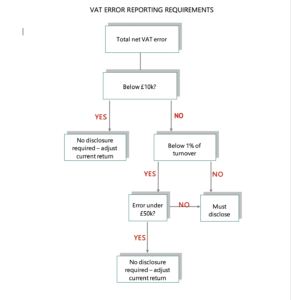
What the penalty is based on
The amount of the penalty is calculated by applying the appropriate penalty rate (above) to the ‘Potential Lost Revenue’ or PLR. This is essentially the additional amount of VAT due or payable, as a result of the inaccuracy, or the failure to notify an under-assessment. Special rules apply where there are a number of errors, and they fall into different penalty bands.
Defending a penalty
The percentage penalty may be reduced by a range of ‘defences:’
– Telling; this includes admitting the document was inaccurate, or that there was an under-assessment, disclosing the inaccuracy in full, and explaining how and why the inaccuracies arose;
– Helping; this includes giving reasonable help in quantifying the inaccuracy, giving positive assistance rather than passive acceptance, actively engaging in work required to quantify the inaccuracy, and volunteering any relevant information;
– Giving Access; this includes providing documents, granting requests for information, allowing access to records and other documents.
Further, where there is an ‘unprompted disclosure’ of the error, HMRC have power to reduce the penalty further. This measure is designed to encourage businesses to review their own VAT returns.
A disclosure is unprompted if it is made at a time when a person had no reason to believe that HMRC have discovered or are about to discover the inaccuracy. The disclosure will be treated as unprompted even if at the time it is made, the full extent of the error is not known, as long as fuller details are provided within a reasonable time.
HMRC have included a provision whereby a penalty can be suspended for up to two years. This will occur for a careless inaccuracy, not a deliberate inaccuracy. HMRC will consider suspension of a penalty where, given the imposition of certain conditions, the business will improve its accuracy. The aim is to improve future compliance and encourage businesses which genuinely seek to fulfil their obligations.
Appealing a penalty
HMRC have an internal reconsideration procedure, where a business should apply to in the first instance. If the outcome is not satisfactory, the business can pursue an appeal to the First Tier Tribunal. A business can appeal on the grounds of; whether a penalty is applicable, the amount of the penalty, a decision not to suspend a penalty, and the conditions for suspension.
The normal time limit for penalties to four years. Additionally, where there is deliberate action to evade VAT, a 20 year limit applies. In particular, this applies to a loss of VAT which arises as a result of a deliberate inaccuracy in a document submitted by that person.
These are just the penalties for making “errors” on VAT returns. HMRC have plenty more for anything from late registration to issuing the wrong paperwork.
Even darker
There are even more severe penalties for deliberate acts, including significant terms of imprisonment. That is the subject of another article.
Assistance
My advice is always to check on all aspects of a penalty and seek assistance for grounds to challenge a decision to levy a penalty. We have a very high success rate in defending businesses against inappropriate penalties. It is always worth running a penalty past us.
COVID-19 Update
HMRC has published concessions in VEXP30310 relating to the conditions for the zero rating of exports.
Background
Most exports of goods from the UK are subject to zero rating. However, in order for VAT free treatment to apply, certain conditions must be met, otherwise 20% VAT applies to the sale. One of the conditions is that the goods must be exported within specified time limits.
Time limits
Generally, goods can be zero rated provided that:
COVID-19
During the pandemic, it may not be possible for businesses to export goods within the prescribed time. HMRC recognises that some intended exports have been delayed due to circumstances outside a business’ control. Therefore, the guidance sets out the circumstances in which HMRC may agree to additional time for the export before any tax is collected.
Additional time
The time limits for the export of goods from the UK are set out in legislation. However, HMRC has discretion to permit non-observance of the conditions and time limits for export of goods – VAT Act 1994, Section 30(10). HMRC has said that it will use its discretion to temporarily waive the prescribed time limits for export on a case by case basis. The goods must, however, have either already been exported or will be as soon as is reasonably practicable after the date a business is notified that HMRC is temporarily waiving the tax. An application for HMRC to waive the time limits must be made in writing.
Conditions
HMRC will permit a temporary waiver of time limits if the following conditions are met:
Examples include:
This list is not exhaustive.
2. the goods have been/will be exported or removed at the earliest opportunity
3. all other conditions for zero rating exports or removals are met – exporters’ responsibilities here
Expiry
Any waiver will expire
whichever is the earlier.
If a business considers there are extenuating circumstances that mean additional time is needed to export goods beyond that permitted by the extension, it should contact HMRC setting out the details in full.
Evidence
A business must retain evidence that supports its case for the waiver (eg; cancellation notes demonstrating that the transport intended to use to take goods out of the UK did not take place, or screen shots of government rules preventing the export or removal of the goods).
Please contact us if you require any further advice or assistance.
We cannot control the future…
The Sonaecom case
In the opinion* of the CJEU AG (C-42/19) the importance of a taxpayer’s intention was of utmost importance, regardless of whether that intention was achieved.
Background
Sonaecom intended to acquire a telecoms provider company. As is usual in such cases, input tax was incurred on consultancy received, from, amongst others; accountants and legal service providers. The intention post acquisition was for Sonaecom to make certain charges to the acquired co. These would have been taxable supplies.
Unfortunately, the intended purchase was aborted.
The issue
The issue before the AG was; as no taxable supplies took place as the deal fell through – to what should the input tax incurred on advice be attributed?
Opinion
In the AG’s view the fact that the acquisition was aborted was no reason for the claim for input tax to denied. This was based on the fact that:
Commentary
There are often issues in relation to intentions of a taxpayer. It is clear, and was emphasised in this case, that intention is all important. Of course, intentions can change over a period of time and commercial and political events may thwart or cause intentions to be re-evaluated. There is often an issue about evidencing an intention. HMRC usually require comprehensive documentary evidence to demonstrate an objective. Such evidence is sometime not available for various reasons. Consequently, it is prudent for businesses to record (board meeting minutes etc at the very least) the commercial reasons for taking a certain course of action. This issue quite often arises in transactions in land and property – which can create additional technical issues.
There is legislation in place to cover situations when intentions, or actual events change and which affect the original input tax position: The Capital Goods Scheme (CGS) and The Value Added Tax Regulations 1995, Regs 108 and 109.
Other areas of VAT which often to raise issues are management charges and holding companies. HMRC apparently continue to be eager to attack taxpayers in these areas and I have looked at the role of holding companies and the VAT treatment here, here and here.
I think it is useful to bear in mind a question which, in itself does not evidence an intention, but provides commercial coherence – Why were the costs incurred if there was no intention to make the acquisition? This does leave aside the future management charges position but goes some way to provide business logic.
It will be interesting to see how this case proceeds, but I would find it very surprising if the court diverges from this AG opinion.
* AG’s Opinion
The Court of Justice of the European Union (CJEU) consists of one judge from each Member State, assisted by eleven Advocates General whose role is to consider the written and oral submissions to the court in every case that raises a new point of law, and deliver an impartial opinion to the court on the legal solution.
HMRC has published an updated version of VAT Notice 700/57: Administrative agreements with trade bodies.
This is an unusual publication as it lists situations where there are, or can be, deviations from “normal” VAT rules.
The agreements in the Notice permit members of trade bodies to use procedures which take into account their individual circumstances so they may meet their obligations under VAT law. The agreements apply only to areas where HMRC can exercise discretion, and HMRC say that they convey no direct financial advantage or relief from the legal requirements of the tax. However, there can be benefits a business can derive from the arrangements, including, but not limited to; simplification, cashflow, compliance and management.
The agreements can provide unique solutions to particular problems and reduce the burdens on businesses. Some of them might usefully be applied by other businesses, but it should be born in mind that a business cannot adopt any special method based on these agreements unless HMRC has given approval in advance.
The trade bodies covered in the Notice are:
London Bullion Market Association
Brewers’ Society
Association of British Factors and Discounters
Finance Houses Association Ltd
Association of British Insurers
Association of Investment Trust Companies
British Printing Industries Federation
Marine, Aviation and Transport Insurance Underwriters
Association of British Insurers, Lloyd’s of London, the Institute of London Underwriters and British Insurance and Investment Association
National Caravan Council Limited and the British Holiday and Home Park Association Limited
Association of Unit Trust and Investment Managers
British Bankers’ Association
British Vehicle Rental and Leasing Association
Society of Motor Manufacturers and Traders
Gaming Board for Great Britain and the British Casino Association
British Phonographic Industry
Thoroughbred Breeders Association and the British Horseracing Board
Meat and Livestock Commission
Society of Motor Manufacturers and Traders Limited
Retail Motor Industry Federation
if you or your clients are involved in business covered by, or similar to, the above entities, it maybe worthwhile considering whether any specialised trade agreements may be of benefit.
Further to the history of objection to reduce rating e-publications, and the 2020 budget announcement which stated that e-publications will be zero rated from 1 December 2020, the Chancellor of the Exchequer has today announced that this date is brought forward and zero rating will now apply from 1 May 2020 – which is of course tomorrow.
Further details of the measure here.
Zero rating
This brings electronically supplied sales in line with traditional printed matter. The zero rate will apply to:
What supplied electronically means
The term ‘supplied electronically’ is not defined in legislation. It falls to be interpreted in accordance with its generally accepted meaning and includes supplies made over the internet and by e-mail.
Excluded items
Items that are not entitled to the VAT zero rate:
If more than half of an e-publication is devoted to advertising, audio or video content, its supply will remain standard rated for VAT purposes.
The zero rating extension only applies to the supply of electronic versions of books already zero rated in UK law. As such, zero-rating is limited to electronic versions of books that can be read or looked at. Supplies of audiobooks remain taxable at the standard rate whether supplied in a physical or digital format.
e-book readers are one form of hardware to which e-books can be downloaded before being read but are not in themselves e-books. Therefore, supplies of e-book readers are standard rated
Software, eg: an app is used to access e-publications but is not in itself an e-publication. Therefore, supplies of such software are standard rated.
Lending of electronic publications
The lending of any of the zero rated e-publications for a charge (for example, by a library) is zero rated.
Summary
Although welcome, as zero rating is VAT nirvana, the short lead in time could catch out some business which make such online supplies. Businesses which provide e-publications may want to consider making a retrospective claim as a result of the News Corp case.