Tag Archives: vat-import

Who can claim import VAT? The TSI Instruments case

By   5 November 2025

Latest from the courts

In the First-tier Tribunal (FTT) case of TSI Instruments Limited the issue was whether the appellant could claim import VAT when it was not the owner of the imported goods. The amount of VAT at stake was circa £8.5 million.

Background

TSI Instruments (TSI) imported scientific equipment owned by its customers for repair. The main activity of TSI in the UK is the service, repair and calibration of TSI Group goods which had previously been sold to customers around the world.

TSI is named as the importer and paid the charges made by the shipping company for dealing with the declaration and customs clearance formalities on behalf of TSI as well as paying the import VAT which it claimed.

Contentions

HMRC refused to repay the claims on the basis that only the entity with title to the goods is able to deduct the import VAT.

The appellant argued there is no requirement in the legislation that the importer should be the owner of the goods in order for import VAT to be credited. TSI asserted that, as long as the goods are imported for the purposes of its taxable business and it bears the costs of the import, the import VAT can be credited as input tax.

Decision

The FTT ruled that TSI was not entitled to claim input VAT credit for import VAT paid on goods it did not own, and the appeal was dismissed. Via both EU and UK VAT law, the right to deduct import VAT is restricted to the actual owner of the goods or the entity which has the right to dispose of the goods as their owner (or where the cost or value of the goods is reflected in the price of specific output transactions or in the price of goods and services supplied in the course of their economic activities). Since TSI did not own the goods, and their value was not included in the repair service price, the FTT ruled against TSI.

Commentary

This position could have been avoided by planning being put in place. TSI could have used Inward Processing Relief or the owner of the goods could have been the importer.

Legislation/HMRC guidance

VIT13300 – Import VAT may only be claimed by the owner of the goods who would be entitled to reclaim the import VAT either in accordance with s24 VATA 1994 (if registered for VAT in the UK) or under part XXI of the VAT Regulations 1995 (SI 1995/2518) if they are not registered for VAT in the UK, provided they satisfy the legislative conditions. For further information see Notice 723A.

HMRC published Revenue and Customs Briefs 2 (2019) and Brief 15 (2020) which restated HMRC’s long-standing policy that it is the owner of the imported goods who is entitled to recover the import VAT under current UK legislation. These Briefs clarify, but do not change, HMRC’s policy.

A VAT Did you know?

By   22 September 2025

Wigs for teddy bears are subject to Customs Duty, but the Upper Tribunal ruled that ‘realistic” hearts used for a Build-A-Bear toy are duty free. 

VAT & Import Duty

By   26 August 2025

HMRC has updated its Guidance on How to claim a repayment of import duty and VAT if you have overpaid

It sets out how to check time limits and how to claim for importers, agents, freight forwarders or express operators. It also explains how to use the Customs Declaration Service or form C285 as an individual.

It covers:

  • who can apply
  • when to apply
  • how to apply
  • what you need — Customs Declaration Service
  • apply online — Customs Declaration Service
  • what you will need — C285 form
  • apply online — C285 form
  • what happens after the application

How to pay duties and VAT on imports – updated guidance

By   22 July 2024

HMRC has updated its guidance on how to pay Customs Duty, Excise Duties and VAT on imports from outside the UK.

The document covers, inter alia:

The update includes the removal of references to the Customs Handling of Import and Export Freight (CHIEF) system, as all import declarations must now be made through the Customs Declaration Service.

VAT – A Christmas Tale

By   6 December 2022

Well, it is nearly Christmas…. and at Christmas tradition dictates that you repeat the same nonsense every year….

Dear Marcus

My business, if that is what it is, has become large enough for me to fear that HMRC might take an interest in my activities.  May I explain what I do and then you can write to me with your advice?  If you think a face to face meeting would be better, I can be found in most decent sized department stores from mid-September to 24 December.

First of all, I am based in Greenland, but I do bring a stock of goods, mainly toys, to the UK and I distribute them. Where do I belong? Am I making supplies in the UK? Do I pay Customs Duty?

If I do this for philanthropic reasons, am I a charity, and if so, does that mean I do not pay VAT?

I have heard that giving vouchers can be complicated, I think I will need help with these gifts.

The toys are of course mainly for children and I wonder if zero rating might apply?  I have heard that small T shirts are zero rated so what about a train set – it is small and intended for children. Does it matter if adults play with it? My friend Rudolph has told me that there is a peculiar rule about gifts.  He says that if I give them away regularly or they cost more than £50 I might have to account for output tax. Is that right?

My next question concerns barter transactions.  Fathers often leave me a food item such as a mince pie and a drink and there is an unwritten rule that I should then leave something in return.  If I’m given Sainsbury’s own brand sherry, I will leave polyester underpants but if I’m left a glass of Glenfiddich I will be more generous and leave best woollen socks.  Have I made a supply and what is the value please?  My feeling is that the food items are not solicited so VAT might not be due and, in any event; isn’t food zero-rated, or does it count as catering? Oh, and what if the food is hot?

Transport is a big worry for me.  Lots of children ask me for a ride on my airborne transport.  I suppose I could manage to fit twelve passengers in.  Does that mean my services are zero-rated?  If I do this free of charge will I need to charge Air Passenger Duty?  Does it matter if I stay within the UK, or the EU or the rest of the world? What if I travel to every country?  My transport is the equivalent of six horsepower and if I refuel with fodder in the UK will I be liable for fuel scale charges?  After dropping the passengers off I suppose I will be accused of using fuel for the private journey back home – is this non-business? Somebody has told me that if I buy hay labelled as animal food I can avoid VAT but if I buy the much cheaper bedding hay I will need to pay tax. Please comment.

May I also ask about VAT registration?  I know the limit is £85,000 per annum but do blips count?  If I do make supplies at all, I do nothing for 364 days and then, in one day (well, night really) I blast through the limit and then drop back to nil turnover. May I be excused from registration?  If I do need to register should I use AnNOEL Accounting?  At least I can get only one penalty per annum if I get the sums wrong.

I would like to make a claim for input tax on clothing.  I feel that my red clothing not only protects me from the extreme cold, but it is akin to a uniform and should be allowable. These are not clothes that I would choose to wear except for my fairly unusual job. If lady barristers can claim for black skirts, I think I should be able to claim for red dress. And what about my annual haircut?  That costs a fortune.  I only let my hair grow that long because it is expected of me.

Insurance worries me too.  You know that I carry some very expensive goods on my transport.  Play Stations, mountain bikes, i-Pads and Accrington Stanley replica shirts for example.  My parent company in Greenland takes out insurance there and they make a charge to me.  If I am required to register for VAT in England will I need to apply the Reverse Charge?  This seems to be a daft idea if I understand it correctly.  Does it mean I have to charge myself VAT on something that is not VATable and then claim it back again?

And what about Brexit? I know the UK has already left the EU, but does this affect me? What about distance selling? How do I account for supplies to and from the EU? Will there be Tariffs? Do I have to queue at Dover?

Next, you’ll be telling me that Father Christmas isn’t real……….

HAPPY CHRISTMAS EVERYBODY!

VAT: New process to support repayment claims

By   14 November 2022

HMRC has announced a useful new tool for speeding up repayment payments.

When a business submits a repayment return (when input tax exceeds output tax) HMRC may carry out a “pre-cred” (pre-credibility check) inspection or queries. This is to ensure that a claim is valid before money is released.

If not subject to a visit, a business is likely to be asked for information to support a claim. Such requests are more common if a business normally submits payment returns or it is a first return. The requested information is usually in the form of copy purchase invoices or import documentation.

Prior to the changes, HMRC sent a letter by snail mail and the information would also be returned by post. This was often subject to delays and “misunderstandings”.

From this month, HMRC has launched an online form so that a claimant, or an agent, can upload documents to support the claim via the Government Gateway. It is hoped that this will result in businesses receiving a repayment in shorter order.

HMRC require:

  • the VAT registration number
  • the CFSS reference number from the HMRC letter
  • details of the main business activities
  • the date the business began
  • the VAT rates that apply to sales
  • details of any VAT schemes
  • the detailed VAT account
  • the five highest value purchase invoices, and
  • any additional specific information requested by HMRC

Depending on circumstances, HMRC may also need:

  • bank statements
  • export sales invoices or supporting documents
  • import VAT documents
  • hire purchase or lease agreements
  • completion statements and proof of transfer of funds for the purchase of land or property
  • the planning reference and postcode of construction
  • sales invoices where non-standard VAT rates were charged

HMRC aim to look at this information within seven working days and will contact the claimant or agent when a decision is made, or if any further information is required.

Let us hope that speeds up the process.

Incoterms: What are they, and how can they be of use for VAT?

By   12 September 2022

VAT – Cross border sales of goods

Incoterms stands for International Commercial Terms.

These are published by the International Chamber of Commerce (ICC) and describe agreed commercial terms. These rules set out the responsibilities of buyers and sellers for the supply of goods under a contract. They are very commonly used in cross-border commercial transactions in order that both sides in a transaction are aware of the contractual position. They help businesses avoid costly misunderstandings by clarifying the tasks, costs and risks involved in the delivery of goods from sellers to buyers. The latest terms were published in 2010 and came into effect in 2011.

The use of Incoterms for assistance for VAT purposes

One of the most difficult areas of providing VAT advice is obtaining sufficient detailed information to advise accurately and comprehensively.  Quite often advisers are given what a client believes to be the arrangements for a transaction. This may differ from the actual facts, or the understanding of the other party in the transaction.

Pragmatically, this uncertainty about the details may be increased if; a number of different people within an organisation are involved, it is a new or one-off type of transaction, there are language difficulties, or communication and documentation is less than ideal. In such cases, incoterms will provide invaluable information which gives clarity and certainty and usually give a sound basis on which to advise. This enables the adviser to establish the place of supply (POS) and therefore what VAT treatment needs to be applied.

So what is this set of pre-defined international contract terms?

They are 11 pre-defined terms which are subdivided into two categories:

Group 1 – Incoterms that apply to any mode of transport are:

EXW – Ex Works (named place)

The seller makes the goods available at their premises. This term places the maximum obligation on the buyer and minimum obligations on the seller. EXW means that a buyer incurs the risks for bringing the goods to their final destination. The buyer arranges the pickup of the freight from the supplier’s designated ship site, owns the in-transit freight, and is responsible for clearing the goods through Customs. The buyer is also responsible for completing all the export documentation.

Most jurisdictions require companies to provide proof of export for VAT purposes. In an EXW shipment, the buyer is under no obligation to provide such proof, or indeed to even export the goods. It is therefore of utmost importance that these matters are discussed with the buyer before the contract is agreed.

FCA – Free Carrier (named place of delivery)

The seller delivers the goods, cleared for export, at a named place. This can be to a carrier nominated by the buyer, or to another party nominated by the buyer.

It should be noted that the chosen place of delivery has an impact on the obligations of loading and unloading the goods at that place. If delivery occurs at the seller’s premises, the seller is responsible for loading the goods on to the buyer’s carrier. However, if delivery occurs at any other place, the seller is deemed to have delivered the goods once their transport has arrived at the named place; the buyer is responsible for both unloading the goods and loading them onto their own carrier.

CPT – Carriage Paid To (named place of destination)

The seller pays for the carriage of the goods up to the named place of destination. Risk transfers to buyer upon handing goods over to the first carrier at the place of shipment in the country of Export. The Shipper is responsible for origin costs including export clearance and freight costs for carriage to named place (usually a destination port or airport). The shipper is not responsible for delivery to the final destination (generally the buyer’s facilities), or for buying insurance. If the buyer does require the seller to obtain insurance, the Incoterm CIP should be considered.

CIP – Carriage and Insurance Paid to (named place of destination)

This term is broadly similar to the above CPT term, with the exception that the seller is required to obtain insurance for the goods while in transit. CIP requires the seller to insure the goods for 110% of their value.

DAT – Delivered At Terminal (named terminal at port or place of destination)

This term means that the seller covers all the costs of transport (export fees, carriage, unloading from main carrier at destination port and destination port charges) and assumes all risk until destination port or terminal. The terminal can be a Port, Airport, or inland freight interchange. Import duty/VAT/customs costs are to be borne by the buyer.

DAP – Delivered At Place (named place of destination)

The seller is responsible for arranging carriage and for delivering the goods, ready for unloading from the arriving conveyance, at the named place. Duties are not paid by the seller under this term. The seller bears all risks involved in bringing the goods to the named place.

DDP – Delivered Duty Paid (named place of destination)

The seller is responsible for delivering the goods to the named place in the country of the buyer, and pays all costs in bringing the goods to the destination including import duties and VAT. The seller is not responsible for unloading. This term places the maximum obligations on the seller and minimum obligations on the buyer. With the delivery at the named place of destination all the risks and responsibilities are transferred to the buyer and it is considered that the seller has completed his obligations.

Group 2 – Incoterms that apply to sea and inland waterway transport only:

FAS – Free Alongside Ship (named port of shipment)

The seller delivers when the goods are placed alongside the buyer’s vessel at the named port of shipment. This means that the buyer has to bear all costs and risks of loss of or damage to the goods from that moment. The FAS term requires the seller to clear the goods for export. However, if the parties wish the buyer to clear the goods for export, this should be made clear by adding explicit wording to this effect in the contract of sale. This term can be used only for sea or inland waterway transport.

FOB – Free On Board (named port of shipment)

FOB means that the seller pays for delivery of goods to the vessel including loading. The seller must also arrange for export clearance. The buyer pays cost of marine freight transport, insurance, unloading and transport cost from the arrival port to destination. The buyer arranges for the vessel, and the shipper must load the goods onto the named vessel at the named port of shipment. Risk passes from the seller to the buyer when the goods are loaded aboard the vessel.

CFR – Cost and Freight (named port of destination)

The seller pays for the carriage of the goods up to the named port of destination. Risk transfers to buyer when the goods have been loaded on board the ship in the country of export. The shipper is responsible for origin costs including export clearance and freight costs for carriage to named port. The shipper is not responsible for delivery to the final destination from the port (generally the buyer’s facilities), or for buying insurance. CFR should only be used for non-containerised sea freight, for all other modes of transport it should be replaced with CPT.

CIF – Cost, Insurance and Freight (named port of destination)

This term is broadly similar to the above CFR term, with the exception that the seller is required to obtain insurance for the goods while in transit to the named port of destination. CIF requires the seller to insure the goods for 110% of their. CIF should only be used for non-containerised sea freight; for all other modes of transport it should be replaced with CIP.

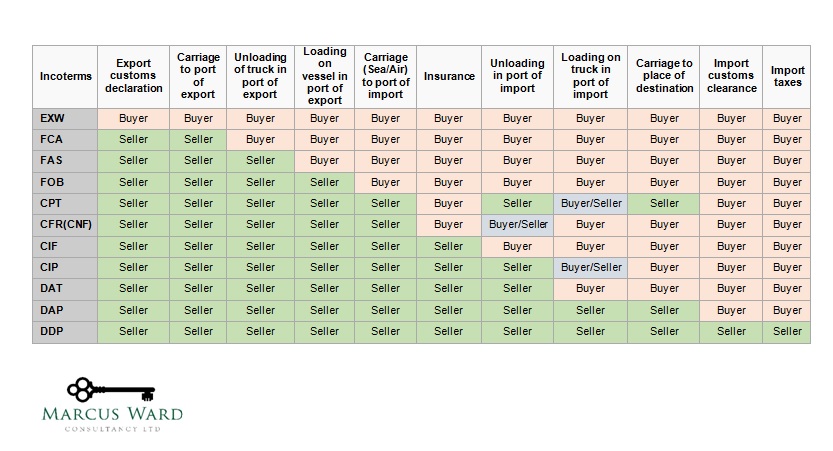
Allocations of costs to buyer/seller via incoterms

Once the Incoterm has been established, the VAT treatment is usually immediately apparent.

Summary Chart

Incoterms Chart

VAT Implications of Transfer Pricing – Valuation

By   21 April 2022

When can Transfer Pricing (TP) adjustments affect the application of VAT?

There is a continuing potential conflict between the way sales are valued. For TP purposes value is determined via arm’s length (open market value) versus the subjective value, ie; the price actually paid, for VAT purposes.

More detail on VAT valuation/consideration here.

Transfer Pricing

The arm’s length principle is the international transfer pricing standard that the Organisation for Economic Co-operation and Development (OECD) member countries have agreed, and which should be used for tax purposes by Multinational Enterprise Group (“MNE group”) and tax administrations, including the price, match comparable market conditions and that profits are fairly divided between the jurisdictions in which MNE operates.

According to the OECD TP Guidelines, by seeking to adjust profits by reference to the conditions which would have been obtained between independent enterprises for comparable transactions and under comparable circumstances, ie; in “comparable uncontrolled transactions” the arm’s length principle treats the members of an MNE group as entities operating separately rather than as inseparable parts of a single unified business. Because the separate entity approach treats the members of an MNE group as if they were independent entities, attention is focused on the nature of the transactions between those members and on whether the conditions thereof differ from those that would be obtained in comparable uncontrolled transactions.

VAT

It is not generally required for VAT purposes that the consideration which must be present in order for a transaction to be qualified as taxable, has to reflect the market value of the goods or services supplied. In fact, as to the concept of “consideration”, it is settled case law of the CJEU that the taxable amount for the supply of goods or services is represented by the consideration actually received for them.

It is an important area of tax and I recommend reading the EC Working Paper for any business or adviser involved in international supplies. It is also an interesting read for students of the tax technical side of such supplies.

We have a strong global structure of skilled advisers which are able to assist if you have any queries.

VAT: Trading with the EU from 1 January 2022

By   14 December 2021

Further to my article on the new changes from next year, HMRC has published information on the rules of origin for trade between the UK and EU.

The Bulletin covers the rules of origin and the forthcoming changes to the requirement for supplier declarations to support proof of origin.

VAT: HMRC – Customs changes from 1 January and 1 July 2022

By   6 December 2021

Further to my article on new procedures, HMRC has issued a reminder of customs changes that come into effect on 1 January 2022.

It is now less than a month until full controls are introduced.

The Changes

  • Customs declarations

Businesses will no longer be able to delay making import customs declarations under the Staged Customs Controls Most importers will have to make declarations and pay relevant tariffs at the point of import.

  • Border controls

Ports and other border locations will be required to control goods moving Great Britain and the EU. This means that unless goods have a valid declaration and have received customs clearance, they will not be able to be released into circulation, and in most cases will not be able to leave the port. From 1 January 2022, goods may be directed to an Inland Border Facility for documentary or physical checks if these checks cannot be done at the border.

  • Rules of origin for imports and exports

The UK’s deal called the Trade and Cooperation Agreement (TCA), means that the goods imported or exported may benefit from a reduced rate of Customs Duty (tariff preference). To use this a business will need proof that goods which are:

. imported from the EU originate there

. exported to the EU originate in the UK

  • Commodity codes

Commodity codes are used worldwide to classify goods that are imported and exported. They are standardised up to six digits and reviewed by the World Customs Organisation every five years. Following the end of the latest review, the UK codes will be changing on 1 January 2022. HMRC guidance is available on finding commodity codes for imports into or exports out of the UK which includes information on using the ‘Trade Tariff Tool’ to find the correct commodity codes.

  • Postponed VAT Accounting

A VAT registered importer is able to continue to use Postponed VAT Accounting (PVA) on all customs declarations that are liable to import VAT (including supplementary declarations).

Further changes from 1 July 2022

The following changes will be introduced from July 2022:

  • requirements for full safety and security declarations for all imports
  • new requirements for Export Health Certificates
  • requirements for Phytosanitary Certificates
  • physical checks on sanitary and phytosanitary goods at Border Control Posts

Businesses must be prepared for these changes and I recommend that an experienced representative is used.